Results by title
808 books match the query 'Drama' and 7 start with v
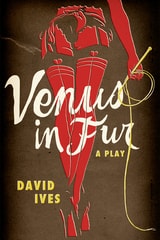
Venus in Fur
A PlayDavid Ives
Northwestern University Press, 2012
An unsettling drama, a playful comedy, and an exploration of gender roles and sexuality, Venus in Fur is a witty, dark look at the art of acting—onstage and off.
A young playwright, Thomas, has written an adaptation of the 1870 novel Venus in Fur by Leopold von Sacher-Masoch (after whom the term “masochism” was coined); the novel is the story of an obsessive adulterous relationship between a man and the mistress to whom he becomes enslaved. At the end of a long day in which the actresses Thomas auditions fail to impress him, in walks Vanda, very late and seemingly clueless, but she convinces him to give her a chance. As they perform scenes from Thomas’s play, and Vanda the actor and Vanda the character gradually take control of the audition, the lines between writer, actor, director, and character begin to blur.
Victory Gardens Theater Presents
Seven New Plays from the Playwrights EnsembleSandy Shinner
Northwestern University Press, 2006
This collection features seven plays by talented authors from the twelve-member Playwrights Ensemble at Victory Gardens. Their works tackle a wide range of topics from a colorful and imaginative retelling of the Medea legend set in the Carribbean to the desperation and regret that can fill a high-school reunion, from a feisty stroke-survivor claiming her independence to a historical drama about the first free man of color to attend Ohio University. Whether focusing on the drama between the four walls of a home or testing the broader realms of culture, history, and politics, the Victory Gardens Theater has always encouraged diverse perspectives and supported original work. Victory Gardens Theater Presents showcases some of the best examples of the distinctive talent that continues to find a home there.
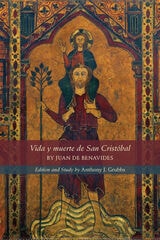
Vida y muerte de San Cristóbal
Juan de Benavides
Arizona Center for Medieval and Renaissance Studies, 2020
As the patron of travelers, Saint Christopher inspired one of the most popular cults in the medieval era, which spread across Europe and especially the Iberian Peninsula. Artistic renderings of the saint were found near the doors of most Spanish Gothic churches, and paratheatrical representations of Saint Christopher were also commonplace in religious processions. His conversion and martyrdom were often staged between the fifteenth and early eighteenth centuries.
In the theater, Juan de Benavides’s Vida y muerte de San Cristóbal is one of two known comedias dealing with the saint, but it was heavily censored after its premiere. The immense popularity of St. Christopher and other primitive saints first drew the attention of the Council of Trent in the mid-1500s, when the Catholic Church attempted to suppress the influence of the earlier saints due to their fantastical nature. The stories of these saints were censored, rewritten or even omitted in the post-Tridentine martyrologies. This publication is the first critical edition of the only extant copy of Benavides’s playscript. The circumstances surrounding Benavides’s play continue a dialogue about such important topics as censorship and the influence of the church over artistic production.
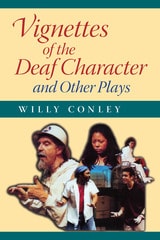
Vignettes of the Deaf Character and Other Plays
Willy Conley
Gallaudet University Press, 2009
After spending three years in The National Theatre of the Deaf performing plays by hearing authors featuring hearing characters, Willy Conley realized that he wanted to write plays with deaf, hard-of- hearing, and hearing characters created from the Deaf perspective. Vignettes of the Deaf Character and Other Plays presents the result of his desire in twelve masterful plays.
“I write for the eye, always searching for live, mobile, provocative images that would fill and illuminate the entire stage space with the complexities, the pathos, and the humor involved when deaf and hearing cultures merge or collide,” writes Conley in his introduction. His plays depict a wide range of Deaf characters, including two brothers locked in a tragic rivalry familiar to families of all backgrounds; the broadly comedic Deaf Guide and hearing Techie interspersing laughs with cultural lessons in their Museum of Signs for People with Communication Disorders; Everyone searching for her Good Deeds as she faces imminent Death in an updating of the classic morality play, plus many others. These works explore a broad palette of circumstances with and without hearing characters, allowing Deaf characters to interact minus the direct influence that the dominant culture might exert. Vignettes of the Deaf Character and Other Plays presents the drama and passion of a master playwright who, through his perceptions, reveals facets of the Deaf character in all of us.

Vladimir's Carrot
Modern Drama and the Modern ImaginationJohn Peter
University of Chicago Press, 1987
For Peter, Beckett's Waiting for Godot makes such a radical break with dramatic tradition that it prompts the question: Is this play the single most important event in the theater since Aeschylus? Or is it the fulfillment of forces at work long before Beckett wrote it? Peter shows how Beckett's work represents a change in the very subject matter of drama, a fundamental revision of concepts of character, plot, and meaning, which in turn requires a new way of responding to drama. Where plays have traditionally engaged audiences in critical and moral dialogue, theater like Beckett's, according to Peter, is closed to questioning; it presents a vision of the world which can only be accepted or rejected. As such, it not only signals a new form of drama, but also posits a fundamentally changed audience.
Peter views this change—essentially, a change of mind—in its wider context. The times and the thought that contribute to the modern imagination are represented here by novels, paintings, and music—works by Wagner, Kafka, Proust, Picasso, and Braque—as well as plays. Peter shows how the depiction of the world by these artists echoes—and is echoed by—the work of modern thinkers such as Schopenhauer, Nietzsche, and Freud.
Vladimir's Carrot will provoke and stimulate readers who find themselves either lost or perfectly at home in "modern" culture.
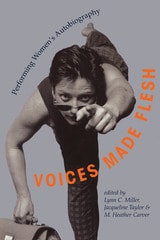
Voices Made Flesh
Performing Women'S AutobiographyLynn C. Miller
University of Wisconsin Press, 2003
Fourteen bold, dynamic, and daring women take the stage in this collection of women's lives and stories. Individually and collectively, these writers and performers speak the unspoken and perform the heretofore unperformed.
The first section includes scripts and essays about performances of the lives of Gertrude Stein, Georgia O'Keeffe, Mary Church Terrell, Charlotte Cushman, Anaïs Nin, Calamity Jane, and Mary Martin. The essays consider intriguing interpretive issues that arise when a woman performer represents another woman's life. In the second section, seven performers—Tami Spry, Jacqueline Taylor, Linda Park-Fuller, Joni Jones, Terri Galloway, Linda M. Montano, and Laila Farah—tell their own stories. Ranging from narrrative lectures (sometimes aided by slides and props) to theatrical performances, their works wrest comic and dramatic meaning from a world too often chaotic and painful. Their performances engage issues of sexual orientation, ethnicity, race, loss of parent, disability, life and death, and war and peace. The volume as a whole highlights issues of representation, identity, and staging in autobiographical performance. It examines the links among theory and criticism of women's autobiography, feminist performance theory, and performance practice.
Voices of Change in the Spanish American Theater
An AnthologyEdited and translated by William I. Oliver
University of Texas Press, 1971
The aim of this anthology is to present a selection of plays that are representative of a fresh spirit and of societal pressures and changes in Spanish American culture. The plays shun the earlier realistic, sentimental, and melodramatic conventions of Spanish American theater. Instead, they reflect the tenor of the dramatic imagination of the mid-to-late twentieth century—an imagination that sought new forms and ways of expressing a new awareness of the Spanish American dilemma.
In selecting these plays, William I. Oliver looked for more than mere illustrations of these changes. As a practicing director and playwright, he sought works that are effective on the stage as well as on the page. As an editor and translator, he sought works “that could be translated culturally as well as linguistically.” The six plays in this varied and vigorous anthology are the measure of his success.
The plays included are The Day They Let the Lions Loose, by Emilio Carballido (Mexico); The Camp, by Griselda Gambaro (Argentina); The Library, by Carlos Maggi (Uruguay); In the Right Hand of God the Father, by Enrique Buenaventura (Colombia); The Mulatto’s Orgy, by Luisa Josefina Hernández (Mexico); and Viña: Three Beach Plays, by Sergio Vodánovic (Chile).