Results by title
615 books match the query 'England' and 11 start with v
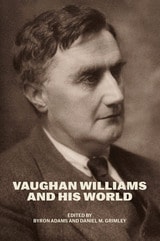
Vaughan Williams and His World
Edited by Byron Adams and Daniel M. Grimley
University of Chicago Press, 2023
Ralph Vaughan Williams (1872–1958) was one of the most innovative and creative figures in twentieth-century music, whose symphonies stand alongside those of Sibelius, Nielsen, Shostakovich, and Roussel. After his death, shifting priorities in the music world led to a period of critical neglect. What could not have been foreseen is that by the second decade of the twenty-first century, a handful of Vaughan Williams’s scores would attain immense popularity worldwide. Yet the present renown of these pieces has led to misapprehension about the nature of Vaughan Williams’s cultural nationalism and a distorted view of his international cultural and musical significance.
Vaughan Williams and His World traces the composer’s stylistic and aesthetic development in a broadly chronological fashion, reappraising Vaughan Williams’s music composed during and after the Second World War and affirming his status as an artist whose leftist political convictions pervaded his life and music. This volume reclaims Vaughan Williams’s deeply held progressive ethical and democratic convictions while celebrating his achievements as a composer.

Verdict According to Conscience
Perspectives on the English Criminal Trial Jury, 1200-1800Thomas Andrew Green
University of Chicago Press, 1985
Via Crucis
Essays on Early Medieval Sources and IdeasTHOMAS N. HALL
West Virginia University Press, 2002
This book originated as a series of papers delivered at a Symposium on Irish and Anglo-Saxon Literary Culture in Honor of J. E. Cross, held in conjunction with the 30th International Congress on Medieval Studies at Kalamazoo in May 1996. The purpose of that symposium was to bring together a number of friends and admirers of Professor Cross to celebrate his remarkably rich career as a scholar of Old English and Insular Latin literature; Anglo-Saxon manuscripts; and medieval sermons, saints’ lives, and apocrypha.
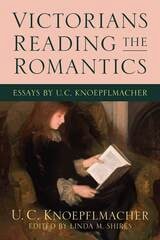
Victorians Reading the Romantics
Essays by U. C. KnoepflmacherEssays by U. C. Knoepflmacher, edited by Linda M. Shires
The Ohio State University Press, 2016
Victorians Reading the Romantics: Essays by U. C. Knoepflmacher, edited by LindaM. Shires, offers a compelling new perspective on the long and influential publishing career and thought of Knoepflmacher, a leading critic of the novel and Victorian poetry. This volume draws together essays on nineteenth-century literature written between 1963 and 2012.An introductory essay and new scaffolding emphasize the interrelations among the essays, which together form a consistent approach to literary criticism.
Knoepflmacher’s vision of texts and readersstressesthe emotional knowledge afforded by reading, writing about, and teaching literary texts.Each chapter links Romantic texts to those of later writers. Shelley and Keats try to revise Wordsworth, but they are themselves recast by Browning and Hardy. Similarly, George Eliot and Virginia Woolf’s reliance on Romantic tropes are fruitfully examined. Above all, however, these chapters stress the impact of Wordsworth on his many contemporaries and successors. Knoepflmacher probes into their texts to find, as Wordsworth did, a momentaryfusionof opposites.He posits a reader who is flexible—able to move in multiple directions by paying attention to spatial, verbal, and imagistic coordinates, across and down a page.Given the attention paid tothe translation of affect into thought,this collectionwillcontribute to Victorian studiesas well as enhance our understanding of the affective dynamics of nineteenth-century literature.
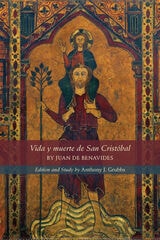
Vida y muerte de San Cristóbal
Juan de Benavides
Arizona Center for Medieval and Renaissance Studies, 2020
As the patron of travelers, Saint Christopher inspired one of the most popular cults in the medieval era, which spread across Europe and especially the Iberian Peninsula. Artistic renderings of the saint were found near the doors of most Spanish Gothic churches, and paratheatrical representations of Saint Christopher were also commonplace in religious processions. His conversion and martyrdom were often staged between the fifteenth and early eighteenth centuries.
In the theater, Juan de Benavides’s Vida y muerte de San Cristóbal is one of two known comedias dealing with the saint, but it was heavily censored after its premiere. The immense popularity of St. Christopher and other primitive saints first drew the attention of the Council of Trent in the mid-1500s, when the Catholic Church attempted to suppress the influence of the earlier saints due to their fantastical nature. The stories of these saints were censored, rewritten or even omitted in the post-Tridentine martyrologies. This publication is the first critical edition of the only extant copy of Benavides’s playscript. The circumstances surrounding Benavides’s play continue a dialogue about such important topics as censorship and the influence of the church over artistic production.
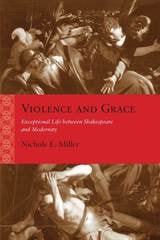
Violence and Grace
Exceptional Life between Shakespeare and ModernityNichole E. Miller
Northwestern University Press, 2014
In Violence and Grace, Nichole Miller establishes a conceptual link between early modern English drama and twentieth-century political theology, both of which emerge from the experience of political crisis. Miller’s analyses accordingly undertake to retrieve for political theology the relations between gender, sexuality, and the political aesthetics of violence on the early modern stage, addressing the plays of Marlowe, Middleton, and especially Shakespeare. In doing so, she expands our understanding of drama’s continuing theoretical impact.
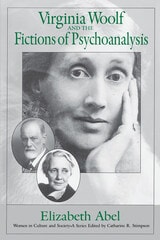
Virginia Woolf and the Fictions of Psychoanalysis
Elizabeth Abel
University of Chicago Press, 1989
"Virginia Woolf and the Fictions of Psychoanalysis brings Woolf's extraordinary craftsmanship back into view; the book combines powerful claims about sexual politics and intellectual history with the sort of meticulous, imaginative close reading that leaves us, simply, seeing much more in Woolf's words than we did before. It is the most exciting book on Woolf to come along in some time."—Lisa Ruddick, Modern Philology
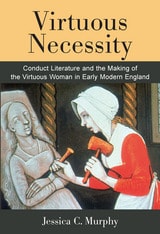
Virtuous Necessity
Conduct Literature and the Making of the Virtuous Woman in Early Modern EnglandJessica C. Murphy
University of Michigan Press, 2015
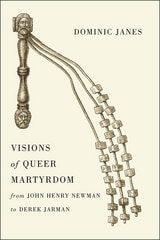
Visions of Queer Martyrdom from John Henry Newman to Derek Jarman
Dominic Janes
University of Chicago Press, 2015
Janes finds the beginnings of queer martyrdom in the nineteenth-century Church of England and the controversies over Cardinal John Henry Newman’s sexuality. He then considers how liturgical expression of queer desire in the Victorian Eucharist provided inspiration for artists looking to communicate their own feelings of sexual deviance. After looking at Victorian monasteries as queer families, he analyzes how the Biblical story of David and Jonathan could be used to create forms of same-sex partnerships. Finally, he delves into how artists and writers employed ecclesiastical material culture to further queer self-expression, concluding with studies of Oscar Wilde and Derek Jarman that illustrate both the limitations and ongoing significance of Christianity as an inspiration for expressions of homoerotic desire.
Providing historical context to help us reevaluate the current furor over homosexuality in the Church, this fascinating book brings to light the myriad ways that modern churches and openly gay men and women can learn from the wealth of each other’s cultural and spiritual experience.
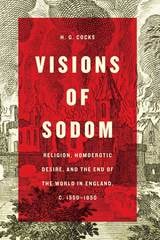
Visions of Sodom
Religion, Homoerotic Desire, and the End of the World in England, c. 1550-1850H. G. Cocks
University of Chicago Press, 2017
In Visions of Sodom, H. G. Cocks examines the many different ways in which the story of Sodom’s destruction provided a template for understanding homoerotic desire and behaviour in Britain between the Reformation and the nineteenth century. Sodom was not only a marker of sexual sins, but also the epitome of false—usually Catholic—religion, an exemplar of the iniquitous city, a foreshadowing of the world’s fiery end, an epitome of divine and earthly punishment, and an actual place that could be searched for and discovered. Visions of Sodom investigates each of these ways of reading Sodom’s annihilation in the three hundred years after the Reformation. The centrality of scripture to Protestant faith meant that Sodom’s demise provided a powerful origin myth of homoerotic desire and sexual excess, one that persisted across centuries, and retains an apocalyptic echo in the religious fundamentalism of our own time.
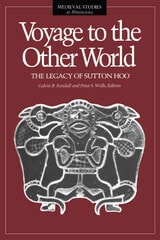
Voyage To The Other World
The Legacy of Sutton HooCalvin Kendall
University of Minnesota Press, 1992
A fascinating exploration of pagan Anglo-Saxon culture-a world caught on the boundary between competing ideologies and contrasting social systems.
Contributors: James Campbell, Martin Carver, Robert Payson Creed, Roberta Frank, Michael N. Geselowitz, Gloria Polizzotti Greis, Henrik M. Jansen, Simon Keynes, Edward Schoenfeld, Jana Schulman, Alan M. Stahl, Wesley M. Stevens, and Else Roesdahl.Medieval Cultures Series, volume 5