Results by title
5448 books match the query 'History and criticism' and 75 start with v
VICTORIAN SENSATIONS
ESSAYS ON A SCANDALOUS GENREKIMBERLY HARRISON
The Ohio State University Press, 2006
Valorizing the Barbarians
Enemy Speeches in Roman HistoriographyBy Eric Adler
University of Texas Press, 2011
With the growth of postcolonial theory in recent decades, scholarly views of Roman imperialism and colonialism have been evolving and shifting. Much recent discussion of the topic has centered on the ways in which ancient Roman historians consciously or unconsciously denigrated non-Romans. Similarly, contemporary scholars have downplayed Roman elite anxiety about their empire's expansion.
In this groundbreaking new work, Eric Adler explores the degree to which ancient historians of Rome were capable of valorizing foreigners and presenting criticisms of their own society. By examining speeches put into the mouths of barbarian leaders by a variety of writers, he investigates how critical of the empire these historians could be.
Adler examines pairs of speeches purportedly delivered by non-Roman leaders so that the contrast between them might elucidate each writer's sense of imperialism. Analyses of Sallust's and Trogus's treatments of the Eastern ruler Mithradates, Polybius's and Livy's speeches from Carthage's Hannibal, and Tacitus's and Cassius Dio's accounts of the oratory of the Celtic warrior queen Boudica form the core of this study. Adler supplements these with examinations of speeches from other characters, as well as contextual narrative from the historians. Throughout, Adler wrestles with broader issues of Roman imperialism and historiography, including administrative greed and corruption in the provinces, the treatment of gender and sexuality, and ethnic stereotyping.

Value and Vision in American Literature
Essays in Honor of Ray Lewis WhiteJoseph Candido
Ohio University Press, 1999
Through their various (and sometimes contrasting) critical points of view, these essays call attention to ideas or connections that demand a reappraisal of conventional attitudes or ingrained responses. Ranging in focus from the period of the mid-nineteenth century to the present day, they treat indisputably canonical figures such as Hawthorne, Faulkner, James, Hemingway, Cather, Bellow, Porter, Welty, and Warren in the same breath and often refreshingly on the same terms with Wallace Stegner, Cormac McCarthy, Dunstan Thompson, neglected Civil War poets, and the New Formalist critics of the last ten years.
In celebration and in reflection of the important critical contribution Ray Lewis White has made to the study of American literature, these writers, each a noted scholar in the field of literary studies, present a picture of American literature that manages to value the past at the same time that it asks us to envision that past anew.
Vampire Lectures
Laurence A. Rickels
University of Minnesota Press, 1999
A wild and wide-ranging “psycho-history” of the vampire.
A wild and wide-ranging “psycho-history” of the vampire.
Bela Lugosi may-as the eighties gothic rock band Bauhaus sang-be dead, but the vampire lives on. A nightmarish figure dwelling somewhere between genuine terror and high camp, a morbid repository for the psychic projections of diverse cultures, an endlessly recyclable mass-media icon, the vampire is an enduring object of fascination, fear, ridicule, and reverence. In The Vampire Lectures, Laurence A. Rickels sifts through the rich mythology of vampirism, from medieval folklore to Marilyn Manson, to explore the profound and unconscious appeal of the undead.Based on the course Rickels has taught at the University of California, Santa Barbara, for several years (a course that is itself a cult phenomenon on campus), The Vampire Lectures reflects Rickels’s unique lecture style and provides a lively history of vampirism in legend, literature, and film. Rickels unearths a trove that includes eyewitness accounts of vampire attacks; burial rituals and sexual taboos devised to keep vampirism at bay; Hungarian countess Elisabeth Bathory’s use of girls’ blood in her sadistic beauty regimen; Bram Stoker’s Dracula, with its turn-of-the-century media technologies; F. W. Murnau’s haunting Nosferatu; and crude, though intense, straight-to-video horror films such as Subspecies. He makes intuitive, often unexpected connections among these sometimes wildly disparate sources.More than a compilation of vampire lore, however, The Vampire Lectures makes an original and intellectually rigorous contribution to literary and psychoanalytic theory, identifying the subconscious meanings, complex symbolism, and philosophical arguments-particularly those of Marx, Freud, and Nietzsche-embedded in vampirism and gothic literature.ISBN 0-8166-3391-6 Cloth £34.50 $49.95xxISBN 0-8166-3392-4 Paper £14.00 $19.95376 Pages 5 7/8 x 9 SeptemberTranslation inquiries: University of Minnesota Press
Vampires, Mummies and Liberals
Bram Stoker and the Politics of Popular FictionDavid Glover
Duke University Press, 1996
Glover’s efforts reveal a writer who was more wide-ranging and politically engaged than his current reputation suggests. An Irish Protestant and nationalist, Stoker nonetheless drew his political inspiration from English liberalism at a time of impending crisis, and the tradition’s contradictions and uncertainties haunt his work. At the heart of Stoker’s writing Glover exposes a preoccupation with those sciences and pseudo-sciences—from physiognomy and phrenology to eugenics and sexology—that seemed to cast doubt on the liberal faith in progress. He argues that Dracula should be read as a text torn between the stances of the colonizer and the colonized, unable to accept or reject the racialized images of backwardness that dogged debates about Irish nationhood. As it tracks the phantasmatic form given to questions of character and individuality, race and production, sexuality and gender, across the body of Stoker’s writing, Vampires, Mummies, and Liberals draws a fascinating portrait of an extraordinary transitional figure.
Combining psychoanalysis and cultural theory with detailed historical research, this book will be of interest to scholars of Victorian and Irish fiction and to those concerned with cultural studies and popular culture.
Vanishing Moments
Class and American LiteratureEric Schocket
University of Michigan Press, 2010
Schocket offers careful readings of works by Herman Melville, Rebecca Harding Davis, William Dean Howells, Jack London, T. S. Eliot, Gertrude Stein, Muriel Rukeyser, and Langston Hughes, among others, and explores how these authors worked to try to heal the rift between the classes. He considers the challenges writers faced before the Civil War in developing a language of class amidst the predominant concerns about race and slavery; how early literary realists dealt with the threat of class insurrection; how writers at the turn of the century attempted to span the divide between the classes by going undercover as workers; how early modernists used working-class characters and idioms to shape their aesthetic experiments; and how leftists in the 1930s struggled to develop an adequate model to connect class and literature. Vanishing Moments’ unique combination of a broad historical scope and in-depth readings makes it an essential book for scholars and students of American literature and culture, as well as for political scientists, economists, and humanists.
“An important book containing many brilliant arguments—hard-hitting and original. Schocket demonstrates a sophisticated acquaintance with issues within the working-class studies movement.”
--Barbara Foley, Rutgers University
Vardis Fisher
A Mormon NovelistMichael Austin
University of Illinois Press, 2021
Engrossing and enlightening, Vardis Fisher illuminates the acclaimed author's impact on Mormon culture, American letters, and the literary tradition of the American West.
Variety
The Life of a Roman ConceptWilliam Fitzgerald
University of Chicago Press, 2016
William Fitzgerald looks at the definition and use of the Latin term varietas and how it has played out in different works and with different authors. He shows that, starting with the Romans, variety has played a key role in our thinking about nature, rhetoric, creativity, pleasure, aesthetics, and empire. From the lyric to elegy and satire, the concept of variety has helped to characterize and distinguish different genres. Arguing that the ancient Roman ideas and controversies about the value of variety have had a significant afterlife up to our own time, Fitzgerald reveals how modern understandings of diversity and choice derive from what is ultimately an ancient concept.
Varro the Agronomist
Political Philosophy, Satire, and Agriculture in the Late RepublicGrant A. Nelsestuen
The Ohio State University Press, 2015
On one level, Varro’s treatise presents an innovative account of the Roman farm, which rationalizes new agricultural and pastoral opportunities for contemporary elite owners of large-scale estates. But on another level, this bold agronomical vision associates the farm’s different spheres with distinct areas under Roman control, thereby allegorizing Rome’s empire on the model of a farm. Nelsestuen argues that Varro’s treatise thus provides his contemporaries with a model for governing the Roman state, anticipates Augustus’ subsequent transformation of Roman dominion into a coherent territorial state, and offers an ancient theory of imperialism.
Shedding new light on the only completely extant work of a much-celebrated but ill-understood figure, Varro the Agronomist has much to offer to those interested in Latin literature—especially, Cicero and Vergil—as well as on the political dimensions of intellectual life in first-century bce Rome, ancient imperialism, and Roman political philosophy.
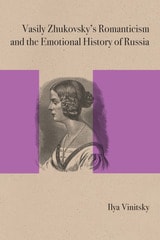
Vasily Zhukovsky's Romanticism and the Emotional History of Russia
Ilya Vinitsky
Northwestern University Press, 2015
The first major study in English of Vasily Zhukovsky (1783–1852)—poet, translator of German romantic verse, and mentor of Pushkin—this book brings overdue attention to an important figure in Russian literary and cultural history. Vinitsky’s “psychological biography” argues that Zhukovsky very consciously set out to create for himself an emotional life reflecting his unique brand of romanticism, different from what we associate with Pushkin or poets such as Byron or Wordsworth. For Zhukovsky, ideal love was harmonious, built on a mystical foundation of spiritual kinship. Vinitsky shows how Zhukovksy played a pivotal role in the evolution of ideas central to Russia’s literary and cultural identity from the end of the eighteenth century into the decades following the Napoleonic Wars.
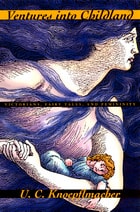
Ventures into Childland
Victorians, Fairy Tales, and FemininityU. C. Knoepflmacher
University of Chicago Press, 1998
"Ventures into Childland is acute, well written and stimulating. It also has a political purpose, to insist on the importance of protecting and nurturing children, imaginatively and physically."—Jan Marsh, Times Literary Supplement
"A provocative and interesting book about Victorian culture."—Library Journal
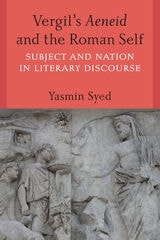
Vergil's Aeneid and the Roman Self
Subject and Nation in Literary DiscourseYasmin Syed
University of Michigan Press, 2005
Now in Paper!
As the most widely read Roman poem in antiquity, the Aeneid was indelibly burned into the memories of generations of Roman school children. In this book, author Yasmin Syed analyzes the formative influence the poem exerted on its broad audience of educated Romans. Syed analyzes Roman pedagogy and reading practices as well as ancient beliefs about the powerful influence of poetry. Her study considers these cultural components together with the aspects of identity that define the Aeneid’s characters. By doing so, Syed shows how Vergil’s ancient audiences saw themselves—their experiences, goals, and values—reflected in the poem and guided by it. In particular, Syed’s treatment of gender and ethnicity brings to light the key role of Vergil’s poem in the formation of Romanness.
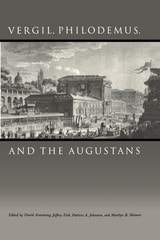
Vergil, Philodemus, and the Augustans
Edited by David Armstrong, Jeffrey Fish, Patricia A. Johnston, and Marilyn B. Skinner
University of Texas Press, 2003
The Epicurean teacher and poet Philodemus of Gadara (c. 110-c. 40/35 BC) exercised significant literary and philosophical influence on Roman writers of the Augustan Age, most notably the poets Vergil and Horace. Yet a modern appreciation for Philodemus' place in Roman intellectual history has had to wait on the decipherment of the charred remains of Philodemus' library, which was buried in Herculaneum by the eruption of Vesuvius in 79 AD. As improved texts and translations of Philodemus' writings have become available since the 1970s, scholars have taken a keen interest in his relations with leading Latin poets.
The essays in this book, derived from papers presented at the First International Symposium on Philodemus, Vergil, and the Augustans held in 2000, offer a new baseline for understanding the effect of Philodemus and Epicureanism on both the thought and poetic practices of Vergil, Horace, and other Augustan writers. Sixteen leading scholars trace his influence on Vergil's early writings, the Eclogues and the Georgics, and on the Aeneid, as well as on the writings of Horace and others. The volume editors also provide a substantial introduction to Philodemus' philosophical ideas for all classicists seeking a fuller understanding of this pivotal figure.
Vertical Grammar of Parallelism in Biblical Hebrew
David Toshio Tsumura
SBL Press, 2023
An essential resource for sound exegesis of biblical poetry
While previous books on parallelism have focused almost exclusively on semantic classification, in his new book David Toshio Tsumura focuses on the grammatical and phonetic aspects as well. In particular, he defines and illustrates the vertical grammatical relationship between parallel lines. Readers will master how to read Biblical Hebrew poetry effectively by focusing on the basic linguistic features of word order, parallelistic structure, and rhetorical devices. For the benefit of nonspecialists, all Hebrew poems are given in accessible transliteration. This book is an indispensable companion to the Hebrew Bible for both beginners and experienced scholars.
Veteran Americans
Literature and Citizenship from Revolution to ReconstructionBenjamin Cooper
University of Massachusetts Press, 2018
“I may dare to speak, and I intend to speak and write what I think,” wrote a New York volunteer serving in the Mexican War in 1848. Such sentiments of resistance and confrontation run throughout the literature produced by veteran Americans in the nineteenth century—from prisoner-of-war narratives and memoirs to periodicals, adventure pamphlets, and novels. Military men and women were active participants in early American print culture, yet they struggled against civilian prejudice about their character, against shifting collective memories that removed military experience from the nation's self-definition, and against a variety of headwinds in the uneven development of antebellum print culture.
In this new literary history of early American veterans, Benjamin Cooper reveals how soldiers and sailors from the Revolutionary War through the Civil War demanded, through their writing, that their value as American citizens and authors be recognized. Relying on an archive of largely understudied veteran authors, Cooper situates their perspective against a civilian monopoly in defining American citizenship and literature that endures to this day.
Via Crucis
Essays on Early Medieval Sources and IdeasTHOMAS N. HALL
West Virginia University Press, 2002
This book originated as a series of papers delivered at a Symposium on Irish and Anglo-Saxon Literary Culture in Honor of J. E. Cross, held in conjunction with the 30th International Congress on Medieval Studies at Kalamazoo in May 1996. The purpose of that symposium was to bring together a number of friends and admirers of Professor Cross to celebrate his remarkably rich career as a scholar of Old English and Insular Latin literature; Anglo-Saxon manuscripts; and medieval sermons, saints’ lives, and apocrypha.
Vicious Infants
Dangerous Childhoods in Antebellum U.S. LiteratureLaura Soderberg
University of Massachusetts Press, 2021
Vicious Infants offers a counterhistory of literary childhood as both perceived social threat and site of resistance, revealing that many children were not only cut off from family and society, they were also preemptively excluded from the rewards of citizenship and adulthood. Turning to prison documents, medical journals, overlooked periodical fiction, and literary works from William Apess, Harriet Wilson, Herman Melville, Susan Paul, and Harriet Beecher Stowe, Laura Soderberg recovers alternate narratives of childhood and provides an important window into the cultural links between race, reproduction, and childhood in the antebellum period.
Victims or Villains
Jewish Images in Classic English Detective FictionMalcolm J. Turnbull
University of Wisconsin Press, 1998
Victorian Afterlife
Postmodern Culture Rewrites the Nineteenth CenturyJohn Kucich
University of Minnesota Press, 2000
A foundational look at contemporary uses of the Victorian and the presence of the past in postmodern culture.
Celebrated films by Francis Ford Coppola, Jane Campion, and Ang Lee; best-selling novels by A. S. Byatt and William Gibson; revivals of Oscar Wilde, Lewis Carroll’s Alice, and nostalgic photography; computer graphics and cyberpunk performances: contemporary culture, high and low, has fallen in love with the nineteenth century. Major critical thinkers have found in the period the origins of contemporary consumerism, sexual science, gay culture, and feminism. And postmodern theory, which once drove a wedge between contemporary interpretation and its historical objects, has lately displayed a new self-consciousness about its own appropriations of the past. This diverse collection of essays begins a long-overdue discussion of how postmodernism understands the Victorian as its historical predecessor.
Contributors: Nancy Armstrong, Brown U; Ian Baucom, Duke U; Jay Clayton, Vanderbilt U; Mary A. Favret, Indiana U; Simon Gikandi, U of Michigan; Jennifer Green-Lewis, George Washington U; Kali Israel, U of Michigan; Laurie Langbauer, U of North Carolina; Susan Lurie, Rice U; John McGowan, U of North Carolina; Judith Roof, Indiana U; Hilary M. Schor, USC; Ronald R. Thomas, Trinity College; and Shelton Waldrep, U of Southern Maine.
Victorian Art Criticism and the Woman Writer
John Paul M. Kanwit
The Ohio State University Press, 2013
Victorian Dogs, Victorian Men
Affect and Animals in Nineteenth-Century Literature and CultureKeridiana W. Chez
The Ohio State University Press, 2017
Chez traces the evolution of the human-dog relationship as it developed parallel to an increasingly imperialist national discourse. The dog began as the affective mediator of the family, then addressed the emotional needs of its individual members, and finally evolved into both “man’s best friend” and worst enemy. By the last decades of the nineteenth century, the porous human-animal boundary served to produce the “humane” man: a liberal subject enabled to engage in aggressive imperial projects. Reading the work of Charles Dickens, George Eliot, Margaret Marshall Saunders, Bram Stoker, and Jack London, Victorian Dogs, Victorian Men charts the mobilization of affect through transatlantic narratives, demonstrating the deep interconnections between animals, affect, and gender.
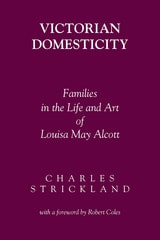
Victorian Domesticity
Families in the Life and Art of Louisa May AlcottCharles Strickland
University of Alabama Press, 1985
The subject of Victorian Domesticity is family life in America. The life and works of Louisa May Alcott served as the vehicle for exploring and analyzing this subject. Although Alcott was deeply influenced by popular currents of sentimentality, her own experience exposed her to the confusions and contradictions generated when sentiment confronted the reality of life in 19th-century America.
In the first chapter Strickland outlines the ways in which sentimentality colored the perception of 19th-century Americans about such issues as courtship, marriage, the relationship between the sexes, generational relationships, and the relationship between the nuclear family and the community outside the family. Chapters two and three trace Alcott’s childhood and adolescent experiences, exploring the tensions that developed between Louisa and her father, and detailing the ways in which she carried the double burden of being both poor and female as she sought her identity as a writer.
The following six chapters treat the varieties of family life that appear in Alcott’s stories, the impact of feminism on her life, and her emphasis on the importance of child nurture. In the final two chapters the author treats the relationships that Alcott perceived between the family and the world around it and assesses the legacy of the Victorian family idea.
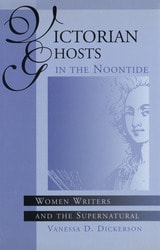
Victorian Ghosts in the Noontide
Women Writers and the SupernaturalVanessa D. Dickerson
University of Missouri Press, 1996
During the nineteenth century, British society was making rapid advancements in science and technology. While the men became materially productive, women were expected to be the fulcrums of society's changes. As one means of adjusting to these changes, many women focused on supernaturalism and spirituality.
In Victorian Ghosts in the Noontide, Vanessa D. Dickerson analyzes women's spirituality in a materialistic age by examining the supernatural fiction of Charlotte and Emily Brontë, Elizabeth Gaskell, and George Eliot and provides interpretive readings of familiar texts like Jane Eyre and Wuthering Heights. Other works by lesser-known authors are also examined.
Technological advances eliminated many of the jobs women were accustomed to doing. This left women looking for their place in society. A sense of "in-betweenness" developed in these women who were now expected to attend not only to the physical but also to the moral and spiritual needs of the family. As an answer to this "in-betweenness" some channeled their power toward the art of writing. Because people in the mid-1800s were so thoroughly engaged in scientific thought and advancements, supernatural folklore and spirituality were disreputable ideas for anyone, especially women, to explore. Ghosts and spirits were tied to old-wives' tales, superstitions, and legends. However, by focusing on these concepts and using fiction as an outlet, women were able to make great strides in being seen and heard. The art of writing functioned as an exploration of their spiritualism in which women discovered expression, freedom, and power.
This perceptive, well-written book will add a new dimension to our understanding of women's supernatural writings of the Victorian era. Scholars of Victorian literature, women's studies, and popular culture will benefit from its insights.
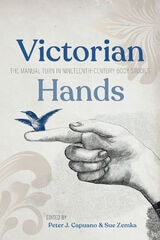
Victorian Hands
The Manual Turn in Nineteenth-Century Body StudiesEdited by Peter J. Capuano and Sue Zemka
The Ohio State University Press, 2020
Contributors
James Eli Adams, Karen Bourrier, Aviva Briefel, Peter J. Capuano, Jonathan Cheng, Kate Flint, Pamela K. Gilbert, Tamara Ketabgian, J. Hillis Miller, Deborah Denenholz Morse, Daniel A. Novak, Julianne Smith, Herbert F. Tucker, and Sue Zemka
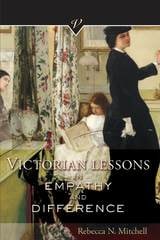
Victorian Lessons in Empathy and Difference
Rebecca N. Mitchell
The Ohio State University Press, 2011
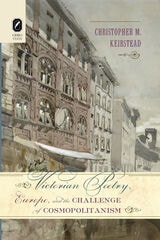
Victorian Poetry, Europe, and the Challenge of Cosmopolitanism
Christopher M. Keirstead
The Ohio State University Press, 2011
The scope and complexity of the encounter with Europe in Victorian poetry remains largely underappreciated despite recent critical attention to the genre’s global and transnational contexts. Providing much more than colorful settings or a convenient place of self-exile from England, Europe—as destination and idea—formed the basis of a dynamic, evolving form of critical cosmopolitanism much in tune with attempts to theorize the concept today. Christopher M. Keirstead’s Victorian Poetry, Europe, and the Challenge of Cosmopolitanism synthesizes the complex relationship between several notable Victorian poets, including Elizabeth Barrett Browning, Robert Browning, Matthew Arnold, and A. C. Swinburne, and their respective attitudes toward Europe as a cosmopolitan whole. Examining their international relationships and experiences, the monograph explores the ways in which these poets worked to reconcile their emotional and intellectual affinity for world citizenship with their British identity.
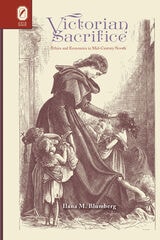
Victorian Sacrifice
Ilana M. Blumberg
The Ohio State University Press, 2013
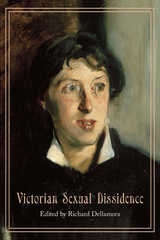
Victorian Sexual Dissidence
Edited by Richard Dellamora
University of Chicago Press, 1999
One essay, for example, traces the remarkable feminist appropriation of male-identified fields of study, such as Classical philology. Others address the validation of male bodies as objects of desire in writing, painting, and emergent modernist choreography. The writings shed light on the diverse interests served by a range of cultural practitioners and on the complex ways in which the late Victorians invented themselves as modern subjects.
This volume will be essential reading for students of British literary and cultural history as well as for those interested in feminist, gay, and lesbian studies.
Contributors are: Oliver Buckton, Richard Dellamora, Dennis Denisoff, Regenia Gagnier, Eric Haralson, Andrew Hewitt, Christopher Lane, Thaïs Morgan, Yopie Prins, Kathy Alexis Psomiades, Julia Saville, Robert Sulcer, Jr., Martha Vicinus.

Victorian Subjects
J. Hillis Miller
Duke University Press, 1991
Miller defines the term “Victorian subjects” in more than one sense. The phrase identifies an historical time but also names a concern throughout with subjectivity, consciousness, and selfhood in Victorian literature. The essays show various Victorian subjectivities seeking to ground themselves in their own underlying substance or in some self beneath or beyond the self. But “Victorian subjects” also discusses those who were subject to Queen Victoria, to the reigning ideologies of the time, to historical, social, and material conditions, including the conditions under which literature was written, published, distributed, and consumed.
These essays, taken together, sketch the outlines of ideological assumptions within the period about the self, interpersonal relations, nature, literary form, the social function of literature, and other Victorian subjects.

Victorian Vogue
British Novels on ScreenDianne F. Sadoff
University of Minnesota Press, 2009
Ranging from cinematic images of Jane Austen's estates to Oscar Wilde's drawing rooms, Dianne F. Sadoff looks at popular heritage films, often featuring Hollywood stars, that have been adapted from nineteenth-century novels.
Victorian Vogue argues that heritage films perform different cultural functions at key historical moments in the twentieth century. According to Sadoff, they are characterized by a double historical consciousness-one that is as attentive to the concerns of the time of production as to those of the Victorian period. If James Whale's Frankenstein and Tod Browning's Dracula exploited post-Depression fear in the 1930s, the horror films of the 1950s used the genre to explore homosexual panic, 1970s movies elaborated the sexuality only hinted at in the thirties, and films of the 1990s indulged the pleasures of consumption.
Taking a broad view of the relationships among film, literature, and current events, Sadoff contrasts films not merely with their nineteenth-century source novels but with crucial historical moments in the twentieth century, showing their cultural use in interpreting the present, not just the past.
Victorian Women Writers, Radical Grandmothers, and the Gendering of God
Gail Turley Houston
The Ohio State University Press, 2013
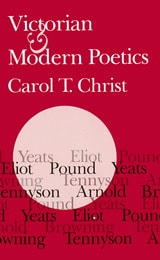
Victorian and Modern Poetics
Carol T. Christ
University of Chicago Press, 1984
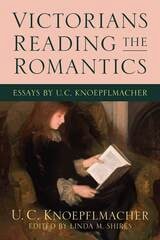
Victorians Reading the Romantics
Essays by U. C. KnoepflmacherEssays by U. C. Knoepflmacher, edited by Linda M. Shires
The Ohio State University Press, 2016
Victorians Reading the Romantics: Essays by U. C. Knoepflmacher, edited by LindaM. Shires, offers a compelling new perspective on the long and influential publishing career and thought of Knoepflmacher, a leading critic of the novel and Victorian poetry. This volume draws together essays on nineteenth-century literature written between 1963 and 2012.An introductory essay and new scaffolding emphasize the interrelations among the essays, which together form a consistent approach to literary criticism.
Knoepflmacher’s vision of texts and readersstressesthe emotional knowledge afforded by reading, writing about, and teaching literary texts.Each chapter links Romantic texts to those of later writers. Shelley and Keats try to revise Wordsworth, but they are themselves recast by Browning and Hardy. Similarly, George Eliot and Virginia Woolf’s reliance on Romantic tropes are fruitfully examined. Above all, however, these chapters stress the impact of Wordsworth on his many contemporaries and successors. Knoepflmacher probes into their texts to find, as Wordsworth did, a momentaryfusionof opposites.He posits a reader who is flexible—able to move in multiple directions by paying attention to spatial, verbal, and imagistic coordinates, across and down a page.Given the attention paid tothe translation of affect into thought,this collectionwillcontribute to Victorian studiesas well as enhance our understanding of the affective dynamics of nineteenth-century literature.
Victories Never Last
Reading and Caregiving in a Time of PlagueRobert Zaretsky
University of Chicago Press, 2022
In any time of disruption or grief, many of us seek guidance in the work of great writers who endured similar circumstances. During the first year of the COVID-19 pandemic, historian and biographer Robert Zaretsky did the same while also working as a volunteer in a nursing home in south Texas. In Victories Never Last Zaretsky weaves his reflections on the pandemic siege of his nursing home with the testimony of six writers on their own times of plague: Thucydides, Marcus Aurelius, Michel de Montaigne, Daniel Defoe, Mary Shelley, and Albert Camus, whose novel The Plague provides the title of this book.
Zaretsky delves into these writers to uncover lessons that can provide deeper insight into our pandemic era. At the same time, he goes beyond the literature to invoke his own experience of the tragedy that enveloped his Texas nursing home, one which first took the form of chronic loneliness and then, inevitably, the deaths of many residents whom we come to know through Zaretsky’s stories. In doing so, Zaretsky shows the power of great literature to connect directly to one’s own life in a different moment and time.
For all of us still struggling to comprehend this pandemic and its toll, Zaretsky serves as a thoughtful and down-to-earth guide to the many ways we can come to know and make peace with human suffering.
Violence and Grace
Exceptional Life between Shakespeare and ModernityNichole E. Miller
Northwestern University Press, 2014
In Violence and Grace, Nichole Miller establishes a conceptual link between early modern English drama and twentieth-century political theology, both of which emerge from the experience of political crisis. Miller’s analyses accordingly undertake to retrieve for political theology the relations between gender, sexuality, and the political aesthetics of violence on the early modern stage, addressing the plays of Marlowe, Middleton, and especially Shakespeare. In doing so, she expands our understanding of drama’s continuing theoretical impact.
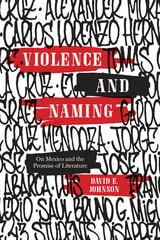
Violence and Naming
On Mexico and the Promise of LiteratureBy David E. Johnson
University of Texas Press, 2019
Reclaiming the notion of literature as an institution essential for reflecting on the violence of culture, history, and politics, Violence and Naming exposes the tension between the irreducible, constitutive violence of language and the reducible, empirical violation of others. Focusing on an array of literary artifacts, from works by journalists such as Elena Poniatowska and Sergio González Rodríguez to the Zapatista communiqués to Roberto Bolaño's The Savage Detectives and 2666, this examination demonstrates that Mexican culture takes place as a struggle over naming—with severe implications for the rights and lives of women and indigenous persons.
Through rereadings of the Conquest of Mexico, the northern Mexican feminicide, the Zapatista uprising in Chiapas, the disappearance of the forty-three students at Iguala in 2014, and the 1999 abortion-rights scandal centering on “Paulina,” which revealed the tenuousness of women’s constitutionally protected reproductive rights in Mexico, Violence and Naming asks how societies can respond to violence without violating the other. This essential question is relevant not only to contemporary Mexico but to all struggles for democracy that promise equality but instead perpetuate incessant cycles of repression.
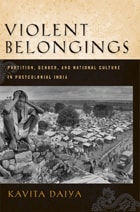
Violent Belongings
Partition, Gender, and National Culture in Postcolonial IndiaKavita Daiya
Temple University Press, 2008
In addition to challenging the official narratives of independence and Partition, these narratives challenge our contemporary understanding of gender and ethnicity in history and politics. Violent Belongings argues that both male and female bodies, and heterosexual coupledom, became symbols of the nation in public life. In the newly independent Indian nation both men and women were transformed into ideal citizens or troubling bodies, immigrants or refugees, depending on whether they were ethnically Hindu, Muslim, Jewish or Sikh. The divisions set in motion during Partition continue into our own time and account for ethnic violence in South Asia.
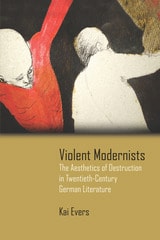
Violent Modernists
The Aesthetics of Destruction in Twentieth-Century German LiteratureKai Evers
Northwestern University Press, 2013
Kai Evers’s Violent Modernists: The Aesthetics of Destruction in Twentieth-Century German Literature develops a new understanding of German modernism that moves beyond the oversimplified dichotomy of an avant-garde prone to aggression on the one hand and a modernism opposed to violence on the other. Analyzing works by Robert Musil, Franz Kafka, Karl Kraus, Walter Benjamin, Elias Canetti, and others, Evers argues that these authors are among the most innovative thinkers on violence and its impact on contemporary concepts of the self, history, and society.
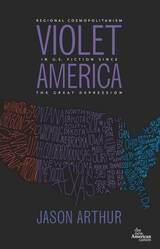
Violet America
Regional Cosmopolitanism in U.S. FictionJason Arthur
University of Iowa Press, 2013
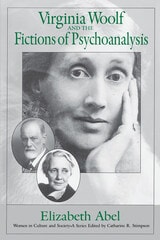
Virginia Woolf and the Fictions of Psychoanalysis
Elizabeth Abel
University of Chicago Press, 1989
"Virginia Woolf and the Fictions of Psychoanalysis brings Woolf's extraordinary craftsmanship back into view; the book combines powerful claims about sexual politics and intellectual history with the sort of meticulous, imaginative close reading that leaves us, simply, seeing much more in Woolf's words than we did before. It is the most exciting book on Woolf to come along in some time."—Lisa Ruddick, Modern Philology
Virginia Woolf’s Mythic Method
Amy C. Smith
The Ohio State University Press, 2022
Virtual Americas
Transnational Fictions and the Transatlantic ImaginaryPaul Giles
Duke University Press, 2002
Throughout Virtual Americas Giles focuses on specific examples of transatlantic cultural interactions such as Frederick Douglass’s experiences and reputation in England; Herman Melville’s satirizing fictions of U.S. and British nationalism; and Vladimir Nabokov’s critique of European high culture and American popular culture in Lolita. He also reverses his perspective, looking at the representation of San Francisco in the work of British-born poet Thom Gunn and Sylvia Plath’s poetic responses to England. Giles develops his theory about the need to defamiliarize the study of American literature by considering the cultural legacy of Surrealism as an alternative genealogy for American Studies and by examining the transatlantic dimensions of writers such as Henry James and Robert Frost in the context of Surrealism.
Virtual Modernism
Writing and Technology in the Progressive EraKatherine Biers
University of Minnesota Press, 2013
In Virtual Modernism, Katherine Biers offers a fresh view of the emergence of American literary modernism from the eruption of popular culture in the early twentieth century. Employing dynamic readings of the works of Stephen Crane, Henry James, James Weldon Johnson, Djuna Barnes, and Gertrude Stein, she argues that American modernist writers developed a “poetics of the virtual” in response to the rise of mass communications technologies before World War I. These authors’ modernist formal experimentation was provoked by the immediate, individualistic pleasures and thrills of mass culture. But they also retained a faith in the representational power of language—and the worth of common experience—more characteristic of realism and naturalism. In competition with new media experiences such as movies and recorded music, they simultaneously rejected and embraced modernity.
Biers establishes the virtual poetics of these five writers as part of a larger “virtual turn” in the United States, when a fascination with the writings of Henri Bergson, William James, and vitalist philosophy—and the idea of virtual experience—swept the nation. Virtual Modernism contends that a turn to the virtual experience of language was a way for each of these authors to carve out a value for the literary, both with and against the growth of mass entertainments. This technologically inspired reengagement with experience was formative for American modernism.
Situated at the crossing points of literary criticism, philosophy, media studies, and history, Virtual Modernism provides an examination of Progressive Era preoccupations with the cognitive and corporeal effects of new media technologies that traces an important genealogy of present-day concerns with virtuality.
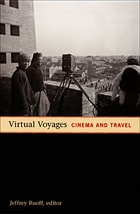
Virtual Voyages
Cinema and TravelJeffrey Ruoff, ed.
Duke University Press, 2006
Some contributors take a broad view of travelogues by examining the colonial and imperial perspectives embodied in early travel films, the sensation of movement that those films evoked, and the role of live presentations such as lectures in our understanding of travelogues. Other essays are focused on specific films, figures, and technologies, including early travelogues encouraging Americans to move to the West; the making and reception of the documentary Grass (1925), shot on location in Turkey, Syria, Iraq, and Iran; the role of travel imagery in 1930s Hollywood cinema; the late-twentieth-century 16mm illustrated-lecture industry; and the panoramic possibilities presented by IMAX technologies. Together the essays provide a nuanced appreciation of how, through their representations of travel, filmmakers actively produce the worlds they depict.
Contributors. Rick Altman, Paula Amad, Dana Benelli, Peter J. Bloom, Alison Griffiths, Tom Gunning, Hamid Naficy, Jennifer Lynn Peterson, Lauren Rabinovitz, Jeffrey Ruoff, Alexandra Schneider, Amy J. Staples
Virtue and Venom
Catalogs of Women from Antiquity to the RenaissanceGlenda McLeod
University of Michigan Press, 1991
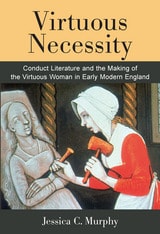
Virtuous Necessity
Conduct Literature and the Making of the Virtuous Woman in Early Modern EnglandJessica C. Murphy
University of Michigan Press, 2015
Vise and Shadow
Essays on the Lyric Imagination, Poetry, Art, and CulturePeter Balakian
University of Chicago Press, 2015
Vise and Shadow draws into conversation such disparate figures as W. B. Yeats, Hart Crane, Joan Didion, Primo Levi, Robert Rauschenberg, Bob Dylan, Elia Kazan, and Arshile Gorky, revealing how the lyric imagination of these artists grips experience, "shadows history," and "casts its own type of illumination," creating one of the deepest kinds of human knowledge and sober truth. In these elegantly written essays, Balakian offers a fresh way to think about the power of poetry, art, and the lyrical imagination as well as history, trauma, and memory.
Visible Dissent
Latin American Writers, Small U.S. Presses, and Progressive Social ChangeTeresa V. Longo
University of Iowa Press, 2018
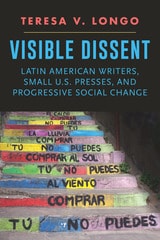
As Teresa Longo’s groundbreaking examination reveals, North America’s dissident literature has its roots in the Latin American literary tradition. From Pablo Neruda’s Canto General to Eduardo Galeano’s Open Veins of Latin America to Gabriel García Márquez’s One Hundred Years of Solitude—among others—contemporary writers throughout the Americas have forced us to reconsider the United States’s relationship with Latin America, and more broadly with the Global South. Highlighting the importance of reading and re-reading the Latin American canon in the United States, Longo finds that literature can be an instrument of progressive social change, and argues that small literary presses—City Lights, Curbstone, and Seven Stories—have made that dissent visible in the United States. In the book’s final two chapters on the Robert F. Kennedy Center’s Speak Truth to Power initiative and the publication of Marc Falkoff’s Poems from Guantánamo, the author turns our attention further outward, probing the role poetry, theater, and photography play in global human rights work.
Locating the work of artists and writers alongside that of scholars and legal advocates, Visible Dissent not only unveils the staying-power of committed writing, it honors the cross-currents and the on-the-ground implications of humane political engagement.
Vision and Textuality
Stephen Melville and Bill Readings, eds.
Duke University Press, 1995
With essays by Rosalind Krauss, Hal Foster, Norman Bryson, Victor Burgin, Martin Jay, Louis Marin, Thomas Crow, Griselda Pollock, and others, the volume is organized into sections devoted to the discipline of art history, the implications of semiotics, the new cultural history of art, and the impact of psychoanalysis. The works discussed in these essays range from Rembrandt’s Danae to Jorge Immendorf’s Café Deutschland, from Vauxhall Gardens to Max Ernst, and from the Imagines of Philostratus to William Godwin’s novel Caleb Williams. Each section is preceded by a short introduction that offers further contexts for considering the essays that follow, while the editors’ general introduction presents an overall exploration of the relation between vision and textuality in a variety of both institutional and theoretical contexts. Among other issues, it examines the relevance of aesthetics, the current concern with modernism and postmodernism, and the possible development of new disciplinary formations in the humanities.
Contributors. Mieke Bal, John Bender, Norman Bryson, Victor Burgin, Thomas Crow, Peter de Bolla, Hal Foster, Michael Holly, Martin Jay, Rosalind Krauss, Françoise Lucbert, Louis Martin, Stephen Melville, Griselda Pollock, Bill Readings, Irit Rogoff, Bennet Schaber, John Tagg
Vision and Violence
Arthur P. Mendel
University of Michigan Press, 1999
Much of the book is devoted to an examination of the persistence of the apocalyptic heritage from ancient Greek and Hebrew civilizations, through the religious revivals of the Middle Ages and the Enlightenment belief in progress, to its importance in Hegelian and Bolshevik thought, and finally to its expression today in the resurgence of religious fundamentalism in Judaism, Christianity, and Islam.
Mendel concludes his remarkable book with an appeal for the more modest and humane philosophy of the "repair of the world," which, he argues, is central to biblical teaching.
The late Arthur P. Mendel was Professor of History, University of Michigan, specializing in Russian intellectual history. His first book, Dilemmas of Progress in Tsarist Russia: Legal Marxism and Legal Populism, established him as one of the outstanding historians of his generation. Richard Landes is co-founder, with Stephen O'Leary, of the Center for Millennial Studies. He is also Associate Professor of History, Boston University, and author of Relics, Apocalypse, and the Deceits of History: Ademar of Chabannes, 989-1034.