Results by title
477 books match the query 'Italy' and 10 start with v
Vasari on Theatre
Thomas A. Pallen
Southern Illinois University Press, 1999
In the process of creating the massive work that eventually became Lives of the Most Eminent Painters, Sculptors, and Architects, painter and scholar Giorgio Vasari (1511–1574) spent much of the mid-sixteenth century traveling throughout Italy, meeting Renaissance artists and writing about their lives and works.
From this imposing source, Thomas A. Pallen has created a compendium of theatrical references augmented by related modern Italian scholarship. Vasari's Lives—daunting because of its sheer magnitude—has remained relatively obscure to English-speaking theatre historians. To introduce the numerous scenographic references of this great work to the English-speaking audience, Pallen provides new translations of all relevant passages, as well as a table of cross-references to the principal editions of Vasari in both English and Italian. And because Vasari often omitted important information, Pallen annotates the text, providing important names, places, and historical background.
Essentially, Pallen divides Vasari's work into four categories: triumphs and pageantry, ingegni for mystery plays and festivals, theatrical scenery, and miscellanea and lacunae. Although triumphs and pageantry were not directly theatrical, they were executed by many of the same artists who worked on theatrical productions and either used or introduced many Renaissance Italian theatrical techniques. The works described here range from tableaux vivants and other forms of street decoration to fireworks displays.
While Vasari did not personally know the work of either Filippo Brunelleschi or Francesco d'Angelo (called Cecca), he discusses their inventions for staging mystery plays and street festivals; indeed, Pallen shows how the work of these two artists paved the way for all later Renaissance scenography.
Pallen then deals with Vasari's references to and descriptions of the theatrical scenery and lighting effects of his time and the artists who created them. In accordance with the schema developed by Elena Povoledo, Pallen leads the reader through the evolution of scenographic thought and practice from the elementary work of Girolamo Genga to the advanced settings created by Vasari himself.
Veii
Edited by Jacopo Tabolli with Orlando Cerasuolo
University of Texas Press, 2019
Reputed to be the richest city of Etruria, Veii was one of the most important cities in the ancient Mediterranean world. It was located ten miles northwest of Rome, and the two cities were alternately allied and at war for over three hundred years until Veii fell to Rome in 396 BCE, although the city continued to be inhabited until the Middle Ages. Rediscovered in the seventeenth century, Veii has undergone the longest continuous excavation of any of the Etruscan cities.
The most complete volume on the city in English, Veii presents the research and interpretations of multiple generations of Etruscan scholars who are at the forefront of the discipline. Their essays are grouped into four parts. The first provides a general overview of archaeological excavation at Veii and discusses the different types of methodologies employed over the years. The second part narrates the history of Etruscan occupation of the city and its role in the greater Mediterranean world. The third section examines the surviving material culture of Veii, including pottery, painting, sculpture, metalworking, and architectural terracottas. Finally, the legacy of Veii is discussed, and a chronology of the site is presented. This pioneering research offers all students of the ancient Mediterranean a new understanding of the development of Veii and its territory from the late Bronze Age to the Roman conquest, as well as of the interactions of Veii with nearby sites and territories in central Tyrrhenian Italy.
Venice
William H. McNeill
University of Chicago Press, 1974
In this magisterial history, National Book Award winner William H. McNeill chronicles the interactions and disputes between Latin Christians and the Orthodox communities of eastern Europe during the period 1081–1797. Concentrating on Venice as the hinge of European history in the late medieval and early modern period, McNeill explores the technological, economic, and political bases of Venetian power and wealth, and the city’s unique status at the frontier between the papal and Orthodox Christian worlds. He pays particular attention to Venetian influence upon southeastern Europe, and from such an angle of vision, the familiar pattern of European history changes shape.
“No other historian would have been capable of writing a book as direct, as well-informed and as little weighed down by purple prose as this one. Or as impartial. McNeill has succeeded admirably.”—Fernand Braudel, Times Literary Supplement
“The book is serious, interesting, occasionally compelling, and always suggestive.”—Stanley Chojnacki, American Historical Review
Venice For Lovers
Louis Begley and Anka Muhlstein
Haus Publishing, 2003
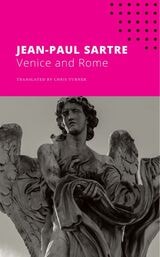
Venice and Rome
Jean-Paul Sartre
Seagull Books, 2021
Iconic French novelist, playwright, and essayist Jean-Paul Sartre is widely recognized as one of the most important philosophers of the twentieth century, and his work has remained relevant and thought-provoking through the decades. The Seagull Sartre Library now presents some of his most incisive philosophical, cultural, and literary critical essays in twelve newly designed and affordable editions.
“Venice speaks to us; this false witness’s voice, shrill at times, whispering at others, broken by silences, is its voice.” In these three moving short pieces, we discover Sartre as a master stylist, lyrically describing his time in two bewitching eternal cities—Venice and Rome. “Antiquity,” Sartre writes, “is alive in Rome, with a hate-filled, magical life.”
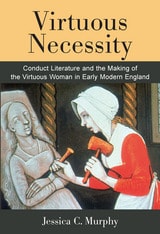
Virtuous Necessity
Conduct Literature and the Making of the Virtuous Woman in Early Modern EnglandJessica C. Murphy
University of Michigan Press, 2015
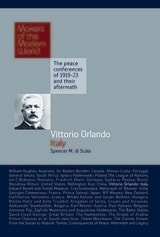
Vittorio Orlando
ItalySpencer Di Scala
Haus Publishing, 2009
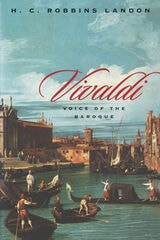
Vivaldi
Voice of the BaroqueH. C. Robbins Landon
University of Chicago Press, 1996
Very little has been written on Vivaldi for the nonspecialist, especially in English. Landon rediscovers the composer in this accessible and musically informed biography while presenting documentation of the musician's life discovered after the Baroque revival in the 1930s. This book includes illustrations of eighteenth-century Venice and several newly translated letters, thoroughly evoking the style of the time and revealing some of the more personal aspects of Vivaldi's life.
"Belongs on the shelf of every serious music student."—Kirkus
"Gives a good feel for Vivaldi's life and times . . . and describes particularly well how Vivaldi has been revived."—Booklist
"Robbins Landon is marvelously entertaining, extravagantly learned."—The Independent
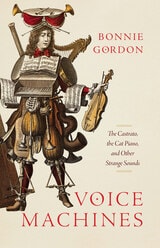
Voice Machines
The Castrato, the Cat Piano, and Other Strange SoundsBonnie Gordon
University of Chicago Press, 2023
Italian courts and churches began employing castrato singers in the late sixteenth century. By the eighteenth century, the singers occupied a celebrity status on the operatic stage. Constructed through surgical alteration and further modified by rigorous training, castrati inhabited human bodies that had been “mechanized” to produce sounds in ways that unmechanized bodies could not. The voices of these technologically enhanced singers, with their unique timbre, range, and strength, contributed to a dramatic expansion of musical vocabulary and prompted new ways of imagining sound, the body, and personhood.
Connecting sometimes bizarre snippets of history, this multi-disciplinary book moves backward and forward in time, deliberately troubling the meaning of concepts like “technology” and “human.” Voice Machines attends to the ways that early modern encounters and inventions—including settler colonialism, emergent racialized worldviews, the printing press, gunpowder, and the telescope—participated in making castrati. In Bonnie Gordon’s revealing study, castrati serve as a critical provocation to ask questions about the voice, the limits of the body, and the stories historians tell.
Voting for Hitler and Stalin
Elections under 20th Century DictatorshipsEdited by Ralph Jessen and Hedwig Richter
Campus Verlag, 2011