Results by title
936 books match the query 'LGBTQ+ Studies' and 12 start with v

Vanguard
A Queer History of Mutual AidJoseph Plaster
Duke University Press, 2027
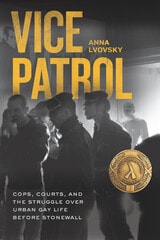
Vice Patrol
Cops, Courts, and the Struggle over Urban Gay Life before StonewallAnna Lvovsky
University of Chicago Press, 2021
In Vice Patrol, Anna Lvovsky chronicles this painful story, tracing the tactics used to criminalize, profile, and suppress gay life from the 1930s through the 1960s, and the surprising controversies those tactics often inspired in court. Lvovsky shows that the vice squads’ campaigns stood at the center of live debates about not only the law’s treatment of queer people, but also the limits of ethical policing, the authority of experts, and the nature of sexual difference itself—debates that had often unexpected effects on the gay community’s rights and freedoms. Examining those battles, Vice Patrol enriches understandings of the regulation of queer life in the twentieth century and disputes about police power that continue today.

Vice Patrol
Cops, Courts, and the Struggle over Urban Gay Life before StonewallAnna Lvovsky
University of Chicago Press, 2021
In the mid-twentieth century, gay life flourished in American cities even as the state repression of queer communities reached its peak. Liquor investigators infiltrated and shut down gay-friendly bars. Plainclothes decoys enticed men in parks and clubs. Vice officers surveilled public bathrooms through peepholes and two-way mirrors.
In Vice Patrol, Anna Lvovsky chronicles this painful story, tracing the tactics used to criminalize, profile, and suppress gay life from the 1930s through the 1960s, and the surprising controversies those tactics often inspired in court. Lvovsky shows that the vice squads’ campaigns stood at the center of live debates about not only the law’s treatment of queer people, but also the limits of ethical policing, the authority of experts, and the nature of sexual difference itself—debates that had often unexpected effects on the gay community’s rights and freedoms. Examining those battles, Vice Patrol enriches understandings of the regulation of queer life in the twentieth century and disputes about police power that continue today.
Victory Deferred
How AIDS Changed Gay Life in AmericaJohn-Manuel Andriote
University of Chicago Press, 1999
John-Manuel Andriote chronicles the impact of the disease from the coming-out revelry of the 1970s to the post-AIDS gay community of the 1990s, showing how it has changed both individual lives and national organizations. He tells the truly remarkable story of how a health crisis pushed a disjointed jumble of local activists to become a nationally visible and politically powerful civil rights movement, a full-fledged minority group challenging the authority of some of the nation's most powerful institutions. Based on hundreds of interviews with those at the forefront of the medical, political, and cultural
responses to the disease, Victory Deferred artfully blends personal narratives with institutional histories and organizational politics to show how AIDS forced gay men from their closets and ghettos into the hallways of power to lobby and into the streets to protest.
Andriote, who has been at the center of national advocacy and AIDS politics in Washington, is judicious without being uncritical, and his account of the political maturation of the gay community is one of the most stirring civil rights stories of our time.
Victory Deferred draws on hundreds of original interviews, including first-hand accounts from: Virginia Apuzzo, Reverend Carl Bean, Marcus Conant, M.D., John D'Emilio, Anthony Fauci, M.D, Fenton Johnson, Larry Kramer, Lawrence D. Mass, M.D., Armistead Maupin, Walt Odets, Torie Osborn, Eric Rofes, Urvashi Vaid, Timothy Westmoreland, and Reggie Williams.
"[Victory Deferred] is a richly textured account of the rise of the AIDS sector, that though detailed and comprehensive, reads quickly. The thematic organization of the book works especially well. The clear chronology of the events reveals how competing models of service delivery, treatment activism and private-public cooperation were subsumed into a national AIDS movement. The book should prove excellent for teaching or recreational reading."—Jose Gabilondo, Washington Post
"[A] fine history of the epidemic. . . . Andriote shines with chapters on less-covered but no less important subjects, including the multibillion-dollar 'AIDS industry' and private fund-raising groups. He brings together in one place many facts and figures heretofore unsynthesized."—Joe R. Neel, Boston Globe
"While many books have explored aspects of the impact of AIDS, Victory Deferred is among the most comprehensive. Andriote's adroit integration of the personal and the historical results is an illustrative, analytical account of the disease and its impact on the gay civil-rights movement. His depiction of the poignant struggles, heroic responses and resultant social and political gains emanating from AIDS is a perceptive document for our time—relevant to all readers, regardless of their sexual orientation."—John R. Killacky, Minneapolis Star Tribune
"[A] well-researched and nuanced portrait of the many lives on which this grave disease has wrought both destruction and transformation."—Publishers Weekly
"Andriote combines broad strokes and telling details in this engaging history of the complicated war against both disease and bigotry."—Library Journal
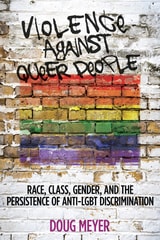
Violence against Queer People
Race, Class, Gender, and the Persistence of Anti-LGBT DiscriminationMeyer, Doug
Rutgers University Press, 2015
Selected as one of “The Best of the Best from the University Presses: Books You Should Know About” at the 2016 ALA Annual Conference
Violence against lesbians and gay men has increasingly captured media and scholarly attention. But these reports tend to focus on one segment of the LGBT community—white, middle class men—and largely ignore that part of the community that arguably suffers a larger share of the violence—racial minorities, the poor, and women. In Violence against Queer People, sociologist Doug Meyer offers the first investigation of anti-queer violence that focuses on the role played by race, class, and gender.
Drawing on interviews with forty-seven victims of violence, Meyer shows that LGBT people encounter significantly different forms of violence—and perceive that violence quite differently—based on their race, class, and gender. His research highlights the extent to which other forms of discrimination—including racism and sexism—shape LGBT people’s experience of abuse. He reports, for instance, that lesbian and transgender women often described violent incidents in which a sexual or a misogynistic component was introduced, and that LGBT people of color sometimes weren’t sure if anti-queer violence was based solely on their sexuality or whether racism or sexism had also played a role. Meyer observes that given the many differences in how anti-queer violence is experienced, the present media focus on white, middle-class victims greatly oversimplifies and distorts the nature of anti-queer violence. In fact, attempts to reduce anti-queer violence that ignore race, class, and gender run the risk of helping only the most privileged gay subjects.
Many feel that the struggle for gay rights has largely been accomplished and the tide of history has swung in favor of LGBT equality. Violence against Queer People, on the contrary, argues that the lives of many LGBT people—particularly the most vulnerable—have improved very little, if at all, over the past thirty years.

Violent Intimacies
The Trans Everyday and the Making of an Urban WorldAsli Zengin
Duke University Press, 2024
Virtuous Vice
Homoeroticism and the Public SphereEric O. Clarke
Duke University Press, 2000
Examining the role of eroticism in citizenship and why only normalizing
constructions of homosexuality enable inclusion, Clarke reconsiders the work of Habermas and Foucault in relation to contemporary visibility politics, Kant’s moral and political theory, Marx’s analysis of value, and the sexualized dynamics of the Victorian cultural public sphere. The juxtaposition of Habermas with Foucault reveals the surprising value of reading the former in the context of queer politics and the usefulness of the theory of the public sphere for understanding contemporary identity politics and the visibility politics of the 1990s. Examining how a host of nonsexual factors impinge historically upon the constitution of sexual identities and practices, Clarke negotiates the relation between questions of publicity and categories of value. Discussions of television sitcoms (such as Ellen), marketing techniques, authenticity, and literary culture add to this daring analysis of visibility politics.
As a critique of the claim that equal representation of gays and lesbians necessarily constitutes progress, this significant intervention into social theory will find enthusiastic readers in the fields of Victorian, cultural, literary, and gay and lesbian studies, as well as other fields engaged with categories of identity.
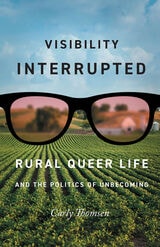
Visibility Interrupted
Rural Queer Life and the Politics of UnbecomingCarly Thomsen
University of Minnesota Press, 2021
A questioning of the belief in the power of LGBTQ visibility through the lives of queer women in the rural Midwest
Today most LGBTQ rights supporters take for granted the virtue of being “out, loud, and proud.” Most also assume that it would be terrible to be LGBTQ in a rural place. By considering moments in which queerness and rurality come into contact, Visibility Interrupted argues that both positions are wrong. In the first monograph on LGBTQ women in the rural Midwest, Carly Thomsen deconstructs the image of the rural as a flat, homogenous, and anachronistic place where LGBTQ people necessarily suffer. And she suggests that visibility is not liberation and will not lead to liberation.
Far from being an unambiguous good, argues Thomsen, visibility politics can, in fact, preclude collective action. They also advance metronormativity, postraciality, and capitalism. To make these interventions, Thomsen develops the theory of unbecoming: interrogating the relationship between that which we celebrate and that which we find disdainful—the past, the rural, politics—is crucial for developing alternative subjectivities and politics. Unbecoming precedes becoming. Drawing from critical race studies, disability studies, and queer Marxism, in addition to feminist and queer studies, the insights of this book will be useful to scholars theorizing issues far beyond sexuality and place and to social justice activists who want to move beyond visibility.
Visions of Queer Martyrdom from John Henry Newman to Derek Jarman
Dominic Janes
University of Chicago Press, 2015
Janes finds the beginnings of queer martyrdom in the nineteenth-century Church of England and the controversies over Cardinal John Henry Newman’s sexuality. He then considers how liturgical expression of queer desire in the Victorian Eucharist provided inspiration for artists looking to communicate their own feelings of sexual deviance. After looking at Victorian monasteries as queer families, he analyzes how the Biblical story of David and Jonathan could be used to create forms of same-sex partnerships. Finally, he delves into how artists and writers employed ecclesiastical material culture to further queer self-expression, concluding with studies of Oscar Wilde and Derek Jarman that illustrate both the limitations and ongoing significance of Christianity as an inspiration for expressions of homoerotic desire.
Providing historical context to help us reevaluate the current furor over homosexuality in the Church, this fascinating book brings to light the myriad ways that modern churches and openly gay men and women can learn from the wealth of each other’s cultural and spiritual experience.
Visions of Sodom
Religion, Homoerotic Desire, and the End of the World in England, c. 1550-1850H. G. Cocks
University of Chicago Press, 2017
In Visions of Sodom, H. G. Cocks examines the many different ways in which the story of Sodom’s destruction provided a template for understanding homoerotic desire and behaviour in Britain between the Reformation and the nineteenth century. Sodom was not only a marker of sexual sins, but also the epitome of false—usually Catholic—religion, an exemplar of the iniquitous city, a foreshadowing of the world’s fiery end, an epitome of divine and earthly punishment, and an actual place that could be searched for and discovered. Visions of Sodom investigates each of these ways of reading Sodom’s annihilation in the three hundred years after the Reformation. The centrality of scripture to Protestant faith meant that Sodom’s demise provided a powerful origin myth of homoerotic desire and sexual excess, one that persisted across centuries, and retains an apocalyptic echo in the religious fundamentalism of our own time.
Vulgar Genres
Gay Pornographic Writing and Contemporary FictionSteven Ruszczycky
University of Chicago Press, 2021
Long fixated on visual forms, the field of porn studies is overdue for a book-length study of gay pornographic writing. Steven Ruszczycky delivers with an impressively researched work on the ways gay pornographic writing emerged as a distinct genre in the 1960s and went on to shape queer male subjectivity well into the new millennium.
Ranging over four decades, Ruszczycky draws on a large archive of pulp novels and short fiction, lifestyle magazines and journals, reviews, editorial statements, and correspondence. He puts these materials in conversation with works by a number of contemporary writers, including William Carney, Dennis Cooper, Samuel Delany, John Rechy, and Matthew Stadler. While focused on the years 1966 to 2005, Vulgar Genres reveals that the history of gay pornographic writing during this period informs much of what has happened online over the past twenty years, from cruising to the production of digital pornographic texts. The result is a milestone in porn studies and an important contribution to the history of gay life.
Vulnerable Constitutions
Queerness, Disability, and the Remaking of American ManhoodCynthia Barounis
Temple University Press, 2019
Amputation need not always signify castration; indeed, in Jack London’s fiction, losing a limb becomes part of a process through which queerly gendered men become properly masculinized. In her astute book, Vulnerable Constitutions, Cynthia Barounis explores the way American writers have fashioned alternative—even resistant—epistemologies of queerness, disability, and masculinity. She seeks to understand the way perverse sexuality, physical damage, and bodily contamination have stimulated—rather than created a crisis for—masculine characters in twentieth- and early twenty-first-century literature.
Barounis introduces the concept of “anti-prophylactic citizenship”—a mode of political belonging characterized by vulnerability, receptivity, and risk—to examine counternarratives of American masculinity. Investigating the work of authors including London, William Faulkner, James Baldwin, and Eli Clare, she presents an evolving narrative of medicalized sexuality and anti-prophylactic masculinity. Her literary readings interweave queer theory, disability studies, and the history of medicine to demonstrate how evolving scientific conversations around deviant genders and sexualities gave rise to a new model of national belonging—ultimately rewriting the story of American masculinity as a story of queer-crip rebellion.