Results by title
1917 books match the query 'Law' and 11 start with v
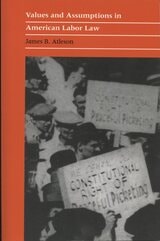
Values and Assumptions in American Labor Law
James B. Atleson
University of Massachusetts Press, 1983
Chosen as a Lawyer's Literary Club Selection, this book looks behind stated legal rules and doctrines in the field of labor law to clearly formulate the often hidden values and assumptions that motivate those who make labor law decisions. The author demonstrates that the “received wisdom” in labor law, which is that decisions are based on analyses of the rational implications of statutory policy, language, or legislative history, fails to account for the actual history of decision-making, particularly the interpretation of the Wagner Act of 1935 that established collective bargaining and the National Labor Relations Board. Through close interpretation, Atleson shows the legal decisions that have been reached are better explained by such factors as notional of inherent property rights, the need for capital mobility, and the interest in continued productivity.
Valuing Life
Humanizing the Regulatory StateCass R. Sunstein
University of Chicago Press, 2014
As OIRA Administrator, Sunstein helped oversee regulation in a broad variety of areas, including highway safety, health care, homeland security, immigration, energy, environmental protection, and education. This background allows him to describe OIRA and how it works—and how it can work better—from an on-the-ground perspective. Using real-world examples, many of them drawn from today’s headlines, Sunstein makes a compelling case for improving cost-benefit analysis, a longtime cornerstone of regulatory decision-making, and for taking account of variables that are hard to quantify, such as dignity and personal privacy. He also shows how regulatory decisions about health, safety, and life itself can benefit from taking into account behavioral and psychological research, including new findings about what scares us, and what does not. By better accounting for people’s fallibility, Sunstein argues, we can create regulation that is simultaneously more human and more likely to achieve its goals.
In this highly readable synthesis of insights from law, policy, economics, and psychology, Sunstein breaks down the intricacies of the regulatory system and offers a new way of thinking about regulation that incorporates human dignity– and an insistent focus on the consequences of our choices.

Verdict According to Conscience
Perspectives on the English Criminal Trial Jury, 1200-1800Thomas Andrew Green
University of Chicago Press, 1985
Versions of Academic Freedom
From Professionalism to RevolutionStanley Fish
University of Chicago Press, 2014
Depending on who’s talking, academic freedom is an essential bulwark of democracy, an absurd fig leaf disguising liberal agendas, or, most often, some in-between muddle that both exaggerates its own importance and misunderstands its actual value to scholarship. Fish enters the fray with his typical clear-eyed, no-nonsense analysis. The crucial question, he says, is located in the phrase “academic freedom” itself: Do you emphasize “academic” or “freedom”? The former, he shows, suggests a limited, professional freedom, while the conception of freedom implied by the latter could expand almost infinitely. Guided by that distinction, Fish analyzes various arguments for the value of academic freedom: Is academic freedom a contribution to society's common good? Does it authorize professors to critique the status quo, both inside and outside the university? Does it license and even require the overturning of all received ideas and policies? Is it an engine of revolution? Are academics inherently different from other professionals? Or is academia just a job, and academic freedom merely a tool for doing that job?
No reader of Fish will be surprised by the deftness with which he dismantles weak arguments, corrects misconceptions, and clarifies muddy arguments. And while his conclusion—that academic freedom is simply a tool, an essential one, for doing a job—may surprise, it is unquestionably bracing. Stripping away the mystifications that obscure academic freedom allows its beneficiaries to concentrate on what they should be doing: following their intellectual interests and furthering scholarship.
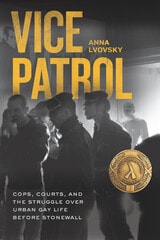
Vice Patrol
Cops, Courts, and the Struggle over Urban Gay Life before StonewallAnna Lvovsky
University of Chicago Press, 2021
In Vice Patrol, Anna Lvovsky chronicles this painful story, tracing the tactics used to criminalize, profile, and suppress gay life from the 1930s through the 1960s, and the surprising controversies those tactics often inspired in court. Lvovsky shows that the vice squads’ campaigns stood at the center of live debates about not only the law’s treatment of queer people, but also the limits of ethical policing, the authority of experts, and the nature of sexual difference itself—debates that had often unexpected effects on the gay community’s rights and freedoms. Examining those battles, Vice Patrol enriches understandings of the regulation of queer life in the twentieth century and disputes about police power that continue today.
Vice Patrol
Cops, Courts, and the Struggle over Urban Gay Life before StonewallAnna Lvovsky
University of Chicago Press, 2021
In the mid-twentieth century, gay life flourished in American cities even as the state repression of queer communities reached its peak. Liquor investigators infiltrated and shut down gay-friendly bars. Plainclothes decoys enticed men in parks and clubs. Vice officers surveilled public bathrooms through peepholes and two-way mirrors.
In Vice Patrol, Anna Lvovsky chronicles this painful story, tracing the tactics used to criminalize, profile, and suppress gay life from the 1930s through the 1960s, and the surprising controversies those tactics often inspired in court. Lvovsky shows that the vice squads’ campaigns stood at the center of live debates about not only the law’s treatment of queer people, but also the limits of ethical policing, the authority of experts, and the nature of sexual difference itself—debates that had often unexpected effects on the gay community’s rights and freedoms. Examining those battles, Vice Patrol enriches understandings of the regulation of queer life in the twentieth century and disputes about police power that continue today.
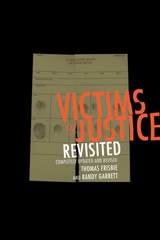
Victims of Justice Revisited
Completely Updated and RevisedThomas Frisbie and Randy Garrett
Northwestern University Press, 2005
The kidnapping of Jeanine Nicarico from her quiet suburban home and her brutal slaying sparked a public demand for justice. But the longer authorities strove to execute Cruz and the two other men, the more evidence emerged that the defendants were innocent-and that the death penalty process in America itself was deeply flawed.
Here is the start of a chain reaction that led to a moratorium on the death penalty in Illinois and the clearing out of Death Row, as Illinois Governor George Ryan-worried about unfairness in death penalty convictions-granted clemency to all those awaiting execution. This is a detailed study of a nationally known case that should be cited whenever serious scholars examine how capital cases are prosecuted in America. Here is the most thorough investigation yet published into the background of the man who-after Cruz already was on Death Row-claimed to be the real killer.
Violence As Obscenity
Limiting the Media's First Amendment ProtectionKevin W. Saunders
Duke University Press, 1996
Saunders examines the public debate on media violence, the arguments of professional and public interest groups urging governmental action, and the media and the ACLU’s desire for self-regulation. Citing research that links violence in the media to actual violence, Saunders argues that a present danger to public safety may be reduced by invoking the existing law on obscenity. Reviewing the justifications of that law, he finds that not only is the legal history relied on by the Supreme Court inadequate to distinguish violence from sex, but also many of the justifications apply more forcefully to instances of violence than to sexually explicit material that has been ruled obscene. Saunders also examines the actions that Congress, states, and municipalities have taken to regulate media violence as well as the legal limitations imposed on such regulations by the First Amendment protections given to speech and the press. In discussing the current operation of the obscenity exception and confronting the issue of censorship, he advocates adapting to the regulation of violent material the doctrine of variable obscenity, which applies a different standard for material aimed at youth, and the doctrine of indecency, which allows for federal regulation of broadcast material.
Cogently and passionately argued, Violence as Obscenity will attract scholars of American constitutional law and mass communication, and general readers moved by current debates about media violence, regulation, and censorship.
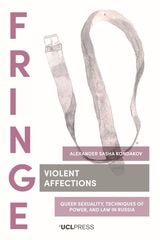
Violent Affections
Queer Sexuality, Techniques of Power, and Law in RussiaAlexander Sasha Kondakov
University College London, 2022
Passed in 2013, Russia’s “gay propaganda” law cemented the nation’s anti-LGBTQ sentiment into legal rhetoric that has since emboldened countless instances of violence against queer people. Based on an analysis of over three hundred criminal cases of anti-queer violence in Russia before and after the introduction of the law, Violent Affections shows how violent acts are framed in emotional language by perpetrators during their criminal trials, thus uncovering the techniques of power that work to translate emotions into violence against queer people. Utilizing an original methodology of studying legal memes, this book argues that individual affective states are directly connected to the political and legislative violence aimed at policing queer lives. Alexander Sasha Kondakov expands upon two sets of interdisciplinary literature–queer theory and affect theory–in order to conceptualize what is referred to as neo-disciplinary power. The book traces how affections circulate from body to body as a kind of virus, eventually enabling the turn from a memetic response to violent action.
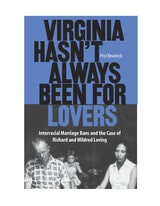
Virginia Hasn't Always Been for Lovers
Interracial Marriage Bans and the Case of Richard and Mildred LovingPhyl Newbeck
Southern Illinois University Press, 2004
This landmark volume chronicles the history of laws banning interracial marriage in the United States with particular emphasis on the case of Richard and Mildred Loving, a white man and a black woman who were convicted by the state of Virginia of the crime of marrying across racial lines in the late 1950s. The Lovings were not activists, but their battle to live together as husband and wife in their home state instigated the 1967 U.S. Supreme Court ruling that antimiscegenation laws were unconstitutional, which ultimately resulted in the overturning of laws against interracial marriage that were still in effect in sixteen states by the late 1960s.
Vranesh's Colorado Water Law, Revised Edition
James N. Corbridge, Jr.
University Press of Colorado, 1999
Vranesh's Colorado Water Law serves as a reference resource for attorneys practicing in the field of water law, as well as a thorough introduction for those just getting started in the subject. It will also be a helpful reference work for individuals and institutions interested in the acquisition and distribution of water: municipalities, water conservancy districts, irrigation organizations, water engineers, and hydrologists.