Results by title
1947 books match the query 'Music' and 20 start with v
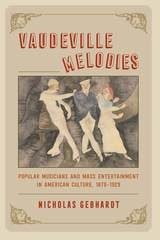
Vaudeville Melodies
Popular Musicians and Mass Entertainment in American Culture, 1870-1929Nicholas Gebhardt
University of Chicago Press, 2017
In Vaudeville Melodies, Nicholas Gebhardt introduces us to the performers, managers, and audiences who turned disjointed variety show acts into a phenomenally successful business. First introduced in the late nineteenth century, by 1915 vaudeville was being performed across the globe, incorporating thousands of performers from every branch of show business. Its astronomical success relied on a huge network of theatres, each part of a circuit and administered from centralized booking offices. Gebhardt shows us how vaudeville transformed relationships among performers, managers, and audiences, and argues that these changes affected popular music culture in ways we are still seeing today. Drawing on firsthand accounts, Gebhardt explores the practices by which vaudeville performers came to understand what it meant to entertain an audience, the conditions in which they worked, the institutions they relied upon, and the values they imagined were essential to their success.
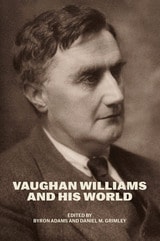
Vaughan Williams and His World
Edited by Byron Adams and Daniel M. Grimley
University of Chicago Press, 2023
Ralph Vaughan Williams (1872–1958) was one of the most innovative and creative figures in twentieth-century music, whose symphonies stand alongside those of Sibelius, Nielsen, Shostakovich, and Roussel. After his death, shifting priorities in the music world led to a period of critical neglect. What could not have been foreseen is that by the second decade of the twenty-first century, a handful of Vaughan Williams’s scores would attain immense popularity worldwide. Yet the present renown of these pieces has led to misapprehension about the nature of Vaughan Williams’s cultural nationalism and a distorted view of his international cultural and musical significance.
Vaughan Williams and His World traces the composer’s stylistic and aesthetic development in a broadly chronological fashion, reappraising Vaughan Williams’s music composed during and after the Second World War and affirming his status as an artist whose leftist political convictions pervaded his life and music. This volume reclaims Vaughan Williams’s deeply held progressive ethical and democratic convictions while celebrating his achievements as a composer.

Venda Children's Songs
A Study in Ethnomusicological AnalysisJohn Blacking
University of Chicago Press, 1995
Venda Children's Songs presents a detailed analysis of both the music and the cultural significance of children's songs among the Venda. Among its many original contributions is the identifying of the role of melody in generating rhythm, something that distinguishes this form of music from that of Venda adults as well as from other genres of African music in general.
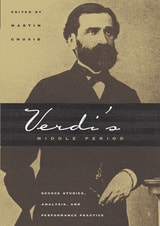
Verdi's Middle Period
Source Studies, Analysis, and Performance PracticeEdited by Martin Chusid
University of Chicago Press, 1997
In addition to offering new insights into such staples as Il trovatore, La traviata, and Un ballo in maschera, Verdi's Middle Period also highlights works which have only recently begun to re-enter public consciousness, such as Stiffelio, as well as lesser-known works such as Luisa Miller and Les Vêpres siciliennes. Comprising major essays by some of the best-known Verdians of our day, as well as articles from up-and-coming scholars, this volume has much to offer readers ranging from musicologists to serious opera buffs.
Contributors are Martin Chusid, Markus Engelhardt, Linda B. Fairtile, Philip Gossett, Kathleen Kuzmick Hansell, Elizabeth Hudson, James Hepokoski, Roberta Montemorra Marvin, Carlo Matteo Mossa, Roger Parker, Harold S. Powers, David Rosen, and Mary Ann Smart.
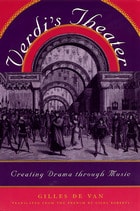
Verdi's Theater
Creating Drama through MusicGilles de Van
University of Chicago Press, 1998
Although melodrama tends to dominate Verdi's early work and musical drama his later, both aesthetics are woven into all his operas: musical drama is already present in Ernani (1844), and melodrama is still present in Otello (1887). Indeed, much of the interest and originality of Verdi's operas lies in his adherence to both these contradictory systems, allowing the composer/dramatist to be simultaneously classical and modern, traditionalist and innovator.

Vinyl Freak
Love Letters to a Dying MediumJohn Corbett
Duke University Press, 2017

Vinyl Theory
Jeffrey R. Di Leo
Lever Press, 2020
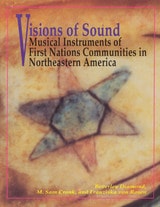
Visions of Sound
Musical Instruments of First Nation Communities in Northeastern AmericaBeverley Diamond, M. Sam Cronk, and Franziska von Rosen
University of Chicago Press, 1995
Featuring over two hundred photographs of instruments, dialogues among the coauthors, numerous interviews with individual music makers, and an appended catalogue of over seven hundred instrument descriptions, this is an important book for all ethnomusicologists and students of Native American culture as well as general readers interested in Native American mythology and religious life.
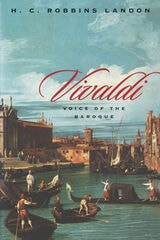
Vivaldi
Voice of the BaroqueH. C. Robbins Landon
University of Chicago Press, 1996
Very little has been written on Vivaldi for the nonspecialist, especially in English. Landon rediscovers the composer in this accessible and musically informed biography while presenting documentation of the musician's life discovered after the Baroque revival in the 1930s. This book includes illustrations of eighteenth-century Venice and several newly translated letters, thoroughly evoking the style of the time and revealing some of the more personal aspects of Vivaldi's life.
"Belongs on the shelf of every serious music student."—Kirkus
"Gives a good feel for Vivaldi's life and times . . . and describes particularly well how Vivaldi has been revived."—Booklist
"Robbins Landon is marvelously entertaining, extravagantly learned."—The Independent

Vodou Nation
Haitian Art Music and Cultural NationalismMichael Largey
University of Chicago Press, 2006
Around the time of the United States’s occupation of Haiti in 1915, African American composers began to incorporate Vodou-inspired musical idioms to showcase black artistry and protest white oppression. Together with Haitian musicians, these composers helped create what Michael Largey calls the “Vodou Nation,” an ideal vision of Haiti that championed its African-based culture as a bulwark against America’s imperialism. Highlighting the contributions of many Haitian and African American composers who wrote music that brought rhythms and melodies of the Vodou ceremony to local and international audiences, Vodou Nation sheds light on a black cosmopolitan musical tradition that was deeply rooted in Haitian culture and politics.
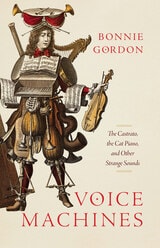
Voice Machines
The Castrato, the Cat Piano, and Other Strange SoundsBonnie Gordon
University of Chicago Press, 2023
Italian courts and churches began employing castrato singers in the late sixteenth century. By the eighteenth century, the singers occupied a celebrity status on the operatic stage. Constructed through surgical alteration and further modified by rigorous training, castrati inhabited human bodies that had been “mechanized” to produce sounds in ways that unmechanized bodies could not. The voices of these technologically enhanced singers, with their unique timbre, range, and strength, contributed to a dramatic expansion of musical vocabulary and prompted new ways of imagining sound, the body, and personhood.
Connecting sometimes bizarre snippets of history, this multi-disciplinary book moves backward and forward in time, deliberately troubling the meaning of concepts like “technology” and “human.” Voice Machines attends to the ways that early modern encounters and inventions—including settler colonialism, emergent racialized worldviews, the printing press, gunpowder, and the telescope—participated in making castrati. In Bonnie Gordon’s revealing study, castrati serve as a critical provocation to ask questions about the voice, the limits of the body, and the stories historians tell.
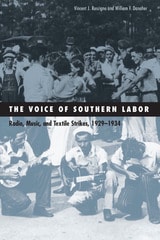
Voice Of Southern Labor
Radio, Music, And Textile Strikes, 1929-1934Vincent J. Roscigno
University of Minnesota Press, 2004
Vividly shows how music united striking workers
The 1934 strike of southern textile workers, involving nearly 400,000 mill hands, remains perhaps the largest collective mobilization of workers in U.S. history. How these workers came together in the face of the powerful and coercive opposition of management and the state is the remarkable story at the center of this book.
The Voice of Southern Labor chronicles the lives and experiences of southern textile workers and provides a unique perspective on the social, cultural, and historical forces that came into play when the group struck, first in 1929, and then on a massive scale in 1934. The workers’s grievances, solidarity, and native radicalism of the time were often reflected in the music they listened to and sang, and Vincent J. Roscigno and William F. Danaher offer an in-depth context for understanding this intersection of labor, politics, and culture. The authors show how the message of the southern mill hands spread throughout the region with the advent of radio and the rise of ex–mill worker musicians, and how their sense of opportunity was further bolstered by Franklin D. Roosevelt’s radio speeches and policies.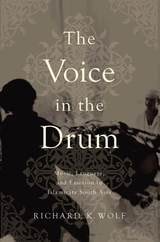
Voice in the Drum
Music, Language, and Emotion in Islamicate South AsiaRichard Wolf
University of Illinois Press, 2017
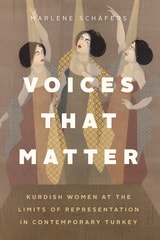
Voices That Matter
Kurdish Women at the Limits of Representation in Contemporary TurkeyMarlene Schäfers
University of Chicago Press, 2023
A fine-grained ethnography exploring the sociopolitical power of Kurdish women’s voices in contemporary Turkey.
“Raise your voice!” and “Speak up!” are familiar refrains that assume, all too easily, that gaining voice will lead to empowerment, healing, and inclusion for marginalized subjects. Marlene Schäfers’s Voices That Matter reveals where such assumptions fall short, demonstrating that “raising one’s voice” is no straightforward path to emancipation but fraught with anxieties, dilemmas, and contradictions. In its attention to the voice as form, this book examines not only what voices say but also how they do so, focusing on Kurdish contexts where oral genres have a long, rich legacy. Examining the social labor that voices carry out as they sound, speak, and resonate, Schäfers shows that where new vocal practices arise, they produce new selves and practices of social relations. In Turkey, recent decades have seen Kurdish voices gain increasing moral and political value as metaphors of representation and resistance. Women’s voices, in particular, are understood as potent means to withstand patriarchal restrictions and political oppression. By ethnographically tracing the transformations in how Kurdish women relate to and employ their voices as a result of these shifts, Schäfers illustrates how contemporary politics foster not only new hopes and desires but also create novel vulnerabilities as they valorize, elicit, and discipline voice in the name of empowerment and liberation.

Voices of Drought
The Politics of Music and Environment in Northeastern BrazilMichael B. Silvers
University of Illinois Press, 2018
Silvers offers case studies focused on the sertão that range from the Brazilian wax harvested in Ceará for use in early wax cylinder sound recordings to the drought- and austerity-related cancellation of Carnival celebrations in 2014-16. Unearthing links between music and the environmental and social costs of drought, his daring synthesis explores ecological exile, poverty, and unequal access to water resources alongside issues like corruption, prejudice, unbridled capitalism, and expanding neoliberalism.

Voices of a People
THE STORY OF YIDDISH FOLKSONGRuth Rubin
University of Illinois Press, 1974
A priceless collection of song texts in Yiddish and English, as well as a selection of tunes Rubin transcribed, this volume brings the Jews' ancient, itinerant culture alive through children's songs, dancing songs, and songs about love and courtship, poverty and work, crime and corruption, immigration, and the dream of a homeland. Rubin's notes and annotations weave each text into the larger story of the Jewish experience.
Noted scholar Mark Slobin provides a new foreword that includes a biographical sketch of Rubin and an assessment of her contributions over a lifetime of collecting, absorbing, and disseminating Yiddish folksong.

Voices of the Jazz Age
Profiles of Eight Vintage JazzmenChip Deffaa
University of Illinois Press, 1990

Voices of the Magi
Enchanted Journeys in Southeast BrazilSuzel Reily
University of Chicago Press, 2002
Focusing on urban folias, Suzel Ana Reily shows how participants use the ritual journeys and musical performances of the folias to create sacred spheres distinct from, yet intimately related to, their everyday world. Reily calls this practice "enchantment" and argues that it allows the folia communities to temporarily make the social ideals of mutual reciprocity and equality embodied in their religious beliefs a reality. The contrast between their ritual experiences and the daily lives of these impoverished workers, in turn, reinforces the religious convictions of these devotees of the music of the Magi.
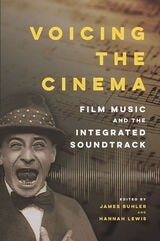
Voicing the Cinema
Film Music and the Integrated SoundtrackEdited by James Buhler and Hannah Lewis
University of Illinois Press, 2020
The collection is divided into four sections. The first explores historical approaches to technology in the silent film, French cinema during the transition era, the films of the so-called New Hollywood, and the post-production sound business. The second investigates the practice of the singing voice in diverse repertories such as Bergman's films, Eighties teen films, and girls' voices in Brave and Frozen. The third considers the auteuristic voice of the soundtrack in works by Kurosawa, Weir, and others. A last section on narrative and vococentrism moves from The Martian and horror film to the importance of background music and the state of the soundtrack at the end of vococentrism.
Contributors: Julie Brown, James Buhler, Marcia Citron, Eric Dienstfrey, Erik Heine, Julie Hubbert, Hannah Lewis, Brooke McCorkle, Cari McDonnell, David Neumeyer, Nathan Platte, Katie Quanz, Jeff Smith, Janet Staiger, and Robynn Stilwell
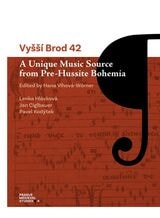
Vyšší Brod 42
A Unique Music Source from Pre-Hussite BohemiaLenka Hlávková, Jan Ciglbauer, and Pavel Kodýtek
Karolinum Press, 2025
Manuscript 42 from the Cistercian monastery in Vyšší Brod (Hohenfurth), Czech Republic, compiled in 1410, today represents one of the most important music sources from medieval Bohemia, providing insight into the rich and varied liturgical and devotional repertory circulating in Central Europe just before the outbreak of the Hussite Wars in 1419. The manuscript’s collection of monophonic and polyphonic songs, one of the oldest ones in Europe, serves as a starting point for studies of the Latin mensural cantio, an important late medieval music form and cultural phenomenon.
In Vyšší Brod 42, three extensive studies explore various aspects of the manuscript and its contents. In the first, Jan Ciglbauer examines its creation process and the involvement of various scribes in noting down new texts and melodies. In the second, Hana Vlhová-Wörner delves into the variety of late medieval chant compositions contained within it and the relationship of this truly novel repertory to the formalized Cistercian liturgy. The last chapter, co-authored by Lenka Hlávková and Pavel Kodýtek, scrutinizes the manuscript’s remarkable collection of spiritual songs and identifies their inscription as “snapshots” of a vivid oral tradition.
Together, these three studies bring a new perspective on musical life in Cistercian monasteries in Central Europe in the late Middle Ages, a topic that has received very little exploration until now.