Results by title
2916 books match the query 'Politics and government' and 21 start with v
Varieties of Liberalism in Central America
Nation-States as Works in ProgressBy Forrest D. Colburn and Arturo Cruz S.
University of Texas Press, 2007
Why do some countries progress while others stagnate? Why does adversity strengthen some countries and weaken others? Indeed, in this era of unprecedented movement of people, goods, and ideas, just what constitutes a nation-state? Forrest Colburn and Arturo Cruz suggest how fundamental these questions are through an exploration of the evolution of Guatemala, El Salvador, Honduras, Nicaragua, and Costa Rica over the last quarter of a century, a period of intriguing, often confounding, paradoxes in Central America's development.
Offering an elegant defense of empiricism, Colburn and Cruz explore the roles of geography and political choice in constructing nations and states. Countries are shown to be unique: there are a daunting number of variables. There is causality, but not the kind that can be revealed in the laboratory or on the blackboard. Liberalism—today defined as democracy and unfettered markets—may be in vogue, but it has no inherent determinants. Democracy and market economies, when welded to the messy realities of individual countries, are compatible with many different outcomes. The world is more pluralistic in both causes and effects than either academic theories or political rhetoric suggest.

Varieties of Muslim Experience
Encounters with Arab Political and Cultural LifeLawrence Rosen
University of Chicago Press, 2008
In Varieties of Muslim Experience, anthropologist Lawrence Rosen explores aspects of Arab Muslim life that are, at first glance, perplexing to Westerners. He ranges over such diverse topics as why Arabs eschew portraiture, why a Muslim scientist might be attracted to fundamentalism, and why the Prophet must be protected from blasphemous cartoons. What connects these seemingly disparate features of Arab social, political, and cultural life? Rosen argues that the common thread is the importance Arabs place on the negotiation of interpersonal relationships—a link that helps to explain actions as seemingly unfathomable as suicide bombing and as elusive as Quranic interpretation.
Written with eloquence and a deep knowledge of the entire spectrum of Muslim experience, Rosen’s book will interest not only anthropologists and Islamicists but anyone invested in better understanding the Arab world.
Venezuela's Bolivarian Democracy
Participation, Politics, and Culture under ChávezDavid Smilde and Daniel Hellinger, eds.
Duke University Press, 2011
Contributors
Carolina Acosta-Alzuru
Julia Buxton
Luis Duno Gottberg
Sujatha Fernandes
María Pilar García-Guadilla
Kirk A. Hawkins
Daniel Hellinger
Michael E. Johnson
Luis E. Lander
Margarita López-Maya
Elizabeth Gackstetter Nichols
Coraly Pagan
Guillermo Rosas
Naomi Schiller
David Smilde
Alejandro Velasco
Veto Power
Institutional Design in the European UnionJonathan B. Slapin
University of Michigan Press, 2011
"This is a terrific book. The questions that Slapin asks about intergovernmental conferences (IGCs) in the European Union are extraordinarily important and ambitious, with implications for the EU and for international cooperation more generally. Furthermore, Slapin's theorizing of his core questions is rigorous, lucid, and accessible to scholarly readers without extensive formal modeling background . . . This book is a solid, serious contribution to the literature on EU studies."
---Mark Pollack, Temple University
"An excellent example of the growing literature that brings modern political science to bear on the politics of the European Union."
---Michael Laver, New York University
Veto rights can be a meaningful source of power only when leaving an organization is extremely unlikely. For example, small European states have periodically wielded their veto privileges to override the preferences of their larger, more economically and militarily powerful neighbors when negotiating European Union treaties, which require the unanimous consent of all EU members.
Jonathan B. Slapin traces the historical development of the veto privilege in the EU and how a veto---or veto threat---has been employed in treaty negotiations of the past two decades. As he explains, the importance of veto power in treaty negotiations is one of the features that distinguishes the EU from other international organizations in which exit and expulsion threats play a greater role. At the same time, the prominence of veto power means that bargaining in the EU looks more like bargaining in a federal system. Slapin's findings have significant ramifications for the study of international negotiations, the design of international organizations, and European integration.
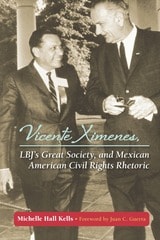
Vicente Ximenes, LBJ's Great Society, and Mexican American Civil Rights Rhetoric
Michelle Hall Kells, with a foreword by Juan C. Guerra
Southern Illinois University Press, 2018
Kells draws on Ximenes’s extensive archive of speeches, reports, articles, and oral interviews to present the activist’s rhetorical history. After a discussion of Ximenes’s early life, the author focuses on his career as an activist, examining Ximenes’s leadership in several key civil rights events, including the historic 1967 White House Cabinet Committee Hearings on Mexican American Affairs. Also highlighted is his role in advancing Mexican Americans and Latinos from social marginalization to greater representation in national politics.
This book shows us a remarkable man who dedicated the majority of his life to public service, using rhetoric to mobilize activists for change to secure civil rights advances for his fellow Mexican Americans.
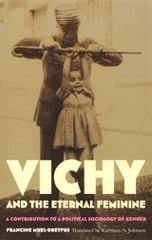
Vichy and the Eternal Feminine
A Contribution to a Political Sociology of GenderFrancine Muel-Dreyfus
Duke University Press, 2001
Drawing on an extensive body of legislative, religious, educational, medical, and literary texts, Muel-Dreyfus examines how the Vichy regime brutally resurrected the gender politics that had been rejected during France’s social struggles in the 1930s. Strikingly, she reveals how this resurrection in turn fed into racial politics: childless women, for instance, and those who had abortions were construed—like Jews—as threats to France’s racial “purity.” With its atendant patterns of social inclusion and exclusion that were deeply rooted in the political and cultural history of the Third Republic, Muel-Dreyfus claims, a pervasive range of gendered metaphors helped to structure the very laws and policies of the Vichy regime.
The French language edition of this book was published in 1996 to wide acclaim. Contributing to theories about the role of gender in political philosophy, to the cultural anthropology of symbolic representation, and to our understanding of the history of fascism, Vichy and the Eternal Feminine will appeal to French, European, and twentieth-century historians; students and scholars of gender and racial studies; political scientists; and anthropologists.
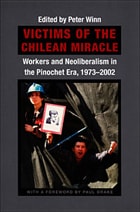
Victims of the Chilean Miracle
Workers and Neoliberalism in the Pinochet Era, 1973–2002Peter Winn, ed.
Duke University Press, 2004
Implemented in the 1970s at the point of the bayonet and in the shadow of the torture chamber, the neoliberal policies of Augusto Pinochet’s dictatorship reversed many of the gains in wages, benefits, and working conditions that Chile’s workers had won during decades of struggle and triggered a severe economic crisis. Later refined and softened, Pinochet’s neoliberal model began, finally, to promote economic growth in the mid-1980s, and it was maintained by the center-left governments that followed the restoration of democracy in 1990. Yet, despite significant increases in worker productivity, real wages stagnated, the expected restoration of labor rights faltered, and gaps in income distribution continued to widen. To shed light on this history and these ongoing problems, the contributors look at industries long part of the Chilean economy—including textiles and copper—and industries that have expanded more recently—including fishing, forestry, and agriculture. They not only show how neoliberalism has affected Chile’s labor force in general but also how it has damaged the environment and imposed special burdens on women. Painting a sobering picture of the two Chiles—one increasingly rich, the other still mired in poverty—these essays suggest that the Chilean miracle may not be as miraculous as it seems.
Contributors.
Paul Drake
Volker Frank
Thomas Klubock
Rachel Schurman
Joel Stillerman
Heidi Tinsman
Peter Winn
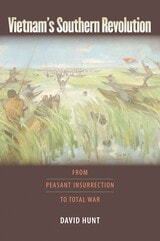
Vietnam's Southern Revolution
From Peasant Insurrection to Total WarDavid Hunt
University of Massachusetts Press, 2009
In Vietnam, the American government vowed to win the “hearts and minds” of the people. On the other side, among those who led and sympathized with the insurgents, the term “people's war” gained a wide currency. Yet while much has been written about those who professed to speak for the Vietnamese population, we know surprisingly little about the everyday life of the peasants who made up the bulk of the country's inhabitants. This book illuminates that subject. Drawing on a wide range of sources, including interviews conducted by the Rand Corporation with informants from My Tho Province in the Mekong Delta, David Hunt brings to light the daily experience of villagers in the midst of war and revolution.
The peasants of southern Vietnam were neither onlookers nor mere victims as fighting raged throughout their country. From the “concerted uprising” in 1959–1960 to the Tet Offensive of 1968, the revolutionary movement they created was in fact the driving force within the war. Known as the “Viet Cong” to their adversaries, the rebels called themselves the “Liberation Front.” They demanded an end to landlordism and an egalitarian distribution of the means of subsistence as well as a democratization of relations between town and countryside, parents and children, men and women. They hoped the Vietnamese people would achieve a fuller sense of their place in the world and of the power they possessed to fashion their own destinies, without reliance on supernatural forces.In the first half of the book, Hunt analyzes this cultural revolution. As fighting spread and became more destructive, especially after the U.S. escalation in 1965, villagers were driven from their homes, the rural infrastructure collapsed, and customary notions of space and time lost purchase on an increasingly chaotic world. In the second half of the book, Hunt shows how peasants, who earlier had aspired to a kind of revolutionary modernism, now found themselves struggling to survive and to cope with the American intruders who poured into My Tho, and how they managed to regroup and spearhead the Tet Offensive that irrevocably altered the course of the war.
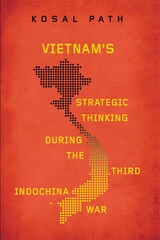
Vietnam's Strategic Thinking during the Third Indochina War
Kosal Path
University of Wisconsin Press, 2023
In contrast to earlier studies, Path traces the moving target of these changing policy priorities, providing a vital addition to existing scholarship on asymmetric wartime decision-making and alliance formation among small states. The result uncovers how this critical period had lasting implications for the ways Vietnam continues to conduct itself on the global stage.
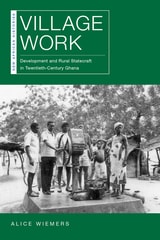
Village Work
Development and Rural Statecraft in Twentieth-Century GhanaAlice Wiemers
Ohio University Press, 2021
A robust historical case study that demonstrates how village development became central to the rhetoric and practice of statecraft in rural Ghana.
Combining oral histories with decades of archival material, Village Work formulates a sweeping history of twentieth-century statecraft that centers on the daily work of rural people, local officials, and family networks, rather than on the national governments and large-scale plans that often dominate development stories. Wiemers shows that developmentalism was not simply created by governments and imposed on the governed; instead, it was jointly constructed through interactions between them.
The book contributes to the historiographies of development and statecraft in Africa and the Global South by
- emphasizing the piecemeal, contingent, and largely improvised ways both development and the state are comprised and experienced
- providing new entry points into longstanding discussions about developmental power and discourse
- unsettling common ideas about how and by whom states are made
- exposing the importance of unpaid labor in mediating relationships between governments and the governed
- showing how state engagement could both exacerbate and disrupt inequities
Despite massive changes in twentieth-century political structures—the imposition and destruction of colonial rule, nationalist plans for pan-African solidarity and modernization, multiple military coups, and the rise of neoliberal austerity policies—unremunerated labor and demonstrations of local leadership have remained central tools by which rural Ghanaians have interacted with the state. Grounding its analysis of statecraft in decades of daily negotiations over budgets and bureaucracy, the book tells the stories of developers who decided how and where projects would be sited, of constituents who performed labor, and of a chief and his large cadre of educated children who met and shaped demands for local leaders. For a variety of actors, invoking “the village” became a convenient way to allocate or attract limited resources, to highlight or downplay struggles over power, and to forge national and international networks.
Violence of Democracy
Interparty Conflict in South IndiaRuchi Chaturvedi
Duke University Press, 2023

Violence, Political Culture & Development in Africa
Preben Kaarsholm
Ohio University Press, 2006
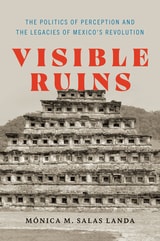
Visible Ruins
The Politics of Perception and the Legacies of Mexico's RevolutionMónica M. Salas Landa
University of Texas Press, 2024
2026 Honorable Mention, Mejor Libro, Historia Reciente y Memoria Section of the Latin American Studies Association
An examination of the failures of the Mexican Revolution through the visual and material records.
The Mexican Revolution (1910–1920) introduced a series of state-led initiatives promising modernity, progress, national grandeur, and stability; state surveyors assessed land for agrarian reform, engineers used nationalized oil for industrialization, archaeologists reconstructed pre-Hispanic monuments for tourism, and anthropologists studied and photographed Indigenous populations to achieve their acculturation. Far from accomplishing their stated goals, however, these initiatives concealed violence, and permitted land invasions, forced displacement, environmental damage, loss of democratic freedom, and mass killings. Mónica M. Salas Landa uses the history of northern Veracruz to demonstrate how these state-led efforts reshaped the region's social and material landscapes, affecting what was and is visible. Relying on archival sources and ethnography, she uncovers a visual order of ongoing significance that was established through postrevolutionary projects and that perpetuates inequality based on imperceptibility.
Visions of Transformation
Hegemony, Plurinationality, and Revolution in BoliviaAaron Augsburger
University of Arizona Press, 2025
On a wave of revolutionary upheaval in the early twenty-first century, Evo Morales was swept into state power as Bolivia’s first Indigenous president with a mandate to radically transform the country. The ensuing period, known simply as “el proceso de cambio” (the process of change), has been a tension-filled and contradictory process involving progressive transformations, ambiguous continuities, and outright revolutionary failures. Importantly, the contradictions have been just as much ideological as they are material.
By examining and illuminating the contrasting logics underlying opposing theories of revolutionary change, Visions of Transformation provides an analytical framework through which to understand and interpret the central conflicts and contradictions of Bolivia under Evo Morales and the Movimiento al Socialismo.
Based on nearly two years of immersive fieldwork, Visions of Transformation explores the relation between theoretical production and political practice. Through the contrasting perspectives of hegemony and plurinationality, the book analyzes three specific conjunctural moments—a proposed highway through the TIPNIS, a conflict over representation of the highland Indigenous movement organization CONAMAQ, and the struggle for Indigenous autonomy—to shed light on the primary economic, social, political, and theoretical tensions at the heart of Bolivia’s proceso de cambio.

Voice Lessons
By Alice Embree
University of Texas Press, 2021
Voice Lessons explores the rich personal and political terrain of Alice Embree, a 1960s activist and convert to the women’s liberation movement of the 1970s, bringing a woman’s perspective to a transformational time in US history. This riveting memoir traces the author’s roots in segregated Austin and her participation in efforts to integrate the University of Texas. It follows her antiwar activism from a vigil in front of President Lyndon Johnson’s ranch in 1965 to a massive protest after the shootings at Kent State in 1970. Embree’s activism brought her and the Students for a Democratic Society into conflict with Frank Erwin, the powerful chairman of the UT Board of Regents, and inspired a campus free speech movement. She recounts her experiences living in New York during the tumultuous years of 1968 and 1969, including the Columbia University strike and the Woodstock music festival. She also tells about protesting at the Chicago Democratic Convention, her interactions with Yippies and poets, and her travels to Chile, Cuba, and Mexico. Embree highlights the radical roots of the women’s liberation movement in Austin and the audacious women’s community that challenged gender roles, fought for reproductive justice, and inspired a lifetime of activism.

Voices From the Other Side
An Oral History of Terrorism Against CubaKeith Bolender
Pluto Press, 2010
Keith Bolender brings to bear the enormous impact that terrorism has had on Cuba’s civilian population, with over 1,000 documented incidents resulting in more than 3,000 deaths and 2,000 injuries. Bolender allows the victims to articulate the atrocities the Cuban people have suffered - which largely originate from Cuban counter-revolutionaries based in the US, often with the active help of the CIA.
Voices From The Other Side includes first-person interviews with more than 75 Cuban citizens who have been victims of these terrorist acts, or have had family members or close friends die from the attacks. It is a unique resource for activists, journalists and students interested in Cuba's torrid relationship with the US.
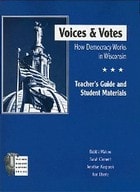
Voices and Votes Teacher's Guide
How Democracy Works in Wisconsin TGJon Kasparek and Bobbie Malone
Wisconsin Historical Society Press, 2006
Voices and Votes: How Democracy Works in Wisconsin; Teacher's Guide and Student Materials features several activities for each chapter to engage students in a more in-depth exploration of the book. These activities, designed for both individual and small groups, demand the use of higher-level thinking skills while integrating a wide range of learning styles, and all have culminating components that can be used for assessment. The guide also features easily reproducible student pages, including maps, charts, and interesting illustrations.
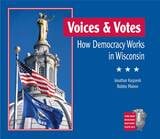
Voices and Votes
How Democracy Works in WisconsinJon Kasparek
Wisconsin Historical Society Press, 2006
Voices & Votes: How Democracy Works in Wisconsin invites upper elementary school students to explore the intersection of American civics and Wisconsin history. This sixth and final book in the New Badger History series introduces students to the basic structures of American democracy, state government, and Wisconsin's road to statehood. The first seven chapters help students grasp how the three branches of government function at the federal, state, local, and tribal levels, while tying these structural notions to Wisconsin history. Students will learn that citizens' voices and votes help government evolve to meet ever-changing societal needs. The last chapter emphasizes how young people can actively engage in their communities to bring about positive change.
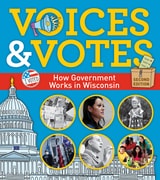
Voices and Votes
How Government Works in WisconsinWisconsin Historical Society Press, 2025
What are the different levels of government in Wisconsin? How are laws made? What is a political party? Who is allowed to vote in elections? How can citizens get involved in their communities?
These questions and many more are answered in this revised and updated edition of Voices and Votes, aimed at students in grades 3–5. Filled with color photos and illustrations—as well as diagrams, maps, and vocabulary words that make the material easy to absorb—this book explores:
- The fundamentals of federal, state, local, and Tribal government
- How Wisconsin’s constitution was created and how it has changed
- The way elections work and why voting matters
Readers will also find compelling examples of citizens from our state’s past who spoke up and worked to change laws and policies in order to improve their communities, including:
- Gaylord Nelson, who advocated for the environment as a state senator, member of Congress, and governor
- Vel Phillips, who helped expand housing opportunities as a member of Milwaukee’s city council
- Jesus Salas, who worked with state agencies to improve the lives of migrant farmworkers in Wisconsin
The book also offers contemporary stories of young people engaging with their communities, working to solve problems, and sharing their voices. This brilliantly updated edition of Voices and Votes will inspire a new generation of readers to understand and participate in our democracy.
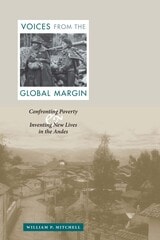
Voices from the Global Margin
Confronting Poverty and Inventing New Lives in the AndesBy William P. Mitchell
University of Texas Press, 2006
2007 — LASA Peru Flora Tristán Book Prize from the Peru Section – Latin American Studies Association
Voices from the Global Margin looks behind the generalities of debates about globalization to explore the personal impact of global forces on the Peruvian poor. In this highly readable ethnography, William Mitchell draws on the narratives of people he has known for forty years, offering deep insight into how they have coped with extreme poverty and rapid population growth—and their creation of new lives and customs in the process. In their own passionate words they describe their struggles to make ends meet, many abandoning rural homes for marginal wages in Lima and the United States. They chronicle their terror during the Shining Path guerrilla war and the government's violent military response. Mitchell's long experience as an anthropologist living with the people he writes about allows him to put the stories in context, helping readers understand the impact of the larger world on individuals and their communities. His book reckons up the human costs of the global economy, urging us to work toward a more just world.
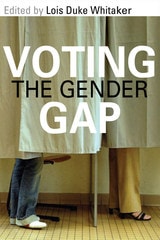
Voting the Gender Gap
Edited by Lois Duke Whitaker
University of Illinois Press, 2007
This book concentrates on the gender gap in voting--the difference in the proportion of women and men voting for the same candidate. Evident in every presidential election since 1980, this polling phenomenon reached a high of 11 percentage points in the 1996 election. The contributors discuss the history, complexity, and ways of analyzing the gender gap; the gender gap in relation to partisanship; motherhood, ethnicity, and the impact of parental status on the gender gap; and the gender gap in races involving female candidates. Voting the Gender Gap analyzes trends in voting while probing how women's political empowerment and gender affect American politics and the electoral process.
Contributors are Susan J. Carroll, Erin Cassese, Cal Clark, Janet M. Clark, M. Margaret Conway, Kathleen A. Dolan, Laurel Elder, Kathleen A. Frankovic, Steven Greene, Leonie Huddy, Mary-Kate Lizotte, Barbara Norrander, Margie Omero, and Lois Duke Whitaker.