Results by title
1668 books match the query 'Popular culture' and 19 start with v
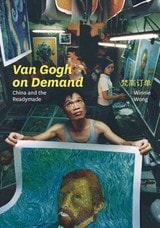
Van Gogh on Demand
China and the ReadymadeWinnie Won Yin Wong
University of Chicago Press, 2014
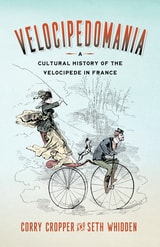
Velocipedomania
A Cultural History of the Velocipede in FranceCorry Cropper
Bucknell University Press, 2023
Velocipedomania is the first in-depth study of the velocipede fad and the popular culture it inspired. It explores how the device was hailed as a symbol of France’s cutting-edge technological advancements, yet also marketed as an invention with a noble pedigree, born from the nation’s cultural and literary heritage. Giving readers a window into the material culture and enthusiasms of Second Empire France, it provides the first English translations of 1869’s Manual of the Velocipede, 1868’s Note on Monsieur Michaux’s Velocipede, and the 1869 operetta Dagobert and his Velocipede. It also reprints scores of rare images from newspapers and advertisements, analyzing how these magnificent machines captured the era’s visual imagination. By looking at how it influenced French attitudes towards politics, national identity, technology, fashion, fitness, and gender roles, this book shows how the short-lived craze of velocipedomania had a big impact.
Very Special Episodes
Televising Industrial and Social ChangeJonathan Cohn
Rutgers University Press, 2021

Victims or Villains
Jewish Images in Classic English Detective FictionMalcolm J. Turnbull
University of Wisconsin Press, 1998

Victorian Freaks
The Social Context of Freakery in BritainMarlene Tromp
The Ohio State University Press, 2008
While “freaks” have captivated our imagination since well before the nineteenth century, the Victorians flocked to shows featuring dancing dwarves, bearded ladies, “missing links,” and six-legged sheep. Indeed, this period has been described by Rosemarie Garland-Thomson as the epoch of “consolidation” for freakery: an era of social change, enormously popular freak shows, and taxonomic frenzy. Victorian Freaks: The Social Context of Freakery in Britain, edited by Marlene Tromp, turns to that rich nexus, examining the struggle over definitions of “freakery” and the unstable and sometimes conflicting ways in which freakery was understood and deployed. As the first study centralizing British culture, this collection discusses figures as varied as Joseph Merrick, “The Elephant Man”; Daniel Lambert, “King of the Fat Men”; Julia Pastrana, “The Bear Woman”; and Laloo “The Marvellous Indian Boy” and his embedded, parasitic twin. The Victorian Freaks contributors examine Victorian culture through the lens of freakery, reading the production of the freak against the landscape of capitalist consumption, the medical community, and the politics of empire, sexuality, and art. Collectively, these essays ask how freakery engaged with notions of normalcy and with its Victorian cultural context.

Vidding
A HistoryFrancesca Coppa
University of Michigan Press, 2022
Vidding: A History emphasizes vidding as a critical, feminist form of fan practice. Working outward from interviews, VHS liner notes, convention programs, and mailing list archives, Coppa offers a rich history of vidding communities as they evolved from the 1970s through to the present. Built with the classroom in mind, the open-access electronic version of this book includes over one-hundred vids and an appendix that includes additional close readings of vids.
Viet Nam Expose
French Scholarship on Twentieth-Century Vietnamese SocietyGisele Bousquet and Pierre Brocheux, Editors
University of Michigan Press, 2002
The book is divided into three parts. Part I, "Vietnamese Society in the Early Twentieth Century," takes a micro approach to the study of Vietnamese society on the eve of the irreversible social transformation that occurred as the colonial infrastructure took root in Indochina. Part II, "Vietnamese Intellectuals: Contesting Colonial Power," contains biographical accounts of Vietnamese intellectuals who tried to reform their society under colonial domination. Part III, "Post-Colonial Vietnam: From Welfare State to Market-Oriented Economy," traces Vietnam's search for a viable economic model while maintaining itself as a socialist state.
The book speaks to diverse themes, including the nature of village life, the development of health care during the colonial era, the status of women, the role of Vietnamese intellectuals in the anticolonial struggle, the building of a socialist state, contemporary rural migration, labor relations, and Vietnam in an age of globalization.
Gisele Bousquet is Research Associate at the Center for Southeast Asian Studies, University of California, Berkeley. Pierre Brocheux is Maître de Conference of History, Université Denis Diderot-Paris VII.

Vietnam Anthology
American War LiteratureNancy Anisfield
University of Wisconsin Press, 1987
Novel excerpts include: Robert Stone’s Dog Soldiers, David Halberstam’s One Very Hot Day, and Jeff Danziger’s Lieutenant Kitt. Short stories include Asa Baber’s “The Ambush,” Tobias Wolff’s “Wingfield,” and Tim O’Brien’s “The Things They Carried.” Drama excerpts include David Rabe’s Streamers and Lanford Wilson’s The 5th of July. Poets include: Denise Levertov, Jan Barry, E. D. Ehrhart, Basil T. Paquet, Stephen Sossaman, Bryan Alec Floyd, Bruce Weigl, and Trang Thi Nga.

Vietnam Zippos
American Soldiers' Engravings and Stories (1965-1973)Edited by Sherry Buchanan
University of Chicago Press, 2007
—from an engraving on a Vietnam-era Zippo lighter
In 1965, journalist Morley Safer followed the United States Marines on a search and destroy mission into Cam Ne. When the Marines he accompanied reached the village, they ordered the civilians there to evacuate their homes—grass huts whose thatched roofs they set ablaze with Zippo lighters. Safer’s report on the event soon aired on CBS and was among the first to paint a harrowing portrait of the War in Vietnam. LBJ responded to the segment furiously, accusing Safer of having “shat on the American flag.” For the first time since World War II, American boys in uniform had been portrayed as murderers instead of liberators. Our perception of the war—and the Zippo lighter—would never be the same.
But as this stunning book attests, the Zippo was far more than an instrument of death and destruction. For the American soldiers who wielded them, they were a vital form of social protest as well. Vietnam Zippos showcases the engravings made by U.S. soldiers on their lighters during the height of the conflict, from 1965 to 1973. In a real-life version of the psychedelic war portrayed in Francis Ford Coppola’s Apocalypse Now, Sherry Buchanan tells the fascinating story of how the humble Zippo became a talisman and companion for American GIs during their tours of duty. Through a dazzling array of images, we see how Zippo lighters were used during the war, and we discover how they served as a canvas for both personal and political expression during the Age of Aquarius, engraved with etchings of peace signs and marijuana leaves and slogans steeped in all the rock lyrics, sound bites, combat slang, and antiwar mottos of the time.
Death from Above. Napalm Sticks to Kids. I Love You Mom, From a Lonely Paratrooper. The engravings gathered in this copiously illustrated volume are at once searing, caustic, and moving, running the full emotional spectrum with both sardonic reflections—I Love the Fucking Army and the Army Loves Fucking Me—and poignant maxims—When the Power of Love Overcomes the Love of Power, the World Will Know Peace. Part pop art and part military artifact, they collectively capture the large moods of the sixties and the darkest days of Vietnam—all through the world of the tiny Zippo.
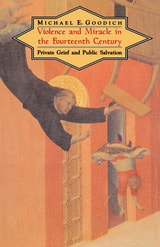
Violence and Miracle in the Fourteenth Century
Private Grief and Public SalvationMichael E. Goodich
University of Chicago Press, 1995
Rescue miracles offer a wide range of voices rarely heard in medieval history, from women and children to peasants and urban artisans. They tell of salvation not just from the ravages of nature and war, but from the vagaries of a violent society—crime, unfair judicial practices, domestic squabbles, and communal or factional conflict. The stories speak to a collapse of confidence in decaying institutions, from the law to the market to feudal authority. Particularly, the miraculous escapes documented during the Hundred Years' War, the Italian communal wars, and other conflicts are vivid testimony to the end of aristocratic warfare and the growing victimization of noncombatants.
Miracles, Goodich finds, represent the transcendent and unifying force of faith in a time of widespread distress and the hopeless conditions endured by the common people of the Middle Ages. Just as the lives of the saints, once dismissed as church propaganda, have become valuable to historians, so have rescue miracles, as evidence of an underlying medieval mentalite. This work expands our knowledge of that state of mind and the grim conditions that colored and shaped it.
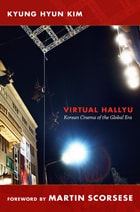
Virtual Hallyu
Korean Cinema of the Global EraKyung Hyun Kim
Duke University Press, 2011
In the late 1990s, South Korean film and other cultural products, broadly known as hallyu (Korean wave), gained unprecedented international popularity. Korean films earned an all-time high of $60.3 million in Japan in 2005, and they outperformed their Hollywood competitors at Korean box offices. In Virtual Hallyu, Kyung Hyun Kim reflects on the precariousness of Korean cinema’s success over the past decade. Arguing that state film policies and socioeconomic factors cannot fully explain cinema’s true potentiality, Kim draws on Deleuze’s concept of the virtual—according to which past and present and truth and falsehood coexist—to analyze the temporal anxieties and cinematic ironies embedded in screen figures such as a made-in-the-USA aquatic monster (The Host), a postmodern Chosun-era wizard (Jeon Woo-chi), a schizo man-child (Oasis), a weepy North Korean terrorist (Typhoon), a salary man turned vengeful fighting machine (Oldboy), and a sick nationalist (the repatriated colonial-era film Spring of Korean Peninsula). Kim maintains that the full significance of hallyu can only be understood by exposing the implicit and explicit ideologies of protonationalism and capitalism that, along with Korea’s ambiguous post-democratization and neoliberalism, are etched against the celluloid surfaces.
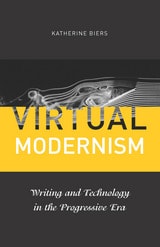
Virtual Modernism
Writing and Technology in the Progressive EraKatherine Biers
University of Minnesota Press, 2013
In Virtual Modernism, Katherine Biers offers a fresh view of the emergence of American literary modernism from the eruption of popular culture in the early twentieth century. Employing dynamic readings of the works of Stephen Crane, Henry James, James Weldon Johnson, Djuna Barnes, and Gertrude Stein, she argues that American modernist writers developed a “poetics of the virtual” in response to the rise of mass communications technologies before World War I. These authors’ modernist formal experimentation was provoked by the immediate, individualistic pleasures and thrills of mass culture. But they also retained a faith in the representational power of language—and the worth of common experience—more characteristic of realism and naturalism. In competition with new media experiences such as movies and recorded music, they simultaneously rejected and embraced modernity.
Biers establishes the virtual poetics of these five writers as part of a larger “virtual turn” in the United States, when a fascination with the writings of Henri Bergson, William James, and vitalist philosophy—and the idea of virtual experience—swept the nation. Virtual Modernism contends that a turn to the virtual experience of language was a way for each of these authors to carve out a value for the literary, both with and against the growth of mass entertainments. This technologically inspired reengagement with experience was formative for American modernism.
Situated at the crossing points of literary criticism, philosophy, media studies, and history, Virtual Modernism provides an examination of Progressive Era preoccupations with the cognitive and corporeal effects of new media technologies that traces an important genealogy of present-day concerns with virtuality.
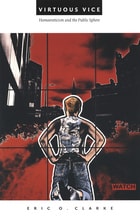
Virtuous Vice
Homoeroticism and the Public SphereEric O. Clarke
Duke University Press, 2000
Examining the role of eroticism in citizenship and why only normalizing
constructions of homosexuality enable inclusion, Clarke reconsiders the work of Habermas and Foucault in relation to contemporary visibility politics, Kant’s moral and political theory, Marx’s analysis of value, and the sexualized dynamics of the Victorian cultural public sphere. The juxtaposition of Habermas with Foucault reveals the surprising value of reading the former in the context of queer politics and the usefulness of the theory of the public sphere for understanding contemporary identity politics and the visibility politics of the 1990s. Examining how a host of nonsexual factors impinge historically upon the constitution of sexual identities and practices, Clarke negotiates the relation between questions of publicity and categories of value. Discussions of television sitcoms (such as Ellen), marketing techniques, authenticity, and literary culture add to this daring analysis of visibility politics.
As a critique of the claim that equal representation of gays and lesbians necessarily constitutes progress, this significant intervention into social theory will find enthusiastic readers in the fields of Victorian, cultural, literary, and gay and lesbian studies, as well as other fields engaged with categories of identity.
Vision/Re-Vision
Adapting Contemporary American Fiction To FilmBarbara Tepa Lupack
University of Wisconsin Press, 1996
The essays in Vision/Re-Vision analyze in detail ten popular and important films adapted from contemporary American fiction by women, addressing the ways in which the writers' latent or overt feminist messages are reinterpreted by the filmmakers who bring them to the screen, demonstrating that there is much to praise as well as much to fault in the adaptations and that the process of adaptation itself is instructive rather than destructive, since it enriches understanding about both media.
Visions of War
World War II in Popular Literature and CultureM. Paul Holsinger
University of Wisconsin Press, 1992

Voices for the Future
Essays on Major Science Fiction Writers, Volume 1Thomas D. Clareson
University of Wisconsin Press, 1976
Voices for the Future
Essays on Major Science Fiction Writers, Volume 3Thomas D. Clareson
University of Wisconsin Press, 1984
Voices in the Code
A Story about People, Their Values, and the Algorithm They MadeDavid G. Robinson
Russell Sage Foundation, 2022
In Voices in the Code, scholar David G. Robinson tells the story of how one community built a life-and-death algorithm in an inclusive, accountable way. Between 2004 and 2014, a diverse group of patients, surgeons, clinicians, data scientists, public officials and advocates collaborated and compromised to build a new kidney transplant matching algorithm—a system to offer donated kidneys to particular patients from the U.S. national waiting list. Drawing on interviews with key stakeholders, unpublished archives, and a wide scholarly literature, Robinson shows how this new Kidney Allocation System emerged and evolved over time, as participants gradually built a shared understanding both of what was possible, and of what would be fair. Robinson finds much to criticize, but also much to admire, in this story. It ultimately illustrates both the promise and the limits of participation, transparency, forecasting and auditing of high stakes software. The book’s final chapter draws out lessons for the broader struggle to build technology in a democratic and accountable way.
Voices
An Anthropologist's Dialogue with an Italian-American FestivalRichard M. Swiderski
University of Wisconsin Press, 1987