Results by title
4741 books match the query 'Religion' and 40 start with v

Valuable and Vulnerable
Children in the Hebrew Bible, especially the Elisha CycleJulie Faith Parker
SBL Press, 2013

Vardis Fisher
A Mormon NovelistMichael Austin
University of Illinois Press, 2021
Engrossing and enlightening, Vardis Fisher illuminates the acclaimed author's impact on Mormon culture, American letters, and the literary tradition of the American West.
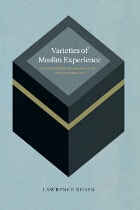
Varieties of Muslim Experience
Encounters with Arab Political and Cultural LifeLawrence Rosen
University of Chicago Press, 2008
In Varieties of Muslim Experience, anthropologist Lawrence Rosen explores aspects of Arab Muslim life that are, at first glance, perplexing to Westerners. He ranges over such diverse topics as why Arabs eschew portraiture, why a Muslim scientist might be attracted to fundamentalism, and why the Prophet must be protected from blasphemous cartoons. What connects these seemingly disparate features of Arab social, political, and cultural life? Rosen argues that the common thread is the importance Arabs place on the negotiation of interpersonal relationships—a link that helps to explain actions as seemingly unfathomable as suicide bombing and as elusive as Quranic interpretation.
Written with eloquence and a deep knowledge of the entire spectrum of Muslim experience, Rosen’s book will interest not only anthropologists and Islamicists but anyone invested in better understanding the Arab world.
Ve-’Ed Ya‘aleh (Gen 2
6), Volume 1: Essays in Biblical and Ancient Near Eastern Studies Presented to Edward L. GreensteinPeter Machinist
SBL Press, 2021
Ve-’Ed Ya‘aleh (Gen 2
6), Volume 2: Essays in Biblical and Ancient Near Eastern Studies Presented to Edward L. GreensteinPeter Machinist
SBL Press, 2021
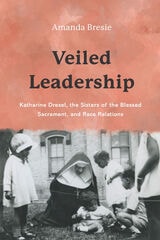
Veiled Leadership
Katharine Drexel, The Sisters of the Blessed Sacrament, and Race RelationsAmanda Bresie
Catholic University of America Press, 2023
Veins of Devotion
Blood Donation and Religious Experience in North IndiaCopeman, Jacob
Rutgers University Press, 2008
Veins of Devotion details recent collaborations between guru-led devotional movements and public health campaigns to encourage voluntary blood donation in northern India. Focusing primarily on Delhi, Jacob Copeman carefully situates the practice within the context of religious gift-giving, sacrifice, caste, kinship, and nationalism. The book analyzes the operations of several high-profile religious orders that organize large-scale public blood-giving events and argues that blood donation has become a site not only of frenetic competition between different devotional movements, but also of intense spiritual creativity.
Despite tensions between blood banks and these religious groups, their collaboration is a remarkable success storyùthe nation's blood supply is replenished while blood donors discover new devotional possibilities.
Download open access ebook here.
Vertical Grammar of Parallelism in Biblical Hebrew
David Toshio Tsumura
SBL Press, 2023
An essential resource for sound exegesis of biblical poetry
While previous books on parallelism have focused almost exclusively on semantic classification, in his new book David Toshio Tsumura focuses on the grammatical and phonetic aspects as well. In particular, he defines and illustrates the vertical grammatical relationship between parallel lines. Readers will master how to read Biblical Hebrew poetry effectively by focusing on the basic linguistic features of word order, parallelistic structure, and rhetorical devices. For the benefit of nonspecialists, all Hebrew poems are given in accessible transliteration. This book is an indispensable companion to the Hebrew Bible for both beginners and experienced scholars.
Vespers
Contemporary American Poems of Religion and SpiritualityVirgil Suarez
University of Iowa Press, 2003
At the heart of human existence lie fundamental questions that are pondered by philosophers, theologians, poets and thoughtful people from all walks of life. What is the meaning of life? Who or what is a divine being? How can a benevolent deity justify human suffering? Such questions are especially relevant to our lives in the current climate of American society. In Vespers: American Poems of Religion and Spirituality, editors Virgil Suárez and Ryan G. Van Cleave offer the reading world a timely anthology of powerful and passionate poems that cut to the heart of our contemporary theological and spiritual underpinnings.
Featuring fifty of today's most respected American poets, including Pulitzer Prize winners Stephen Dunn and Carolyn Kizer, Vespers allows us to witness and understand the challenging ideas and philosophies surrounding religion and spirituality. Through these poems, we can come to a better understanding of who, what, and why we are.
From deathbed spirituals to initiation songs, transformative ballads to transcendent sonnets, poets of myriad backgrounds—Native American, African American, Asian American, Latino, Protestant, Buddhist, Catholic, Jewish—echo the thoughts, concerns, and fears that linger in our souls. Their poems help us realize that we are not alone, that we're never truly alone, that even in the face of darkness the world is vibrant, beautiful, joyous.
More than a creative exploration of theological concerns—Vespers is a roadmap of where we've been, where we are, and where we are heading in terms of our spiritual and religious existence. It will keep you company, good company, whatever your religious or spiritual background.
Vestal Virgins, Sibyls, and Matrons
Women in Roman ReligionBy Sarolta A. Takács
University of Texas Press, 2007
Roman women were the procreators and nurturers of life, both in the domestic world of the family and in the larger sphere of the state. Although deterred from participating in most aspects of public life, women played an essential role in public religious ceremonies, taking part in rituals designed to ensure the fecundity and success of the agricultural cycle on which Roman society depended. Thus religion is a key area for understanding the contributions of women to Roman society and their importance beyond their homes and families.
In this book, Sarolta A. Takács offers a sweeping overview of Roman women's roles and functions in religion and, by extension, in Rome's history and culture from the republic through the empire. She begins with the religious calendar and the various festivals in which women played a significant role. She then examines major female deities and cults, including the Sibyl, Mater Magna, Isis, and the Vestal Virgins, to show how conservative Roman society adopted and integrated Greek culture into its mythic history, artistic expressions, and religion. Takács's discussion of the Bona Dea Festival of 62 BCE and of the Bacchantes, female worshippers of the god Bacchus or Dionysus, reveals how women could also jeopardize Rome's existence by stepping out of their assigned roles. Takács's examination of the provincial female flaminate and the Matres/Matronae demonstrates how women served to bind imperial Rome and its provinces into a cohesive society.

Victim of History
Cardinal Mindszenty, a biographyMargit Balogh
Catholic University of America Press, 2022
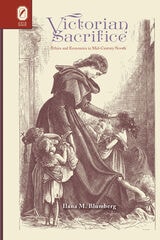
Victorian Sacrifice
Ilana M. Blumberg
The Ohio State University Press, 2013
Victorian Women Writers, Radical Grandmothers, and the Gendering of God
Gail Turley Houston
The Ohio State University Press, 2013
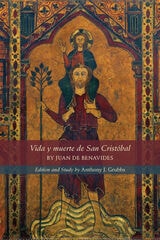
Vida y muerte de San Cristóbal
Juan de Benavides
Arizona Center for Medieval and Renaissance Studies, 2020
As the patron of travelers, Saint Christopher inspired one of the most popular cults in the medieval era, which spread across Europe and especially the Iberian Peninsula. Artistic renderings of the saint were found near the doors of most Spanish Gothic churches, and paratheatrical representations of Saint Christopher were also commonplace in religious processions. His conversion and martyrdom were often staged between the fifteenth and early eighteenth centuries.
In the theater, Juan de Benavides’s Vida y muerte de San Cristóbal is one of two known comedias dealing with the saint, but it was heavily censored after its premiere. The immense popularity of St. Christopher and other primitive saints first drew the attention of the Council of Trent in the mid-1500s, when the Catholic Church attempted to suppress the influence of the earlier saints due to their fantastical nature. The stories of these saints were censored, rewritten or even omitted in the post-Tridentine martyrologies. This publication is the first critical edition of the only extant copy of Benavides’s playscript. The circumstances surrounding Benavides’s play continue a dialogue about such important topics as censorship and the influence of the church over artistic production.
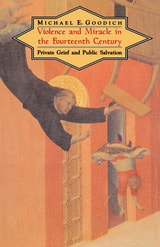
Violence and Miracle in the Fourteenth Century
Private Grief and Public SalvationMichael E. Goodich
University of Chicago Press, 1995
Rescue miracles offer a wide range of voices rarely heard in medieval history, from women and children to peasants and urban artisans. They tell of salvation not just from the ravages of nature and war, but from the vagaries of a violent society—crime, unfair judicial practices, domestic squabbles, and communal or factional conflict. The stories speak to a collapse of confidence in decaying institutions, from the law to the market to feudal authority. Particularly, the miraculous escapes documented during the Hundred Years' War, the Italian communal wars, and other conflicts are vivid testimony to the end of aristocratic warfare and the growing victimization of noncombatants.
Miracles, Goodich finds, represent the transcendent and unifying force of faith in a time of widespread distress and the hopeless conditions endured by the common people of the Middle Ages. Just as the lives of the saints, once dismissed as church propaganda, have become valuable to historians, so have rescue miracles, as evidence of an underlying medieval mentalite. This work expands our knowledge of that state of mind and the grim conditions that colored and shaped it.
Violence and the Medieval Clergy
Gerhard Jaritz
Central European University Press, 2012

Violence in the Films of Alfred Hitchcock
A Study in MimesisDavid Humbert
Michigan State University Press, 2017

Violence, the Sacred, and Things Hidden
A Discussion with René Girard at Esprit (1973)René Girard
Michigan State University Press, 2022
Vision and Violence
Arthur P. Mendel
University of Michigan Press, 1999
Much of the book is devoted to an examination of the persistence of the apocalyptic heritage from ancient Greek and Hebrew civilizations, through the religious revivals of the Middle Ages and the Enlightenment belief in progress, to its importance in Hegelian and Bolshevik thought, and finally to its expression today in the resurgence of religious fundamentalism in Judaism, Christianity, and Islam.
Mendel concludes his remarkable book with an appeal for the more modest and humane philosophy of the "repair of the world," which, he argues, is central to biblical teaching.
The late Arthur P. Mendel was Professor of History, University of Michigan, specializing in Russian intellectual history. His first book, Dilemmas of Progress in Tsarist Russia: Legal Marxism and Legal Populism, established him as one of the outstanding historians of his generation. Richard Landes is co-founder, with Stephen O'Leary, of the Center for Millennial Studies. He is also Associate Professor of History, Boston University, and author of Relics, Apocalypse, and the Deceits of History: Ademar of Chabannes, 989-1034.
Visionary of the Word
Melville and ReligionEdited by Jonathan A. Cook and Brian Yothers
Northwestern University Press, 2017
Visions of Queer Martyrdom from John Henry Newman to Derek Jarman
Dominic Janes
University of Chicago Press, 2015
Janes finds the beginnings of queer martyrdom in the nineteenth-century Church of England and the controversies over Cardinal John Henry Newman’s sexuality. He then considers how liturgical expression of queer desire in the Victorian Eucharist provided inspiration for artists looking to communicate their own feelings of sexual deviance. After looking at Victorian monasteries as queer families, he analyzes how the Biblical story of David and Jonathan could be used to create forms of same-sex partnerships. Finally, he delves into how artists and writers employed ecclesiastical material culture to further queer self-expression, concluding with studies of Oscar Wilde and Derek Jarman that illustrate both the limitations and ongoing significance of Christianity as an inspiration for expressions of homoerotic desire.
Providing historical context to help us reevaluate the current furor over homosexuality in the Church, this fascinating book brings to light the myriad ways that modern churches and openly gay men and women can learn from the wealth of each other’s cultural and spiritual experience.
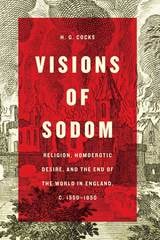
Visions of Sodom
Religion, Homoerotic Desire, and the End of the World in England, c. 1550-1850H. G. Cocks
University of Chicago Press, 2017
In Visions of Sodom, H. G. Cocks examines the many different ways in which the story of Sodom’s destruction provided a template for understanding homoerotic desire and behaviour in Britain between the Reformation and the nineteenth century. Sodom was not only a marker of sexual sins, but also the epitome of false—usually Catholic—religion, an exemplar of the iniquitous city, a foreshadowing of the world’s fiery end, an epitome of divine and earthly punishment, and an actual place that could be searched for and discovered. Visions of Sodom investigates each of these ways of reading Sodom’s annihilation in the three hundred years after the Reformation. The centrality of scripture to Protestant faith meant that Sodom’s demise provided a powerful origin myth of homoerotic desire and sexual excess, one that persisted across centuries, and retains an apocalyptic echo in the religious fundamentalism of our own time.
Visions of the Holy
Studies in Biblical Theology and LiteratureMarvin A. Sweeney
SBL Press, 2023
Visions of the Holy is a collection of essays by Marvin A. Sweeney on the study of biblical and postbiblical theology and literature. The volume includes previously published and unpublished essays related to the developing field of Jewish biblical theology; historical, comparative, and reception-critical studies; and the reading of texts from the Pentateuch, Former Prophets, Latter Prophets, and Ketuvim. Additional essays examine Asian biblical theology, the understanding of Shabbat, intertextuality in Exodus–Numbers, Samuel, Isaiah, and the Twelve in intertextual perspective, and the democratization of messianism in modern Jewish thought. The volume is an excellent resource for scholars, students, and clergy interested in theological readings of the Hebrew Bible.
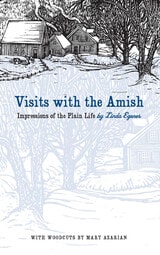
Visits with the Amish
Impressions of the Plain LifeLinda Egenes
University of Iowa Press, 2000
Who are the “plain people,” the men and women who till their fields with horse and plow, travel by horse and buggy, live without electricity and telephones, and practice “help thy neighbor” in daily life? Linda Egenes visited with her Old Order Amish neighbors in southeast Iowa for thirteen years before writing this informative and companionable introduction to their lifeways.
Drawn to their slower pace of life and their resistance to the lures of a consumer society, Egenes found a warm welcome among the Amish, and in return she has given us an equally warm perspective on Amish family life as she experienced it. The Amish value harmony in family life above all, and Egenes found an abundance of harmony as she savored homemade ice cream in a kitchen where the refrigerator ran on kerosene, learned to milk a two-bucket cow, helped cook dinner for nine in a summer kitchen, spent the day in a one-room schoolhouse, and sang “The Hymn of Praise” in its original German at Sunday service.
Whether quilting at a weekly sewing circle above the Stringtown Grocery, playing Dutch Blitz and Dare Base with schoolchildren, learning the intricacies of harness making, or mulching strawberries in a huge garden, Egenes was treated with the kindness, respect, and dignity that exemplify the strong community ties of the Amish. Her engaging account of her visits with the Amish, beautifully illustrated with woodcuts by Caldecott Medal winner Mary Azarian, reveals the serene and peaceful ways of a plain people whose lives are anything but plain.
Visualizing Secularism and Religion
Egypt, Lebanon, Turkey, IndiaAlev Cinar, Srirupa Roy and Maha Yahya, Editors
University of Michigan Press, 2012
Over the past two decades secular polities across the globe have witnessed an increasing turn to religion-based political movements, such as the rise of political Islam and Hindu nationalism, which have been fueling new and alternative notions of nationhood and national ideologies. The rise of such movements has initiated widespread debates over the meaning, efficacy, and normative worth of secularism. Visualizing Secularism and Religion examines the constitutive role of religion in the formation of secular-national public spheres in the Middle East and South Asia, arguing that in order to establish secularism as the dominant national ideology of countries such as Turkey, Lebanon, and India, the discourses, practices, and institutions of secular nation-building include rather than exclude religion as a presence within the public sphere. The contributors examine three fields---urban space and architecture, media, and public rituals such as parades, processions, and commemorative festivals---with a view to exploring how the relation between secularism, religion, and nationalism is displayed and performed. This approach demands a reconceptualization of secularism as an array of contextually specific practices, ideologies, subjectivities, and "performances" rather than as simply an abstract legal bundle of rights and policies.
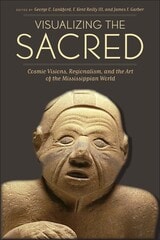
Visualizing the Sacred
Cosmic Visions, Regionalism, and the Art of the Mississippian WorldEdited by George E. Lankford, F. Kent Reilly III, and James F. Garber
University of Texas Press, 2011
The prehistoric native peoples of the Mississippi River Valley and other areas of the Eastern Woodlands of the United States shared a complex set of symbols and motifs that constituted one of the greatest artistic traditions of the pre-Columbian Americas. Traditionally known as the Southeastern Ceremonial Complex, these artifacts of copper, shell, stone, clay, and wood were the subject of the groundbreaking 2007 book Ancient Objects and Sacred Realms: Interpretations of Mississippian Iconography, which presented a major reconstruction of the rituals, cosmology, ideology, and political structures of the Mississippian peoples.
Visualizing the Sacred advances the study of Mississippian iconography by delving into the regional variations within what is now known as the Mississippian Iconographic Interaction Sphere (MIIS). Bringing archaeological, ethnographic, ethnohistoric, and iconographic perspectives to the analysis of Mississippian art, contributors from several disciplines discuss variations in symbols and motifs among major sites and regions across a wide span of time and also consider what visual symbols reveal about elite status in diverse political environments. These findings represent the first formal identification of style regions within the Mississippian Iconographic Interaction Sphere and call for a new understanding of the MIIS as a network of localized, yet interrelated religious systems that experienced both continuity and change over time.
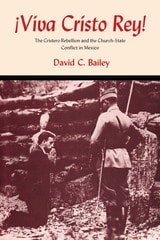
Viva Cristo Rey!
The Cristero Rebellion and the Church-State Conflict in MexicoBy David C. Bailey
University of Texas Press, 1974
Between 1926 and 1929, thousands of Mexicans fought and died in an attempt to overthrow the government of their country. They were the Cristeros, so called because of their battle cry, ¡Viva Cristo Rey!—Long Live Christ the King! The Cristero rebellion and the church-state conflict remain one of the most controversial subjects in Mexican history, and much of the writing on it is emotional polemic. David C. Bailey, basing his study on the most important published and unpublished sources available, strikes a balance between objective reporting and analysis. This book depicts a national calamity in which sincere people followed their convictions to often tragic ends.
The Cristero rebellion climaxed a century of animosity between the Catholic church and the Mexican state, and this background is briefly summarized here. With the coming of the 1910 revolution the hostility intensified. The revolutionists sought to impose severe limitations on the Church, and Catholic anti-revolutionary militancy grew apace. When the government in 1926 decreed strict enforcement of anticlerical legislation, matters reached a crisis. Church authorities suspended public worship throughout Mexico, and Catholics in various parts of the country rose up in arms. There followed almost three years of indecisive guerrilla warfare marked by brutal excesses on both sides. Bailey describes the armed struggle in broad outline but concentrates on the political and diplomatic maneuvering that ultimately decided the issue.
A de facto settlement was brought about in 1929, based on the government’s pledge to allow the Church to perform its spiritual offices under its own internal discipline. The pact was arranged mainly through the intercession of U.S. Ambassador Dwight Morrow. His role in the conflict, as well as that of other Americans who decisively influenced the course of events, receives detailed attention in the study. The position of the Vatican during the conflict and its role in the settlement are also examined in detail.
With the 1929 settlement the clergy returned to the churches, whereupon the Cristeros lost public support and the rebellion collapsed. The spirit of the settlement soon evaporated, more strife followed, and only after another decade did permanent religious peace come to Mexico.
Vocation to Virtue
Christian Marriage as a Consecrated LifeKent Lasnoski
Catholic University of America Press, 2014
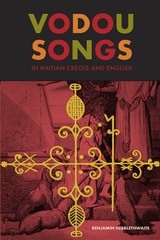
Vodou Songs in Haitian Creole and English
Benjamin Hebblethwaite
Temple University Press, 2011
Vodou songs constitute the living memory of Haitian Vodou communities, and song texts are key elements to understanding Haitian culture. Vodou songs form a profound religious and cultural heritage that traverses the past and refreshes the present. Offering a one-of-a-kind research tool on Vodou and its cultural roots in Haiti and pre-Haitian regions, Vodou Songs in Haitian Creole and English provides a substantial selection of hard to find or unpublished sacred Vodou songs in a side-by-side bilingual format.
Esteemed scholar Benjamin Hebblethwaite introduces the language, mythology, philosophy, origins, and culture of Vodou through several chapters of source songs plus separate analytical chapters. He guides readers through songs, chants, poems, magical formulae, invocations, prayers, historical texts and interviews, as well as Haitian Creole grammar and original sacred literature. An in-depth dictionary of key Vodou terms and concepts is also provided.
This corpus of songs and the research about them provide a crucial understanding of the meaning of Vodou religion, language, and culture.
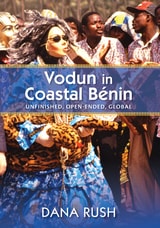
Vodun in Coastal Benin
Unfinished, Open-Ended, GlobalDana Rush
Vanderbilt University Press, 2013
The book is richly illustrated with color photographs of Vodun shrines, temple wall paintings, masquerades, and Hindu chromolithographs.
This book is the first publication in a new series called "Critical Investigations of the African Diaspora." The series grows out of Issues in Critical Investigation, a Vanderbilt initiative to assist junior scholars through critical feedback from senior faculty, annual symposia, and prize competitions in the humanities and social sciences. Dana Rush's Vodun in Coastal Benin is the winner of the inaugural Anna Julia Cooper Prize in the Humanities.
Voices From Catholic Worker
Rosalie Troester
Temple University Press, 1993
Voices Of The Religious Left
Rebecca Alpert
Temple University Press, 2000
The academics and activists who write this rich volume, edited by Rebecca Alpert, argue passionately on topics that concern all of us. Quoting from the Bible, the Torah, the Qur'an, the teachings of Buddha, as well as Native American folklore, they make the voices of the religious left heard -- teaching lessons of peace and liberation.
As this invaluable sourcebook shows, the religious left is committed to issues of human rights and dignity. Answering questions of identity and ideology, the essays included here stem from the "culture wars" that have divided orthodox and liberal believers. Responding to the needs of and raised by marginalized social groups, the writers discuss economic issues and religious politics as they champion equal rights, and promote the teaching of progressive vision.
Containing insightful perspectives of adherents to many faiths, Voices of the Religious Left makes it clear that there is a group dedicated to instilling the values of justice and freedom. They are far from silent.
All of the essays in this collection "...represent the power of the written word as a vehicle for advocacy and social change....It is my hope that the readers of these essays will themselves feel compelled to think more about the importance of taking a stand on issues from religious perspectives, and to act on something that compels them." --Rabbi Rebecca Alpert
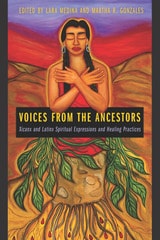
Voices from the Ancestors
Xicanx and Latinx Spiritual Expressions and Healing PracticesEdited by Lara Medina and Martha R. Gonzales
University of Arizona Press, 2019
This wisdom is based on the authors’ oral traditions, research, intuitions, and lived experiences—wisdom inspired by, and created from, personal trajectories on the path to spiritual conocimiento, or inner spiritual inquiry. This conocimiento has reemerged over the last fifty years as efforts to decolonize lives, minds, spirits, and bodies have advanced. Yet this knowledge goes back many generations to the time when the ancestors understood their interconnectedness with each other, with nature, and with the sacred cosmic forces—a time when the human body was a microcosm of the universe.
Reclaiming and reconstructing spirituality based on non-Western epistemologies is central to the process of decolonization, particularly in these fraught times. The wisdom offered here appears in a variety of forms—in reflective essays, poetry, prayers, specific guidelines for healing practices, communal rituals, and visual art, all meant to address life transitions and how to live holistically and with a spiritual consciousness for the challenges of the twenty-first century.
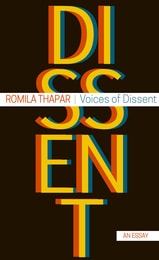
Voices of Dissent
An EssayRomila Thapar
Seagull Books, 2020
People have argued since time immemorial. Disagreement is a part of life, of human experience. But we now live in times when any form of protest in India is marked as anti-Indian and met with arguments that the very concept of dissent was imported into India from the West. As Romila Thapar explores in her timely historical essay, however, dissent has a long history in the subcontinent, even if its forms have evolved through the centuries.
In Voices of Dissent: An Essay, Thapar looks at the articulation of nonviolent dissent and relates it to various pivotal moments throughout India’s history. Beginning with Vedic times, she takes us from the second to the first millennium BCE, to the emergence of groups that were jointly called the Shramanas—the Jainas, Buddhists, and Ajivikas. Going forward in time, she also explores the views of the Bhakti sants and others of the fifteenth and sixteenth centuries and brings us to a major moment of dissent that helped to establish a free and democratic India: Mahatma Gandhi’s satyagraha. Then Thapar places in context the recent peaceful protests against India’s new, controversial citizenship law, maintaining that dissent in our time must be opposed to injustice and supportive of democratic rights so that society may change for the better.
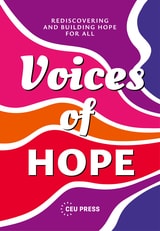
Voices of Hope
Rediscovering and Building Hope for AllJan Jorrit Hasselaar
Central European University Press, 2026
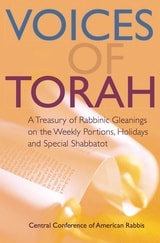
Voices of Torah, Vol. 1
A Treasury of Rabbinic Gleanings on the Weekly Portions, Holidays and SpecialRabbi Hara E. Person
Central Conference of American Rabbis, 2011
A wonderful Torah study resource! Discover multiple perspectives on every parashah in this rich collection of commentary written by CCAR members. Includes holiday portions as well. Makes a great gift for students, teachers, and congregational leaders.
Available in a discounted bundle with Voices of Torah, Volume 2
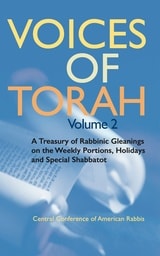
Voices of Torah, Volume 2
A Treasury of Rabbinic Gleanings on the Weekly Portions, Holidays, and Special ShabbatotRabbi Sonja K. Pilz, PhD
Central Conference of American Rabbis, 2020
In this second volume of the classic CCAR publication, you'll find a compilation of multiple commentaries written by CCAR members on every parashah, including holiday portions. A great resource for d'var Torah preparation for lay leaders and clergy alike, this volume makes a great gift for students, teachers, and congregational leaders.
Available in a discounted bundle with Voices of Torah, Volume 1
Voicing the Mystery
An Introduction to the Q?ne Tradition of the Täwa??do Orthodox ChurchesCalum A. Samuelson and Ralph Lee
Bridwell Press, 2026
This volume presents a new study of Qǝne, the extemporaneous sacred oral poetry of the Ethiopian and Eritrean Täwaḥǝdo churches. It discusses the technique of “Wax and Gold” used to compose Qǝne through which poets construct multilayered meaning using complex grammatical structures, polysemous vocabulary, and oblique allusions to texts and customs. The Introduction outlines the history of the Qǝne tradition, its liturgical function, and the challenges involved in understanding its multiple layers of meaning, and it provides a detailed account of the translation method developed for this study.
Aimed at both scholars of the Täwaḥǝdo tradition and a wider audience, this book exposes readers to an ancient poetic practice previously inaccessible without a comprehensive knowledge of Gǝʿǝz. The book introduces the new approach of Integrative Translation: each poem is presented through paired Plain and Poetic translations, enabling readers to perceive the branching meanings of the original Gǝʿǝz text and the diverse connections they evoke. A selection of fifteen qǝne poems is included, drawn from published collections compiled by notable traditional scholars of the churches, each featuring the Gǝʿǝz text and paired translations on facing pages.
Extensive annotations guide readers through the interpretive world in which Qǝne is composed, tracing the scriptural, liturgical, exegetical, hagiographical, and cultural sources that shape the tradition and illuminate the multiple meanings embedded in each poem. A Glossary also explains key terms and concepts. This is the first volume to make the Qǝne tradition accessible in English while preserving the distinctive multilayered character of the poetry.
Von Balthasar & the Option for the Poor
Theodramatics in the Light of Liberation TheologyTodd Walatka
Catholic University of America Press, 2017
Voyages of Catholic Thought to North America
Intellectual Networks and Cultural Exchanges Between Europe, Canada, and the United States, 1920-1950Florian Michel
Catholic University of America Press, 2026