501 books match the query 'South' and 8 start with v

cover of Violence in Rural South Africa, 1880–1963

Violence in Rural South Africa, 1880–1963

Sean Redding

University of Wisconsin Press, 2023

Violence was endemic to rural South African society from the late nineteenth century to the mid-twentieth century. But acts of violence were not inherent in African culture; rather, violence resulted from the ways in which Africans navigated the hazardous social and political landscape imposed by white rule. Focusing on the Eastern Cape province, Sean Redding investigates the rise of large-scale lethal fights among men, increasingly coercive abduction marriages, violent acts resulting from domestic troubles and witchcraft accusations within families and communities, and political violence against state policies and officials. 

Many violent acts attempted to reestablish and reinforce a moral, social, and political order among Africans. However, what constituted a moral order changed as white governance became more intrusive, land became scarcer, and people reconstructed their notions of “traditional” culture. State policies became obstacles around which Africans had to navigate by invoking the idea of tradition, using the state’s court system, alleging the use of witchcraft, or engaging in violent threats and acts. Redding’s use of multiple court cases and documents to discuss several types of violence provides a richer context for the scholarly conversation about the legitimation of violence in traditions, family life, and political protest.
[more]
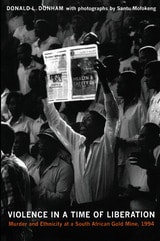
cover of Violence in a Time of Liberation: Murder and Ethnicity at a South African Gold Mine, 1994

Violence in a Time of Liberation

Murder and Ethnicity at a South African Gold Mine, 1994

Donald L. Donham

Duke University Press, 2011
How can we account for the apparent increase in ethnic violence across the globe? Donald L. Donham develops a methodology for understanding violence that shows why this question needs to be recast. He examines an incident that occurred at a South African gold mine at the moment of the 1994 elections that brought apartheid to a close. Black workers ganged up on the Zulus among them, killing two and injuring many more. While nearly everyone came to characterize the conflict as “ethnic,” Donham argues that heightened ethnic identity was more an outcome of the violence than its cause. Based on his careful reconstruction of events, he contends that the violence was not motivated by hatred of an ethnic other. It emerged, rather, in ironic ways, as capitalist managers gave up apartheid tactics and as black union activists took up strategies that departed from their stated values. National liberation, as it actually occurred, was gritty, contradictory, and incomplete. Given unusual access to the mine, Donham comes to this conclusion based on participant observation, review of extensive records, and interviews conducted over the course of a decade. Violence in a Time of Liberation is a kind of murder mystery that reveals not only who did it but also the ways that narratives of violence, taken up by various media, create ethnic violence after the fact.
[more]
cover of Violence of Democracy: Interparty Conflict in South India

Violence of Democracy

Interparty Conflict in South India

Ruchi Chaturvedi

Duke University Press, 2023
In Violence of Democracy Ruchi Chaturvedi tracks the rise of India’s divisive politics through close examination of decades-long confrontations in Kerala between members of the Communist Party of India (Marxist) and supporters of the Hindu nationalist Rashtriya Swayam Sevak Sangh and the Bharatiya Janata Party. Drawing on ethnographic fieldwork and extensive archival research, Chaturvedi investigates the unique character of the conflict between the party left and the Hindu right. This conflict, she shows, defies explanations centering religious, caste, or ideological differences. It offers instead new ways of understanding how quotidian political competition can produce antagonistic majoritarian communities. Rival political parties mobilize practices of disbursing care and aggressive masculinity in their struggle for electoral and popular power, a process intensified by a criminal justice system that reproduces rather than mitigating violence. Chaturvedi traces these dynamics from the late colonial period to the early 2000s, illuminating the broader relationships between democratic life, divisiveness, and majoritarianism.
[more]
cover of Visible Histories, Disappearing Women: Producing Muslim Womanhood in Late Colonial Bengal

Visible Histories, Disappearing Women

Producing Muslim Womanhood in Late Colonial Bengal

Mahua Sarkar

Duke University Press, 2008

In Visible Histories, Disappearing Women, Mahua Sarkar examines how Muslim women in colonial Bengal came to be more marginalized than Hindu women in nationalist discourse and subsequent historical accounts. She also considers how their near-invisibility except as victims has underpinned the construction of the ideal citizen-subject in late colonial India. Through critical engagements with significant feminist and postcolonial scholarship, Sarkar maps out when and where Muslim women enter into the written history of colonial Bengal. She argues that the nation-centeredness of history as a discipline and the intellectual politics of liberal feminism have together contributed to the production of Muslim women as the oppressed, mute, and invisible “other” of the normative modern Indian subject.

Drawing on extensive archival research and oral histories of Muslim women who lived in Calcutta and Dhaka in the first half of the twentieth century, Sarkar traces Muslim women as they surface and disappear in colonial, Hindu nationalist, and liberal Muslim writings, as well as in the memories of Muslim women themselves. The oral accounts provide both a rich source of information about the social fabric of urban Bengal during the final years of colonial rule and a glimpse of the kind of negotiations with stereotypes that even relatively privileged, middle-class Muslim women are still frequently obliged to make in India today. Sarkar concludes with some reflections on the complex links between past constructions of Muslim women, current representations, and the violence against them in contemporary India.

[more]
cover of Visualizing Secularism and Religion: Egypt, Lebanon, Turkey, India

Visualizing Secularism and Religion

Egypt, Lebanon, Turkey, India

Alev Cinar, Srirupa Roy and Maha Yahya, Editors

University of Michigan Press, 2012

Over the past two decades secular polities across the globe have witnessed an increasing turn to religion-based political movements, such as the rise of political Islam and Hindu nationalism, which have been fueling new and alternative notions of nationhood and national ideologies. The rise of such movements has initiated widespread debates over the meaning, efficacy, and normative worth of secularism. Visualizing Secularism and Religion examines the constitutive role of religion in the formation of secular-national public spheres in the Middle East and South Asia, arguing that in order to establish secularism as the dominant national ideology of countries such as Turkey, Lebanon, and India, the discourses, practices, and institutions of secular nation-building include rather than exclude religion as a presence within the public sphere. The contributors examine three fields---urban space and architecture, media, and public rituals such as parades, processions, and commemorative festivals---with a view to exploring how the relation between secularism, religion, and nationalism is displayed and performed. This approach demands a reconceptualization of secularism as an array of contextually specific practices, ideologies, subjectivities, and "performances" rather than as simply an abstract legal bundle of rights and policies.
[more]
cover of Voice in the Drum: Music, Language, and Emotion in Islamicate South Asia

Voice in the Drum

Music, Language, and Emotion in Islamicate South Asia

Richard Wolf

University of Illinois Press, 2017

Based on extensive research in India and Pakistan, this new study examines the ways drumming and voices interconnect over vast areas of South Asia and considers what it means for instruments to be voice-like and carry textual messages in particular contexts. Richard K. Wolf employs a hybrid, novelistic form of presentation in which the fictional protagonist Muharram Ali, a man obsessed with finding music he believes will dissolve religious and political barriers, interacts with Wolf's field consultants, to communicate ethnographic and historical realities that transcend the local details of any one person's life. The result is a daring narrative that follows Muharram Ali on a journey that explores how the themes of South Asian Muslims and their neighbors coming together, moving apart, and relating to God and spiritual intermediaries resonate across ritual and expressive forms such as drumming and dancing.
[more]
cover of Voice, Silence and Gender in South Africa's Anti-Apartheid Struggle: The Shadow of a Young Woman

Voice, Silence and Gender in South Africa's Anti-Apartheid Struggle

The Shadow of a Young Woman

Rachel E. Johnson

University of London Press, 2025

In 1978, amidst the aftermath of the Soweto Uprisings and after being held in detention without charge for over a year, a young black woman who had just turned eighteen stepped into the witness box at Kempton Park Circuit Court, northeast of Johannesburg. She was there to testify in the apartheid State’s case against eleven Soweto school student activists, on trial for sedition. She confirmed her name as Mary Masabata Loate. Loate would live with the consequences of this decision to talk for the rest of her short life.

Who spoke about the liberation struggle whilst it was ongoing? When did they speak and how? And what effects do the gendered history of speech and silence within anti-apartheid politics continue to have upon our knowledge of the past? Arguing that she is emblematic of the way gendered narratives of the struggle have been made, this book listens for the voice and silence of Masabata Loate and her contemporaries within political trials; newspapers; photography; human rights reportage; creative fiction, drama, poetry and song; autobiography and memoir; and oral histories. The result is an unconventional biography that sees this young woman as a shadow within the story of South Africa’s anti-apartheid liberation struggle.

[more]
cover of Voices of Dissent: An Essay

Voices of Dissent

An Essay

Romila Thapar

Seagull Books, 2020

Written by one of India’s best-known public intellectuals,  this book is essential reading for anyone interested in India’s fascinating history as well as the direction in which the nation is headed.

People have argued since time immemorial. Disagreement is a part of life, of human experience. But we now live in times when any form of protest in India is marked as anti-Indian and met with arguments that the very concept of dissent was imported into India from the West. As Romila Thapar explores in her timely historical essay, however, dissent has a long history in the subcontinent, even if its forms have evolved through the centuries.
 
In Voices of Dissent: An Essay, Thapar looks at the articulation of nonviolent dissent and relates it to various pivotal moments throughout India’s history. Beginning with Vedic times, she takes us from the second to the first millennium BCE, to the emergence of groups that were jointly called the Shramanas—the Jainas, Buddhists, and Ajivikas. Going forward in time, she also explores the views of the Bhakti sants and others of the fifteenth and sixteenth centuries and brings us to a major moment of dissent that helped to establish a free and democratic India: Mahatma Gandhi’s satyagraha. Then Thapar places in context the recent peaceful protests against India’s new, controversial citizenship law, maintaining that dissent in our time must be opposed to injustice and supportive of democratic rights so that society may change for the better.  


[more]