Results by title
247 books match the query 'South Africa' and 3 start with v
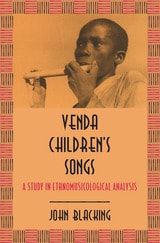
Venda Children's Songs
A Study in Ethnomusicological AnalysisJohn Blacking
University of Chicago Press, 1995
John Blacking is widely recognized for his theoretical works How Musical Is Man? and The Anthropology of the Body. This series of essays and articles on the music of the Venda people of the northern Transvaal in South Africa constitutes his major scholarly legacy.
Venda Children's Songs presents a detailed analysis of both the music and the cultural significance of children's songs among the Venda. Among its many original contributions is the identifying of the role of melody in generating rhythm, something that distinguishes this form of music from that of Venda adults as well as from other genres of African music in general.
Venda Children's Songs presents a detailed analysis of both the music and the cultural significance of children's songs among the Venda. Among its many original contributions is the identifying of the role of melody in generating rhythm, something that distinguishes this form of music from that of Venda adults as well as from other genres of African music in general.
[more]
Violence in Rural South Africa, 1880–1963
Sean Redding
University of Wisconsin Press, 2023
Violence was endemic to rural South African society from the late nineteenth century to the mid-twentieth century. But acts of violence were not inherent in African culture; rather, violence resulted from the ways in which Africans navigated the hazardous social and political landscape imposed by white rule. Focusing on the Eastern Cape province, Sean Redding investigates the rise of large-scale lethal fights among men, increasingly coercive abduction marriages, violent acts resulting from domestic troubles and witchcraft accusations within families and communities, and political violence against state policies and officials.
Many violent acts attempted to reestablish and reinforce a moral, social, and political order among Africans. However, what constituted a moral order changed as white governance became more intrusive, land became scarcer, and people reconstructed their notions of “traditional” culture. State policies became obstacles around which Africans had to navigate by invoking the idea of tradition, using the state’s court system, alleging the use of witchcraft, or engaging in violent threats and acts. Redding’s use of multiple court cases and documents to discuss several types of violence provides a richer context for the scholarly conversation about the legitimation of violence in traditions, family life, and political protest.
Many violent acts attempted to reestablish and reinforce a moral, social, and political order among Africans. However, what constituted a moral order changed as white governance became more intrusive, land became scarcer, and people reconstructed their notions of “traditional” culture. State policies became obstacles around which Africans had to navigate by invoking the idea of tradition, using the state’s court system, alleging the use of witchcraft, or engaging in violent threats and acts. Redding’s use of multiple court cases and documents to discuss several types of violence provides a richer context for the scholarly conversation about the legitimation of violence in traditions, family life, and political protest.
[more]
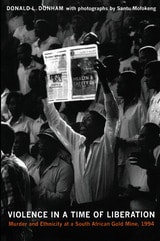
Violence in a Time of Liberation
Murder and Ethnicity at a South African Gold Mine, 1994Donald L. Donham
Duke University Press, 2011
How can we account for the apparent increase in ethnic violence across the globe? Donald L. Donham develops a methodology for understanding violence that shows why this question needs to be recast. He examines an incident that occurred at a South African gold mine at the moment of the 1994 elections that brought apartheid to a close. Black workers ganged up on the Zulus among them, killing two and injuring many more. While nearly everyone came to characterize the conflict as “ethnic,” Donham argues that heightened ethnic identity was more an outcome of the violence than its cause. Based on his careful reconstruction of events, he contends that the violence was not motivated by hatred of an ethnic other. It emerged, rather, in ironic ways, as capitalist managers gave up apartheid tactics and as black union activists took up strategies that departed from their stated values. National liberation, as it actually occurred, was gritty, contradictory, and incomplete. Given unusual access to the mine, Donham comes to this conclusion based on participant observation, review of extensive records, and interviews conducted over the course of a decade. Violence in a Time of Liberation is a kind of murder mystery that reveals not only who did it but also the ways that narratives of violence, taken up by various media, create ethnic violence after the fact.
[more]