Results by title
18284 books match the query 'United States' and 122 start with v

VISIONS OF PLACE
CITY, NEIGHBORHOODS, SUBURBS, AND CINCINNATI'S CLIFTON, 1850–2000ZANE L. MILLER
The Ohio State University Press, 2001
Almost every American city has or had neighborhoods like Clifton, which developed in the mid-nineteenth century as a silk-stocking suburb with a more diverse population than most observers noticed. Incorporated by Cincinnati in the late nineteenth century, Clifton had a reputation as a better-than-average place in which to live, a view that persisted until the end of the twentieth century.
In Visions of Place, Zane L. Miller treats ideas about the nature of cities—including their neighborhoods and their suburbs—as the dynamic factors in Clifton’s experience and examines the changes in Clifton's social, physical, civic, and political structure resulting from these transforming notions. These structural shifts involved a variety of familiar nineteenth- and twentieth-century urban phenomena, including not only the switch from suburban village to city neighborhood and the salience of interracial fears but also the rise of formal city planning and conflicts among Protestants, Catholics, and Jews over the future of Clifton's religious and ethnic ambiance.
Miller concludes with a policy analysis of current and future prospects for neighborhoods like Clifton and the cities and metropolitan areas of which they form a part.

Vacationland
Sarah Stonich
University of Minnesota Press, 2013
On a lake in northernmost Minnesota, you might find Naledi Lodge—only two cabins still standing, its pathways now trodden mostly by memories. And there you might meet Meg, or the ghost of the girl she was, growing up under her grandfather’s care in a world apart and a lifetime ago. Now an artist, Meg paints images “reflected across the mirrors of memory and water,” much as the linked stories of Vacationland cast shimmering spells across distance and time.
Those whose paths have crossed at Naledi inhabit Vacationland: a man from nearby Hatchet Inlet who knew Meg back when, a Sarajevo refugee sponsored by two parishes who can’t afford “their own refugee,” aged sisters traveling to fulfill a fateful pact once made at the resort, a philandering ad man, a lonely Ojibwe stonemason, and a haiku-spouting girl rescued from a bog.
Sarah Stonich, whose work has been described as “unexpected and moving” by the Chicago Tribune and “a well-paced feast” by the Los Angeles Times, weaves these tales of love and loss, heartbreak and redemption into a rich novel of interconnected and disjointed lives. Vacationland is a moving portrait of a place—at once timeless and of the moment, composed of conflicting dreams and shared experience—and of the woman bound to it by legacy and sometimes longing, but not necessarily by choice.

Vaccine Nation
America's Changing Relationship with ImmunizationElena Conis
University of Chicago Press, 2014
Vaccine Nation opens in the 1960s, when government scientists—triumphant following successes combating polio and smallpox—considered how the country might deploy new vaccines against what they called the “milder” diseases, including measles, mumps, and rubella. In the years that followed, Conis reveals, vaccines fundamentally changed how medical professionals, policy administrators, and ordinary Americans came to perceive the diseases they were designed to prevent. She brings this history up to the present with an insightful look at the past decade’s controversy over the implementation of the Gardasil vaccine for HPV, which sparked extensive debate because of its focus on adolescent girls and young women. Through this and other examples, Conis demonstrates how the acceptance of vaccines and vaccination policies has been as contingent on political and social concerns as on scientific findings.
By setting the complex story of American vaccination within the country’s broader history, Vaccine Nation goes beyond the simple story of the triumph of science over disease and provides a new and perceptive account of the role of politics and social forces in medicine.

Vaccine Nation
America's Changing Relationship with ImmunizationElena Conis
University of Chicago Press, 2014
With employers offering free flu shots and pharmacies expanding into one-stop shops to prevent everything from shingles to tetanus, vaccines are ubiquitous in contemporary life. The past fifty years have witnessed an enormous upsurge in vaccines and immunization in the United States: American children now receive more vaccines than any previous generation, and laws requiring their immunization against a litany of diseases are standard. Yet, while vaccination rates have soared and cases of preventable infections have plummeted, an increasingly vocal cross section of Americans have questioned the safety and necessity of vaccines. In Vaccine Nation, Elena Conis explores this complicated history and its consequences for personal and public health.
Vaccine Nation opens in the 1960s, when government scientists—triumphant following successes combating polio and smallpox—considered how the country might deploy new vaccines against what they called the “milder” diseases, including measles, mumps, and rubella. In the years that followed, Conis reveals, vaccines fundamentally changed how medical professionals, policy administrators, and ordinary Americans came to perceive the diseases they were designed to prevent. She brings this history up to the present with an insightful look at the past decade’s controversy over the implementation of the Gardasil vaccine for HPV, which sparked extensive debate because of its focus on adolescent girls and young women. Through this and other examples, Conis demonstrates how the acceptance of vaccines and vaccination policies has been as contingent on political and social concerns as on scientific findings.
By setting the complex story of American vaccination within the country’s broader history, Vaccine Nation goes beyond the simple story of the triumph of science over disease and provides a new and perceptive account of the role of politics and social forces in medicine.

Vaccine Rhetorics
Heidi Yoston Lawrence
The Ohio State University Press, 2020
Honorable Mention, Conference on College Composition and Communication Best Book in Technical or Scientific Communication
Debates over vaccination run rampant in the US—from the pages of medical journals, to news coverage about the latest outbreak, to vehement messages passed back and forth online. From the professional level to the personal one, almost everyone has an opinion on vaccinations—and often conversations around this issue pit supporters of vaccinations against “anti-vaxxers.” In Vaccine Rhetorics, Heidi Yoston Lawrence turns a critical eye toward such conversations—proposing a new approach that moves us beyond divisive rhetoric and seeks to better understand the material conditions underlying the debate.
Starting with a key question—If vaccines work, why are they controversial?—and using an approach she calls “material exigence,” Lawrence seeks to understand the material conditions of disease and injury associated with vaccination. Examining four primary motivations—the exigency of disease at the heart of physician views, the desire for eradication from policymakers, concern over injury expressed by parents and patients in online confessionals, and questions about the unknown surrounding potential recipients of the flu vaccine, Lawrence demonstrates the complexity of vaccination skepticism and the need for more nuanced public discourse. In bringing together the voices of those who oppose, question, and support vaccines, Vaccine Rhetorics unearths the material circumstances that lead to differing viewpoints and brings important attention not just to what is said but how and why it is said—providing a useful framework for studying other controversial issues.
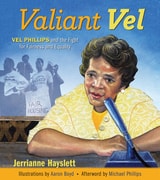
Valiant Vel
Vel Phillips and the Fight for Fairness and EqualityJerrianne Hayslett
Wisconsin Historical Society Press, 2025
An illustrated biography of groundbreaking civil rights activist Vel Phillips for young readers
Fair housing advocate, civil rights champion, and civic leader Vel Phillips spent her life breaking barriers and fighting for justice for all people. As the first Black woman on the Milwaukee Common Council, Wisconsin’s first Black judge, and the first Black woman to win statewide office when she was elected secretary of state of Wisconsin, Phillips left a lasting legacy that has inspired generations to continue the fight for justice and equality.
Valiant Vel depicts Phillips’s captivating story for young readers in middle and high school—from her childhood experiences facing racial discrimination, to achieving her dream of becoming a lawyer, to her long career in politics and civil rights. In the 1960s, Phillips spearheaded a campaign to advocate for fair housing in Milwaukee, joining forces with the NAACP Youth Council and marching alongside other activists in the face of violent opposition. In 1968, Phillips’s persistence paid off when the Milwaukee Common Council passed a fair housing ordinance.
Beautifully illustrated with historic photographs and original artwork by Milwaukee artist Aaron Boyd, Valiant Vel makes an excellent addition to young readers’ bookshelves at school and at home. With an afterword by Phillips’s son, Michael, a glossary of terms, and sources for further research, this book provides a thorough look at an inspirational activist who dedicated her life to making the world a better place.
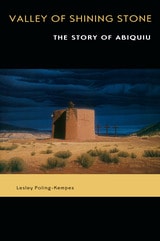
Valley of Shining Stone
The Story of AbiquiuLesley Poling-Kempes
University of Arizona Press, 1997
O'Keeffe saw the magic of sandstone cliffs and turquoise skies, but her life and death here are only part of the story. Reading almost like a novel, this book spills over with other legends buried deep in time, just as some of North America's oldest dinosaur bones lie hidden beneath the valley floor. Here are the stories of Pueblo Indians who have claimed this land for generations. Here, too, are Utes, Navajos, Jicarilla Apaches, Hispanos, and Anglos—many lives tangled together, yet also separate and distinct.
Underlying these stories is the saga of Ghost Ranch itself, a last living vestige of the Old West ideal of horses, cowboys, and wide-open spaces. Readers will meet a virtual Who's Who of visitors from "dude ranch" days, ranging from such luminaries as Willa Cather, Ansel Adams, and Charles Lindbergh to World War II scientist J. Robert Oppenheimer and his colleagues, who were working on the top-secret atomic bomb in nearby Los Alamos. Moving on through the twentieth century, the book describes struggles to preserve the valley's wild beauty in the face of land development and increased tourism.
Just as the Piedra Lumbre landscape has captivated countless wayfarers over hundreds of years, so its stories cast their own spell. Indispensable for travelers, pure pleasure for history buffs and general readers, these pages are a magic carpet to a magic land: Abiquiu, Ghost Ranch, the Valley of Shining Stone.
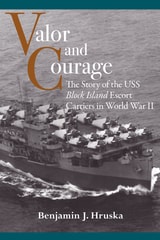
Valor and Courage
The Story of the USS Block Island Escort Carriers in World War IIBenjamin J. Hruska
University of Alabama Press, 2021
Recounts the stories of the USS Block Island CVE 21 and CVE 106 and their crews, many of whom served on both ships in the Atlantic and Pacific theatres
In Valor and Courage: The Story of the USS Block Island Escort Carriers in World War II Benjamin Hruska explores the history and commemoration of the USS Block Island—or, more properly, the Block Islands, as two escort carriers bore that name during WWII. The first, CVE 21, bears the distinction of having been the only American aircraft carrier sunk in the Atlantic Theatre after being torpedoed by a German U-boat off the coast of North Africa.
Of the CVE 21’s 957 crew members, six sailors were killed and eighteen injured in the strike, and four of the Block Island’s fighter pilots were lost later in the day searching for a safe place to land their planes. When the CVE 106 was commissioned to replace its predecessor, Captain Massie Hughes successfully persuaded the Navy to keep the CVE 21’s crew together in manning the new ship. After resurrection as the CVE 106, the Block Island was assigned to the Pacific theater where it fought until the end of the war. The saga of these two ships and the crew that navigated two very different theaters of war offers a unique lens on naval strategy and engineering as it evolved during WWII, especially as pertains to the escort carrier class—generally underappreciated both in naval studies and in public memory.
Using archival materials, dozens of oral histories, primary sources, and official records, Hruska traces the life of the Block Island from the CVE 21’s construction through its missions in the Atlantic, its work as an antisubmarine hunter, its destruction, and the lasting impact of those experiences on its crew. Hruska’s study juxtaposes traditional military history with an examination of the acts of remembrance and commemoration by veterans who served on the escort carriers, how those practices evolved over time, and how the meanings of personal wartime experiences and memories gradually shifted throughout that process.
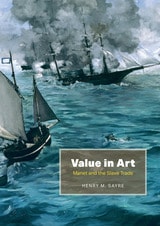
Value in Art
Manet and the Slave TradeHenry M. Sayre
University of Chicago Press, 2022
How did art critics come to speak of light and dark as, respectively, “high in value” and “low in value”? Henry M. Sayre traces the origin of this usage to one of art history’s most famous and racially charged paintings, Édouard Manet’s Olympia.
Art critics once described light and dark in painting in terms of musical metaphor—higher and lower tones, notes, and scales. Sayre shows that it was Émile Zola who introduced the new “law of values” in an 1867 essay on Manet. Unpacking the intricate contexts of Zola’s essay and of several related paintings by Manet, Sayre argues that Zola’s usage of value was intentionally double coded—an economic metaphor for the political economy of slavery. In Manet’s painting, Olympia and her maid represent objects of exchange, a commentary on the French Empire’s complicity in the ongoing slave trade in the Americas.
Expertly researched and argued, this bold study reveals the extraordinary weight of history and politics that Manet’s painting bears. Locating the presence of slavery at modernism’s roots, Value in Art is a surprising and necessary intervention in our understanding of art history.
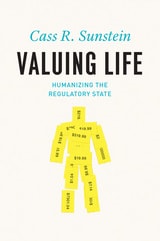
Valuing Life
Humanizing the Regulatory StateCass R. Sunstein
University of Chicago Press, 2014
As OIRA Administrator, Sunstein helped oversee regulation in a broad variety of areas, including highway safety, health care, homeland security, immigration, energy, environmental protection, and education. This background allows him to describe OIRA and how it works—and how it can work better—from an on-the-ground perspective. Using real-world examples, many of them drawn from today’s headlines, Sunstein makes a compelling case for improving cost-benefit analysis, a longtime cornerstone of regulatory decision-making, and for taking account of variables that are hard to quantify, such as dignity and personal privacy. He also shows how regulatory decisions about health, safety, and life itself can benefit from taking into account behavioral and psychological research, including new findings about what scares us, and what does not. By better accounting for people’s fallibility, Sunstein argues, we can create regulation that is simultaneously more human and more likely to achieve its goals.
In this highly readable synthesis of insights from law, policy, economics, and psychology, Sunstein breaks down the intricacies of the regulatory system and offers a new way of thinking about regulation that incorporates human dignity– and an insistent focus on the consequences of our choices.
Van Dorn
The Life and Times of a Confederate GeneralRobert G. Hartje
Vanderbilt University Press, 1967
When it came to large-scale military initiatives, however, Van Dorn was remarkable for his failures. His tactical blunders at the battles of Pea Ridge, Arkansas, and Corinth, Mississippi, contributed greatly to the end of the Confederate military advantage in the Civil War.
The intrigue and scandals that figured in his personal life, even at the height of the War, led directly to his murder and the mystery that still surrounds it. Van Dorn’s dishonorable death concludes Hartje’s fascinating account of a checkered career and the role Earl Van Dorn played in the great tragedy of the Civil War.
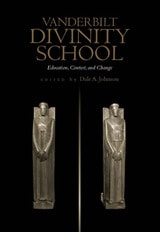
Vanderbilt Divinity School
Education, Contest and ChangeDale A. Johnson
Vanderbilt University Press, 2002
Engagement with southern culture, present from the beginnings of the university but taking on special significance in the mid-twentieth century around the issue of race;
The transition from an institution of the church (Methodist) to an independent and interdenominational school with a liberal Protestant orientation;
The development of the modern research university, evident in the establishment of a graduate program in religion in addition to its program for the profession of ministry;
From the 1950s, a growing concern with diversity and inclusivity, in keeping with national and international issues and developments both religious and cultural, which has broadened the school's sense of ecumenism and deepened its commitments to social justice.
Conflict has played an important part in shaping the history of the Vanderbilt Divinity School, from struggles over initial visions to questions of financial support and institutional control, from local debates over academic freedom to national issues of social justice. Especially noteworthy are the transformations the school has undergone since 1960: the "James Lawson affair," where the divinity school faculty resigned over the expulsion of an African American graduate student who was organizing local lunch counter sit-ins; the impact of social change on the school since the late 1960s; and the contributions of women and African Americans, including their appointment to the faculty.

Vanguard
A Queer History of Mutual AidJoseph Plaster
Duke University Press, 2027
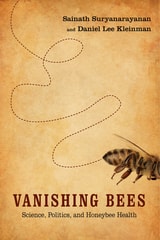
Vanishing Bees
Science, Politics, and Honeybee HealthSuryanarayanan, Sainath
Rutgers University Press, 2016
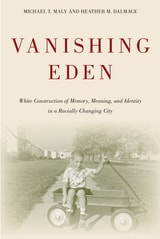
Vanishing Eden
White Construction of Memory, Meaning, and Identity in a Racially Changing CityMichael Maly
Temple University Press, 2015
For many whites, desegregation initially felt like an attack on their community. But how has the process of racial change affected whites’ understanding of community and race? In Vanishing Eden, Michael Maly and Heather Dalmage provide an intriguing analysis of the experiences and memories of whites who lived in Chicago neighborhoods experiencing racial change during the 1950s through the 1980s. They pay particular attention to examining how young people made sense of what was occurring, and how this experience impacted their lives.
Using a blend of urban studies and whiteness studies, the authors examine how racial solidarity and whiteness were created and maintained—often in subtle and unreflective ways. Vanishing Eden also considers how race is central to the ways social institutions such as housing, education, and employment function. Surveying the shifting social, economic, and racial contexts, the authors explore how race and class at local and national levels shaped the organizing strategies of those whites who chose to stay as racial borders began to change.
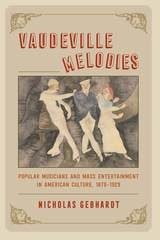
Vaudeville Melodies
Popular Musicians and Mass Entertainment in American Culture, 1870-1929Nicholas Gebhardt
University of Chicago Press, 2017
In Vaudeville Melodies, Nicholas Gebhardt introduces us to the performers, managers, and audiences who turned disjointed variety show acts into a phenomenally successful business. First introduced in the late nineteenth century, by 1915 vaudeville was being performed across the globe, incorporating thousands of performers from every branch of show business. Its astronomical success relied on a huge network of theatres, each part of a circuit and administered from centralized booking offices. Gebhardt shows us how vaudeville transformed relationships among performers, managers, and audiences, and argues that these changes affected popular music culture in ways we are still seeing today. Drawing on firsthand accounts, Gebhardt explores the practices by which vaudeville performers came to understand what it meant to entertain an audience, the conditions in which they worked, the institutions they relied upon, and the values they imagined were essential to their success.
Veeck As In Wreck
The Autobiography of Bill VeeckBill Veeck with Ed Linn
University of Chicago Press, 2001
Vegas Strong
Bearing Witness 1 October 2017Roberta Sterman Sabbath
University of Nevada Press, 2023
Mass shootings have been on the rise in the United States since the early 2000s, but until the heartbreak of the 1 October 2017 Route 91 Harvest Music Festival, the citizens of Las Vegas had never experienced the violence and tragedy of this now all-too-frequent occurrence. That day, fifty-eight people were shot to death on site, while another two victims later died of their injuries. The 1 October incident physically wounded nearly 900 concert-goers, but psychologically impacted countless untold victims.
As individual and institutional response to urgent requests for help came in both during and after the 1 October catastrophe, those who call Las Vegas home struggled to cope with pain and grief. Now, editor Roberta Sabbath draws together a collection of personal essays, oral histories, interviews, scholarly writings, and commentaries to remember those whose lives were lost, and to honor survivors and their loved ones. Written five years after the tragedy, each contribution offers a unique story of healing, demonstrating the wide-ranging experiences and repercussions of the event. The essays in this collection represent a broad diversity of voices from political leaders, health professionals, first responders, community members, and incident survivors. This work is dedicated to those who lost their lives on 1 October 2017, to survivors and their loved ones, and to the caregivers—both individual and institutional—all of whom continue to keep Vegas Strong.
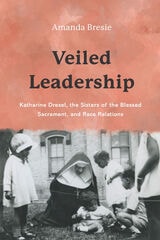
Veiled Leadership
Katharine Drexel, The Sisters of the Blessed Sacrament, and Race RelationsAmanda Bresie
Catholic University of America Press, 2023
Venice
A Contested Bohemia in Los AngelesAndrew Deener
University of Chicago Press, 2012
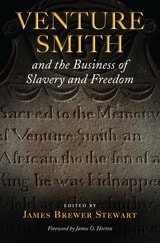
Venture Smith and the Business of Slavery and Freedom
James Brewer Stewart
University of Massachusetts Press, 2010
But what began as a scientific inquiry into African origins rapidly evolved into an unparalleled interdisciplinary collaboration between historians, literary analysts, geographers, genealogists, anthropologists, political philosophers, genomic biologists, and, perhaps most revealingly, a poet. Their common goal has been to reconstruct the life of an extraordinary African American and to assay its implications for the sprawling, troubled eighteenth-century world of racial exploitation over which he triumphed. This volume displays the rich results of that collaboration.
A highly intelligent, deeply self-motivated and immensely energetic slave transported from Africa, Venture Smith transformed himself through unstinting labor into a respectable Connecticut citizen, a successful entrepreneur, and the liberator of other enslaved African Americans. As James O. Horton emphasizes in his foreword to this volume, "Venture Smith's saga is a gift to all who seek to understand the complex racial beginnings of America. It helps to connect the broad American story with the stories of many Americans whose lives illustrate the national struggle to live out the national ideals."
In addition to Horton and volume editor James Brewer Stewart, contributors include Cameron Blevins, Vincent Carretta, Anna Mae Duane, Robert P. Forbes, Anne L. Hiskes, Paul Lovejoy, Marilyn Nelson, David Richardson, Chandler B. Saint, Linda Strausbaugh, Kevin Tulimieri, and John Wood Sweet.
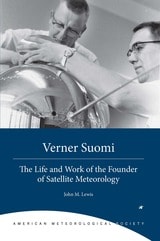
Verner Suomi
The Life and Work of the Founder of Satellite MeteorologyJohn M. Lewis et al.
American Meteorological Society, 2018
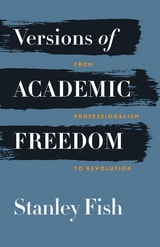
Versions of Academic Freedom
From Professionalism to RevolutionStanley Fish
University of Chicago Press, 2014
Depending on who’s talking, academic freedom is an essential bulwark of democracy, an absurd fig leaf disguising liberal agendas, or, most often, some in-between muddle that both exaggerates its own importance and misunderstands its actual value to scholarship. Fish enters the fray with his typical clear-eyed, no-nonsense analysis. The crucial question, he says, is located in the phrase “academic freedom” itself: Do you emphasize “academic” or “freedom”? The former, he shows, suggests a limited, professional freedom, while the conception of freedom implied by the latter could expand almost infinitely. Guided by that distinction, Fish analyzes various arguments for the value of academic freedom: Is academic freedom a contribution to society's common good? Does it authorize professors to critique the status quo, both inside and outside the university? Does it license and even require the overturning of all received ideas and policies? Is it an engine of revolution? Are academics inherently different from other professionals? Or is academia just a job, and academic freedom merely a tool for doing that job?
No reader of Fish will be surprised by the deftness with which he dismantles weak arguments, corrects misconceptions, and clarifies muddy arguments. And while his conclusion—that academic freedom is simply a tool, an essential one, for doing a job—may surprise, it is unquestionably bracing. Stripping away the mystifications that obscure academic freedom allows its beneficiaries to concentrate on what they should be doing: following their intellectual interests and furthering scholarship.
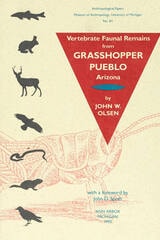
Vertebrate Faunal Remains from Grasshopper Pueblo, Arizona
John W. Olsen with a foreword by John D. Speth
University of Michigan Press, 1990
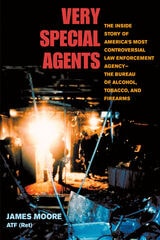
Very Special Agents
The Inside Story of America's Most Controversial Law Enforcement Agency--The Bureau of Alcohol, Tobacco, and FirearmsJames Moore, ATF (Ret.)
University of Illinois Press, 1997
Moore's personal, from-the-hip history spans the long-running war against dons and drug dealers and covers agents' daring infiltration of the Ku Klux Klan, Hell's Angels, and other violent groups. He reveals the cutting-edge forensics work that helped crack the World Trade Center and Oklahoma City bombings and also provides an insider account of the raid on the Branch Davidians at Waco. Finally, Moore discusses the ATF's rivalry with the FBI and the political power games that impede the government's ability to fight crime.

Very Special Episodes
Televising Industrial and Social ChangeJonathan Cohn
Rutgers University Press, 2021
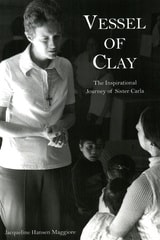
Vessel of Clay
The Inspirational Journey of Sister CarlaJacqueline Hansen Maggiore
University of Scranton Press, 2010
Jacqueline Hansen Maggiore presents in this volume the biography of her lifelong friend Carol Piette, known throughout Chile and El Salvador as Sister Carla. Drawing from the memories of those who knew her and excerpts from her letters and diaries, Vessel of Clay chronicles Sister Carla’s extraordinary life, highlighting her dedication to the poor of Latin America but also revealing her struggles with self-doubt and emotional frailty. Vessel of Clay will appeal to both lay and religious readers interested in peace and social justice, spiritual formation and development, women’s issues, liberation theology, and mission service.
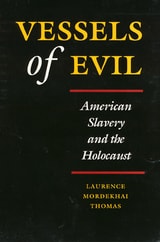
Vessels of Evil
American Slavery and the HolocaustLaurence Mordekhai Thomas
Temple University Press, 1993
Two profound atrocities in the history of Western culture form the subject of this moving philosophical exploration: American Slavery and the Holocaust. An African American and a Jew, Laurence Mordekhai Thomas denounces efforts to place the suffering of one group above the other. Rather, he pronounces these two defining historical experiences as profoundly evil in radically different ways and points to their logically incompatible aims.
The author begins with a discussion of the nature of evil, exploring the fragility of human beings and the phenomena of compartmentalizing, unquestioning obedience to authority, and moral drift. Citing compelling examples from history and contemporary life, he characterizes evil acts in terms of moral agency, magnitude, and intent.
With moving testimony, Thomas depicts the moral pain of African Americans and Jews during their ordeals and describes how their past as victims has affected their future. Without invidious comparison, he distinguishes between extermination and domination, death and natal alienation, physical and mental cruelty, and between being viewed as irredeemable evil and as a moral simpleton. Thomas also considers the role of blacks and Jews in the Christian narrative.
In Vessels of Evil, Thomas also considers the ways Jews and blacks have gone on to survive. He analyzes the relative flourishing of Jews and the languishing of blacks in this country and examines the implications of their dissimilar tragedies on any future relationship between these two minorities.
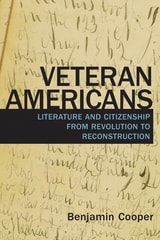
Veteran Americans
Literature and Citizenship from Revolution to ReconstructionBenjamin Cooper
University of Massachusetts Press, 2018
“I may dare to speak, and I intend to speak and write what I think,” wrote a New York volunteer serving in the Mexican War in 1848. Such sentiments of resistance and confrontation run throughout the literature produced by veteran Americans in the nineteenth century—from prisoner-of-war narratives and memoirs to periodicals, adventure pamphlets, and novels. Military men and women were active participants in early American print culture, yet they struggled against civilian prejudice about their character, against shifting collective memories that removed military experience from the nation's self-definition, and against a variety of headwinds in the uneven development of antebellum print culture.
In this new literary history of early American veterans, Benjamin Cooper reveals how soldiers and sailors from the Revolutionary War through the Civil War demanded, through their writing, that their value as American citizens and authors be recognized. Relying on an archive of largely understudied veteran authors, Cooper situates their perspective against a civilian monopoly in defining American citizenship and literature that endures to this day.
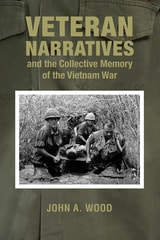
Veteran Narratives and the Collective Memory of the Vietnam War
John A. Wood
Ohio University Press, 2016
In the decades since the Vietnam War, veteran memoirs have influenced Americans’ understanding of the conflict. Yet few historians or literary scholars have scrutinized how the genre has shaped the nation’s collective memory of the war and its aftermath. Instead, veterans’ accounts are mined for colorful quotes and then dropped from public discourse; are accepted as factual sources with little attention to how memory, no matter how authentic, can diverge from events; or are not contextualized in terms of the race, gender, or class of the narrators.
Veteran Narratives and the Collective Memory of the Vietnam War is a landmark study of the cultural heritage of the war in Vietnam as presented through the experience of its American participants. Crossing disciplinary borders in ways rarely attempted by historians, John A. Wood unearths truths embedded in the memoirists’ treatments of combat, the Vietnamese people, race relations in the United States military, male-female relationships in the war zone, and veterans’ postwar troubles. He also examines the publishing industry’s influence on collective memory, discussing, for example, the tendency of publishers and reviewers to privilege memoirs critical of the war. Veteran Narratives is a significant and original addition to the literature on Vietnam veterans and the conflict as a whole.

Vibrator Nation
How Feminist Sex-Toy Stores Changed the Business of PleasureLynn Comella
Duke University Press, 2017
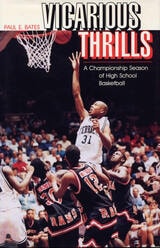
Vicarious Thrills
A Championship Season of High School BasketballPaul E. Bates
Southern Illinois University Press, 1995
This engaging book chronicles the Carbondale Terriers’ 1993–94 season, a season in which the team progressed all the way to the state high school basketball championship game before ending the season with a one-point loss.
Although arranged chronologically, the book is much more than a team diary. Paul E. Bates, whose son was one of the team’s starting guards, brings his sensitivity and expertise as an educational psychologist to bear on team sports in general and on how they define and are defined by the players and coaches that make up the teams and by the communities in which they thrive.
Bates frames the team’s experience by sharing his own personal love of basketball, beginning with his childhood years in Decatur, Illinois, when Stephen Decatur High School was a perennial Illinois high school powerhouse. Through his exploration of the sport and his involvement and interest in it, Bates creates a book that serves both as a rousing tale of youthful achievement and as a history of high school basketball in the state of Illinois.
Throughout his account, Bates repeatedly emphasizes his belief that extraordinary accomplishment is no accident but rather the result of years of preparation, dedication, and hard work. Most of the key performers on the 1993–94 Terriers, for example, had played together on a grade school all-star team that was undefeated. Then, in junior high, this group went on to win numerous championships, and in high school their remarkable success continued, even though their accomplishments were humbled by season-ending losses.
But Vicarious Thrills leads the reader through a very personal account of both the ups and downs of championship basketball. Triumph does not occur without defeat, and it is through defeat that the team members, as well as their families and other supporters, learn many important lessons. As significant as the individual and team accomplishments are in making up this story, the 1993–94 basketball season is more importantly a beginning rather than the defining moment in the lives of these young men.
As an inspiration and motivation to young people, and as a spark to memories of childhood aspirations for older readers, this book is a pleasure to read for individuals of all ages.
Vice Patrol
Cops, Courts, and the Struggle over Urban Gay Life before StonewallAnna Lvovsky
University of Chicago Press, 2021
In Vice Patrol, Anna Lvovsky chronicles this painful story, tracing the tactics used to criminalize, profile, and suppress gay life from the 1930s through the 1960s, and the surprising controversies those tactics often inspired in court. Lvovsky shows that the vice squads’ campaigns stood at the center of live debates about not only the law’s treatment of queer people, but also the limits of ethical policing, the authority of experts, and the nature of sexual difference itself—debates that had often unexpected effects on the gay community’s rights and freedoms. Examining those battles, Vice Patrol enriches understandings of the regulation of queer life in the twentieth century and disputes about police power that continue today.

Vice Patrol
Cops, Courts, and the Struggle over Urban Gay Life before StonewallAnna Lvovsky
University of Chicago Press, 2021
In the mid-twentieth century, gay life flourished in American cities even as the state repression of queer communities reached its peak. Liquor investigators infiltrated and shut down gay-friendly bars. Plainclothes decoys enticed men in parks and clubs. Vice officers surveilled public bathrooms through peepholes and two-way mirrors.
In Vice Patrol, Anna Lvovsky chronicles this painful story, tracing the tactics used to criminalize, profile, and suppress gay life from the 1930s through the 1960s, and the surprising controversies those tactics often inspired in court. Lvovsky shows that the vice squads’ campaigns stood at the center of live debates about not only the law’s treatment of queer people, but also the limits of ethical policing, the authority of experts, and the nature of sexual difference itself—debates that had often unexpected effects on the gay community’s rights and freedoms. Examining those battles, Vice Patrol enriches understandings of the regulation of queer life in the twentieth century and disputes about police power that continue today.
Vicente Ximenes, LBJ's Great Society, and Mexican American Civil Rights Rhetoric
Michelle Hall Kells, with a foreword by Juan C. Guerra
Southern Illinois University Press, 2018
Kells draws on Ximenes’s extensive archive of speeches, reports, articles, and oral interviews to present the activist’s rhetorical history. After a discussion of Ximenes’s early life, the author focuses on his career as an activist, examining Ximenes’s leadership in several key civil rights events, including the historic 1967 White House Cabinet Committee Hearings on Mexican American Affairs. Also highlighted is his role in advancing Mexican Americans and Latinos from social marginalization to greater representation in national politics.
This book shows us a remarkable man who dedicated the majority of his life to public service, using rhetoric to mobilize activists for change to secure civil rights advances for his fellow Mexican Americans.

Vicious Infants
Dangerous Childhoods in Antebellum U.S. LiteratureLaura Soderberg
University of Massachusetts Press, 2021
Vicious Infants offers a counterhistory of literary childhood as both perceived social threat and site of resistance, revealing that many children were not only cut off from family and society, they were also preemptively excluded from the rewards of citizenship and adulthood. Turning to prison documents, medical journals, overlooked periodical fiction, and literary works from William Apess, Harriet Wilson, Herman Melville, Susan Paul, and Harriet Beecher Stowe, Laura Soderberg recovers alternate narratives of childhood and provides an important window into the cultural links between race, reproduction, and childhood in the antebellum period.
Vicksburg Besieged
Edited by Steven E. Woodworth and Charles D. Grear
Southern Illinois University Press, 2020
Vicksburg, Mississippi, held strong through a bitter, hard-fought, months-long Civil War campaign, but General Ulysses S. Grant’s forty-day siege ended the stalemate and, on July 4, 1863, destroyed Confederate control of the Mississippi River. In the first anthology to examine the Vicksburg Campaign’s final phase, nine prominent historians and emerging scholars provide in-depth analysis of previously unexamined aspects of the historic siege.
Ranging in scope from military to social history, the contributors’ invitingly written essays examine the role of Grant’s staff, the critical contributions of African American troops to the Union Army of the Tennessee, both sides’ use of sharpshooters and soldiers’ opinions about them, unusual nighttime activities between the Union siege lines and Confederate defensive positions, the use of West Point siege theory and the ingenuity of Midwestern soldiers in mining tunnels under the city’s defenses, the horrific experiences of civilians trapped in Vicksburg, the Louisiana soldier's defense of Jackson amid the strains of piano music, and the effect of the campaign on Confederate soldiers from the Trans-Mississippi region.
The contributors explore how the Confederate Army of Mississippi and residents of Vicksburg faced food and supply shortages as well as constant danger from Union cannons and sharpshooters. Rebel troops under the leadership of General John C. Pemberton sought to stave off the Union soldiers, and though their morale plummeted, the besieged soldiers held their ground until starvation set in. Their surrender meant that Grant’s forces succeeded in splitting in half the Confederate States of America.
Editors Steven E. Woodworth and Charles D. Grear, along with their contributors—Andrew S. Bledsoe, John J. Gaines, Martin J. Hershock, Richard H. Holloway, Justin S. Solonick, Scott L. Stabler, and Jonathan M. Steplyk—give a rare glimpse into the often overlooked operations at the end of the most important campaign of the Civil War.
Victor Arnautoff and the Politics of Art
Robert W. Cherny
University of Illinois Press, 2017
Victorian Domesticity
Families in the Life and Art of Louisa May AlcottCharles Strickland
University of Alabama Press, 1985
The subject of Victorian Domesticity is family life in America. The life and works of Louisa May Alcott served as the vehicle for exploring and analyzing this subject. Although Alcott was deeply influenced by popular currents of sentimentality, her own experience exposed her to the confusions and contradictions generated when sentiment confronted the reality of life in 19th-century America.
In the first chapter Strickland outlines the ways in which sentimentality colored the perception of 19th-century Americans about such issues as courtship, marriage, the relationship between the sexes, generational relationships, and the relationship between the nuclear family and the community outside the family. Chapters two and three trace Alcott’s childhood and adolescent experiences, exploring the tensions that developed between Louisa and her father, and detailing the ways in which she carried the double burden of being both poor and female as she sought her identity as a writer.
The following six chapters treat the varieties of family life that appear in Alcott’s stories, the impact of feminism on her life, and her emphasis on the importance of child nurture. In the final two chapters the author treats the relationships that Alcott perceived between the family and the world around it and assesses the legacy of the Victorian family idea.
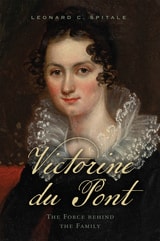
Victorine du Pont
The Force behind the FamilyLeonard C. Spitale
University of Delaware Press, 2023
Victory Deferred
How AIDS Changed Gay Life in AmericaJohn-Manuel Andriote
University of Chicago Press, 1999
John-Manuel Andriote chronicles the impact of the disease from the coming-out revelry of the 1970s to the post-AIDS gay community of the 1990s, showing how it has changed both individual lives and national organizations. He tells the truly remarkable story of how a health crisis pushed a disjointed jumble of local activists to become a nationally visible and politically powerful civil rights movement, a full-fledged minority group challenging the authority of some of the nation's most powerful institutions. Based on hundreds of interviews with those at the forefront of the medical, political, and cultural
responses to the disease, Victory Deferred artfully blends personal narratives with institutional histories and organizational politics to show how AIDS forced gay men from their closets and ghettos into the hallways of power to lobby and into the streets to protest.
Andriote, who has been at the center of national advocacy and AIDS politics in Washington, is judicious without being uncritical, and his account of the political maturation of the gay community is one of the most stirring civil rights stories of our time.
Victory Deferred draws on hundreds of original interviews, including first-hand accounts from: Virginia Apuzzo, Reverend Carl Bean, Marcus Conant, M.D., John D'Emilio, Anthony Fauci, M.D, Fenton Johnson, Larry Kramer, Lawrence D. Mass, M.D., Armistead Maupin, Walt Odets, Torie Osborn, Eric Rofes, Urvashi Vaid, Timothy Westmoreland, and Reggie Williams.
"[Victory Deferred] is a richly textured account of the rise of the AIDS sector, that though detailed and comprehensive, reads quickly. The thematic organization of the book works especially well. The clear chronology of the events reveals how competing models of service delivery, treatment activism and private-public cooperation were subsumed into a national AIDS movement. The book should prove excellent for teaching or recreational reading."—Jose Gabilondo, Washington Post
"[A] fine history of the epidemic. . . . Andriote shines with chapters on less-covered but no less important subjects, including the multibillion-dollar 'AIDS industry' and private fund-raising groups. He brings together in one place many facts and figures heretofore unsynthesized."—Joe R. Neel, Boston Globe
"While many books have explored aspects of the impact of AIDS, Victory Deferred is among the most comprehensive. Andriote's adroit integration of the personal and the historical results is an illustrative, analytical account of the disease and its impact on the gay civil-rights movement. His depiction of the poignant struggles, heroic responses and resultant social and political gains emanating from AIDS is a perceptive document for our time—relevant to all readers, regardless of their sexual orientation."—John R. Killacky, Minneapolis Star Tribune
"[A] well-researched and nuanced portrait of the many lives on which this grave disease has wrought both destruction and transformation."—Publishers Weekly
"Andriote combines broad strokes and telling details in this engaging history of the complicated war against both disease and bigotry."—Library Journal
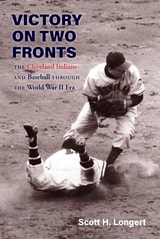
Victory on Two Fronts
The Cleveland Indians and Baseball through the World War II EraScott H. Longert
Ohio University Press, 2022
Victory without Violence
The First Ten Years of the St. Louis Committee of Racial Equality (CORE), 1947-1957Mary Kimbrough & Margaret W. Dagen
University of Missouri Press, 2000
Winner, Missouri Conference on History Book Award, 2001
Victory without Violence is the story of a small, integrated group of St. Louisans who carried out sustained campaigns from 1947 to 1957 that were among the earliest in the nation to end racial segregation in public accommodations. Guided by Gandhian principles of nonviolent direct action, the St. Louis Committee of Racial Equality (CORE) conducted negotiations, demonstrations, and sit-ins to secure full rights for the African American residents of St. Louis.
The book opens with an overview of post-World War II racial injustice in the United States and in St. Louis. After recounting the genesis of St. Louis CORE, the writers vividly relate activities at lunch counters, cafeterias, and restaurants, demonstrating CORE's remarkable success in winning over initially hostile owners, manager, and service employees. A detailed review of its sixteen-month campaign at a major St. Louis department store, Stix, Baer & Fuller, illustrates the groups' patient persistence. Kimbrough and Dagen show after the passage of a public accommodations ordinance in 1961, CORE's goal of equal access was realized throughout the city of St. Louis.
On the scene reports drawn from CORE newsletters (1951-1955) and reminiscences by members appear throughout the text. In a closing chapter, the authors trace the lasting effects of the CORE experience on the lives of its members. Victory without Violence casts light on a previously obscured decade in St. Louis civil rights history.
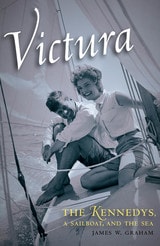
Victura
The Kennedys, a Sailboat, and the SeaJames W. Graham
University Press of New England, 2015
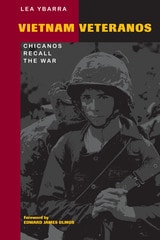
Vietnam Veteranos
Chicanos Recall the WarBy Lea Ybarra
University of Texas Press, 2004
One of the most decorated groups that served in the Vietnam War, Chicanos fought and died in numbers well out of proportion to their percentage of the United States' population. Yet despite this, their wartime experiences have never received much attention in either popular media or scholarly studies. To spotlight and preserve some of their stories, this book presents substantial interviews with Chicano Vietnam veterans and their families that explore the men's experiences in combat, the war's effects on the Chicano community, and the veterans' postwar lives.
Lea Ybarra groups the interviews topically to bring out different aspects of the Chicano vets' experiences. In addition to discussing their involvement in and views on the Vietnam War, the veterans also reflect on their place in American society, American foreign policy, and the value of war. Veterans from several states and different socioeconomic classes give the book a broad-based perspective, which Ybarra frames with sociological material on the war and its impact on Chicanos.

Vietnam Zippos
American Soldiers' Engravings and Stories (1965-1973)Edited by Sherry Buchanan
University of Chicago Press, 2007
—from an engraving on a Vietnam-era Zippo lighter
In 1965, journalist Morley Safer followed the United States Marines on a search and destroy mission into Cam Ne. When the Marines he accompanied reached the village, they ordered the civilians there to evacuate their homes—grass huts whose thatched roofs they set ablaze with Zippo lighters. Safer’s report on the event soon aired on CBS and was among the first to paint a harrowing portrait of the War in Vietnam. LBJ responded to the segment furiously, accusing Safer of having “shat on the American flag.” For the first time since World War II, American boys in uniform had been portrayed as murderers instead of liberators. Our perception of the war—and the Zippo lighter—would never be the same.
But as this stunning book attests, the Zippo was far more than an instrument of death and destruction. For the American soldiers who wielded them, they were a vital form of social protest as well. Vietnam Zippos showcases the engravings made by U.S. soldiers on their lighters during the height of the conflict, from 1965 to 1973. In a real-life version of the psychedelic war portrayed in Francis Ford Coppola’s Apocalypse Now, Sherry Buchanan tells the fascinating story of how the humble Zippo became a talisman and companion for American GIs during their tours of duty. Through a dazzling array of images, we see how Zippo lighters were used during the war, and we discover how they served as a canvas for both personal and political expression during the Age of Aquarius, engraved with etchings of peace signs and marijuana leaves and slogans steeped in all the rock lyrics, sound bites, combat slang, and antiwar mottos of the time.
Death from Above. Napalm Sticks to Kids. I Love You Mom, From a Lonely Paratrooper. The engravings gathered in this copiously illustrated volume are at once searing, caustic, and moving, running the full emotional spectrum with both sardonic reflections—I Love the Fucking Army and the Army Loves Fucking Me—and poignant maxims—When the Power of Love Overcomes the Love of Power, the World Will Know Peace. Part pop art and part military artifact, they collectively capture the large moods of the sixties and the darkest days of Vietnam—all through the world of the tiny Zippo.
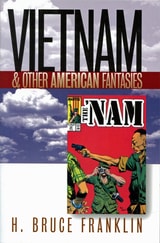
Vietnam and Other American Fantasies
H. Bruce Franklin
University of Massachusetts Press, 2000
There is now fairly widespread acknowledgment that the Vietnam War shattered many of the traditional narratives central to formerly prevailing vision of the United States and its history. Some people regret this and seek to restore old narratives that they consider essential to a unifying national identity, but their mighty efforts are unlikely to put Humpty Dumpty together again. Others see this shattering as a liberation from dangerous illusions, a wake-up call that forced millions of Americans toward more truthful and beneficial narratives about American history and culture. There is a third view, one that has gained considerable influence in intellectual circles, that sees any “master narrative” or “meta-narrative”—or, for that matter, any coherently structured narrative—as a socially constructed fantasy that radically falsifies the fragmentary, conflicted, and de-centered character of social experience. Although in this book the author does not engage in overt arguments about narrative theory, he does operate from a theoretical position that highly values narratives, especially coherently structures narratives—including some forms of fantasy—as crucial to comprehending, within our human limits, human reality.
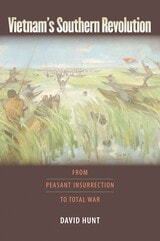
Vietnam's Southern Revolution
From Peasant Insurrection to Total WarDavid Hunt
University of Massachusetts Press, 2009
In Vietnam, the American government vowed to win the “hearts and minds” of the people. On the other side, among those who led and sympathized with the insurgents, the term “people's war” gained a wide currency. Yet while much has been written about those who professed to speak for the Vietnamese population, we know surprisingly little about the everyday life of the peasants who made up the bulk of the country's inhabitants. This book illuminates that subject. Drawing on a wide range of sources, including interviews conducted by the Rand Corporation with informants from My Tho Province in the Mekong Delta, David Hunt brings to light the daily experience of villagers in the midst of war and revolution.
The peasants of southern Vietnam were neither onlookers nor mere victims as fighting raged throughout their country. From the “concerted uprising” in 1959–1960 to the Tet Offensive of 1968, the revolutionary movement they created was in fact the driving force within the war. Known as the “Viet Cong” to their adversaries, the rebels called themselves the “Liberation Front.” They demanded an end to landlordism and an egalitarian distribution of the means of subsistence as well as a democratization of relations between town and countryside, parents and children, men and women. They hoped the Vietnamese people would achieve a fuller sense of their place in the world and of the power they possessed to fashion their own destinies, without reliance on supernatural forces.In the first half of the book, Hunt analyzes this cultural revolution. As fighting spread and became more destructive, especially after the U.S. escalation in 1965, villagers were driven from their homes, the rural infrastructure collapsed, and customary notions of space and time lost purchase on an increasingly chaotic world. In the second half of the book, Hunt shows how peasants, who earlier had aspired to a kind of revolutionary modernism, now found themselves struggling to survive and to cope with the American intruders who poured into My Tho, and how they managed to regroup and spearhead the Tet Offensive that irrevocably altered the course of the war.
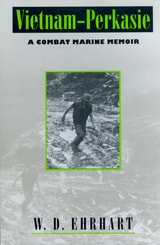
Vietnam-Perkasie
W. D. Ehrhart
University of Massachusetts Press, 1995
In 1982, John Newman, curator of the Vietnam War Literature Collection at Colorado State University, said of W.D. Ehrhart: “As a poet and editor, Bill Ehrhart is clearly one of the major figures in Vietnam War literature.” This autobiographical account of the war, the author's first extended prose work, demonstrates Ehrhart's abilities as a writer of prose as well. Vietnam–Perkasie is grim, comical, disturbing, and accurate. The presentation is novelistic—truly, a “page-turner”—but the events are all real, the atmosphere intensely evocative.
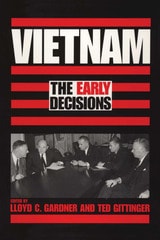
Vietnam
The Early DecisionsEdited by Lloyd C. Gardner and Ted Gittinger
University of Texas Press, 1997
Haunting questions remain about our involvement in Vietnam. Perhaps the most persistent of these is whether President Kennedy would have ended American involvement in Vietnam if he had lived.
For many Americans, Oliver Stone's film JFK left no doubt that before his assassination Kennedy had determined to quit Vietnam. Yet the historical record offers a more complex answer. In this fresh look at the archival evidence, noted scholars take up the challenge to provide us with their conclusions about the early decisions that put the United States on the path to the greatest American tragedy since the Civil War. The tensions and turmoil that accompanied those decisions reveal the American presidency at the center of a storm of conflicting advice.
The book is divided into four sections. Parts one and two delve into the political and military contexts of the early decisions. Part three raises the intriguing questions of Kennedy's and Johnson's roles in the conflict, particularly the thorny issue of whether Kennedy did, in fact, intend to withdraw from Vietnam and whether Johnson reversed that policy. Part four reveals an uncanny parallel between early Soviet policy toward Hanoi and U.S. policy toward Saigon.