Results by title
246 books match the query 'Violence in Society' and 13 start with v
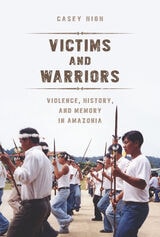
Victims and Warriors
Violence, History, and Memory in AmazoniaCasey High
University of Illinois Press, 2015
Victims and Warriors examines contemporary violence in the context of political and economic processes that transcend local events. Casey High explores how popular imagery of Amazonian violence has become part of Waorani social memory in oral histories, folklore performances, and indigenous political activism. As Amazonian forms of social memory merge with constructions of masculinity and other intercultural processes, the Waorani absorb missionaries, oil development, and logging depredations into their legacy of revenge killings and narratives of victimhood. High shows that these memories of past violence form sites of negotiation and cultural innovation, and thus violence comes to constitute a central part of Amazonian sociality, identity, and memory.
Violence against Queer People
Race, Class, Gender, and the Persistence of Anti-LGBT DiscriminationMeyer, Doug
Rutgers University Press, 2015
Selected as one of “The Best of the Best from the University Presses: Books You Should Know About” at the 2016 ALA Annual Conference
Violence against lesbians and gay men has increasingly captured media and scholarly attention. But these reports tend to focus on one segment of the LGBT community—white, middle class men—and largely ignore that part of the community that arguably suffers a larger share of the violence—racial minorities, the poor, and women. In Violence against Queer People, sociologist Doug Meyer offers the first investigation of anti-queer violence that focuses on the role played by race, class, and gender.
Drawing on interviews with forty-seven victims of violence, Meyer shows that LGBT people encounter significantly different forms of violence—and perceive that violence quite differently—based on their race, class, and gender. His research highlights the extent to which other forms of discrimination—including racism and sexism—shape LGBT people’s experience of abuse. He reports, for instance, that lesbian and transgender women often described violent incidents in which a sexual or a misogynistic component was introduced, and that LGBT people of color sometimes weren’t sure if anti-queer violence was based solely on their sexuality or whether racism or sexism had also played a role. Meyer observes that given the many differences in how anti-queer violence is experienced, the present media focus on white, middle-class victims greatly oversimplifies and distorts the nature of anti-queer violence. In fact, attempts to reduce anti-queer violence that ignore race, class, and gender run the risk of helping only the most privileged gay subjects.
Many feel that the struggle for gay rights has largely been accomplished and the tide of history has swung in favor of LGBT equality. Violence against Queer People, on the contrary, argues that the lives of many LGBT people—particularly the most vulnerable—have improved very little, if at all, over the past thirty years.
Violence and Indigenous Communities
Confronting the Past and Engaging the PresentEdited by Susan Sleeper-Smith, Jeffrey Ostler, and Joshua L. Reid
Northwestern University Press, 2021
In contrast to past studies that focus narrowly on war and massacre, treat Native peoples as victims, and consign violence safely to the past, this interdisciplinary collection of essays opens up important new perspectives. While recognizing the long history of genocidal violence against Indigenous peoples, the contributors emphasize the agency of individuals and communities in genocide’s aftermath and provide historical and contemporary examples of activism, resistance, identity formation, historical memory, resilience, and healing. The collection also expands the scope of violence by examining the eyewitness testimony of women and children who survived violence, the role of Indigenous self-determination and governance in inciting violence against women, and settler colonialism’s promotion of cultural erasure and environmental destruction.
By including contributions on Indigenous peoples in the United States, Canada, the Pacific, Greenland, Sápmi, and Latin America, the volume breaks down nation-state and European imperial boundaries to show the value of global Indigenous frameworks. Connecting the past to the present, this book confronts violence as an ongoing problem and identifies projects that mitigate and push back against it.
Violence and Peace
From the Atomic Bomb to Ethnic CleansingPierre Hassner
Central European University Press, 1997

Violence and Redemption, Volume 15
Candace Vogler and Patchen Markell
Duke University Press, 0
The essays examine topics such as the socioeconomic crisis in Mexico in the 1980s; continuities between plantation slavery, colonization, and the emergence of independent states as war machines in Africa; the culture of a Palestinian suicide bomber; the architecture of mass rioting and rape in Indonesia; the experience of unredeemed suffering in Herman Melville’s “Shiloh;” and the aggression of Aborigines in Australia.
Contributors. Tim Blackmore, John Borneman, Gillian Cowlishaw, Richard Falk, Ken Graves, Ghassan Hage, Abidin Kusno, Eva Lipman, Claudio Lomnitz, Patchen Markell, Achille Mbembe, Laura Nader, Steven Sampson, Nancy Scheper-Hughes, Candace Vogler, Michael Warner, Margaret Werry, Richard Ashby Wilson
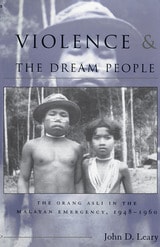
Violence and the Dream People
The Orang Asli in the Malayan Emergency, 1948-1960John D. Leary
Ohio University Press, 1995
Violence and the Dream People is an account of a little-known struggle by the Malayan government and the communist guerrillas, during the 1948-1960 Malayan Emergency, to win the allegiance of the Orang Asli, the indigenous people of the peninsular Malaya. The author argues that the use of force by both sides in their attempts to woo or coerce the jungle dwellers to support one side or the other in the conflict, caused tensions among the Orang Asli that resulted in counter violence against the interlopers and internecine killings in the tribal groups.
This study challenges the depiction of the Orang Asli as naïve innocents, unwittingly manipulated by outsiders for their own purposes. Heavily outnumbered, they looked to their own resources to survive, in the face of relocation, conscription, random bombings, and haphazard killing. Leary argues that they were shrewd enough to recognize the winning side and backed their judgment with force where necessary.
Violence and the Dream People is an important study of a much neglected facet of the Malayan Emergency and of the history of the indigenous peoples of the Malay Peninsula.
Violence in Rural South Africa, 1880–1963
Sean Redding
University of Wisconsin Press, 2023
Many violent acts attempted to reestablish and reinforce a moral, social, and political order among Africans. However, what constituted a moral order changed as white governance became more intrusive, land became scarcer, and people reconstructed their notions of “traditional” culture. State policies became obstacles around which Africans had to navigate by invoking the idea of tradition, using the state’s court system, alleging the use of witchcraft, or engaging in violent threats and acts. Redding’s use of multiple court cases and documents to discuss several types of violence provides a richer context for the scholarly conversation about the legitimation of violence in traditions, family life, and political protest.

Violence in the Work of Composition
Recognizing, Intervening, Amelioratingedited by Scott Gage and Kristie S. Fleckenstein
Utah State University Press, 2022
This book provides a focused, nuanced, and systematic discussion of violence and its presence and influence across pedagogical and administrative sites. Violence in the Work of Composition offers a close look at the nature of violence as it emerges in the work of composition; provides strategies for identifying violence, especially covert violence, addressing its impact and preventing its eruption across many sites; and invites readers to reflect on both the presence of violence and the hope for its cessation. Contributors consider, first, how compositionists can recognize the ways their work inadvertently enacts and/or perpetuates violence and, second, how they can intervene and mitigate that violence.
Rich with the voices of myriad stakeholders, Violence in the Work of Composition initiates an essential conversation about violence and literacy education at a time when violence in its many forms continues to shape our culture, communities, and educational systems.
Contributors: Kerry Banazek, Katherine Bridgman, Eric Camarillo, Elizabeth Chilbert Powers, Joshua Daniel, Lisa Dooley, Allison Hargreaves, Jamila Kareem, Lynn C. Lewis, Trevor Meyer, Cathryn Molloy, Kellie Sharp-Hoskins, Ellen Skirvin, Krista Speicher Sarraf, Thomas Sura, James Zimmerman

Violence, the Body, and the South, Volume 73
Houston A. Baker Jr. and Dana D. Nelson, eds.
Duke University Press, 0
This collection represents first-rate examples of gender, critical race, genre, and material culture studies. Topics ranging from epistemological and authorial rebellions marking Frederick Douglass’s Narrative and Charles Chesnutt’s The Marrow of Tradition to the twentieth-century labors of writers, such as Francisco Goldman and Helena María Viramontes, who work to make visible the complexities of “North” and “South” with respect to subordinated Latino/a bodies. William Faulkner is revisited in an essay on the internalization of “race” in Light in August. Guess Who’s Coming to Dinner and In the Heat of the Night are analyzed in a framework of homopolitical desire. Genre and regional studies combine in an energetic essay resituating Harriet Jacobs’s Incidents in the Life of a Slave Girl with respect to “Northern” fiction.
Contributors. Houston A. Baker Jr., Jeannine DeLombard, Laura Doyle, Jennifer Rae Greeson, Andrea Levine, Dana D. Nelson, Ana Patricia Rodríguez, Bryan Wagner
Violence
Analysis, Intervention, and PreventionSean Byrne
Ohio University Press, 2012
In a world desperate to comprehend and address what appears to be an ever-enlarging explosion of violence, this book provides important insights into crucial contemporary issues, with violence providing the lens. Violence: Analysis, Intervention, and Prevention provides a multidisciplinary approachto the analysis and resolution of violent conflicts. In particular, the book discusses ecologies of violence, and micro-macro linkages at the local, national, and international levels as well as intervention and prevention processes critical to constructive conflict transformation.
The causes of violence are complex and demand a deep multidimensional analysis if we are to fully understand its driving forces. Yet in the aftermath of such destruction there is hope in the resiliency, knowledge, and creativity of communities, organizations, leaders, and international agencies to transform the conditions that lead to such violence.

Violence
Analysis, Intervention, and PreventionSean Byrne
Ohio University Press, 0
In a world desperate to comprehend and address what appears to be an ever-enlarging explosion of violence, this book provides important insights into crucial contemporary issues, with violence providing the lens. Violence: Analysis, Intervention, and Prevention provides a multidisciplinary approach to the analysis and resolution of violent conflicts. In particular, the book discusses ecologies of violence, and micro-macro linkages at the local, national, and international levels as well as intervention and prevention processes critical to constructive conflict transformation.
The causes of violence are complex and demand a deep multidimensional analysis if we are to fully understand its driving forces. Yet in the aftermath of such destruction there is hope in the resiliency, knowledge, and creativity of communities, organizations, leaders, and international agencies to transform the conditions that lead to such violence.
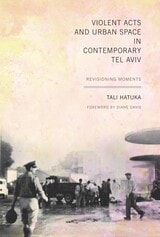
Violent Acts and Urban Space in Contemporary Tel Aviv
Revisioning MomentsBy Tali Hatuka
University of Texas Press, 2010
Violent acts over the past fifteen years have profoundly altered civil rituals, cultural identity, and the meaning of place in Tel Aviv. Three events in particular have shed light on the global rule of urban space in the struggle for territory, resources, and power: the assassination of Prime Minister Rabin in 1995 in the city council square; the suicidal bombing at the Dolphinarium Discothèque along the shoreline in 2001; and bombings in the Neve Shaanan neighborhood in 2003.
Tali Hatuka uses an interdisciplinary framework of urban theory and sociopolitical theory to shed light on the discourse regarding violent events to include an analysis of the physical space where these events take place. She exposes the complex relationships among local groups, the state, and the city, challenging the national discourse by offering a fresh interpretation of contesting forces and their effect on the urban environment.
Perhaps the most valuable contribution of this book is its critical assessment of the current Israeli reality, which is affected by violent events that continually alter the everyday life of its citizens. Although these events have been widely publicized by the media, there is scant literature focusing on their impact on the urban spaces where people live and meet. In addition, Hatuka shows how sociopolitical events become crucial defining moments in contemporary lived experience, allowing us to examine universal questions about the way democracy, ideology, and memory are manifested in the city.
Visuality of Violence
Witnessing the Policing of RaceOfelia Ortiz Cuevas
Temple University Press, 2025
Addressing the frequently ignored experiences of Asian and Native Americans, among others, in its comparative undertaking, Visuality of Violence exceeds intersectional mapping to uniquely charge the spectacle of racial violence as a foundational practice in its continued presence in contemporary society. Cuevas argues that the visual presentations of the racial body throughout history requires a reckoning and acknowledgement of the material and legal effects of the images, narratives, and practices used to maintain hegemonic racial order and inequality.
In holding a theoretical mirror to history, Visuality of Violence reveals liberal mythical reliance on the ideals of western law and its rationalities as the location of justice and freedom, thereby presenting its readers with a new understanding in the quest for peace and liberation.
In the series Critical Race, Indigeneity, and Relationality