Results by title
71 books match the query 'Voice' and 8 start with v
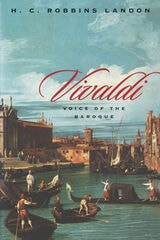
Vivaldi
Voice of the BaroqueH. C. Robbins Landon
University of Chicago Press, 1996
Very little has been written on Vivaldi for the nonspecialist, especially in English. Landon rediscovers the composer in this accessible and musically informed biography while presenting documentation of the musician's life discovered after the Baroque revival in the 1930s. This book includes illustrations of eighteenth-century Venice and several newly translated letters, thoroughly evoking the style of the time and revealing some of the more personal aspects of Vivaldi's life.
"Belongs on the shelf of every serious music student."—Kirkus
"Gives a good feel for Vivaldi's life and times . . . and describes particularly well how Vivaldi has been revived."—Booklist
"Robbins Landon is marvelously entertaining, extravagantly learned."—The Independent
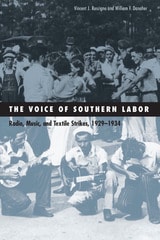
Voice Of Southern Labor
Radio, Music, And Textile Strikes, 1929-1934Vincent J. Roscigno
University of Minnesota Press, 2004
Vividly shows how music united striking workers
The 1934 strike of southern textile workers, involving nearly 400,000 mill hands, remains perhaps the largest collective mobilization of workers in U.S. history. How these workers came together in the face of the powerful and coercive opposition of management and the state is the remarkable story at the center of this book.
The Voice of Southern Labor chronicles the lives and experiences of southern textile workers and provides a unique perspective on the social, cultural, and historical forces that came into play when the group struck, first in 1929, and then on a massive scale in 1934. The workers’s grievances, solidarity, and native radicalism of the time were often reflected in the music they listened to and sang, and Vincent J. Roscigno and William F. Danaher offer an in-depth context for understanding this intersection of labor, politics, and culture. The authors show how the message of the southern mill hands spread throughout the region with the advent of radio and the rise of ex–mill worker musicians, and how their sense of opportunity was further bolstered by Franklin D. Roosevelt’s radio speeches and policies.
Voice and Grammatical Functions in Austronesian Languages
Edited by Peter K. Austin and Simon Musgrave
CSLI, 2005
Voice and Phenomenon
Introduction to the Problem of the Sign in Husserl's PhenomenologyJacques Derrida, Translated from the French by Leonard Lawlor
Northwestern University Press, 2011
Only in relation to phenomenology is it possible to measure the importance of deconstruction. Only in relation to Husserl’s philosophy is it possible to understand the novelty of Derrida’s thinking. Voice and Phenomenon therefore may be the best introduction to Derrida’s thought in general. To adapt Derrida’s comment on Husserl’s Logical Investigations, it contains “the germinal structure” of Derrida’s entire thought. Lawlor’s fresh translation of Voice and Phenomenon brings new life to Derrida’s most seminal work.
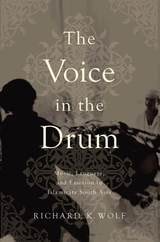
Voice in the Drum
Music, Language, and Emotion in Islamicate South AsiaRichard Wolf
University of Illinois Press, 2017
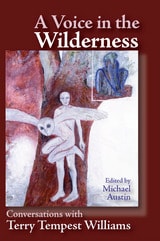
Voice in the Wilderness
Conversations with Terry Tempest Williamsedited by Michael Austin
Utah State University Press, 2006
In her writings, Terry Tempest Williams repeatedly invites us as readers into engagement and conversation with both her and her subject matter, whether it is nature or society, environment or art. From her evocation, in Desert Quartet: An Erotic Landscape, of an eroticism of place that defines erotic as "in relation," to the spiritual connectivity and familial bonds she explores in Refuge: An Unnatural History of Family and Place and the political engagement she urges in The Open Space of Democracy, much of her work is about relationship, connection, and community. Like much good writing, her books invite readers into thoughtful dialogue with the text. Frequently in demand for workshops, lectures, and other speaking venues and well known as an environmental activist, Williams has a public persona and voice almost indistinguishable from her written ones.
Thus, the interviews she has often granted--in print, on the radio, on the Web--seamlessly elaborate the ideas and extend the explorations of her written texts. They also tell us much about the genesis, context, and intent of her books. With her distinctive, impassioned voice and familiar felicity of language, she talks about wilderness and wildlife, place and eroticism, art and literature, democracy and politics, family and heritage, Mormonism and religion, writing and creativity, and other subjects that engage her agile mind. The set of interviews gathered and introduced by Michael Austin in A Voice in the Wilderness represent the span of Terry Tempest Williams's career as a naturalist, author, and activist.

Voice, Silence and Gender in South Africa's Anti-Apartheid Struggle
The Shadow of a Young WomanRachel E. Johnson
University of London Press, 2025
Who spoke about the liberation struggle whilst it was ongoing? When did they speak and how? And what effects do the gendered history of speech and silence within anti-apartheid politics continue to have upon our knowledge of the past? Arguing that she is emblematic of the way gendered narratives of the struggle have been made, this book listens for the voice and silence of Masabata Loate and her contemporaries within political trials; newspapers; photography; human rights reportage; creative fiction, drama, poetry and song; autobiography and memoir; and oral histories. The result is an unconventional biography that sees this young woman as a shadow within the story of South Africa’s anti-apartheid liberation struggle.
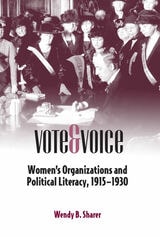
Vote and Voice
Women's Organizations and Political Literacy, 1915-1930Wendy B. Sharer
Southern Illinois University Press, 2007
Vote and Voice is the first book-length study to address the writing and speaking practices of members of women’s political organizations in the decade after the suffrage movement. During those years, women still did not have power within deliberative and administrative organs of politics, despite their recent enfranchisement. Because they were largely absent from diplomatic circles and political parties, post-suffrage women’s organizations developed rhetorical practices of public discourse to push for reform within traditional politics.
Vote and Voice is historically significant as well as pedagogically beneficial for instructors who connect rhetorical education with public participation by integrating writing and speaking skills into a curriculum that aims to prepare educated students and active citizens.