Results by title
991 books match the query 'Writing' and 5 start with v
Very Like a Whale
The Assessment of Writing ProgramsEdward M. White
Utah State University Press, 2015
Winner of the 2015 CPTSC Award for Excellence in Program Assessment
Written for those who design, redesign, and assess writing programs, Very Like a Whale is an intensive discussion of writing program assessment issues. Taking its title from Hamlet, the book explores the multifaceted forces that shape writing programs and the central role these programs can and should play in defining college education.
Given the new era of assessment in higher education, writing programs must provide valid evidence that they are serving students, instructors, administrators, alumni, accreditors, and policymakers. This book introduces new conceptualizations associated with assessment, making them clear and available to those in the profession of rhetoric and composition/writing studies. It also offers strategies that aid in gathering information about the relative success of a writing program in achieving its identified goals.
Philosophically and historically aligned with quantitative approaches, White, Elliot, and Peckham use case study and best-practice scholarship to demonstrate the applicability of their innovative approach, termed Design for Assessment (DFA). Well grounded in assessment theory, Very Like a Whale will be of practical use to new and seasoned writing program administrators alike, as well as to any educator involved with the accreditation process.
Violence in the Work of Composition
Recognizing, Intervening, Amelioratingedited by Scott Gage and Kristie S. Fleckenstein
Utah State University Press, 2022
This book provides a focused, nuanced, and systematic discussion of violence and its presence and influence across pedagogical and administrative sites. Violence in the Work of Composition offers a close look at the nature of violence as it emerges in the work of composition; provides strategies for identifying violence, especially covert violence, addressing its impact and preventing its eruption across many sites; and invites readers to reflect on both the presence of violence and the hope for its cessation. Contributors consider, first, how compositionists can recognize the ways their work inadvertently enacts and/or perpetuates violence and, second, how they can intervene and mitigate that violence.
Rich with the voices of myriad stakeholders, Violence in the Work of Composition initiates an essential conversation about violence and literacy education at a time when violence in its many forms continues to shape our culture, communities, and educational systems.
Contributors: Kerry Banazek, Katherine Bridgman, Eric Camarillo, Elizabeth Chilbert Powers, Joshua Daniel, Lisa Dooley, Allison Hargreaves, Jamila Kareem, Lynn C. Lewis, Trevor Meyer, Cathryn Molloy, Kellie Sharp-Hoskins, Ellen Skirvin, Krista Speicher Sarraf, Thomas Sura, James Zimmerman
Virtual Modernism
Writing and Technology in the Progressive EraKatherine Biers
University of Minnesota Press, 2013
In Virtual Modernism, Katherine Biers offers a fresh view of the emergence of American literary modernism from the eruption of popular culture in the early twentieth century. Employing dynamic readings of the works of Stephen Crane, Henry James, James Weldon Johnson, Djuna Barnes, and Gertrude Stein, she argues that American modernist writers developed a “poetics of the virtual” in response to the rise of mass communications technologies before World War I. These authors’ modernist formal experimentation was provoked by the immediate, individualistic pleasures and thrills of mass culture. But they also retained a faith in the representational power of language—and the worth of common experience—more characteristic of realism and naturalism. In competition with new media experiences such as movies and recorded music, they simultaneously rejected and embraced modernity.
Biers establishes the virtual poetics of these five writers as part of a larger “virtual turn” in the United States, when a fascination with the writings of Henri Bergson, William James, and vitalist philosophy—and the idea of virtual experience—swept the nation. Virtual Modernism contends that a turn to the virtual experience of language was a way for each of these authors to carve out a value for the literary, both with and against the growth of mass entertainments. This technologically inspired reengagement with experience was formative for American modernism.
Situated at the crossing points of literary criticism, philosophy, media studies, and history, Virtual Modernism provides an examination of Progressive Era preoccupations with the cognitive and corporeal effects of new media technologies that traces an important genealogy of present-day concerns with virtuality.
Vision, Rhetoric, and Social Action in the Composition Classroom
Kristie S. Fleckenstein
Southern Illinois University Press, 2009
In this innovative volume, Kristie S. Fleckenstein explores how the intersection of vision, rhetoric, and writing pedagogy in the classroom can help students become compassionate citizens who participate in the world as they become more critically aware of the world. Fleckenstein argues that all social action—behavior designed to increase human dignity, value, and quality of life—depends on a person’s repertoire of visual and rhetorical habits. To develop this repertoire in students, the author advocates the incorporation of visual habits—or ways of seeing—into a language-based pedagogical approach in the writing classroom. According to Fleckenstein, interweaving the visual and rhetorical in composition pedagogy enables students to more readily perceive the need for change, while arming them with the abilities and desire to enact it.
The author addresses social action from the perspective of three visual habits: spectacle, which fosters disengagement; animation, or fusing body with meaning; and antinomy, which invites the invention of new realities. Fleckenstein then examines the ways in which particular visual habits interact with rhetorical habits and with classroom methods, resulting in the emergence of various forms of social action. To enhance the understanding of the concepts she discusses, the author represents the intertwining relationships of vision, rhetoric, and writing pedagogy graphically as what she calls symbiotic knots. In tracing the modes of social action privileged by a visual habit and a teacher’s pedagogical choices, Fleckenstein attends particularly to the experiences of students who have been traditionally barred from participation in the public sphere because of gender, race, or class. The book culminates in a call for visually and rhetorically robust writing pedagogies.
In Vision, Rhetoric, and Social Action in the Composition Classroom, Fleckenstein combines classic methods of rhetorical teaching with fresh perspectives to provide a unique guide for initiating important improvements in teaching social action. The result is a remarkable volume that empowers teachers to best inspire students to take part in their world at that most crucial moment when they are discovering it.
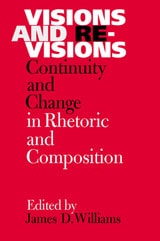
Visions and Revisions
Continuity and Change in Rhetoric and CompositionEdited by James D. Williams
Southern Illinois University Press, 2002
A history of contemporary rhetoric, Visions and Revisions: Continuity and Change in Rhetoric and Composition examines the discipline’s emergence and development from the rise of new rhetoric in the late 1960s through the present. Editor James D. Williams has assembled nine essays from leading scholars to trace the origins of new rhetoric and examine current applications of genre studies, the rhetoric of science, the rhetoric of information, and the influence of liberal democracy on rhetoric in society.
Given the field’s diversity, a historical sketch cannot adopt a single perspective. Part one of Visions and Revisions therefore offers the detailed reminiscences of four pioneers in new rhetoric, while the essays in part two reflect on a variety of issues that have influenced (and continue to influence) current theory and practice. In light of the recent shift in focus of scholarly investigation toward theory, Williams’s collection contextualizes the underlying tension between theory and practice while stressing instruction of students as the most important dimension of rhetoric and composition today. Together, these chapters from some of the most influential scholars in the field provide a range of perspectives on the state of rhetoric and composition and illuminate the discipline’s development over the course of the last forty years.