Results by title
28164 books match the query 'History' and 259 start with v
Vertical Empire
The General Resettlement of Indians in the Colonial AndesJeremy Ravi Mumford
Duke University Press, 2012

Vesna Pavlovic
StagecraftVesna Pavlovic
Vanderbilt University Press, 2021
The book includes critical essays that contextualize and expound on Pavlović's unique treatment of the photographic medium, in which a photographic moment is expanded to include the conditions of image making, production, documentation, and representation.

Vestal Virgins, Sibyls, and Matrons
Women in Roman ReligionBy Sarolta A. Takács
University of Texas Press, 2007
Roman women were the procreators and nurturers of life, both in the domestic world of the family and in the larger sphere of the state. Although deterred from participating in most aspects of public life, women played an essential role in public religious ceremonies, taking part in rituals designed to ensure the fecundity and success of the agricultural cycle on which Roman society depended. Thus religion is a key area for understanding the contributions of women to Roman society and their importance beyond their homes and families.
In this book, Sarolta A. Takács offers a sweeping overview of Roman women's roles and functions in religion and, by extension, in Rome's history and culture from the republic through the empire. She begins with the religious calendar and the various festivals in which women played a significant role. She then examines major female deities and cults, including the Sibyl, Mater Magna, Isis, and the Vestal Virgins, to show how conservative Roman society adopted and integrated Greek culture into its mythic history, artistic expressions, and religion. Takács's discussion of the Bona Dea Festival of 62 BCE and of the Bacchantes, female worshippers of the god Bacchus or Dionysus, reveals how women could also jeopardize Rome's existence by stepping out of their assigned roles. Takács's examination of the provincial female flaminate and the Matres/Matronae demonstrates how women served to bind imperial Rome and its provinces into a cohesive society.
Veteran Americans
Literature and Citizenship from Revolution to ReconstructionBenjamin Cooper
University of Massachusetts Press, 2018
“I may dare to speak, and I intend to speak and write what I think,” wrote a New York volunteer serving in the Mexican War in 1848. Such sentiments of resistance and confrontation run throughout the literature produced by veteran Americans in the nineteenth century—from prisoner-of-war narratives and memoirs to periodicals, adventure pamphlets, and novels. Military men and women were active participants in early American print culture, yet they struggled against civilian prejudice about their character, against shifting collective memories that removed military experience from the nation's self-definition, and against a variety of headwinds in the uneven development of antebellum print culture.
In this new literary history of early American veterans, Benjamin Cooper reveals how soldiers and sailors from the Revolutionary War through the Civil War demanded, through their writing, that their value as American citizens and authors be recognized. Relying on an archive of largely understudied veteran authors, Cooper situates their perspective against a civilian monopoly in defining American citizenship and literature that endures to this day.
Veteran Narratives and the Collective Memory of the Vietnam War
John A. Wood
Ohio University Press, 2016
In the decades since the Vietnam War, veteran memoirs have influenced Americans’ understanding of the conflict. Yet few historians or literary scholars have scrutinized how the genre has shaped the nation’s collective memory of the war and its aftermath. Instead, veterans’ accounts are mined for colorful quotes and then dropped from public discourse; are accepted as factual sources with little attention to how memory, no matter how authentic, can diverge from events; or are not contextualized in terms of the race, gender, or class of the narrators.
Veteran Narratives and the Collective Memory of the Vietnam War is a landmark study of the cultural heritage of the war in Vietnam as presented through the experience of its American participants. Crossing disciplinary borders in ways rarely attempted by historians, John A. Wood unearths truths embedded in the memoirists’ treatments of combat, the Vietnamese people, race relations in the United States military, male-female relationships in the war zone, and veterans’ postwar troubles. He also examines the publishing industry’s influence on collective memory, discussing, for example, the tendency of publishers and reviewers to privilege memoirs critical of the war. Veteran Narratives is a significant and original addition to the literature on Vietnam veterans and the conflict as a whole.
Veterans Stadium
Field Of MemoriesRich Westcott
Temple University Press, 2005
Part of a look-alike generation of all-purpose stadiums erected around the country, the Vet took on its own personality over the years. For all its deficiencies, it left fans loving it in the way they loved their own families—warts and all. Almost 100 photographs and Rich Westcott's yarns make Veterans Stadium the one book that will help Philadelphians—and Philadelphia visitors—remember thirty years of their history.

Veto Power
Institutional Design in the European UnionJonathan B. Slapin
University of Michigan Press, 2011
"This is a terrific book. The questions that Slapin asks about intergovernmental conferences (IGCs) in the European Union are extraordinarily important and ambitious, with implications for the EU and for international cooperation more generally. Furthermore, Slapin's theorizing of his core questions is rigorous, lucid, and accessible to scholarly readers without extensive formal modeling background . . . This book is a solid, serious contribution to the literature on EU studies."
---Mark Pollack, Temple University
"An excellent example of the growing literature that brings modern political science to bear on the politics of the European Union."
---Michael Laver, New York University
Veto rights can be a meaningful source of power only when leaving an organization is extremely unlikely. For example, small European states have periodically wielded their veto privileges to override the preferences of their larger, more economically and militarily powerful neighbors when negotiating European Union treaties, which require the unanimous consent of all EU members.
Jonathan B. Slapin traces the historical development of the veto privilege in the EU and how a veto---or veto threat---has been employed in treaty negotiations of the past two decades. As he explains, the importance of veto power in treaty negotiations is one of the features that distinguishes the EU from other international organizations in which exit and expulsion threats play a greater role. At the same time, the prominence of veto power means that bargaining in the EU looks more like bargaining in a federal system. Slapin's findings have significant ramifications for the study of international negotiations, the design of international organizations, and European integration.
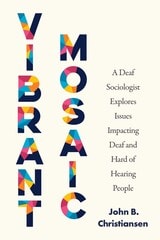
Vibrant Mosaic
A Deaf Sociologist Explores Issues Impacting Deaf and Hard of Hearing PeopleJohn B. Christiansen
Gallaudet University Press, 2025
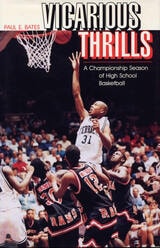
Vicarious Thrills
A Championship Season of High School BasketballPaul E. Bates
Southern Illinois University Press, 1995
This engaging book chronicles the Carbondale Terriers’ 1993–94 season, a season in which the team progressed all the way to the state high school basketball championship game before ending the season with a one-point loss.
Although arranged chronologically, the book is much more than a team diary. Paul E. Bates, whose son was one of the team’s starting guards, brings his sensitivity and expertise as an educational psychologist to bear on team sports in general and on how they define and are defined by the players and coaches that make up the teams and by the communities in which they thrive.
Bates frames the team’s experience by sharing his own personal love of basketball, beginning with his childhood years in Decatur, Illinois, when Stephen Decatur High School was a perennial Illinois high school powerhouse. Through his exploration of the sport and his involvement and interest in it, Bates creates a book that serves both as a rousing tale of youthful achievement and as a history of high school basketball in the state of Illinois.
Throughout his account, Bates repeatedly emphasizes his belief that extraordinary accomplishment is no accident but rather the result of years of preparation, dedication, and hard work. Most of the key performers on the 1993–94 Terriers, for example, had played together on a grade school all-star team that was undefeated. Then, in junior high, this group went on to win numerous championships, and in high school their remarkable success continued, even though their accomplishments were humbled by season-ending losses.
But Vicarious Thrills leads the reader through a very personal account of both the ups and downs of championship basketball. Triumph does not occur without defeat, and it is through defeat that the team members, as well as their families and other supporters, learn many important lessons. As significant as the individual and team accomplishments are in making up this story, the 1993–94 basketball season is more importantly a beginning rather than the defining moment in the lives of these young men.
As an inspiration and motivation to young people, and as a spark to memories of childhood aspirations for older readers, this book is a pleasure to read for individuals of all ages.
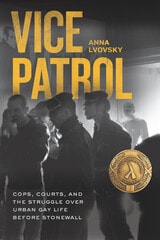
Vice Patrol
Cops, Courts, and the Struggle over Urban Gay Life before StonewallAnna Lvovsky
University of Chicago Press, 2021
In Vice Patrol, Anna Lvovsky chronicles this painful story, tracing the tactics used to criminalize, profile, and suppress gay life from the 1930s through the 1960s, and the surprising controversies those tactics often inspired in court. Lvovsky shows that the vice squads’ campaigns stood at the center of live debates about not only the law’s treatment of queer people, but also the limits of ethical policing, the authority of experts, and the nature of sexual difference itself—debates that had often unexpected effects on the gay community’s rights and freedoms. Examining those battles, Vice Patrol enriches understandings of the regulation of queer life in the twentieth century and disputes about police power that continue today.

Vice Patrol
Cops, Courts, and the Struggle over Urban Gay Life before StonewallAnna Lvovsky
University of Chicago Press, 2021
In the mid-twentieth century, gay life flourished in American cities even as the state repression of queer communities reached its peak. Liquor investigators infiltrated and shut down gay-friendly bars. Plainclothes decoys enticed men in parks and clubs. Vice officers surveilled public bathrooms through peepholes and two-way mirrors.
In Vice Patrol, Anna Lvovsky chronicles this painful story, tracing the tactics used to criminalize, profile, and suppress gay life from the 1930s through the 1960s, and the surprising controversies those tactics often inspired in court. Lvovsky shows that the vice squads’ campaigns stood at the center of live debates about not only the law’s treatment of queer people, but also the limits of ethical policing, the authority of experts, and the nature of sexual difference itself—debates that had often unexpected effects on the gay community’s rights and freedoms. Examining those battles, Vice Patrol enriches understandings of the regulation of queer life in the twentieth century and disputes about police power that continue today.
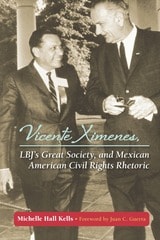
Vicente Ximenes, LBJ's Great Society, and Mexican American Civil Rights Rhetoric
Michelle Hall Kells, with a foreword by Juan C. Guerra
Southern Illinois University Press, 2018
Kells draws on Ximenes’s extensive archive of speeches, reports, articles, and oral interviews to present the activist’s rhetorical history. After a discussion of Ximenes’s early life, the author focuses on his career as an activist, examining Ximenes’s leadership in several key civil rights events, including the historic 1967 White House Cabinet Committee Hearings on Mexican American Affairs. Also highlighted is his role in advancing Mexican Americans and Latinos from social marginalization to greater representation in national politics.
This book shows us a remarkable man who dedicated the majority of his life to public service, using rhetoric to mobilize activists for change to secure civil rights advances for his fellow Mexican Americans.
Vichy and the Eternal Feminine
A Contribution to a Political Sociology of GenderFrancine Muel-Dreyfus
Duke University Press, 2001
Drawing on an extensive body of legislative, religious, educational, medical, and literary texts, Muel-Dreyfus examines how the Vichy regime brutally resurrected the gender politics that had been rejected during France’s social struggles in the 1930s. Strikingly, she reveals how this resurrection in turn fed into racial politics: childless women, for instance, and those who had abortions were construed—like Jews—as threats to France’s racial “purity.” With its atendant patterns of social inclusion and exclusion that were deeply rooted in the political and cultural history of the Third Republic, Muel-Dreyfus claims, a pervasive range of gendered metaphors helped to structure the very laws and policies of the Vichy regime.
The French language edition of this book was published in 1996 to wide acclaim. Contributing to theories about the role of gender in political philosophy, to the cultural anthropology of symbolic representation, and to our understanding of the history of fascism, Vichy and the Eternal Feminine will appeal to French, European, and twentieth-century historians; students and scholars of gender and racial studies; political scientists; and anthropologists.

Vicious Infants
Dangerous Childhoods in Antebellum U.S. LiteratureLaura Soderberg
University of Massachusetts Press, 2021
Vicious Infants offers a counterhistory of literary childhood as both perceived social threat and site of resistance, revealing that many children were not only cut off from family and society, they were also preemptively excluded from the rewards of citizenship and adulthood. Turning to prison documents, medical journals, overlooked periodical fiction, and literary works from William Apess, Harriet Wilson, Herman Melville, Susan Paul, and Harriet Beecher Stowe, Laura Soderberg recovers alternate narratives of childhood and provides an important window into the cultural links between race, reproduction, and childhood in the antebellum period.
Vicksburg Besieged
Edited by Steven E. Woodworth and Charles D. Grear
Southern Illinois University Press, 2020
Vicksburg, Mississippi, held strong through a bitter, hard-fought, months-long Civil War campaign, but General Ulysses S. Grant’s forty-day siege ended the stalemate and, on July 4, 1863, destroyed Confederate control of the Mississippi River. In the first anthology to examine the Vicksburg Campaign’s final phase, nine prominent historians and emerging scholars provide in-depth analysis of previously unexamined aspects of the historic siege.
Ranging in scope from military to social history, the contributors’ invitingly written essays examine the role of Grant’s staff, the critical contributions of African American troops to the Union Army of the Tennessee, both sides’ use of sharpshooters and soldiers’ opinions about them, unusual nighttime activities between the Union siege lines and Confederate defensive positions, the use of West Point siege theory and the ingenuity of Midwestern soldiers in mining tunnels under the city’s defenses, the horrific experiences of civilians trapped in Vicksburg, the Louisiana soldier's defense of Jackson amid the strains of piano music, and the effect of the campaign on Confederate soldiers from the Trans-Mississippi region.
The contributors explore how the Confederate Army of Mississippi and residents of Vicksburg faced food and supply shortages as well as constant danger from Union cannons and sharpshooters. Rebel troops under the leadership of General John C. Pemberton sought to stave off the Union soldiers, and though their morale plummeted, the besieged soldiers held their ground until starvation set in. Their surrender meant that Grant’s forces succeeded in splitting in half the Confederate States of America.
Editors Steven E. Woodworth and Charles D. Grear, along with their contributors—Andrew S. Bledsoe, John J. Gaines, Martin J. Hershock, Richard H. Holloway, Justin S. Solonick, Scott L. Stabler, and Jonathan M. Steplyk—give a rare glimpse into the often overlooked operations at the end of the most important campaign of the Civil War.

Victim of History
Cardinal Mindszenty, a biographyMargit Balogh
Catholic University of America Press, 2022
Victims and Warriors
Violence, History, and Memory in AmazoniaCasey High
University of Illinois Press, 2015
Victims and Warriors examines contemporary violence in the context of political and economic processes that transcend local events. Casey High explores how popular imagery of Amazonian violence has become part of Waorani social memory in oral histories, folklore performances, and indigenous political activism. As Amazonian forms of social memory merge with constructions of masculinity and other intercultural processes, the Waorani absorb missionaries, oil development, and logging depredations into their legacy of revenge killings and narratives of victimhood. High shows that these memories of past violence form sites of negotiation and cultural innovation, and thus violence comes to constitute a central part of Amazonian sociality, identity, and memory.
Victims of the Chilean Miracle
Workers and Neoliberalism in the Pinochet Era, 1973–2002Peter Winn, ed.
Duke University Press, 2004
Implemented in the 1970s at the point of the bayonet and in the shadow of the torture chamber, the neoliberal policies of Augusto Pinochet’s dictatorship reversed many of the gains in wages, benefits, and working conditions that Chile’s workers had won during decades of struggle and triggered a severe economic crisis. Later refined and softened, Pinochet’s neoliberal model began, finally, to promote economic growth in the mid-1980s, and it was maintained by the center-left governments that followed the restoration of democracy in 1990. Yet, despite significant increases in worker productivity, real wages stagnated, the expected restoration of labor rights faltered, and gaps in income distribution continued to widen. To shed light on this history and these ongoing problems, the contributors look at industries long part of the Chilean economy—including textiles and copper—and industries that have expanded more recently—including fishing, forestry, and agriculture. They not only show how neoliberalism has affected Chile’s labor force in general but also how it has damaged the environment and imposed special burdens on women. Painting a sobering picture of the two Chiles—one increasingly rich, the other still mired in poverty—these essays suggest that the Chilean miracle may not be as miraculous as it seems.
Contributors.
Paul Drake
Volker Frank
Thomas Klubock
Rachel Schurman
Joel Stillerman
Heidi Tinsman
Peter Winn
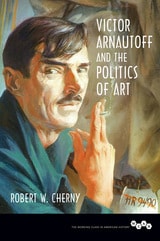
Victor Arnautoff and the Politics of Art
Robert W. Cherny
University of Illinois Press, 2017

Victoria County History of Cumbria
Kirkoswald and RenwickRichard Brockington and with Sarah Rose
University of London Press, 2019
Victorian Afterlife
Postmodern Culture Rewrites the Nineteenth CenturyJohn Kucich
University of Minnesota Press, 2000
A foundational look at contemporary uses of the Victorian and the presence of the past in postmodern culture.
Celebrated films by Francis Ford Coppola, Jane Campion, and Ang Lee; best-selling novels by A. S. Byatt and William Gibson; revivals of Oscar Wilde, Lewis Carroll’s Alice, and nostalgic photography; computer graphics and cyberpunk performances: contemporary culture, high and low, has fallen in love with the nineteenth century. Major critical thinkers have found in the period the origins of contemporary consumerism, sexual science, gay culture, and feminism. And postmodern theory, which once drove a wedge between contemporary interpretation and its historical objects, has lately displayed a new self-consciousness about its own appropriations of the past. This diverse collection of essays begins a long-overdue discussion of how postmodernism understands the Victorian as its historical predecessor.
Contributors: Nancy Armstrong, Brown U; Ian Baucom, Duke U; Jay Clayton, Vanderbilt U; Mary A. Favret, Indiana U; Simon Gikandi, U of Michigan; Jennifer Green-Lewis, George Washington U; Kali Israel, U of Michigan; Laurie Langbauer, U of North Carolina; Susan Lurie, Rice U; John McGowan, U of North Carolina; Judith Roof, Indiana U; Hilary M. Schor, USC; Ronald R. Thomas, Trinity College; and Shelton Waldrep, U of Southern Maine.
Victorian Art Criticism and the Woman Writer
John Paul M. Kanwit
The Ohio State University Press, 2013
Victorian Domesticity
Families in the Life and Art of Louisa May AlcottCharles Strickland
University of Alabama Press, 1985
The subject of Victorian Domesticity is family life in America. The life and works of Louisa May Alcott served as the vehicle for exploring and analyzing this subject. Although Alcott was deeply influenced by popular currents of sentimentality, her own experience exposed her to the confusions and contradictions generated when sentiment confronted the reality of life in 19th-century America.
In the first chapter Strickland outlines the ways in which sentimentality colored the perception of 19th-century Americans about such issues as courtship, marriage, the relationship between the sexes, generational relationships, and the relationship between the nuclear family and the community outside the family. Chapters two and three trace Alcott’s childhood and adolescent experiences, exploring the tensions that developed between Louisa and her father, and detailing the ways in which she carried the double burden of being both poor and female as she sought her identity as a writer.
The following six chapters treat the varieties of family life that appear in Alcott’s stories, the impact of feminism on her life, and her emphasis on the importance of child nurture. In the final two chapters the author treats the relationships that Alcott perceived between the family and the world around it and assesses the legacy of the Victorian family idea.
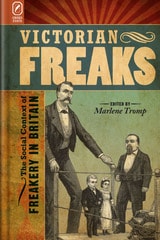
Victorian Freaks
The Social Context of Freakery in BritainMarlene Tromp
The Ohio State University Press, 2008
While “freaks” have captivated our imagination since well before the nineteenth century, the Victorians flocked to shows featuring dancing dwarves, bearded ladies, “missing links,” and six-legged sheep. Indeed, this period has been described by Rosemarie Garland-Thomson as the epoch of “consolidation” for freakery: an era of social change, enormously popular freak shows, and taxonomic frenzy. Victorian Freaks: The Social Context of Freakery in Britain, edited by Marlene Tromp, turns to that rich nexus, examining the struggle over definitions of “freakery” and the unstable and sometimes conflicting ways in which freakery was understood and deployed. As the first study centralizing British culture, this collection discusses figures as varied as Joseph Merrick, “The Elephant Man”; Daniel Lambert, “King of the Fat Men”; Julia Pastrana, “The Bear Woman”; and Laloo “The Marvellous Indian Boy” and his embedded, parasitic twin. The Victorian Freaks contributors examine Victorian culture through the lens of freakery, reading the production of the freak against the landscape of capitalist consumption, the medical community, and the politics of empire, sexuality, and art. Collectively, these essays ask how freakery engaged with notions of normalcy and with its Victorian cultural context.
Victorian Ghosts in the Noontide
Women Writers and the SupernaturalVanessa D. Dickerson
University of Missouri Press, 1996
During the nineteenth century, British society was making rapid advancements in science and technology. While the men became materially productive, women were expected to be the fulcrums of society's changes. As one means of adjusting to these changes, many women focused on supernaturalism and spirituality.
In Victorian Ghosts in the Noontide, Vanessa D. Dickerson analyzes women's spirituality in a materialistic age by examining the supernatural fiction of Charlotte and Emily Brontë, Elizabeth Gaskell, and George Eliot and provides interpretive readings of familiar texts like Jane Eyre and Wuthering Heights. Other works by lesser-known authors are also examined.
Technological advances eliminated many of the jobs women were accustomed to doing. This left women looking for their place in society. A sense of "in-betweenness" developed in these women who were now expected to attend not only to the physical but also to the moral and spiritual needs of the family. As an answer to this "in-betweenness" some channeled their power toward the art of writing. Because people in the mid-1800s were so thoroughly engaged in scientific thought and advancements, supernatural folklore and spirituality were disreputable ideas for anyone, especially women, to explore. Ghosts and spirits were tied to old-wives' tales, superstitions, and legends. However, by focusing on these concepts and using fiction as an outlet, women were able to make great strides in being seen and heard. The art of writing functioned as an exploration of their spiritualism in which women discovered expression, freedom, and power.
This perceptive, well-written book will add a new dimension to our understanding of women's supernatural writings of the Victorian era. Scholars of Victorian literature, women's studies, and popular culture will benefit from its insights.
Victorian Jamaica
Timothy Barringer and Wayne Modest, editors
Duke University Press, 2018
Contributors. Anna Arabindan-Kesson, Tim Barringer, Anthony Bogues, David Boxer, Patrick Bryan, Steeve O. Buckridge, Julian Cresser, John M. Cross, Petrina Dacres, Belinda Edmondson, Nadia Ellis, Gillian Forrester, Catherine Hall, Gad Heuman, Rivke Jaffe, O'Neil Lawrence, Erica Moiah James, Jan Marsh, Wayne Modest, Daniel T. Neely, Mark Nesbitt, Diana Paton, Elizabeth Pigou-Dennis, Veerle Poupeye, Jennifer Raab, James Robertson, Shani Roper, Faith Smith, Nicole Smythe-Johnson, Dianne M. Stewart, Krista A. Thompson
Victorian People
A Reassessment of Persons and Themes, 1851-67Asa Briggs
University of Chicago Press, 1975
"For expounding this theme, this interaction of event and personality, Mr. Briggs is abundantly and happily endowed. He is always readable, often amusing, never facetious. He is widely read and widely interested. He has a sound historic judgment, and an unfailing sense for what is significant in the historic sequence and what is merely topical. . . . Above all, he is in sympathy with the age of which he is writing."—Times Literary Supplement
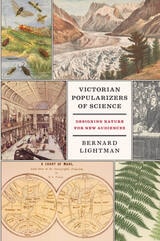
Victorian Popularizers of Science
Designing Nature for New AudiencesBernard Lightman
University of Chicago Press, 2007
Bernard Lightman examines more than thirty of the most prolific, influential, and interesting popularizers of the day, investigating the dramatic lecturing techniques, vivid illustrations, and accessible literary styles they used to communicate with their audience. By focusing on a forgotten coterie of science writers, their publishers, and their public, Lightman offers new insights into the role of women in scientific inquiry, the market for scientific knowledge, tensions between religion and science, and the complexities of scientific authority in nineteenth-century Britain.
Victorian Relativity
Radical Thought and Scientific DiscoveryChristopher Herbert
University of Chicago Press, 2001
Christopher Herbert shows that the idea of relativity produced revolutionary changes in one field after another in the nineteenth century. Surveying a long line of thinkers including Herbert Spencer, Charles Darwin, Alexander Bain, W. K. Clifford, W. S. Jevons, Karl Pearson, James Frazer, and Einstein himself, Victorian Relativity argues that the early relativity movement was bound closely to motives of political and cultural reform and, in particular, to radical critiques of the ideology of authoritarianism. Recuperating relativity from those who treat it as synonymous with nihilism, Herbert portrays it as the basis of some of our crucial intellectual and ethical traditions.
Victorian Sacrifice
Ilana M. Blumberg
The Ohio State University Press, 2013
Victorian Science in Context
Edited by Bernard Lightman
University of Chicago Press, 1997
Victorian Science in Context captures the essence of this fascination, charting the many ways in which science influenced and was influenced by the larger Victorian culture. Contributions from leading scholars in history, literature, and the history of science explore questions such as: What did science mean to the Victorians? For whom was Victorian science written? What ideological messages did it convey? The contributors show how practical concerns interacted with contextual issues to mold Victorian science—which in turn shaped much of the relationship between modern science and culture.
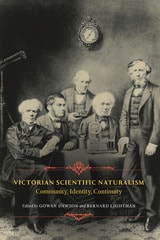
Victorian Scientific Naturalism
Community, Identity, ContinuityEdited by Gowan Dawson and Bernard Lightman
University of Chicago Press, 2014
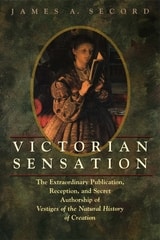
Victorian Sensation
The Extraordinary Publication, Reception, and Secret Authorship of Vestiges of the Natural History of CreationJames A. Secord
University of Chicago Press, 2000
In a pioneering cultural history, James A. Secord uses the story of Vestiges to create a panoramic portrait of life in the early industrial era from the perspective of its readers. We join apprentices in a factory town as they debate the consequences of an evolutionary ancestry. We listen as Prince Albert reads aloud to Queen Victoria from a book that preachers denounced as blasphemy vomited from the mouth of Satan. And we watch as Charles Darwin turns its pages in the flea-ridden British Museum library, fearful for the fate of his own unpublished theory of evolution. Using secret letters, Secord reveals how Vestiges was written and how the anonymity of its author was maintained for forty years. He also takes us behind the scenes to a bustling world of publishers, printers, and booksellers to show how the furor over the book reflected the emerging industrial economy of print.
Beautifully written and based on painstaking research, Victorian Sensation offers a new approach to literary history, the history of reading, and the history of science. Profusely illustrated and full of fascinating stories, it is the most comprehensive account of the making and reception of a book (other than the Bible) ever attempted.
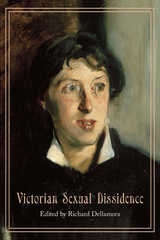
Victorian Sexual Dissidence
Edited by Richard Dellamora
University of Chicago Press, 1999
One essay, for example, traces the remarkable feminist appropriation of male-identified fields of study, such as Classical philology. Others address the validation of male bodies as objects of desire in writing, painting, and emergent modernist choreography. The writings shed light on the diverse interests served by a range of cultural practitioners and on the complex ways in which the late Victorians invented themselves as modern subjects.
This volume will be essential reading for students of British literary and cultural history as well as for those interested in feminist, gay, and lesbian studies.
Contributors are: Oliver Buckton, Richard Dellamora, Dennis Denisoff, Regenia Gagnier, Eric Haralson, Andrew Hewitt, Christopher Lane, Thaïs Morgan, Yopie Prins, Kathy Alexis Psomiades, Julia Saville, Robert Sulcer, Jr., Martha Vicinus.
Victorian Things
Asa Briggs
University of Chicago Press, 1989
Victorian Toronto, 1850 to 1900
Pattern and Process of GrowthPeter G. Goheen
University of Chicago Press, 1970
Victorian Travelers and the Opening of China 1842–1907
Susan Shoenbauer Thurin
Ohio University Press, 1999
Three men and three women: a plant collector, a merchant and his novelist wife, a military officer, and two famous women travelers went to China between the Opium War and the formal end of the opium trade, 1842–1907. Their range of perspectives, their acquaintance with one another and their similar scope of travel to Hong Kong, the treaty ports, and Sichuan lend intensity to their picture of China and the Western presence there.
What the travelers record reveals is a continuity in the response of the West and China to each other. Susan Schoenbauer Thurin’s study of these writings presents a rich tapestry of impressions, biases, and cultural perspectives that inform our own understanding of the Victorians and their views of the world outside their own.
The strange mix of opium and missionaries, the aura of fabled “Cathay” and its valuable trade items, the attraction and repulsion of the exotic otherness the travelers experience, reflect the political, religious, and racial views of their era, and explain the allure of the Orient that, in part, characterized their age. Victorian Travelers and the Opening of China, 1842–1907 is a remarkable look into the cultural past.
Victorine du Pont
The Force behind the FamilyLeonard C. Spitale
University of Delaware Press, 2023

Victors’ Justice
The Tokyo War Crimes TrialRichard H. Minear
University of Michigan Press, 2001
Victory Deferred
How AIDS Changed Gay Life in AmericaJohn-Manuel Andriote
University of Chicago Press, 1999
John-Manuel Andriote chronicles the impact of the disease from the coming-out revelry of the 1970s to the post-AIDS gay community of the 1990s, showing how it has changed both individual lives and national organizations. He tells the truly remarkable story of how a health crisis pushed a disjointed jumble of local activists to become a nationally visible and politically powerful civil rights movement, a full-fledged minority group challenging the authority of some of the nation's most powerful institutions. Based on hundreds of interviews with those at the forefront of the medical, political, and cultural
responses to the disease, Victory Deferred artfully blends personal narratives with institutional histories and organizational politics to show how AIDS forced gay men from their closets and ghettos into the hallways of power to lobby and into the streets to protest.
Andriote, who has been at the center of national advocacy and AIDS politics in Washington, is judicious without being uncritical, and his account of the political maturation of the gay community is one of the most stirring civil rights stories of our time.
Victory Deferred draws on hundreds of original interviews, including first-hand accounts from: Virginia Apuzzo, Reverend Carl Bean, Marcus Conant, M.D., John D'Emilio, Anthony Fauci, M.D, Fenton Johnson, Larry Kramer, Lawrence D. Mass, M.D., Armistead Maupin, Walt Odets, Torie Osborn, Eric Rofes, Urvashi Vaid, Timothy Westmoreland, and Reggie Williams.
"[Victory Deferred] is a richly textured account of the rise of the AIDS sector, that though detailed and comprehensive, reads quickly. The thematic organization of the book works especially well. The clear chronology of the events reveals how competing models of service delivery, treatment activism and private-public cooperation were subsumed into a national AIDS movement. The book should prove excellent for teaching or recreational reading."—Jose Gabilondo, Washington Post
"[A] fine history of the epidemic. . . . Andriote shines with chapters on less-covered but no less important subjects, including the multibillion-dollar 'AIDS industry' and private fund-raising groups. He brings together in one place many facts and figures heretofore unsynthesized."—Joe R. Neel, Boston Globe
"While many books have explored aspects of the impact of AIDS, Victory Deferred is among the most comprehensive. Andriote's adroit integration of the personal and the historical results is an illustrative, analytical account of the disease and its impact on the gay civil-rights movement. His depiction of the poignant struggles, heroic responses and resultant social and political gains emanating from AIDS is a perceptive document for our time—relevant to all readers, regardless of their sexual orientation."—John R. Killacky, Minneapolis Star Tribune
"[A] well-researched and nuanced portrait of the many lives on which this grave disease has wrought both destruction and transformation."—Publishers Weekly
"Andriote combines broad strokes and telling details in this engaging history of the complicated war against both disease and bigotry."—Library Journal
Victory on Two Fronts
The Cleveland Indians and Baseball through the World War II EraScott H. Longert
Ohio University Press, 2022
Victory without Violence
The First Ten Years of the St. Louis Committee of Racial Equality (CORE), 1947-1957Mary Kimbrough & Margaret W. Dagen
University of Missouri Press, 2000
Winner, Missouri Conference on History Book Award, 2001
Victory without Violence is the story of a small, integrated group of St. Louisans who carried out sustained campaigns from 1947 to 1957 that were among the earliest in the nation to end racial segregation in public accommodations. Guided by Gandhian principles of nonviolent direct action, the St. Louis Committee of Racial Equality (CORE) conducted negotiations, demonstrations, and sit-ins to secure full rights for the African American residents of St. Louis.
The book opens with an overview of post-World War II racial injustice in the United States and in St. Louis. After recounting the genesis of St. Louis CORE, the writers vividly relate activities at lunch counters, cafeterias, and restaurants, demonstrating CORE's remarkable success in winning over initially hostile owners, manager, and service employees. A detailed review of its sixteen-month campaign at a major St. Louis department store, Stix, Baer & Fuller, illustrates the groups' patient persistence. Kimbrough and Dagen show after the passage of a public accommodations ordinance in 1961, CORE's goal of equal access was realized throughout the city of St. Louis.
On the scene reports drawn from CORE newsletters (1951-1955) and reminiscences by members appear throughout the text. In a closing chapter, the authors trace the lasting effects of the CORE experience on the lives of its members. Victory without Violence casts light on a previously obscured decade in St. Louis civil rights history.
Victura
The Kennedys, a Sailboat, and the SeaJames W. Graham
University Press of New England, 2015

Vida Zoo-cial
The Buenos Aires Zoo and the Making of Argentine Society, 1875–1924Ashley Elizabeth Kerr
Vanderbilt University Press, 2025
Premio al Mejor Libro en Humanidades, Latin American Studies Association, Nineteenth-Century Section, 2026
In late nineteenth- and early twentieth‑century Buenos Aires, elites attempted to tackle growing poverty and social problems with a suite of social, educational, and medical reforms, hoping to make the city and larger nation more “modern” and “progressive” on the world stage. Known as the “social question,” this turn-of-the-century preoccupation with the future of the city and nation was undergirded by a larger set of social Darwinist beliefs about the biological and racial inferiority of immigrants and the working class, linking them to higher susceptibility to alcoholism, sexual deviancy, insanity, and disease.
In Vida Zoo-cial, Ashley Elizabeth Kerr argues that the Buenos Aires Zoo and its many animal species were an important tool in attempts to remake Argentinian society. Elites used the zoo’s physical spaces, programming, and visual and literary representations of its animals to try to educate and “improve” the masses, especially immigrants and the poor, but stopped short of supporting more radical social transformations. Drawing upon extensive archival research from the zoo’s archive, including correspondence, municipal reports, receipts, and employment records, as well as a range of literary and popular culture sources, Kerr records these efforts, which included enlisting lionesses as object lessons in proper motherhood and elephants as model immigrants. Although some projects were successful, Kerr also documents the many ways others went awry when the zoo's animals and the humans who came to see them failed to cooperate.
Vida Zoo-cial is not only a story about how the poor and working class resisted elite efforts for social reform founded upon racialized beliefs and pseudoscience, but also one that challenges readers to rethink the relationship between humans and non‑humans.

Vidding
A HistoryFrancesca Coppa
University of Michigan Press, 2022
Vidding: A History emphasizes vidding as a critical, feminist form of fan practice. Working outward from interviews, VHS liner notes, convention programs, and mailing list archives, Coppa offers a rich history of vidding communities as they evolved from the 1970s through to the present. Built with the classroom in mind, the open-access electronic version of this book includes over one-hundred vids and an appendix that includes additional close readings of vids.
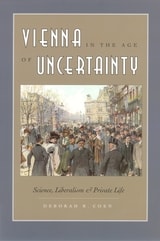
Vienna in the Age of Uncertainty
Science, Liberalism, and Private LifeDeborah R. Coen
University of Chicago Press, 2007
Vienna in the Age of Uncertainty traces the vital and varied roles of science through the story of three generations of the eminent Exner family, whose members included Nobel Prize–winning biologist Karl Frisch, the teachers of Freud and of physicist Erwin Schrödinger, artists of the Vienna Secession, and a leader of Vienna’s women’s movement. Training her critical eye on the Exners through the rise and fall of Austrian liberalism and into the rise of the Third Reich, Deborah R. Coen demonstrates the interdependence of the family’s scientific and domestic lives, exploring the ways in which public notions of rationality, objectivity, and autonomy were formed in the private sphere. Vienna in the Age of Uncertainty presents the story of the Exners as a microcosm of the larger achievements and tragedies of Austrian political and scientific life in the late nineteenth and early twentieth centuries.
Viet Nam Expose
French Scholarship on Twentieth-Century Vietnamese SocietyGisele Bousquet and Pierre Brocheux, Editors
University of Michigan Press, 2002
The book is divided into three parts. Part I, "Vietnamese Society in the Early Twentieth Century," takes a micro approach to the study of Vietnamese society on the eve of the irreversible social transformation that occurred as the colonial infrastructure took root in Indochina. Part II, "Vietnamese Intellectuals: Contesting Colonial Power," contains biographical accounts of Vietnamese intellectuals who tried to reform their society under colonial domination. Part III, "Post-Colonial Vietnam: From Welfare State to Market-Oriented Economy," traces Vietnam's search for a viable economic model while maintaining itself as a socialist state.
The book speaks to diverse themes, including the nature of village life, the development of health care during the colonial era, the status of women, the role of Vietnamese intellectuals in the anticolonial struggle, the building of a socialist state, contemporary rural migration, labor relations, and Vietnam in an age of globalization.
Gisele Bousquet is Research Associate at the Center for Southeast Asian Studies, University of California, Berkeley. Pierre Brocheux is Maître de Conference of History, Université Denis Diderot-Paris VII.
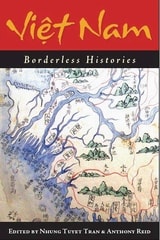
Viet Nam
Borderless HistoriesEdited by Nhung Tuyet Tran and Anthony Reid
University of Wisconsin Press, 2006
“A wonderful introduction to the exciting work that a new generation of scholars is engaging in.”—Liam C. Kelley, International Journal of Asian Studies
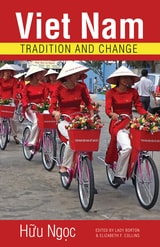
Viet Nam
Tradition and ChangeH?u Ng?c
Ohio University Press, 2016
During his twenty-year tenure as a columnist for Việt Nam News, Hà Nội’s English-language newspaper, Hữu Ngọc charmed and invigorated an international readership hungry for straightforward but elegant entrees into understanding Vietnamese culture. The essays were originally collected in the massive Wandering through Vietnamese Culture. With Viet Nam: Tradition and Change, Ohio University Press presents a selection from these many treasures, which are perfectly suited to students of Vietnamese culture and travelers seeking an introduction to the country’s rich history, culture, and daily life.
With extraordinary linguistic ability and a prodigious memory, Hữu Ngọc is among Việt Nam’s keenest observers of and writers about traditional Vietnamese culture and recent history. The author’s central theme—that all tradition is change through acculturation—twines through each of the book’s ten sections, which contain Hữu Ngọc’s ideas on Vietnamese religion, literature, history, exemplary figures, and more. Taken on its own, each brief essay is an engaging discussion of key elements of Vietnamese culture and the history of an issue confronting Việt Nam today.

Vietnam Zippos
American Soldiers' Engravings and Stories (1965-1973)Edited by Sherry Buchanan
University of Chicago Press, 2007
—from an engraving on a Vietnam-era Zippo lighter
In 1965, journalist Morley Safer followed the United States Marines on a search and destroy mission into Cam Ne. When the Marines he accompanied reached the village, they ordered the civilians there to evacuate their homes—grass huts whose thatched roofs they set ablaze with Zippo lighters. Safer’s report on the event soon aired on CBS and was among the first to paint a harrowing portrait of the War in Vietnam. LBJ responded to the segment furiously, accusing Safer of having “shat on the American flag.” For the first time since World War II, American boys in uniform had been portrayed as murderers instead of liberators. Our perception of the war—and the Zippo lighter—would never be the same.
But as this stunning book attests, the Zippo was far more than an instrument of death and destruction. For the American soldiers who wielded them, they were a vital form of social protest as well. Vietnam Zippos showcases the engravings made by U.S. soldiers on their lighters during the height of the conflict, from 1965 to 1973. In a real-life version of the psychedelic war portrayed in Francis Ford Coppola’s Apocalypse Now, Sherry Buchanan tells the fascinating story of how the humble Zippo became a talisman and companion for American GIs during their tours of duty. Through a dazzling array of images, we see how Zippo lighters were used during the war, and we discover how they served as a canvas for both personal and political expression during the Age of Aquarius, engraved with etchings of peace signs and marijuana leaves and slogans steeped in all the rock lyrics, sound bites, combat slang, and antiwar mottos of the time.
Death from Above. Napalm Sticks to Kids. I Love You Mom, From a Lonely Paratrooper. The engravings gathered in this copiously illustrated volume are at once searing, caustic, and moving, running the full emotional spectrum with both sardonic reflections—I Love the Fucking Army and the Army Loves Fucking Me—and poignant maxims—When the Power of Love Overcomes the Love of Power, the World Will Know Peace. Part pop art and part military artifact, they collectively capture the large moods of the sixties and the darkest days of Vietnam—all through the world of the tiny Zippo.