Results by title
784 books match the query 'American Government' and 34 start with w
WARRING FACTIONS
INTEREST GROUPS, MONEY, SENATE CONFIRMATIONLAUREN COHEN BELL
The Ohio State University Press, 2002
Warring Factions focuses on the United States Senate’s confirmation process, the constitutional process the Senate uses to approve or reject the president’s choices to fill federal government positions. It is a book about history, the evolution, and, arguably, the decline of the process. Most significantly, it is a book that demonstrates the extent to which interest groups and money have transformed the Senate’s confirmation process into a virtual circus.
Based on in-depth research, including two dozen original interviews with United States senators, former senators and Senate staff members and interest group leaders, this volume demonstrates that today’s confirmation process is nothing more than an extension of the Senate’s legislative work. Changes to internal Senate norms in the 1960s and 1970s, coupled with changes to the external political environment, have allowed interest groups to dominate the Senate confirmation process.
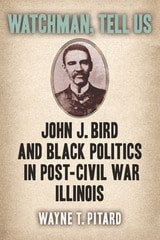
Watchman, Tell Us
John J. Bird and Black Politics in Post-Civil War IllinoisWayne T. Pitard
Southern Illinois University Press, 2024
The most influential Black leader in 19th century southern Illinois
This key biography of John J. Bird unveils the forgotten story of a remarkable Black political figure in post-Civil War Illinois. Emerging as a leader in Cairo, the city with Illinois’ second-largest Black community, Bird played a pivotal role in advancing civil rights within the state, also becoming Illinois’ first Black elected judge and first Black trustee of the University of Illinois. Watchman, Tell Us deftly examines Bird’s lifetime of service and advocacy for a vulnerable community and the ways in which he successfully advocated for and protected voting rights, educational opportunity, and public access for the Black residents of southern Illinois.
Bird arrived in Cairo at age twenty during the Civil War to aid the 2,000 Black refugees from the South living there. By 1870, he had established the city’s substantial Black Republican wing, providing the Black community with unprecedented political influence in this hostile, majority white, Democratic town. Under Bird’s leadership, the Black Republicans pressed for policies that improved the well-being of the African American population, including the early establishment of a Black public school, the rise of an integrated judicial system, and the ability to access public and private businesses. Bird became influential across Illinois as a judge and university trustee, a leader in the Black convention movement, and a significant newspaper editor in Cairo and Springfield. When Bird died in 1912, the nation he loved had once again betrayed its Black citizens, and it appeared that most of the achievements he had fought for had collapsed. But the work of Bird and the other civil rights workers of the nineteenth century created the foundation upon which the movements of the twentieth century could stand.

Waves of Discontent
Electoral Volatility, Public Policymaking, and the Health of American DemocracyJacob F.H. Smith
University of Michigan Press, 2025
Conducting statistical analyses of a wide array of surveys, Smith found that these feelings of displeasure translate to lower turnout among voters from the president’s party and a higher percentage of independents voting for the other party. Subsequently, he conducted a content analysis of New York Times articles to look at the connection between unrest in American society and seat swings in congressional elections, even before the existence of polling. Examining the consequences of volatility in congressional elections reveals that political amateurs are more likely to win in wave years than in normal years. Based on this data, Smith presents a new theory about the policy process—the policy doom loop—in which frustration among voters at both the inability of Congress to pass policy and anger at policies that actually do pass results in even more churn in congressional elections. Waves of Discontent offers some suggestions to promote constructive policymaking efforts in Washington to reduce frustration in the electorate.

We Cannot Escape History
Lincoln and the Last Best Hope of EarthEdited by James M. McPherson
University of Illinois Press, 1995
A who's who of Lincoln scholars explores why Lincoln considered the Union the "last best hope of earth" and how his words and deeds have continued to shape the nation through modern times. Focusing on Lincoln's view of American history and his legacy for the United States and the world, this volume demonstrates the complexity of the problems Lincoln faced and the genius of his leadership in preserving the nation while purging it of slavery.
Welcome to Capitol Hill
Fifty Years of Scandal in Tennessee PoliticsJoel Ebert and Erik Schelzig
Vanderbilt University Press, 2023
Veteran political reporters Joel Ebert and Erik Schelzig draw from interviews, archival documents, and never-before-seen federal investigative files to provide readers with a handy resource about the wrongdoings of our elected officials.

Welcome to Capitol Hill
Fifty Years of Scandal in Tennessee PoliticsJoel Ebert and Erik Schelzig
Vanderbilt University Press, 2024
Veteran political reporters Joel Ebert and Erik Schelzig draw from interviews, archival documents, and never-before-seen federal investigative files to provide readers with a handy resource about the wrongdoings of our elected officials.
Welcoming New Americans?
Local Governments and Immigrant IncorporationAbigail Fisher Williamson
University of Chicago Press, 2018
Abigail Fisher Williamson explores why and how local governments across the country are taking steps to accommodate immigrants, sometimes despite serious political opposition. Drawing on case studies of four new immigrant destinations—Lewiston, Maine; Wausau, Wisconsin; Elgin, Illinois; and Yakima, Washington—as well as a national survey of local government officials, she finds that local capacity and immigrant visibility influence whether local governments take action to respond to immigrants. State and federal policies and national political rhetoric shape officials’ framing of immigrants, thereby influencing how municipalities respond. Despite the devolution of federal immigration enforcement and the increasingly polarized national debate, local officials face on balance distinct legal and economic incentives to welcome immigrants that the public does not necessarily share. Officials’ efforts to promote incorporation can therefore result in backlash unless they carefully attend to both aiding immigrants and increasing public acceptance. Bringing her findings into the present, Williamson takes up the question of whether the current trend toward accommodation will continue given Trump’s anti-immigrant rhetoric and changes in federal immigration policy.
Whatever Happened to Party Government?
Controversies in American Political ScienceMark Wickham-Jones
University of Michigan Press, 2018
In 1950, the Committee on Political Parties of the American Political Science Association (APSA) published its much-anticipated report, Toward a More Responsible Two-Party System. Highly critical of the existing state of affairs, the report became extremely controversial: before publication, scholars attacked the committee’s draft and suggested it should be suppressed. When released it received a barrage of criticisms. Most academics concluded it was an ill-conceived and mistaken initiative.
Mark Wickham-Jones provides the first full, archival-based assessment of the arguments within APSA about political parties and the 1950 report. He details the report’s failure to generate wider discussion between media, politicians, and the White House. He examines whether it was dominated by a dogmatic attachment to “party government,” and charts the relationship between behavioralists and institutionalists. He also discusses the political dimension to research during the McCarthyite years, and reflects on the nature of American political science in the years after 1945, the period in which behavioralism (which privileges the influence of individuals over institutions) became dominant.
Detailing APSA’s most direct and significant intervention in the political process, Wickham-Jones makes an important contribution to debates that remain in the forefront of discussions about American politics.
When Bad Things Happen to Privileged People
Race, Gender, and What Makes a Crisis in AmericaDara Z. Strolovitch
University of Chicago Press, 2023
A deep and thought-provoking examination of crisis politics and their implications for power and marginalization in the United States.
From the climate crisis to the opioid crisis to the Coronavirus crisis, the language of crisis is everywhere around us and ubiquitous in contemporary American politics and policymaking. But for every problem that political actors describe as a crisis, there are myriad other equally serious ones that are not described in this way. Why has the term crisis been associated with some problems but not others? What has crisis come to mean, and what work does it do?
In When Bad Things Happen to Privileged People, Dara Z. Strolovitch brings a critical eye to the taken-for-granted political vernacular of crisis. Using systematic analyses to trace the evolution of the use of the term crisis by both political elites and outsiders, Strolovitch unpacks the idea of “crisis” in contemporary politics and demonstrates that crisis is itself an operation of politics. She shows that racial justice activists innovated the language of crisis in an effort to transform racism from something understood as natural and intractable and to cast it instead as a policy problem that could be remedied. Dominant political actors later seized on the language of crisis to compel the use of state power, but often in ways that compounded rather than alleviated inequality and injustice. In this eye-opening and important book, Strolovitch demonstrates that understanding crisis politics is key to understanding the politics of racial, gender, and class inequalities in the early twenty-first century.
When Bad Things Happen to Privileged People
Race, Gender, and What Makes a Crisis in AmericaDara Z. Strolovitch
University of Chicago Press, 2023
A deep and thought-provoking examination of crisis politics and their implications for power and marginalization in the United States.
From the climate crisis to the opioid crisis to the Coronavirus crisis, the language of crisis is everywhere around us and ubiquitous in contemporary American politics and policymaking. But for every problem that political actors describe as a crisis, there are myriad other equally serious ones that are not described in this way. Why has the term crisis been associated with some problems but not others? What has crisis come to mean, and what work does it do?
In When Bad Things Happen to Privileged People, Dara Z. Strolovitch brings a critical eye to the taken-for-granted political vernacular of crisis. Using systematic analyses to trace the evolution of the use of the term crisis by both political elites and outsiders, Strolovitch unpacks the idea of “crisis” in contemporary politics and demonstrates that crisis is itself an operation of politics. She shows that racial justice activists innovated the language of crisis in an effort to transform racism from something understood as natural and intractable and to cast it instead as a policy problem that could be remedied. Dominant political actors later seized on the language of crisis to compel the use of state power, but often in ways that compounded rather than alleviated inequality and injustice. In this eye-opening and important book, Strolovitch demonstrates that understanding crisis politics is key to understanding the politics of racial, gender, and class inequalities in the early twenty-first century.
When Courts and Congress Collide
The Struggle for Control of America's Judicial SystemCharles Gardner Geyh
University of Michigan Press, 2009
"This is quite simply the best study of judicial independence that I have ever read; it is erudite, historically aware, and politically astute."
-Malcolm M. Feeley, Claire Sanders Clements Dean's Professor, Boalt Hall School of Law, University of California at Berkeley
"Professor Geyh has written a wise and timely book that is informed by the author's broad and deep experience working with the judicial and legislative branches, by the insights of law, history and political science, and by an appreciation of theory and common sense."
-Stephen B. Burbank, David Berger Professor for the Administration of Justice, University of Pennsylvania Law School
With Congress threatening to "go nuclear" over judicial appointments, and lawmakers accusing judges of being "arrogant, out of control, and unaccountable," many pundits see a dim future for the autonomy of America's courts. But do we really understand the balance between judicial independence and Congress's desire to limit judicial reach? Charles Geyh's When Courts and Congress Collide is the most sweeping study of this question to date, and an unprecedented analysis of the relationship between Congress and our federal courts.
Efforts to check the power of the courts have come and gone throughout American history, from the Jeffersonian Congress's struggle to undo the work of the Federalists, to FDR's campaign to pack the Supreme Court, to the epic Senate battles over the Bork and Thomas nominations. If legislators were solely concerned with curbing the courts, Geyh suggests, they would use direct means, such as impeaching uncooperative judges, gerrymandering their jurisdictions, stripping the bench's oversight powers, or slashing judicial budgets. Yet, while Congress has long been willing to influence judicial decision-making indirectly by blocking the appointments of ideologically unacceptable nominees, it has, with only rare exceptions, resisted employing more direct methods of control. When Courts and Congress Collide is the first work to demonstrate that this balance is governed by a "dynamic equilibrium": a constant give-and-take between Congress's desire to control the judiciary and its respect for historical norms of judicial independence.
It is this dynamic equilibrium, Geyh says, rather than what the Supreme Court or the Constitution says about the separation of powers, that defines the limits of the judiciary's independence. When Courts and Congress Collide is a groundbreaking work, requiring all of us to consider whether we are on the verge of radically disrupting our historic balance of governance.
Charles Gardner Geyh is Professor of Law and Charles L. Whistler Faculty Fellow at Indiana University at Bloomington. He has served as director of the American Judicature Society's Center for Judicial Independence, reporter to the American Bar Association Commission on Separation of Powers and Judicial Independence, and counsel to the Judiciary Committee of the U.S. House of Representatives.

When and Where They Enter
Black Women's Candidate Emergence at the State LevelJamil S. Scott-Cummings
University of Michigan Press, 2027
While Black women are often called the backbone of American democracy, their journeys to political office remain understudied. When and Where They Enter offers a way to develop our understanding of the women transforming American politics. By focusing on state-level elections, it explores what motivates Black women to run for public office, the biases they navigate in the public eye, and the structural factors that help or hinder their path to victory.
By deliberately departing from traditional, single-axis models of political ambition, Jamil Scott-Cummings frames candidate emergence through an explicit intersectional lens, treating Black women’s political agency as a dynamic interplay between psychological motivations, institutional factors, personal characteristics, and race-gender bias. She introduces a new conceptual model that challenges standard strategic entry theories: the intentional candidacy framework. Incorporating experiments, observational data, and elite interviews, When and Where They Enter offers robust empirical evidence of how race-gender identity shapes modern electoral supply. An essential read for voters, changemakers, and future leaders, the book offers a roadmap for understanding identity, power, and the future of political representation in America.
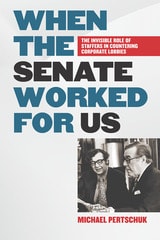
When the Senate Worked for Us
The Invisible Role of Staffers in Countering Corporate LobbiesMichael Pertschuk
Vanderbilt University Press, 2017
What has remained untold is the major behind-the-scenes contribution of entrepreneurial Congressional staff, who planted the seeds of public interest bills in their bosses' minds and maneuvered to counteract the influence of lobbyists to pass laws in consumer protection, public health, and other policy arenas crying out for effective government regulation. They infuriated Nixon's advisor, John Ehrlichman, who called them "bumblebees," a name they wore as a badge of honor.
For his insider account, Pertschuk draws on many interviews, as well as his fifteen years serving on the staff of the Senate Commerce Committee that Senator Warren Magnuson chaired and as the committee's Democratic Staff Director. That committee became, in Ralph Nader's words, "the Grand Central Station for consumer protection advocates."
White House Operations
The Johnson PresidencyBy Emmette S. Redford; and Richard T. McCulley
University of Texas Press, 1986
The relation of White House assistants to the president, their appropriate role in the governmental process, and the most effective means for organizing and managing the White House have been subjects of both public concern and academic dispute. White House Operations addresses these and related questions by providing the first thorough analysis of how the thirty-sixth president managed his staff. By grounding their study in original documents from the Lyndon B. Johnson Presidential Library, the authors lift the veil of secrecy that clouds the inner workings of the White House. The result is an insightful elaboration of the complex, extensive, and diverse roles of White House aides—and av fascinating look at such key White House figures as McGeorge Bundy, Joseph Califano, Bill Moyers, George Reedy, Walt Rostow, Lawrence O’Brien, and Johnson himself.
This exploration of Johnson’s highly personalized White House operations provides far-reaching implications for the nature of effective presidential management. The comprehensive analysis of the range of work done under Johnson and the unique nature of White House assistance leads the authors to a strong and vigorous assertion for a positive role for the White House staff that clashes sharply with the thrust of many recommendations for reorganizing the presidency. Redford and McCulley convincingly demonstrate that management of the White House staff and other parts of the president’s advisory system will remain crucial for successful presidential performance.
The book is the fifth volume in a series designed to provide a comprehensive administrative history of the Johnson presidency. The book will be of interest to the informed general reader, presidential scholars, political scientists, U.S. historians, and students of public management and will be an important addition to academic library collections.
White-Collar Government
The Hidden Role of Class in Economic Policy MakingNicholas Carnes
University of Chicago Press, 2013
With White-Collar Government, Nicholas Carnes answers this question with a resounding—and disturbing—yes. Legislators’ socioeconomic backgrounds, he shows, have a profound impact on both how they view the issues and the choices they make in office. Scant representation from among the working class almost guarantees that the policymaking process will be skewed toward outcomes that favor the upper class. It matters that the wealthiest Americans set the tax rates for the wealthy, that white-collar professionals choose the minimum wage for blue-collar workers, and that people who have always had health insurance decide whether or not to help those without. And while there is no one cause for this crisis of representation, Carnes shows that the problem does not stem from a lack of qualified candidates from among the working class. The solution, he argues, must involve a variety of changes, from the equalization of campaign funding to a shift in the types of candidates the parties support.
If we want a government for the people, we have to start working toward a government that is truly by the people. White-Collar Government challenges long-held notions about the causes of political inequality in the United States and speaks to enduring questions about representation and political accountability.
Who Cleans the Park?
Public Work and Urban Governance in New York CityJohn Krinsky and Maud Simonet
University of Chicago Press, 2017
In Who Cleans the Park? John Krinsky and Maud Simonet explain that the work of maintaining parks has intersected with broader trends in welfare reform, civic engagement, criminal justice, and the rise of public-private partnerships. Welfare-to-work trainees, volunteers, unionized city workers (sometimes working outside their official job descriptions), staff of nonprofit park “conservancies,” and people sentenced to community service are just a few of the groups who routinely maintain parks. With public services no longer being provided primarily by public workers, Krinsky and Simonet argue, the nature of public work must be reevaluated. Based on four years of fieldwork in New York City, Who Cleans the Park? looks at the transformation of public parks from the ground up. Beginning with studying changes in the workplace, progressing through the public-private partnerships that help maintain the parks, and culminating in an investigation of a park’s contribution to urban real-estate values, the book unearths a new urban order based on nonprofit partnerships and a rhetoric of responsible citizenship, which at the same time promotes unpaid work, reinforces workers’ domination at the workplace, and increases the value of park-side property. Who Cleans the Park? asks difficult questions about who benefits from public work, ultimately forcing us to think anew about the way we govern ourselves, with implications well beyond the five boroughs.
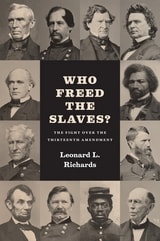
Who Freed the Slaves?
The Fight over the Thirteenth AmendmentLeonard L. Richards
University of Chicago Press, 2015
The real story, however, is much more complicated—and dramatic—than that. With Who Freed the Slaves?, distinguished historian Leonard L. Richards tells the little-known story of the battle over the Thirteenth Amendment, and of James Ashley, the unsung Ohio congressman who proposed the amendment and steered it to passage. Taking readers to the floor of Congress and the back rooms where deals were made, Richards brings to life the messy process of legislation—a process made all the more complicated by the bloody war and the deep-rooted fear of black emancipation. We watch as Ashley proposes, fine-tunes, and pushes the amendment even as Lincoln drags his feet, only coming aboard and providing crucial support at the last minute. Even as emancipation became the law of the land, Richards shows, its opponents were already regrouping, beginning what would become a decades-long—and largely successful—fight to limit the amendment’s impact.
Who Freed the Slaves? is a masterwork of American history, presenting a surprising, nuanced portrayal of a crucial moment for the nation, one whose effects are still being felt today.
Who Governs?
Presidents, Public Opinion, and ManipulationJames N. Druckman and Lawrence R. Jacobs
University of Chicago Press, 2015
Melding big debates about democratic theory with existing research on American politics and innovative use of the archives of three modern presidents—Johnson, Nixon, and Reagan—Druckman and Jacobs deploy lively and insightful analysis to show that the conventional model of representative democracy bears little resemblance to the actual practice of American politics. The authors conclude by arguing that polyarchy and the promotion of accelerated citizen mobilization and elite competition can improve democratic responsiveness. An incisive study of American politics and the flaws of representative government, this book will be warmly welcomed by readers interested in US politics, public opinion, democratic theory, and the fecklessness of American leadership and decision-making.
Who Leads Whom?
Presidents, Policy, and the PublicBrandice Canes-Wrone
University of Chicago Press, 2005
Analyzing the actions of modern presidents ranging from Eisenhower to Clinton, Brandice Canes-Wrone demonstrates that presidents' involvement of the mass public, by putting pressure on Congress, shifts policy in the direction of majority opinion. More important, she also shows that presidents rarely cater to the mass citizenry unless they already agree with the public's preferred course of action. With contemporary politics so connected to the pulse of the American people, Who Leads Whom? offers much-needed insight into how public opinion actually works in our democratic process. Integrating perspectives from presidential studies, legislative politics, public opinion, and rational choice theory, this theoretical and empirical inquiry will appeal to a wide range of scholars of American political processes.
Who Runs?
The Masculine Advantage in Candidate EmergenceSarah Oliver and Meredith Conroy
University of Michigan Press, 2020
Meredith Conroy and Sarah Oliver focus on the candidate emergence process (recruitment, perceived qualifications, and ambition), and investigate the affects of individuals’ gender personality on these variables to improve theories of women’s underrepresentation in government. They argue that since politics and masculinity are congruent, we should observe more precise variation in the candidate emergence process along gender differences, than along sex differences in isolation. Individuals who are more masculine will be more likely to be recruited, perceive of themselves as qualified, and express political ambition, than less masculine individuals. This differs from studies that look at sex differences, because it accepts that some women defy gender norms and break into politics. By including a measure of gender personality we can more fully grapple with women’s progress in American politics, and consider whether this progress rests on masculine behaviors and attributes. Who Runs? The Masculine Advantage in Candidate Emergence explores this possibility and the potential ramifications.
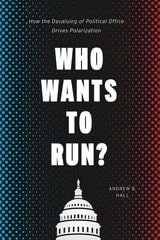
Who Wants to Run?
How the Devaluing of Political Office Drives PolarizationAndrew B. Hall
University of Chicago Press, 2019
Andrew B. Hall argues that we have missed one of the most important reasons for this ideological gulf: the increasing reluctance of moderate citizens to run for office. While political scientists, journalists, and pundits have largely focused on voters, worried that they may be too partisan, too uninformed to vote for moderate candidates, or simply too extreme in their own political views, Hall argues that our political system discourages moderate candidates from seeking office in the first place. Running for office has rarely been harder than it is in America today, and the costs dissuade moderates more than extremists. Candidates have to wage ceaseless campaigns, dialing for dollars for most of their waking hours while enduring relentless news and social media coverage. When moderate candidates are unwilling to run, voters do not even have the opportunity to send them to office. To understand what is wrong with our legislatures, then, we need to ask ourselves the question: who wants to run? If we want more moderate legislators, we need to make them a better job offer.
Why Americans Split Their Tickets
Campaigns, Competition, and Divided GovernmentBarry C. Burden and David C. Kimball
University of Michigan Press, 2004
Why Congressional Reforms Fail
Reelection and the House Committee SystemE. Scott Adler
University of Chicago Press, 2002
What lies behind the House's resistance to change? Challenging recent explanations of this phenomenon, Scott Adler contends that legislators resist rearranging committee powers and jurisdictions for the same reason they cling to the current House structure—the ambition for reelection. The system's structure works to the members' advantage, helping them obtain funding (and favor) in their districts. Using extensive evidence from three major reform periods—the 1940s, 1970s, and 1990s—Adler shows that the reelection motive is still the most important underlying factor in determining the outcome of committee reforms, and he explains why committee reform in the House has never succeeded and probably never will.
Why Not Parties?
Party Effects in the United States SenateEdited by Nathan W. Monroe, Jason M. Roberts, and David W. Rohde
University of Chicago Press, 2008
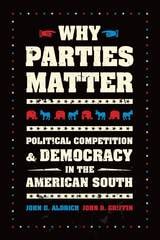
Why Parties Matter
Political Competition and Democracy in the American SouthJohn H. Aldrich and John D. Griffin
University of Chicago Press, 2017
With Why Parties Matter, John H. Aldrich and John D. Griffin make a compelling case that competition between political parties is an essential component of a democracy that is responsive to its citizens and thus able to address their concerns. Tracing the history of the parties through four eras—the Democratic-Whig party era that preceded the Civil War; the post-Reconstruction period; the Jim Crow era, when competition between the parties virtually disappeared; and the modern era—Aldrich and Griffin show how and when competition emerged between the parties and the conditions under which it succeeded and failed. In the modern era, as party competition in the South has come to be widely regarded as matching that of the North, the authors conclude by exploring the question of whether the South is poised to become a one-party system once again with the Republican party now dominant.
Why Parties?
The Origin and Transformation of Political Parties in AmericaJohn H. Aldrich
University of Chicago Press, 1995
Surveying three critical episodes in the development of American political parties—from their formation in the 1790s to the Civil War—Aldrich shows how parties serve to combat three fundamental problems of democracy: how to regulate the number of people seeking public office; how to mobilize voters; and how to achieve and maintain the majorities needed to accomplish goals once in office. Overcoming these obstacles, argues Aldrich, is possible only with political parties.
Aldrich brings this innovative account up to date by looking at the profound changes in the character of political parties since World War II. In the 1960s, he shows, parties started to become candidate-centered organizations that are servants to their office seekers and officeholders. Aldrich argues that this development has revitalized parties, making them stronger, and more vital, with well-defined cleavages and highly effective governing ability.
Why Washington Won't Work
Polarization, Political Trust, and the Governing CrisisMarc J. Hetherington and Thomas J. Rudolph
University of Chicago Press, 2015
In Why Washington Won’t Work, Marc J. Hetherington and Thomas J. Rudolph argue that a contemporary crisis of trust—people whose party is out of power have almost no trust in a government run by the other side—has deadlocked Congress. On most issues, party leaders can convince their own party to support their positions. In order to pass legislation, however, they must also create consensus by persuading some portion of the opposing party to trust in their vision for the future. Without trust, consensus fails to develop and compromise does not occur. Up until recently, such trust could still usually be found among the opposition, but not anymore. Political trust, the authors show, is far from a stable characteristic. It’s actually highly variable and contingent on a variety of factors, including whether one’s party is in control, which part of the government one is dealing with, and which policies or events are most salient at the moment.
Political trust increases, for example, when the public is concerned with foreign policy—as in times of war—and it decreases in periods of weak economic performance. Hetherington and Rudolph do offer some suggestions about steps politicians and the public might take to increase political trust. Ultimately, however, they conclude that it is unlikely levels of political trust will significantly increase unless foreign concerns come to dominate and the economy is consistently strong.
Why We Lost the ERA
Jane J. Mansbridge
University of Chicago Press, 1986
In March 1972 the Equal Rights Amendment to the United States Constitution-the ERA-passed the Senate of the United States with a vote of 84 to 8, seventeen votes more than the two-thirds required for constitutional amendments. In the ensuing ten years, a majority of Americans consistently told interviewers that they favored this amendment to the Constitution. Yet on June 30, 1982, the deadline for ratifying the amendment passed with only thirty-five of the required thirty-eight states having ratified.
How did this happen? In How We Lost the ERA, political scientist Jane J. Mansbridge tells the story of the ERA's rise and fall, revealing self-defeating, contradictory forces within the movement supporting the amendment and how those contributed to its demise. The surprising challenges Mansbridge uncovers here remain salient to political struggles and democratic theory today.
Wisconsin Watershed
Tony Earl and the New Politics of the Democratic PartyDave Cieslewicz
Michigan State University Press, 2027
In 1982, Tony Earl stormed into the Wisconsin governorship with a sweeping victory, rallying blue-collar Democrats around a progressive political platform. Four years later, observers were stunned when he was soundly defeated by conservative Republican Tommy Thompson—not because of any failure as governor, but because, as Dave Cieslewicz notes, the Democratic Party and American politics had undergone a dramatic transformation.
Wisconsin Watershed traces Earl’s journey from Michigan’s Upper Peninsula and the U.S. Navy, through his years in Wisconsin politics and his single, controversial term as Wisconsin’s governor. Earl tackled acid rain, comparable worth, AIDS policy, and tax reform with equal force; he kept American Motors in the state and pulled Wisconsin from a fiscal crisis. Yet voters could not connect his name with his accomplishments. The progressivism that energized new constituencies also alienated the working-class Catholics who had formed the Democratic Party’s backbone. “It’s not the taxes,” one legislator explained. “It’s the desks”—the name for Earl’s symbolic offices to advocate for Native Americans, African Americans, and women.
Earl refused negative campaigning, and he believed that good policy would ultimately prove good politics. His defeat marked the beginning of the end of an era of civility. Through Earl’s story, we witness the Democratic Party’s evolution from New Deal coalition to the emergence of a modern campaign culture that values image and anger over good governance.
Women Take Their Place in State Legislatures
The Creation of Women's CaucusesAnna Mitchell Mahoney
Temple University Press, 2019
How do women strategically make their mark on state legislatures? Anna Mitchell Mahoney’s book traces the development of women’s state legislative caucuses and the influence both gender and party have on women’s ability to organize collectively. She provides a comprehensive analysis of how and why women organize around their gender identity in state legislatures—or why they do not.
Women Take Their Place in State Legislatures includes a quantitative analysis of institutional-level variables and caucus existence in all 50 states. Case studies of caucus attempts in New Jersey, Colorado, Pennsylvania, and Iowa between 2006 and 2010 examine attempts at creating women’s caucuses that succeeded or failed, and why. Mahoney’s interviews with 180 state legislators and their staff explore the motivations of caucus creators and participants. Ultimately, she finds that women’s organizing is contextual; it demonstrates the dynamic nature of gender.
Mahoney also provides insights into broad questions regarding gendered institutions, collective action, and political party governance. Women Take Their Place in State Legislatures fills a lacuna in the evaluation of women in government.
Women in Politics in the American City
Myra Holman
Temple University Press, 2014
This book provides the first comprehensive evaluation of the influence of gender on the behavior of mayors and city council members in the United States. Holman considers the effects of gender in local, urban politics and analyzes how a leader's gender does-and does not-influence policy preferences, processes, behavior, and outcomes.
Holman effectively uses original survey data to evaluate policy attitudes, combined with observations of city council meetings and interviews with leaders and community members. In doing so, she demonstrates the importance of considering the gender of leaders in local office.
Women in Politics in the American City emphasizes that the involvement of women in local politics does matter and that it has significant consequences for urban policy as well as state and local democracy.

Women in the Club
Gender and Policy Making in the SenateMichele L. Swers
University of Chicago Press, 2013
In the run-up to the 2012 presidential election, Democrats and Republicans were locked in a fierce battle for the female vote. Democrats charged Republicans with waging a “war on women,” while Republicans countered that Democratic policies actually undermined women’s rights. The women of the Senate wielded particular power, planning press conferences, appearing on political programs, and taking to the Senate floor over gender-related issues such as workplace equality and reproductive rights.
The first book to examine the impact of gender differences in the Senate, Women in the Club is an eye-opening exploration of how women are influencing policy and politics in this erstwhile male bastion of power. Gender, Michele L. Swers shows, is a fundamental factor for women in the Senate, interacting with both party affiliation and individual ideology to shape priorities on policy. Women, for example, are more active proponents of social welfare and women’s rights. But the effects of gender extend beyond mere policy preferences. Senators also develop their priorities with an eye to managing voter expectations about their expertise and advancing their party’s position on a given issue. The election of women in increasing numbers has also coincided with the evolution of the Senate as a highly partisan institution. The stark differences between the parties on issues pertaining to gender have meant that Democratic and Republican senators often assume very different roles as they reconcile their policy views on gender issues with the desire to act as members of partisan teams championing or defending their party’s record in an effort to reach various groups of voters.
Wrecked
Deinstitutionalization and Partial Defenses in State Higher Education PolicyBarrett J. Taylor
Rutgers University Press, 2022