Results by title
977 books match the query 'American literature' and 59 start with w
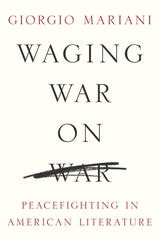
Waging War on War
Peacefighting in American LiteratureGiorgio Mariana
University of Illinois Press, 2015
Giorgio Mariani rigorously engages with the essential question of what makes a text explicitly anti-war. Ranging from Emerson and Joel Barlow to Maxine Hong Kingston and Tim O'Brien, Waging War on War explores why sustained attempts at identifying the anti-war text's formal and philosophical features seem to always end at an impasse. Mariani moves a step beyond to construct a theoretical model that invites new inquiries into America's nonviolent, nonconformist tradition even as it challenges the ways we study U.S. warmaking and the cultural reactions to it. In the process, he shows how the ideal of nonviolence and a dislike of war have been significant, if nonhegemonic, features of American culture since the nation's early days.
Ambitious and nuanced, Waging War on War at last defines anti-war literature while exploring the genre's role in an assertive peacefighting project that offered--and still offers--alternatives to violence.
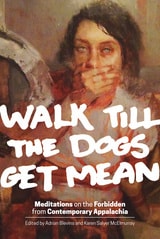
Walk Till the Dogs Get Mean
Meditations on the Forbidden from Contemporary AppalachiaAdrian Blevins
Ohio University Press, 2015
In Walk Till the Dogs Get Mean, Adrian Blevins and Karen Salyer McElmurray collect essays from today’s finest established and emerging writers with roots in Appalachia. Together, these essays take the theme of silencing in Appalachian culture, whether the details of that theme revolve around faith, class, work, or family legacies.
In essays that take wide-ranging forms—making this an ideal volume for creative nonfiction classes—contributors write about families left behind, hard-earned educations, selves transformed, identities chosen, and risks taken. They consider the courage required for the inheritances they carry.
Toughness and generosity alike characterize works by Dorothy Allison, bell hooks, Silas House, and others. These writers travel far away from the boundaries of a traditional Appalachia, and then circle back—always—to the mountains that made each of them the distinctive thinking and feeling people they ultimately became. The essays in Walk Till the Dogs Get Mean are an individual and collective act of courage.
Contributors:
Dorothy Allison, Rob Amberg, Pinckney Benedict, Kathryn Stripling Byer, Sheldon Lee Compton, Michael Croley, Richard Currey, Joyce Dyer, Sarah Einstein, Connie May Fowler, RJ Gibson, Mary Crockett Hill, bell hooks, Silas House, Jason Howard, David Huddle, Tennessee Jones, Lisa Lewis, Jeff Mann, Chris Offutt, Ann Pancake, Jayne Anne Phillips, Melissa Range, Carter Sickels, Aaron Smith, Jane Springer, Ida Stewart, Jacinda Townsend, Jessie van Eerden, Julia Watts, Charles Dodd White, and Crystal Wilkinson.
Walt Whitman and the World
Gay Wilson Allen
University of Iowa Press, 1995
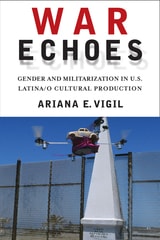
War Echoes
Gender and Militarization in U.S. Latina/o Cultural ProductionVigil, Ariana E
Rutgers University Press, 2014
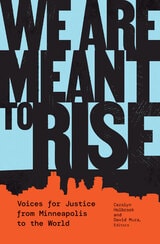
We Are Meant to Rise
Voices for Justice from Minneapolis to the WorldCarolyn Holbrook
University of Minnesota Press, 2021
A brilliant and rich gathering of voices on the American experience of this past year and beyond, from Indigenous writers and writers of color from Minnesota
In this significant collection, Indigenous writers and writers of color bear witness to one of the most unsettling years in the history of the United States. Essays and poems vividly reflect and comment on the traumas we endured in 2020, beginning with the arrival of the COVID-19 pandemic crisis, deepened by the blatant murder of George Floyd by Minneapolis police officers and the uprisings that immersed our city into the epicenter of passionate, worldwide demands for justice. In inspired and incisive writing these contributors speak unvarnished truths not only to the original and pernicious racism threaded through the American experience but also to the deeply personal, in essays about family, loss, food culture, economic security, and mental health. Their call and response is united here to rise and be heard.
We Are Meant to Rise lifts up the astonishing variety of BIPOC writers in Minnesota. From authors with international reputations to newly emerging voices, it features people from many cultures, including Indigenous Dakota and Anishinaabe, African American, Hmong, Somali, Afghani, Lebanese, Korean, Vietnamese, Japanese, Puerto Rican, Colombian, Mexican, transracial adoptees, mixed race, and LGBTQ+ perspectives. Most of the contributors have participated in More Than a Single Story, a popular and insightful conversation series in Minneapolis that features Indigenous and people of color speaking on what most concerns their communities.
We Are Meant to Rise meets the events of the day, the year, the centuries before, again and again, with powerful testament to the intrinsic and unique value of the human voice.
Contributors: Suleiman Adan, Mary Moore Easter, Louise Erdrich, Anika Fajardo, Safy-Hallan Farah, Said Farah, Sherrie Fernandez-Williams, Pamela R. Fletcher Bush, Shannon Gibney, Kathryn Haddad, Tish Jones, Ezekiel Joubert III, Douglas Kearney, Ed Bok Lee, Ricardo Levins Morales, Arleta Little, Resmaa Menakem, Tess Montgomery, Ahmad Qais Munhazim, Melissa Olson, Alexs Pate, Bao Phi, Mona Susan Power, Samantha Sencer-Mura, Said Shaiye, Erin Sharkey, Sun Yung Shin, Michael Torres, Diane Wilson, Kao Kalia Yang, and Kevin Yang.
We Who Love to Be Astonished
Experimental Women's Writing and Performance PoeticsLaura Hinton
University of Alabama Press, 2001
The first critical volume devoted to the full range of women's postmodern works
We Who Love to Be Astonished collects a powerful group of previously unpublished essays to fill a gap in the critical evaluation of women's contributions to postmodern experimental writing. Contributors include Alan Golding, Aldon Nielsen, and Rachel Blau DuPlessis; discussions include analyses of the work of Kathleen Fraser, Harryette Mullen, and Kathy Acker, among others. The editors take as their title a line from the work of Lyn Hejinian, one of the most respected of innovative women poets writing today.
The volume is organized into four sections: the first two seek to identify, from two different angles, the ways women of different sociocultural backgrounds are exploring their relationships to their cultures' inherited traditions; the third section investigates the issue of visuality and the problems and challenges it creates; and the fourth section expands on the role of the body as material and performance.
The collection will breach a once irreconcilable divide between those who theorize about women's writing and those who focus on formalist practice. By embracing "astonishment" as the site of formalist-feminist investigation, the editors seek to show how form configures feminist thought, and, likewise, how feminist thought informs words and letters on a page. Students and scholars of avant-garde poetry, women's writing, and late-20th-century American literature will welcome this lively discussion.
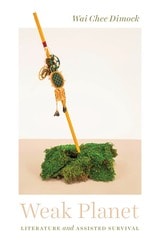
Weak Planet
Literature and Assisted SurvivalWai Chee Dimock
University of Chicago Press, 2020
Drawing on Native American studies, disability studies, and environmental humanities, Dimock shows how hope can be found not in heroic statements but in incremental and unspectacular teamwork. Reversing the usual focus on hegemonic institutions, she highlights instead incomplete gestures given an afterlife with the help of others. She looks at Louise Erdrich’s and Sherman Alexie’s user-amended captivity narratives; nontragic sequels to Moby-Dick by C. L. R. James, Frank Stella, and Amitav Ghosh; induced forms of Irishness in Henry James, Colm Tóibín, W. B. Yeats, and Gish Jen; and the experimentations afforded by a blurry Islam in works by Henri Matisse, James Joyce, Ezra Pound, and Langston Hughes. Celebrating literature’s durability as an assisted outcome, Weak Planet gives us new ways to think about our collective future.
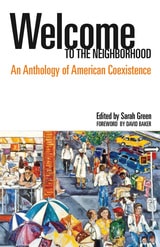
Welcome to the Neighborhood
An Anthology of American CoexistenceSarah Green
Ohio University Press, 2019
How to live with difference—not necessarily in peace, but with resilience, engagement, and a lack of vitriol—is a defining worry in America at this moment. The poets, fiction writers, and essayists (plus one graphic novelist) who contributed to Welcome to the Neighborhood don’t necessarily offer roadmaps to harmonious neighboring. Some of their narrators don’t even want to be neighbors. Maybe they grieve, or rage. Maybe they briefly find resolution or community. But they do approach the question of what it means to be neighbors, and how we should do it, with open minds and nuance.
The many diverse contributors give this collection a depth beyond easy answers. Their attentions to the theme of neighborliness as an ongoing evolution offer hope to readers: possible pathways for rediscovering community, even just by way of a shared wish for it. The result is an enormously rich resource for the classroom and for anyone interested in reflecting on what it means to be American today, and how place and community play a part.
Contributors include Leila Chatti, Rita Dove, Jonathan Escoffery, Rebecca Morgan Frank, Amina Gautier, Ross Gay, Mark Halliday, Joy Harjo, Edward Hirsch, Marie Howe, Sonya Larson, Dinty W. Moore, Robert Pinsky, Christine Schutt, and many more.
West of 98
Living and Writing the New American WestEdited by Lynn Stegner and Russell Rowland
University of Texas Press, 2011
What does it mean to be a westerner? With all the mythology that has grown up about the American West, is it even possible to describe "how it was, how it is, here, in the West—just that," in the words of Lynn Stegner? Starting with that challenge, Stegner and Russell Rowland invited several dozen members of the western literary tribe to write about living in the West and being a western writer in particular. West of 98 gathers sixty-six literary testimonies, in essays and poetry, from a stellar collection of writers who represent every state west of the 98th parallel—a kind of Greek chorus of the most prominent voices in western literature today, who seek to "characterize the West as each of us grew to know it, and, equally important, the West that is still becoming."
In West of 98, western writers speak to the ways in which the West imprints itself on the people who live there, as well as how the people of the West create the personality of the region. The writers explore the western landscape—how it has been revered and abused across centuries—and the inescapable limitations its aridity puts on all dreams of conquest and development. They dismantle the boosterism of manifest destiny and the cowboy and mountain man ethos of every-man-for-himself, and show instead how we must create new narratives of cooperation if we are to survive in this spare and beautiful country. The writers seek to define the essence of both actual and metaphoric wilderness as they journey toward a West that might honestly be called home.
A collective declaration not of our independence but of our interdependence with the land and with each other, West of 98 opens up a whole new panorama of the western experience.
West of the Border
The Multicultural Literature of the Western American FrontiersNoreen Groover Lape
Ohio University Press, 2000
Expanding the scope of American borderland and frontier literary scholarship, West of the Border examines the writings of nineteenth- and turn-of-the-century Native, African, Asian, and Anglo American frontier writers. This book views frontiers as “human spaces” where cultures make contact as it considers multicultural frontier writers who speak from “west of the border.”
James P. Beckwourth, a half-black fur trader; Sarah Winnemucca Hopkins, a Paiute translator; Salishan author Mourning Dove; Cherokee novelist John Rollin Ridge; Sui Sin Far, an Anglo-Chinese short story writer, and her sister, romance novelist Onoto Watanna; and Mary Austin, a white southwestern writer- each of these intercultural writers faces a rite of passage into a new social order. Their writings negotiate their various frontier ordeals: the encroachment of pioneers on the land; reservation life; assimilation; Christianity; battles over territories and resources; exclusion; miscegenation laws; and the devastation of the environment.
In West of the Border, Noreen Groover Lape raises issues inherent in American pluralism today by broaching timely concerns about American frontier politics, conceptualizing frontiers as intercultural contact zones, and expanding the boundaries of frontier literary studies by giving voice to minority writers.
What Wildness Is This
Women Write about the SouthwestEdited by Susan Wittig Albert, Susan Hanson, Jan Epton Seale, and Paula Stallings Yost
University of Texas Press, 2007
Winner, WILLA Literary Award for Creative Nonfiction, 2008
How do women experience the vast, arid, rugged land of the American Southwest? The Story Circle Network, a national organization dedicated to helping women write about their lives, posed this question, and nearly three hundred women responded with original pieces of writing that told true and meaningful stories of their personal experiences of the land. From this deep reservoir of writing—as well as from previously published work by writers including Joy Harjo, Denise Chávez, Diane Ackerman, Naomi Shihab Nye, Leslie Marmon Silko, Gloria Anzaldua, Terry Tempest Williams, and Barbara Kingsolver—the editors of this book have drawn nearly a hundred pieces that witness both to the ever-changing, ever-mysterious life of the natural world and to the vivid, creative, evolving lives of women interacting with it.
Through prose, poetry, creative nonfiction, and memoir, the women in this anthology explore both the outer landscape of the Southwest and their own inner landscapes as women living on the land—the congruence of where they are and who they are. The editors have grouped the writings around eight evocative themes:
- The way we live on the land
- Our journeys through the land
- Nature in cities
- Nature at risk
- Nature that sustains us
- Our memories of the land
- Our kinship with the animal world
- What we leave on the land when we are gone
From the Gulf Coast of Texas to the Pacific Coast of California, and from the southern borderlands to the Great Plains and the Rocky Mountains, these intimate portraits of women's lives on the land powerfully demonstrate that nature writing is no longer the exclusive domain of men, that women bring unique and transformative perspectives to this genre.
What's Nature Worth
Terre Satterfield
University of Utah Press, 2004
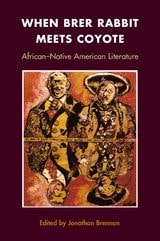
When Brer Rabbit Meets Coyote
AFRICAN-NATIVE AMERICAN LITERATUREEdited by Jonathan Brennan
University of Illinois Press, 2003
Jonathan Brennan, in a sweeping historical and analytical introduction to this collection of essays, surveys several centuries of literature in the context of the historical and cultural exchange and development of distinct African-Native American traditions. Positing a new African-Native American literary theory, he illuminates the roles subjectivity, situational identities, and strategic discourse play in defining African-Native American literatures.
Brennan provides a thorough background to the literary tradition and a valuable overview to topics discussed in the essays. He examines African-Native American political and historical texts, travel narratives, and the Mardi Gras Indian tradition, suggesting that this evolving oral tradition parallels the development of numerous Black Indian literary traditions in the United States and Latin America.
When Sex Changed
Birth Control Politics and Literature between the World WarsLayne Parish Craig
Rutgers University Press, 2013
In When Sex Changed, Layne Parish Craig analyzes the ways literary texts responded to the political, economic, sexual, and social values put forward by the birth control movements of the 1910s to the 1930s in the United States and Great Britain.
Discussion of contraception and related topics (including feminism, religion, and eugenics) changed the way that writers depicted women, marriage, and family life. Tracing this shift, Craig compares disparate responses to the birth control controversy, from early skepticism by mainstream feminists, reflected in Charlotte Perkins Gilman’s Herland, to concern about the movement’s race and class implications suggested in Nella Larsen’s Quicksand, to enthusiastic speculation about contraception’s political implications, as in Virginia Woolf’s Three Guineas.
While these texts emphasized birth control’s potential to transform marriage and family life and emancipate women from the “slavery” of constant childbearing, birth control advocates also used less-than-liberatory language that excluded the poor, the mentally ill, non-whites, and others. Ultimately, Craig argues, the debates that began in these early political and literary texts—texts that document both the birth control movement’s idealism and its exclusionary rhetoric—helped shape the complex legacy of family planning and women’s rights with which the United States and the United Kingdom still struggle.
When We Arrive
A New Literary History of Mexican AmericaJosé F. Aranda Jr.
University of Arizona Press, 2003
In this bold new look at the American canon, Aranda weaves the threads of Mexican American literature into the broader tapestry of Anglo American writing, especially its Puritan origins, by pointing out common ties that bind the two traditions: narratives of persecution, of immigration, and of communal crises, alongside chronicles of the promise of America. Examining texts ranging from María Amparo Ruiz de Burton's 1872 critique of the Civil War, Who Would Have Thought It?, through the contemporary autobiographies of Richard Rodriguez and Cherríe Moraga, he surveys Mexican American history, politics, and literature, locating his analyses within the context of Chicano/a cultural criticism of the last four decades.
When We Arrive integrates Early American Studies and Chicano/a Studies into a comparative cultural framework by using the Puritan connection to shed new light on dominant images of Chicano/a narrative, such as Aztlán and the borderlands. Aranda explores the influence of a nationalized Puritan ethos on nineteenth- and twentieth-century writers of Mexican descent, particularly upon constructions of ethnic identity and aesthetic values. He then frames the rise of contemporary Chicano/a literature within a critical body of work produced from the 1930s through the 1950s, one that combines a Puritan myth of origins with a literary history in which American literature is heralded as the product and producer of social and political dissent.
Aranda's work is a virtual sourcebook of historical figures, texts, and ideas that revitalizes both Chicano/a studies and American literary history. By showing how a comparative study of two genres can produce a more integrated literary history for the United States, When We Arrive enables critics and readers alike to see Mexican American literature as part of a broader tradition and establishes for its writers a more deserving place in the American literary imagination.
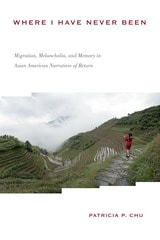
Where I Have Never Been
Migration, Melancholia, and Memory in Asian American Narratives of ReturnPatricia P. Chu
Temple University Press, 2019
In researching accounts of diasporic Chinese offspring who returned to their parents’ ancestral country, author Patricia Chu learned that she was not alone in the experience of growing up in America with an abstract affinity to an ancestral homeland and community. The bittersweet emotions she had are shared in Asian American literature that depicts migration-related melancholia, contests official histories, and portrays Asian American families as flexible and transpacific.
Where I Have Never Been explores the tropes of return, tracing both literal return visits by Asian emigrants and symbolic “returns”: first visits by diasporic offspring. Chu argues that these Asian American narratives seek to remedy widely held anxieties about cultural loss and the erasure of personal and family histories from public memory. In fiction, memoirs, and personal essays, the writers of return narratives—including novelists Lisa See, May-lee Chai, Lydia Minatoya, and Ruth Ozeki, and best-selling author Denise Chong, diplomat Yung Wing, scholar Winberg Chai, essayist Josephine Khu, and many others—register and respond to personal and family losses through acts of remembrance and countermemory.
Where the Southern Cross the Yellow Dog
On Writers and WritingLouis D. Rubin, Jr.
University of Missouri Press, 2005
Where the World Is Not
Cultural Authority and Democratic Desire in Modern American LiteratureKim Savelson
The Ohio State University Press, 2009
White Scholars/African American Texts
Edited by Lisa A. Long
Rutgers University Press, 2005
What makes someone an authority? What makes one person's knowledge more credible than another's? In the ongoing debates over racial authenticity, some attest that we can know each other's experiences simply because we are all "human," while others assume a more skeptical stance, insisting that racial differences create unbridgeable gaps in knowledge.
Bringing new perspectives to these perennial debates, the essays in this collection explore the many difficulties created by the fact that white scholars greatly outnumber black scholars in the study and teaching of African American literature. Contributors, including some of the most prominent theorists in the field as well as younger scholars, examine who is speaking, what is being spoken and what is not, and why framing African American literature in terms of an exclusive black/white racial divide is problematic and limiting.
In highlighting the "whiteness" of some African Americanists, the collection does not imply that the teaching or understanding of black literature by white scholars is definitively impossible. Indeed such work is not only possible, but imperative. Instead, the essays aim to open a much needed public conversation about the real and pressing challenges that white scholars face in this type of work, as well as the implications of how these challenges are met.
Who Will Speak for America?
Stephanie Feldman and Nathaniel Popkin
Temple University Press, 2018
The editors and contributors to Who Will Speak for America? are passionate and justifiably angry voices providing a literary response to today’s political crisis. Inspired by and drawing from the work of writers who participated in nationwide Writers Resist events in January 2017, this volume provides a collection of poems, stories, essays, and cartoons that wrestle with the meaning of America and American identity. The contributions—from established figures including Eileen Myles, Melissa Febos, Jericho Brown, and Madeleine Thien, as well as rising new voices, such as Carmen Maria Machado, Ganzeer, and Liana Finck—confront a country beset by racial injustice, poverty, misogyny, and violence.
Contributions reflect on the terror of the first days after the 2016 Presidential election, but range well beyond it to interrogate the past and imagine possible American futures.
Who Will Speak for America? inspires readers by emphasizing the power of patience, organizing, resilience and community. These moving works advance the conversation the American colonists began, and that generations of activists, in their efforts to perfect our union, have elevated and amplified.
All royalties will benefit the Southern Poverty Law Center.
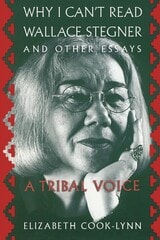
Why I Can't Read Wallace Stegner and Other Essays
A Tribal VoiceElizabeth Cook-Lynn
University of Wisconsin Press, 1996
This provocative collection of essays reveals the passionate voice of a Native American feminist intellectual. Elizabeth Cook-Lynn, a poet and literary scholar, grapples with issues she encountered as a Native American in academia. She asks questions of critical importance to tribal people: who is telling their stories, where does cultural authority lie, and most important, how is it possible to develop an authentic tribal literary voice within the academic community?
In the title essay, “Why I Can’t Read Wallace Stegner,” Cook-Lynn objects to Stegner’s portrayal of the American West in his fiction, contending that no other author has been more successful in serving the interests of the nation’s fantasy about itself. When Stegner writes that “Western history sort of stopped at 1890,” and when he claims the American West as his native land, Cook-Lynn argues, he negates the whole past, present, and future of the native peoples of the continent. Her other essays include discussion of such Native American writers as Michael Dorris, Ray Young Bear, and N. Scott Momaday; the importance of a tribal voice in academia, the risks to American Indian women in current law practices, the future of Indian Nationalism, and the defense of the land.
Cook-Lynn emphasizes that her essays move beyond the narrowly autobiographical, not just about gender and power, not just focused on multiculturalism and diversity, but are about intellectual and political issues that engage readers and writers in Native American studies. Studying the “Indian,” Cook-Lynn reminds us, is not just an academic exercise but a matter of survival for the lifeways of tribal peoples. Her goal in these essays is to open conversations that can make tribal life and academic life more responsive to one another.
Wild Women in the Whirlwind
Afra-American Culture and the Contemporary Literary RenaissanceEdited by Joanne M. Braxton and Andree Nicola McLaughlin
Rutgers University Press, 1989
--New York Times Book Review
"The cultural and literary achievements of black American women are examined and celebrated in some 20 enjoyable, erudite essays by prominent scholars, critics, and activists."
--Publishers Weekly
This book is the first comprehensive collection of critical and theoretical essays to explore the literary and multi-cultural traditions of Black American women in many genres over a broad span of time. The essays explore cultural and literary experience in a wide context and offer a variety of critical theoretical constructs in which to view that experience. The editors have written excellent introductions providing both historical and comparative discussions of the contemporary literary renaissance. The book also includes a valuable bibliography of selected English-language works by Black women in the Americas from the 1970s to the present.
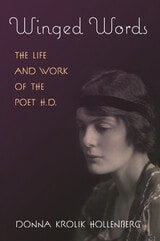
Winged Words
The Life and Work of the Poet H.D.Donna Krolik Hollenberg
University of Michigan Press, 2022
H.D.’s friends and lovers were a veritable Who’s Who of Modernism, and Hollenberg gives us a glimpse into H.D.’s relationships with them. With rich detail, the biography follows H.D. from her early years in America with her family, to her later years in England during both world wars, to Switzerland, which would eventually become H.D.’s home base. It explores her love affairs with both men and women; her long friendship with Bryher; the birth of her daughter, Perdita, and her imaginative bond with her; and her marriage to (and later divorce from) fellow poet Richard Aldington. Additionally, the book includes scenes from her relationships with Ezra Pound, Marianne Moore, William Carlos Williams, and D.H. Lawrence; H.D.’s fascination with spiritualism and the occult; and H.D.’s psychoanalysis with Sigmund Freud. The first new biography of H.D. to be published in over four decades, Winged Words is a must-read resource for anyone conducting research on H.D.
Wisconsin Indian Literature
Anthology of Native VoicesEdited by Kathleen Tigerman; Foreward by Jim Ottery
University of Wisconsin Press, 2006
Literature of the Indian Nations of Wisconsin is a unique anthology that presents the oral traditions, legends, speeches, myths, histories, literature, and historically significant documents of the current twelve independent bands and Indian Nations of Wisconsin. Kathleen Tigerman sought input from tribe elders and educators to provide an accurate chronological portrait of each nation, including the Siouan Ho-Chunk; the Algonquian Menominee, Ojibwe, and Potawatomi; and three groups originally from what is now New York State: the Iroquoian Oneida, the Stockbridge-Munsee band of the Mohican Nations, and the Brothertown Nation.
Some of these works feature a cultural hero or refer to very ancient times—more than six thousand years ago—and others are contemporary. These pieces focus on issues of Wisconsin Native communities by sharing Native knowledge and dialogue about sovereignty, decolonization, cultural genocide, forced removals, assimilation, and other concerns.
This anthology introduces us to a vivid and unforgettable group of voices, enhanced by many maps, photographs, and chronologies. Literature of the Indian Nations of Wisconsin fosters cross-cultural understanding among non-Native readers and the people of the First Nations.
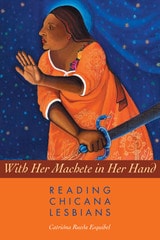
With Her Machete in Her Hand
Reading Chicana LesbiansBy Catrióna Rueda Esquibel
University of Texas Press, 2006
With the 1981 publication of the groundbreaking anthology This Bridge Called My Back: Writings by Radical Women of Color, Cherríe Moraga and Gloria Anzaldúa ushered in an era of Chicana lesbian writing. But while these two writers have achieved iconic status, observers of the Chicana/o experience have been slow to perceive the existence of a whole community—lesbian and straight, male as well as female—who write about the Chicana lesbian experience. To create a first full map of that community, this book explores a wide range of plays, novels, and short stories by Chicana/o authors that depict lesbian characters or lesbian desire.
Catrióna Rueda Esquibel starts from the premise that Chicana/o communities, theories, and feminisms cannot be fully understood without taking account of the perspectives and experiences of Chicana lesbians. To open up these perspectives, she engages in close readings of works centered around the following themes: La Llorona, the Aztec Princess, Sor Juana Inés de la Cruz, girlhood friendships, rural communities and history, and Chicana activism. Her investigation broadens the community of Chicana lesbian writers well beyond Moraga and Anzaldúa, while it also demonstrates that the histories of Chicana lesbians have had to be written in works of fiction because these women have been marginalized and excluded in canonical writings on Chicano life and experience.
Within the Circle
An Anthology of African American Literary Criticism from the Harlem Renaissance to the PresentAngelyn Mitchell
Duke University Press, 1994
The essays in this collection—many of which are not widely available today—either initiated or gave critical definition to specific periods or movements of African American literature. They address issues such as integration, separatism, political action, black nationalism, Afrocentricity, black feminism, as well as the role of art, the artist, the critic, and the audience. With selections from Langston Hughes, Sterling Brown, W. E. B. DuBois, Zora Neale Hurston, Richard Wright, James Baldwin, Toni Morrison, Barbara Smith, Alice Walker, Henry Louis Gates, Jr., and many others, this definitive collection provides a dynamic model of the cultural, ideological, historical, and aesthetic considerations in African American literature and literary criticism.
A major contribution to the study of African American literature, this volume will serve as a foundation for future work by students and scholars. Its importance will be recognized by all those interested in modern literary theory as well as general readers concerned with the African American experience.
Selections by (partial list): Houston A. Baker, Jr., James Baldwin, Sterling Brown, Barbara Christian, W. E. B. DuBois, Ralph Ellison, LeRoi Jones, Sarah Webster Fabio, Henry Louis Gates, Jr., W. Lawrence Hogue, Langston Hughes, Zora Neale Hurston, Alain Locke, Deborah E. McDowell, Toni Morrison, J. Saunders Redding, George Schuyler, Barbara Smith, Valerie Smith, Hortense J. Spillers, Robert B. Stepto, Alice Walker, Margaret Walker, Mary Helen Washington, Richard Wright
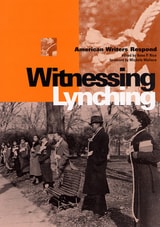
Witnessing Lynching
American Writers RespondEdited by Anne P. Rice
Rutgers University Press, 2003
Witnessing Lynching: American Writers Respond is the first anthology to gather poetry, essays, drama, and fiction from the height of the lynching era (1889–1935). During this time, the torture of a black person drew thousands of local onlookers and was replayed throughout the nation in lurid newspaper reports. The selections gathered here represent the courageous efforts of American writers to witness the trauma of lynching and to expose the truth about this uniquely American atrocity. Included are well-known authors and activists such as Frederick Douglass, W.E.B. Du Bois, Langston Hughes, Ida B. Wells, and Theodore Dreiser, as well as many others. These writers respond to lynching in many different ways, using literature to protest and educate, to create a space of mourning in which to commemorate and rehumanize the dead, and as a cathartic release for personal and collective trauma. Their words provide today’s reader with a chance to witness lynching and better understand the current state of race relations in America.
An introduction by Anne P. Rice offers a broad historical and thematic framework to ground the selections.
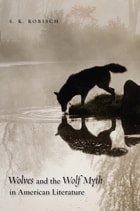
Wolves and the Wolf Myth in American Literature
S.K. Robisch
University of Nevada Press, 2009
The wolf is one of the most widely distributed canid species, historically ranging throughout most of the Northern Hemisphere. For millennia, it has also been one of the most pervasive images in human mythology, art, and psychology. Wolves and the Wolf Myth in American Literature examines the wolf’s importance as a figure in literature from the perspectives of both the animal’s physical reality and the ways in which writers imagine and portray it. Author S. K. Robisch examines more than two hundred texts written in North America about wolves or including them as central figures. From this foundation, he demonstrates the wolf’s role as an archetype in the collective unconscious, its importance in our national culture, and its ecological value. Robisch takes a multidisciplinary approach to his study, employing a broad range of sources: myths and legends from around the world; symbology; classic and popular literature; films; the work of scientists in a number of disciplines; human psychology; and field work conducted by himself and others. By combining the fundamentals of scientific study with close readings of wide-ranging literary texts, Robisch astutely analyzes the correlation between actual, living wolves and their representation on the page and in the human mind. He also considers the relationship between literary art and the natural world, and argues for a new approach to literary study, an ecocriticism that moves beyond anthropocentrism to examine the complicated relationship between humans and nature.

Women Reading Women Writing
Ann Louise Keating
Temple University Press, 1996
Women Writers of the American West, 1833-1927
Nina Baym
University of Illinois Press, 2012
Women of Color
Mother-Daughter Relationships in 20th-Century LiteratureEdited by Elizabeth Brown-Guillory
University of Texas Press, 1996
Interest in the mother-daughter relationship has never been greater, yet there are few books specifically devoted to the relationships between daughters and mothers of color. To fill that gap, this collection of original essays explores the mother-daughter relationship as it appears in the works of African, African American, Asian American, Mexican American, Native American, Indian, and Australian Aboriginal women writers.
Prominent among the writers considered here are Toni Morrison, Alice Walker, Maxine Hong Kingston, Cherrie Moraga, Leslie Marmon Silko, and Amy Tan. Elizabeth Brown-Guillory and the other essayists examine the myths and reality surrounding the mother-daughter relationship in these writers' works. They show how women writers of color often portray the mother-daughter dyad as a love/hate relationship, in which the mother painstakingly tries to convey knowledge of how to survive in a racist, sexist, and classist world while the daughter rejects her mother's experiences as invalid in changing social times.
This book represents a further opening of the literary canon to twentieth-century women of color. Like the writings it surveys, it celebrates the joys of breaking silence and moving toward reconciliation and growth.
Women of the Left Bank
Paris, 1900-1940By Shari Benstock
University of Texas Press, 1986
Now available in a durable paperback edition, Shari Benstock's critically acclaimed, best-selling Women of the Left Bank is a fascinating exploration of the lives and works of some two dozen American, English, and French women whose talent shaped the Paris expatriate experience in the century's early years.
This ambitious historical, biographical, and critical study has taken its place among the foremost works of literary criticism. Maurice Beebe calls it "a distinguished contribution to modern literary history." Jane Marcus hails it as "the first serious literary history of the period and its women writers, making along the way no small contribution to our understanding of the relationships between women artists and their male counterparts, from Henry James to Hemingway, Joyce, Picasso, and Pound."
Women, Celebrity, and Literary Culture between the Wars
By Faye Hammill
University of Texas Press, 2007
As mass media burgeoned in the years between the first and second world wars, so did another phenomenon—celebrity. Beginning in Hollywood with the studio-orchestrated transformation of uncredited actors into brand-name stars, celebrity also spread to writers, whose personal appearances and private lives came to fascinate readers as much as their work. Women, Celebrity, and Literary Culture between the Wars profiles seven American, Canadian, and British women writers—Dorothy Parker, Anita Loos, Mae West, L. M. Montgomery, Margaret Kennedy, Stella Gibbons, and E. M. Delafield—who achieved literary celebrity in the 1920s and 1930s and whose work remains popular even today.
Faye Hammill investigates how the fame and commercial success of these writers—as well as their gender—affected the literary reception of their work. She explores how women writers sought to fashion their own celebrity images through various kinds of public performance and how the media appropriated these writers for particular cultural discourses. She also reassesses the relationship between celebrity culture and literary culture, demonstrating how the commercial success of these writers caused literary elites to denigrate their writing as "middlebrow," despite the fact that their work often challenged middle-class ideals of marriage, home, and family and complicated class categories and lines of social discrimination.
The first comparative study of North American and British literary celebrity, Women, Celebrity, and Literary Culture between the Wars offers a nuanced appreciation of the middlebrow in relation to modernism and popular culture.
Workings of the Spirit
The Poetics of Afro-American Women's WritingHouston A. Baker Jr.
University of Chicago Press, 1990
"Brilliant, and tenderly riveted to gratitude as an indispensable facet of analysis, Houston Baker arrives, yet again, bearing the loveliest flowers of his devotion and delight: thank God he's here!"—June Jordan
Workshops of Empire
Stegner, Engle, and American Creative Writing during the Cold WarEric Bennett
University of Iowa Press, 2015
Creative writing emerged as a graduate discipline in the United States amid this astonishing swirl of grand conceptions. The early workshops were formed not only at the time of, but in the image of, and under the tremendous urgency of, the postwar imperatives for the humanities. Vivid renderings of personal experience would preserve the liberal democratic soul—a soul menaced by the gathering leftwing totalitarianism of the USSR and the memory of fascism in Italy and Germany.
Workshops of Empire explores this history via the careers of Paul Engle at the University of Iowa and Wallace Stegner at Stanford. In the story of these founding fathers of the discipline, Eric Bennett discovers the cultural, political, literary, intellectual, and institutional underpinnings of creative writing programs within the university. He shows how the model of literary technique championed by the first writing programs—a model that values the interior and private life of the individual, whose experiences are not determined by any community, ideology, or political system—was born out of this Cold War context and continues to influence the way creative writing is taught, studied, read, and written into the twenty-first century.
World Beats
Beat Generation Writing and the Worlding of U.S. LiteratureJimmy Fazzino
Dartmouth College Press, 2016
World Elsewhere
Richard Poirier
University of Wisconsin Press, 1985
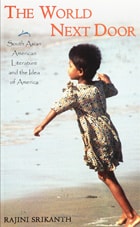
World Next Door
South Asian American LiteratureRajini Srikanth
Temple University Press, 2004
South Asian American literature, with its focus on the multiple geographies and histories of the global dispersal of South Asians, pulls back from a close-up view of the United States to reveal a wider landscape of many nations and peoples.
South Asian American poets, novelists, and playwrights depict the nation as simultaneously discrete and entwined with the urgencies of places as diverse as Bangladesh, Sri Lanka, India, Burma, Pakistan, and Trinidad. Drawing on the cosmopolitan sensibility of scholars like Anthony Appiah, Vinay Dharwadker, Martha Nussbaum, Bruce Robbins, and Amartya Sen, this book exhorts North American residents to envision connectedness with inhabitants of other lands. The world out there arrives next door.
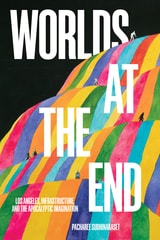
Worlds at the End
Los Angeles, Infrastructure, and the Apocalyptic ImaginationPacharee Sudhinaraset
Temple University Press, 2024
Worlds at the End analyzes destruction, rupture, and continuance through texts ranging from Karen Tei Yamashita’s Tropic of Orange, which considers racial colonial infrastructure, to the work of Diné poet Esther Belin, which illuminates how the separation between the Indian reservation and LA is part of a broader infrastructural network of termination. And she unpacks Octavia Butler’s post-apocalyptic novel, Parable of the Sower, where LA’s freeways and roadways are routes of forced migration, colonization, and flight.
Tearing down existing institutions that marginalize people of color and moving past them, Worlds at the End highlights the imaginaries of those subjugated, racialized, and made other, for whom modernity, freedom, and progress meant violence, brutality, and relegation to the status of devalued surplus populations. As Sudhinaraset deftly shows, the apocalypse marks moments of historical and spatial transition, offering stories of doomsdays that will give rise to resurgence and regeneration.

Write Now
American Literature in the 1980s and 1990s, Volume 68Sharon O’Brien
Duke University Press, 0
Contributors explore many of the relationships now shaping American literature and criticism, including the tensions between postmodernist playfulness and autobiographical earnestness, art and commerce, and politics and aesthetics. Novelists Miriam Levine, Robert Olmstead, and Jonathan Strong offers essays on their creative processes and discuss the imaginative and emotional mysteries of writing and reading. Essays on Alice Walker, Art Spiegelman, Marilynne Robinson, and AIDS literature examine how the act of writing is linked to themes of longing, discovery, desire, and betrayal.
In evaluating both familiar and rarely studied contemporary literature from the standpoint of practicing writers as well as critics, this volume challenges the literary politics that silence critics as well as writers and testifies to the power of silent works to speak aloud. Certain to spark conversations about the politics of scholarship on current American writing, Write Now will be of interest to teachers and scholars of creative writing and American literary studies, those engaged in the arts of writing and literary criticism, and readers of contemporary American literature.
Contributors. Bonnie Braendlin, Christine Caver, Thomas Doherty, Rachel Blau DePlessis, Jennifer Gillan, Stephanie Girard, Deborah Landau, Miriam Levine, Sharon O’Brien, Robert Olmstead, Juliana Spahr, Jonathan Strong
Writers of the Black Chicago Renaissance
Edited by Steven C. Tracy
University of Illinois Press, 2011
The volume covers a vast collection of subjects, including many important writers such as Richard Wright, Gwendolyn Brooks, and Lorraine Hansberry as well as cultural products such as black newspapers, music, and theater. The book includes individual entries by experts on each subject; a discography and filmography that highlight important writers, musicians, films, and cultural presentations; and an introduction that relates the Harlem Renaissance, the White Chicago Renaissance, the Black Chicago Renaissance, and the Black Arts Movement.
Contributors are Robert Butler, Robert H. Cataliotti, Maryemma Graham, James C. Hall, James L. Hill, Michael Hill, Lovalerie King, Lawrence Jackson, Angelene Jamison-Hall, Keith Leonard, Lisbeth Lipari, Bill V. Mullen, Patrick Naick, William R. Nash, Charlene Regester, Kimberly Ruffin, Elizabeth Schultz, Joyce Hope Scott, James Smethurst, Kimberly M. Stanley, Kathryn Waddell Takara, Steven C. Tracy, Zoe Trodd, Alan Wald, Jamal Eric Watson, Donyel Hobbs Williams, Stephen Caldwell Wright, and Richard Yarborough.
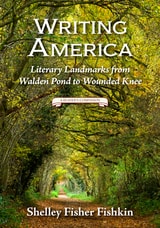
Writing America
Literary Landmarks from Walden Pond to Wounded Knee (A Reader's Companion)Fishkin, Shelley Fisher
Rutgers University Press, 2015
American novelist E.L. Doctorow once observed that literature “endows places with meaning.” Yet, as this wide-ranging new book vividly illustrates, understanding the places that shaped American writers’ lives and their art can provide deep insight into what makes their literature truly meaningful.
Published on the eve of the 50th anniversary of the Historic Preservation Act, Writing America is a unique, passionate, and eclectic series of meditations on literature and history, covering over 150 important National Register historic sites, all pivotal to the stories that make up America, from chapels to battlefields; from plantations to immigration stations; and from theaters to internment camps. The book considers not only the traditional sites for literary tourism, such as Mark Twain’s sumptuous Connecticut home and the peaceful woods surrounding Walden Pond, but also locations that highlight the diversity of American literature, from the New York tenements that spawned Abraham Cahan’s fiction to the Texas pump house that irrigated the fields in which the farm workers central to Gloria Anzaldúa’s poetry picked produce. Rather than just providing a cursory overview of these authors’ achievements, acclaimed literary scholar and cultural historian Shelley Fisher Fishkin offers a deep and personal reflection on how key sites bore witness to the struggles of American writers and inspired their dreams. She probes the global impact of American writers’ innovative art and also examines the distinctive contributions to American culture by American writers who wrote in languages other than English, including Yiddish, Chinese, and Spanish.
Only a scholar with as wide-ranging interests as Shelley Fisher Fishkin would dare to bring together in one book writers as diverse as Gloria Anzaldúa, Nicholas Black Elk, David Bradley, Abraham Cahan, S. Alice Callahan, Raymond Chandler, Frank Chin, Elizabeth Cook-Lynn, Countee Cullen, Frederick Douglass, Paul Laurence Dunbar, Jessie Fauset, William Faulkner, F. Scott Fitzgerald, Allen Ginsberg, Jovita González, Rolando Hinojosa, Langston Hughes, Zora Neale Hurston, Lawson Fusao Inada, James Weldon Johnson, Erica Jong, Maxine Hong Kingston, Irena Klepfisz, Nella Larsen, Emma Lazarus, Sinclair Lewis, Genny Lim, Claude McKay, Herman Melville, N. Scott Momaday, William Northup, John Okada, Miné Okubo, Simon Ortiz, Américo Paredes, John P. Parker, Ann Petry, Tomás Rivera, Wendy Rose, Morris Rosenfeld, John Steinbeck, Harriet Beecher Stowe, Henry David Thoreau, Mark Twain, Yoshiko Uchida, Tino Villanueva, Nathanael West, Walt Whitman, Richard Wright, Hisaye Yamamoto, Anzia Yezierska, and Zitkala-Ša.
Leading readers on an enticing journey across the borders of physical places and imaginative terrains, the book includes over 60 images, and extended excerpts from a variety of literary works. Each chapter ends with resources for further exploration. Writing America reveals the alchemy though which American writers have transformed the world around them into art, changing their world and ours in the process.
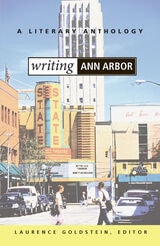
Writing Ann Arbor
A Literary AnthologyLaurence Goldstein, Editor
University of Michigan Press, 2005
The anthology is eclectic and engaging, with many wonderful surprises: an essay on the Underground Railroad in Ann Arbor; one on basketball legend Cazzie Russell; an essay by Arthur Miller; an excerpt from Joyce Carol Oates's All the Good People I've Left Behind; a selection from Tender at the Bone: Growing Up at the Table by food writer and Gourmet magazine editor Ruth Reichl; and much more.
This is more than a series of portraits of Ann Arbor and the University of Michigan; it is a miniature time capsule, a look into the shifting cultural currents of the last two centuries from some of the greatest thinkers and writers of those times.
Poet and literary scholar Laurence Goldstein is Professor of English at the University of Michigan and Editor of the Michigan Quarterly. He is the author of three books of poetry and several books of literary criticism, including The American Poet at the Movies.
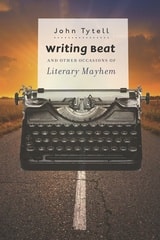
Writing Beat and Other Occasions of Literary Mayhem
John Tytell
Vanderbilt University Press, 2014
Approaching the history of post-war twentieth century American literature, and in particular the Beat literary movement of Kerouac, Ginsberg, Burroughs, and others, Tytell finds himself uniquely positioned as an eyewitness to many of these stories. In this book, he shares his insight with the reader. As he interviewed, drank, traveled, and survived countless moments with some of these literary legends, Tytell discovered much about the craft of nonfiction, biography, and the nature of history. Writing Beat demonstrates, through Tytell's growth as a professor and historian of the Beats, lessons learned and hazards encountered for those aspiring to become writers themselves.
As we approach the sixtieth anniversary of Allen Ginsberg's Howl, Writing Beat reminds us writers do not spring to life fully formed, and the struggle to get to literature can be a blast.
Writing Home
Indigenous Narratives of ResistanceMichael D. Wilson
Michigan State University Press, 2008
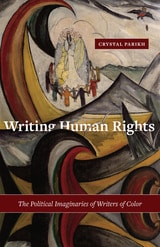
Writing Human Rights
The Political Imaginaries of Writers of ColorCrystal Parikh
University of Minnesota Press, 2017
The legal texts and aspirational ideals of human rights are usually understood and applied in a global context with little bearing on the legal discourse, domestic political struggles, or social justice concerns within the United States. In Writing Human Rights, Crystal Parikh uses the international human rights regime to read works by contemporary American writers of color—Toni Morrison, Chang-rae Lee, Ana Castillo, Aimee Phan, and others—to explore the conditions under which new norms, more capacious formulations of rights, and alternative kinds of political communities emerge.
Parikh contends that unlike humanitarianism, which views its objects as victims, human rights provide avenues for the creation of political subjects. Pairing the ethical deliberations in such works as Beloved and A Gesture Life with human rights texts like the United Nations Convention Against Torture, she considers why principles articulated as rights in international conventions and treaties—such as the right to self-determination or the right to family—are too often disregarded at home. Human rights concepts instead provide writers of color with a deeply meaningful method for political and moral imagining in their literature.
Affiliating transnational works of American literature with decolonization, socialist, and other political struggles in the global south, this book illuminates a human rights critique of idealized American rights and freedoms that have been globalized in the twenty-first century. In the absence of domestic human rights enforcement, these literatures provide a considerable repository for those ways of life and subjects of rights made otherwise impossible in the present antidemocratic moment.
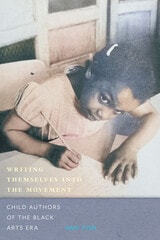
Writing Themselves into the Movement
Child Authors of the Black Arts EraAmy Fish
University of Massachusetts Press, 2024
Between 1967 and 1972, a previously obscure group of authors entered the US cultural spotlight. During this five-year period, at least thirty anthologies of poetry and prose by African American, Latinx, Asian American, and Native American children came out of adult-led workshops, classrooms, and sites of juvenile incarceration. Mass-market publishers, independent imprinters, and local mimeograph machines produced volumes with titles such as I Am Somebody! and The Me Nobody Knows: Children’s Voices from the Ghetto. These young writers actively participated in the Black Arts Movement, and some collaborated with well-known adult authors, most prominently June Jordan. Their anthologies gained national media coverage, occasionally became bestsellers, were quoted by James Baldwin, and even inspired a hit Broadway musical. While writings by children had long attracted adult attention, this flurry of youth writing and publishing was distinguished by the widespread belief that children of color from poor and working-class neighborhoods were uniquely able to speak truth about American racism and inequality.
Focusing on Black and Latinx youth authorship within New York City, and using deep archival research and elegant close readings, Amy Fish examines child-authored texts of this era within the context of their literary production and reception. These young writers were often supervised and edited by white adults, raising concerns about the authenticity and agency of their voices. Fish contends that young authors themselves shared these concerns and that they employed savvy rhetorical strategies of address, temporality, and trope to self-consciously interrogate the perils and possibilities of their adult-influenced work. Young writers thus contributed to the era’s important debates about the nature of authorship and readership within a racist society, while also using their writing as an intimate occasion of self-discovery.
Writing Women's Communities
The Politics and Poetics of Contemporary Multi-Genre AnthologiesCynthia G. Franklin
University of Wisconsin Press, 1997
Beginning in the 1980s, a number of popular and influential anthologies organized around themes of shared identity—Nice Jewish Girls, This Bridge Called My Back, Home Girls, and others—have brought together women’s fiction and poetry with journal entries, personal narratives, and transcribed conversations. These groundbreaking multi-genre anthologies, Cynthia G. Franklin demonstrates, have played a crucial role in shaping current literary studies, in defining cultural and political movements, and in building connections between academic and other communities.
Exploring intersections and alliances across the often competing categories of race, class, gender, and sexuality, Writing Women’s Communities contributes to current public debates about multiculturalism, feminism, identity politics, the academy as a site of political activism, and the relationship between literature and politics.
Writing across the Color Line
U.S. Print Culture and the Rise of Ethnic Literature, 1877-1920Lucas A. Dietrich
University of Massachusetts Press, 2020
Writing across the Color Line details how this body of literature was selected for publication, edited, manufactured, advertised, and distributed, even as it faced hostile criticism and frequent misinterpretation by white readers. Shedding light on the transformative potential of multiethnic literature and the tenacity of racist attitudes that dominated the literary marketplace, Dietrich proves that Native American, African American, Latinx, Asian American, and Irish American writers of the period relied on self-caricature, tricksterism, and the careful control of authorial personae to influence white audiences.
Writing for Love and Money
A NovelKathrin Perutz
University of Arkansas Press, 1991