Results by title
4413 books match the query 'Anthropology' and 157 start with w

Waiting For The Revolution To End
Syrian Displacement, Time and SubjectivityCharlotte Al-Khalili
University College London, 2023
Based on more than three years of embedded fieldwork with Syrians displaced in the border city of Gaziantep (southern Turkey), this book places the Syrian revolution and its tragic aftermath under ethnographic scrutiny. It charts the evolution from peaceful uprising (2011) to armed confrontation (2012), descent into fully fledged conflict (2013) and finally to proxy war (2015), to propose an understanding of revolution beyond success and failure.
While the Assad regime remains in place, the Syrian revolution (al-thawra) still holds a transformational power that can be located on intimate and world-making scales. Charlotte Al-Khalili traces the unintended consequences of revolution to reveal the reshaping of Syrian life-worlds and exiles’ evolving theorizations, experiences, and imaginations of al-thawra. She describes the in-between spatio-temporal realm inhabited by Syrians displaced to Turkey as they await the revolution’s outcomes and maps the revolution’s multidimensional and multi-scalar effects on their everyday life. By following the chronology of events inside Syria and Syrians’ geography of displacement, Waiting for the Revolution to End makes the relation between revolution and displacement its centerpiece, both as an ethnographic object and an analytical device.
Walking in Cities
Quotidian Mobility as Urban Theory, Method, and PracticeEvrick Brown
Temple University Press, 2015
Walking connects the rhythms of urban life to the configuration of urban spaces. As the contributors and editors show in Walking in Cities, walking also reflects the systematic inequalities that order contemporary urban life. Walking has different meanings because it can be a way of temporarily “taking possession” of urban space, or it can make the relatively powerless more vulnerable to crime. The essays in Walking in Cities explore how walking intersects with sociological dimensions such as gender, race and ethnicity, social class, and power.
Various chapters explorethe flâneuse, or female urban drifter, in Tehran’s shopping malls; Hispanic neighborhoods in New York, San Diego, and El Paso; and the intra-neighborhood and inter-class dynamics of gentrification in Greenpoint, Brooklyn.The essays in Walking in Cities provide important lessons about urban life.

Wall Street Women
Melissa S. Fisher
Duke University Press, 2012
Fisher charts the evolution of the women's careers, the growth of their political and economic clout, changes in their perspectives and the cultural climate on Wall Street, and their experiences of the 2008 financial collapse. While most of the pioneering subjects of Wall Street Women did not participate in the women's movement as it was happening in the 1960s and 1970s, Fisher argues that they did produce a "market feminism" which aligned liberal feminist ideals about meritocracy and gender equity with the logic of the market.

Walter Benjamin's Grave
Michael Taussig
University of Chicago Press, 2006
“Looking over these essays written over the past decade,” writes Taussig, “I think what they share is a love of muted and defective storytelling as a form of analysis. Strange love indeed; love of the wound, love of the last gasp.” Although thematically these essays run the gamut—covering the monument and graveyard at Port Bou, discussions of peasant poetry in Colombia, a pact with the devil, the peculiarities of a shaman’s body, transgression, the disappearance of the sea, New York City cops, and the relationship between flowers and violence—each shares Taussig’s highly individual brand of storytelling, one that depends on a deep appreciation of objects and things as a way to retrieve even deeper philosophical and anthropological meanings. Whether he finds himself in Australia, Colombia, Manhattan, or Spain, in the midst of a book or a beach, whether talking to friends or staring at a monument, Taussig makes clear through these marvelous essays that materialist knowledge offers a crucial alternative to the increasingly abstract, globalized, homogenized, and digitized world we inhabit.
Pursuing an adventure that is part ethnography, part autobiography, and part cultural criticism refracted through the object that is Walter Benjamin’s grave, Taussig, with this collection, provides his own literary memorial to the twentieth century’s greatest cultural critic.
Wandering Peoples
Colonialism, Ethnic Spaces, and Ecological Frontiers in Northwestern Mexico, 1700–1850Cynthia Radding
Duke University Press, 1997
Radding describes this colonial mission not merely as an instance of Iberian expansion but as a site of cultural and political confrontation. This alternative vision of colonialism emphasizes the economic links between mission communities and Spanish mercantilist policies, the biological consequences of the Spanish policy of forced congregación, and the cultural and ecological displacements set in motion by the practices of discipline and surveillance established by the religious orders. Addressing wider issues pertaining to ethnic identities and to ecological and cultural borders, Radding’s analysis also underscores the parallel production of colonial and subaltern texts during the course of a 150-year struggle for power and survival.
Wandering Spirits
Loneliness and Longing in GreenlandJanne Flora
University of Chicago Press, 2019
In this innovative study, Flora focuses on Inuit communities in Greenland and addresses a central puzzle: their alarmingly high suicide rate. She explores the deep connections between loneliness and modernity in the Arctic, tracing the history of Greenland and analyzing the social dynamics that shaped it. Flora’s thorough, sensitive engagement with the families that make up these communities uncovers the complex interplay between loneliness and a host of economic and environmental practices, including the widespread local tradition of hunting. Wandering Spirits offers a vivid portrait of a largely overlooked world, in all its fragility and nuance, while engaging with core anthropological concerns of kinship and the structure of social relations.
War by Other Means
Aftermath in Post-Genocide GuatemalaCarlota McAllister and Diane M. Nelson, eds.
Duke University Press, 2013
Contributors consider a wide range of issues confronting present-day Guatemala: returning refugees, land reform, gang violence, neoliberal economic restructuring, indigenous and women's rights, complex race relations, the politics of memory, and the challenges of sustaining hope. From a sweeping account of Guatemalan elites' centuries-long use of violence to suppress dissent to studies of intimate experiences of complicity and contestation in richly drawn localities, War by Other Means provides a nuanced reckoning of the injustices that made genocide possible and the ongoing attempts to overcome them.
Contributors. Santiago Bastos, Jennifer Burrell, Manuela Camus, Matilde González-Izás, Jorge Ramón González Ponciano, Greg Grandin, Paul Kobrak, Deborah T. Levenson, Carlota McAllister, Diane M. Nelson, Elizabeth Oglesby, Luis Solano, Irmalicia Velásquez Nimatuj, Paula Worby

Warfare and the Dynamics of Political Control
Edited by Brian R. Billman
University of Arizona Press, 2025
Warfare and the Dynamics of Political Control draws on a wealth of interdisciplinary perspectives to explore how conflict shapes the establishment and maintenance of political institutions, from small-scale societies to expansive empires. The book examines the material and ideological factors that drive warfare, the organization of combatants, the ways leaders use violence to consolidate power, and how groups resist political domination in times of conflict. By posing critical questions about the efficacy of strategies and the varied outcomes of conflict-driven power struggles, this volume offers profound insights into the dynamics of political control throughout history.
Bringing together case studies from diverse regions and time periods, Warfare and the Dynamics of Political Controlilluminates the multifaceted nature of political violence. The volume includes discussions of human sacrifice, slave-taking, ideological signaling, and military strategy and tactics. The case studies reveal how different forms of political violence influence societal structures. From the fortifications of the Māori in New Zealand to the city walls of early historic India, each contribution provides a detailed analysis of how warfare has been used to both to challenge and to establish political hierarchies. Featuring examples from small foraging communities to large empires across various regions and time periods, the book offers a wide-ranging exploration of how different groups have used and resisted political violence.
This essential work contributes to our understanding of the intersections between conflict and political power, making it a vital resource for scholars of anthropology, archaeology, political science, and history.
Warless Societies and the Origin of War
Raymond C. Kelly
University of Michigan Press, 2000
Kelly addresses fundamental questions concerning the trinity of interrelationship between human nature, war, and the constitution of society: Is war a primordial and pervasive feature of human existence or a set of practices that arose at a certain time in our recent prehistoric past? Are there peaceful societies in which war is absent and, if so, what are they like and how do they differ from warlike societies? Do the critical differentiating features pertain to child-rearing practices, to modes of conflict resolution, to social and economic inequality, to resource competition, or to the constitution of social groups?
As the conclusions of such an inquiry are central to our conceptions of human nature, the book will interest a wide range of readers, from those curious about the origins of collective violence to those studying the roles social institutions play in society.
Raymond C. Kelly is Professor of Anthropology, University of Michigan.
Warring Souls
Youth, Media, and Martyrdom in Post-Revolution IranRoxanne Varzi
Duke University Press, 2006
Highlighting trends that belie the government’s claim that Islamic values have taken hold—including rising rates of suicide, drug use, and sex outside of marriage—Varzi argues that by concentrating on images and the performance of proper behavior, the government’s campaign to produce model Islamic citizens has affected only the appearance of religious orthodoxy, and that the strictly religious public sphere is partly a mirage masking a profound crisis of faith among many Iranians. Warring Souls is a powerful account of contemporary Iran made more vivid by Varzi’s inclusion of excerpts from the diaries she maintained during her research and from journal entries written by Iranian university students with whom she formed a study group.

Waste Works
Vital Politics in Urban GhanaBrenda Chalfin
Duke University Press, 2023
Wastiary
A Bestiary of WasteEdited by Michael Picard, Albert Brenchat-Aguilar, Timothy Carroll, Jane Gilbert, and Nicola Miller
University College London, 2023
Wastiary: A Bestiary of Waste is a creative exercise that occupies letters, numbers, and symbols of Western academic language to compose a list of thirty-five short entries on the uncomfortable but pressing topic of waste in the contemporary world. The collection is richly illustrated with artwork, photography, collage, and mixed media and conveys the message that various forms of waste and pollution have achieved a beast-like or untamable quality, at times pungently transferring to considerations of “the human,” or humans treated as waste.
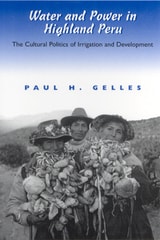
Water and Power in Highland Peru
The Cultural Politics of Irrigation and DevelopmentPaul H Gelles
Rutgers University Press, 2000
Cabanaconde, a town of 5,000 people, is located in the arid Andean highlands. It is dominated by the foreboding Hualca Hualca mountain peak that is the source of this town’s much-needed water. How the villagers obtain this water, Paul Gelles writes, is not a simple process: the politics of irrigation in this area reflect a struggle for control of vital resources, deeply rooted in the clash between local, ritualized models of water distribution and the secular model put forth by the Peruvian state. Water and Power in Highland Peru provides an insightful case study on the intense conflicts over water rights, and a framework for studying ethnic conflict and the effects of “development,” not only in Peru, but in other areas as well.
Most of the inhabitants of Cabanaconde do not identify themselves with the dominant Spanish-speaking culture found in Peru. And the Peruvian state, grounded in a racist, post-Colonial ethos, challenges the village’s long-standing, non-Western framework for organizing water management.
Gelles demonstrates that Andean culture is dynamic and adaptive, and it is a powerful source of ethnic identity, even for those who leave the village to live elsewhere. Indigenous rituals developed in this part of the world, he states, have become powerful tools of resistance against interference by local elites and the present-day Peruvian state. Most importantly, the micropolitics of Cabanaconde provide a window into a struggle that is taking place around the world.
Waterways of Bangkok
Memory, Landscape and TwilightMichael Hurley
National University of Singapore Press, 2025
This ethnographic study explores memory along the waterways, a realm of boats and hovels, merchants and war captives, temples and ghosts. The river also flows into the dissonant realities of Thailand, a country of deep conflicts over power and national ideology. Based on research in a time of political turmoil, centered on the late years of the long-reigning monarch, Rama IX, this book invites readers to look beyond established images of Thai society. More broadly, this work will speak to readers interested in water, cities, and the bonds of memory and landscape.
Wax and Gold
Tradition and Innovation in Ethiopian CultureDonald N. Levine
University of Chicago Press, 1965
Ways of Baloma
Rethinking Magic and Kinship From the TrobriandsMark S. Mosko
HAU, 2017
Informed by a synthesis of Strathern’s model of “dividual personhood” and Lévy-Bruhl’s theory of “participation,” Mosko upends a century of discussion and debate extending from Malinowski to anthropology’s other leading thinkers. His account of the intimate interdependencies of humans and spirits in the cosmic generation and coordination of “life” (momova) and “death” (kaliga) strikes at the nexus of anthropology’s received wisdom, and Ways of Baloma will inevitably lead practitioners and students to reflect anew on the discipline’s multifold theories of personhood, ritual agency, and sociality.
Wayward Reproductions
Genealogies of Race and Nation in Transatlantic Modern ThoughtAlys Eve Weinbaum
Duke University Press, 2004
Gracefully traversing a wide range of discourses––including literature, evolutionary theory, early anthropology, Marxism, feminism, and psychoanalysis––Weinbaum traces a genealogy of the race/reproduction bind within key intellectual formations of the late nineteenth and twentieth centuries. She examines two major theorists of genealogical thinking—Friedrich Nietzsche and Michel Foucault—and unearths the unacknowledged ways their formulations link race and reproduction. She explores notions of kinship and the replication of racial difference that run through Charlotte Perkins Gilman’s work; Marxist thinking based on Friedrich Engel’s The Origin of the Family; Charles Darwin’s theory of sexual selection; and Sigmund Freud’s early studies on hysteria. She also describes W. E. B. Du Bois’s efforts to transcend ideas about the reproduction of race that underwrite citizenship and belonging within the United States. In a coda, Weinbaum brings the foregoing analysis to bear on recent genomic and biotechnological innovations.
We Alone Will Rule
Native Andean Politics in the Age of InsurgencySinclair Thomson
University of Wisconsin Press, 2003
We Are All Equal
Student Culture and Identity at a Mexican Secondary School, 1988–1998Bradley A. U. Levinson
Duke University Press, 2001
Exploring how students develop a cultural “game of equality” that enables them to identify—across typical class and social boundaries—with their peers, the school, and the nation, Levinson considers such issues as the organizational and discursive resources that students draw on to maintain this culture. He also engages cultural studies, media studies, and globalization theory to examine the impact of television, music, and homelife on the students and thereby better comprehend—and problematize—the educational project of the state. Finding that an ethic of solidarity is sometimes used to condemn students defined as different or uncooperative and that little attention is paid to accommodating the varied backgrounds of the students—including their connection to indigenous, peasant, or working class identities—Levinson reveals that their “schooled identity” often collapses in the context of migration to the United States or economic crisis in Mexico. Finally, he extends his study to trace whether the cultural game is reinforced or eroded after graduation as well as its influence relative to the forces of family, traditional gender roles, church, and global youth culture.
We Are All Equal will be of particular interest to educators, sociologists, Latin Americanists, and anthropologists.

We Are Important People Now
Kichwa Tourism, Indigeneity, and Masculinity in Ecuador’s AmazonErnesto J. Benitez
University of Alabama Press, 2026
How the “ecoprimitivist” tourism boom of the early 1990s reshaped the lives of young Kichwa men
We Are Important People Now illuminates the trajectories and life experiences of young Napo Kichwa men who have worked as tour guides in the Ecuadorian Upper Amazon, in the wake of the “ecoprimitivist” tourism boom of the early 1990s. Anthropologist Ernesto J. Benitez analyzes the socioeconomic situation of these men and the motivations and desires that drive them to seek service-based employment. Benitez discusses how the tour guides go through complex processes of transition and adjustment navigating tourists’ expectations, familial obligations, and desires for socioeconomic mobility. The opportunities for self-transformation are at once attractive and fraught with contradictions. They now see their indigeneity as an asset, but their urban lifestyles, pursuits of intimate relationships with foreign tourists, and sometimes-dismissive attitudes toward Kichwa people in rural Ecuador distance them socially from the broader Kichwa population.
Importantly, the book interrogates the possibilities and limitations that produce—and are produced by—such emergent forms of identity formation, situating the current period within a broader analysis of the colonial and postcolonial history of the area. It pays special attention to how different processes of interaction with and incorporation into colonial and state productive and biopolitical regimes have impacted the historical production and performance of Kichwa ethnic and gendered identities in the Upper Amazon region. A wide swath of anthropologists, Latin Americanists, and gender and Indigenous studies specialists will be edified by this timely and accessible narrative.
We Are the Face of Oaxaca
Testimony and Social MovementsLynn Stephen
Duke University Press, 2013
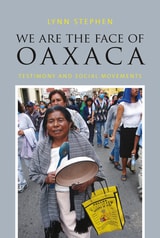
The movement was met with violent repression. Participants were imprisoned, tortured, and even killed. Lynn Stephen emphasizes the crucial role of testimony in human rights work, indigenous cultural history, community and indigenous radio, and women's articulation of their rights to speak and be heard. She also explores transborder support for APPO, particularly among Oaxacan immigrants in Los Angeles. The book is supplemented by a website featuring video testimonials, pictures, documents, and a timeline of key events.
We Are the State!
Barrio Activism in Venezuela’s Bolivarian RevolutionCristobal Valencia
University of Arizona Press, 2015
The author offers an anthropological analysis of the state, social movements, and democracy as lived experiences of the poor, gendered, and racialized residents of two parishes in Caracas, Venezuela, and Afro-Venezuelan communities nearby. Ethnographic research reveals the shift in relationships of power and the evolving political practices among the Chavistas, the Chávez government, and the opposition. Examining the subjective experiences of barrio residents in everyday processes of state formation, this book provides a new perspective on the Chavistas, arguing that they are a broad-based social movement and driving force behind a revolution struggling to transfer state power to organized civil society.
Through his intense engagement with the constantly changing social, political, and economic dynamics, Valencia dramatically challenges top-down understandings of the state and power in Venezuela. He shows the unequal relationships between sectors of civil society, and he shows state formation as a process enmeshed in the struggles for social justice, demonstrating that the state is a sociopolitical entity that acts through civil society, rather than above it.
We Can't Wait
Disability Practices NowMichele Ilana Friedner
University of Minnesota Press, 2027
How disabled people and those around them create inhabitable worlds in an ableist present
In the rush to build a better tomorrow, disability rights advocates often focus their energies on planning for a more inclusive future while critiquing today’s inaccessible society. In We Can’t Wait, Michele Ilana Friedner instead offers a new lens on the current daily acts of worldmaking performed by disabled people, their kin, and nondisabled allies, attending to the joys and complexities that arise within these spaces.
Examining three educational sites in India—a foundation-run school for intellectually disabled children, the complex relationship between a college’s sign language interpreter and the students she works with, and abundant disabled student activism at a university—Friedner’s vivid ethnographic analysis bears witness to the physical, cognitive, and emotional labor with which disabled people and their social circles build inhabitable worlds as they are made to wait for an accessible feature that may never arrive. This practice of antiabandonment distributes agency throughout these communities and stretches social worlds in crucial ways.
Drawing from Alice Wong’s proclamation that disabled people are oracles of our collective futures, We Can’t Wait uplifts affirming approaches to today’s world in which no one is left behind and disabled ways of being can thrive—a care that is needed now, without delay.
Retail e-book files for this title are screen-reader friendly.
We Cannot Forget
Interviews with Survivors of the 1994 Genocide in RwandaTotten, Samuel
Rutgers University Press, 2011
During a one-hundred-day period in 1994, Hutus murdered between half a million and a million Tutsi in Rwanda. The numbers are staggering; the methods of killing were unspeakable. Utilizing personal interviews with trauma survivors living in Rwandan cities, towns, and dusty villages, We Cannot Forget relates what happened during this period and what their lives were like both prior to and following the genocide.
Through powerful stories that are at once memorable, disturbing, and informative, readers gain a critical sense of the tensions and violence that preceded the genocide, how it erupted and was carried out, and what these people faced in the first sixteen years following the genocide.
We Do Not Have Borders
Greater Somalia and the Predicaments of Belonging in KenyaKeren Weitzberg
Ohio University Press, 2017
Though often associated with foreigners and refugees, many Somalis have lived in Kenya for generations, in many cases since long before the founding of the country. Despite their long residency, foreign and state officials and Kenyan citizens often perceive the Somali population to be a dangerous and alien presence in the country, and charges of civil and human rights abuses have mounted against them in recent years.
In We Do Not Have Borders, Keren Weitzberg examines the historical factors that led to this state of affairs. In the process, she challenges many of the most fundamental analytical categories, such as “tribe,” “race,” and “nation,” that have traditionally shaped African historiography. Her interest in the ways in which Somali representations of the past and the present inform one another places her research at the intersection of the disciplines of history, political science, and anthropology.
Given tragic events in Kenya and the controversy surrounding al-Shabaab, We Do Not Have Borders has enormous historical and contemporary significance, and provides unique inroads into debates over globalization, African sovereignty, the resurgence of religion, and the multiple meanings of being African.
We Live with the Sea
Ecologizing Safety in Post-Tsunami JapanAndrew Littlejohn
Duke University Press, 2026
We Remember, We Love, We Grieve
Mortuary and Memorial Practice in Contemporary RussiaElizabeth Warner and Svetlana Adonyeva
University of Wisconsin Press, 2021
“We remember, we love, we grieve” is a common epitaph in this part of the world. As contemporary Russia contends with the Soviet Union’s legacy of dismantling older ways of life, the phrase ripples beyond individual loss—it encapsulates communities’ determination to preserve their customs when faced with oppression. This volume offers insight into a core cultural practice, exploring the dynamism of tradition.
We Shall Not Be Moved/No nos moveran
Biography of a Song of StruggleDavid Spener
Temple University Press, 2016
The activist anthem “We Shall Not Be Moved” expresses resolve in the face of adversity; it helps members of social movements persevere in their struggles to build a better world. The exact origins of the song are unknown, but it appears to have begun as a Protestant revival song sung by rural whites and African slaves in the southeastern United States in the early nineteenth century. The song was subsequently adopted by U.S. labor and civil rights activists, students and workers opposing the Franco dictatorship in Spain, and by Chilean supporters of that country’s socialist government in the early 1970s.
In his fascinating biography, We Shall Not Be Moved, David Spener details the history and the role the song has played in each of the movements in which it has been sung. He analyzes its dissemination, function, and meaning through a number of different sociological and anthropological lenses to explore how songs can serve as an invaluable resource to participants in movements for social change.
We Stay the Same
Subsistence, Logging, and Enduring Hopes for Development in Papua New GuineaJason Steadman Roberts
University of Arizona Press, 2024
Following a long history of smaller-scale and largely unsuccessful resource development efforts, New Hanover became the site of three multinational-controlled special agricultural and business leases (SABLs) that combined to cover over 75 percent of the island for ninety-nine-year lease terms. These agroforestry projects were part of a national effort to encourage “sustainable” rural development by tapping into the growing global demand for agricultural lands and crops like oil palm and biofuels. They were supposed to succeed where the smaller-scale projects of the past had failed. Unfortunately, these SABLs resulted in significant forest loss and livelihood degradation, while doing little to promote the type of economic development that many Lavongai had been hoping for.
It is within this context that We Stay the Same grounds questions of hope for transformative economic change within Lavongai assessments of the inequitable relationships between global processes of resource development and the local lives that have become increasingly defined by the necessities and failures of these processes. Written in a clear and relatable style for students, We Stay the Same combines ethnographic and ecological research to show how the Lavongai continue to survive and make meaningful lives in a situation where their own hopes for a better future have often been used against them as a mechanism of a more distantly profitable dispossession.
We Were Adivasis
Aspiration in an Indian Scheduled TribeMegan Moodie
University of Chicago Press, 2015
Moodie takes readers to a diversity of settings, including households, tribal council meetings, and wedding festivals, to reveal the aspirations that are expressed in each. Crucially, she demonstrates how such aspiration and identity-building are strongly gendered, requiring different dispositions required of men and women in the pursuit of collective social uplift. The Dhanka strategy for occupying the role of adivasi in urban India comes at a cost: young women must relinquish dreams of education and employment in favor of community-sanctioned marriage and domestic life. Ultimately, We Were Adivasis explores how such groups negotiate their pasts to articulate different visions of a yet uncertain future in the increasingly liberalized world.
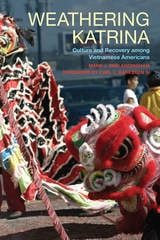
Weathering Katrina
Culture and Recovery among Vietnamese AmericansMark J. VanLandingham
Russell Sage Foundation, 2017
In 2005, Hurricane Katrina devastated New Orleans. The principal Vietnamese-American enclave was a remote, low-income area that flooded badly. Many residents arrived decades earlier as refugees from the Vietnam War and were marginally fluent in English. Yet, despite these poor odds of success, the Vietnamese made a surprisingly strong comeback in the wake of the flood. In Weathering Katrina, public health scholar Mark VanLandingham analyzes their path to recovery, and examines the extent to which culture helped them cope during this crisis.
Contrasting his longitudinal survey data and qualitative interviews of Vietnamese residents with the work of other research teams, VanLandingham finds that on the principal measures of disaster recovery—housing stability, economic stability, health, and social adaptation—the Vietnamese community fared better than other communities. By Katrina’s one-year anniversary, almost 90 percent of the Vietnamese had returned to their neighborhood, higher than the rate of return for either blacks or whites. They also showed much lower rates of post-traumatic stress disorder than other groups. And by the second year after the flood, the employment rate for the Vietnamese had returned to its pre-Katrina level.
While some commentators initially attributed this resilience to fairly simple explanations such as strong leadership or to a set of vague cultural strengths characteristic of the Vietnamese and other “model minorities”, VanLandingham shows that in fact it was a broad set of factors that fostered their rapid recovery. Many of these factors had little to do with culture. First, these immigrants were highly selected—those who settled in New Orleans enjoyed higher human capital than those who stayed in Vietnam. Also, as a small, tightly knit community, the New Orleans Vietnamese could efficiently pass on information about job leads, business prospects, and other opportunities to one another. Finally, they had access to a number of special programs that were intended to facilitate recovery among immigrants, and enjoyed a positive social image both in New Orleans and across the U.S., which motivated many people and charities to offer the community additional resources. But culture—which VanLandingham is careful to define and delimit—was important, too. A shared history of overcoming previous challenges—and a powerful set of narratives that describe these successes; a shared set of perspectives or frames for interpreting events; and a shared sense of symbolic boundaries that distinguish them from broader society are important elements of culture that provided the Vietnamese with some strong advantages in the post-Katrina environment.
By carefully defining and disentangling the elements that enabled the swift recovery of the Vietnamese in New Orleans, Weathering Katrina enriches our understanding of this understudied immigrant community and of why some groups fare better than others after a major catastrophe like Katrina.
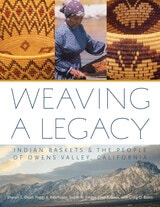
Weaving A Legacy - Paper
Indian Baskets and the People of Owens Valley, CaliforniaSharon Dean
University of Utah Press, 2005
Situated on the western edge of the Great Basin between the Sierra Nevada and White-Inyo mountain ranges, Owens Valley has been home for thousands of years to the Owens Valley Paiute and their southern neighbors, the Panamint Shoshone. The willow baskets both groups created are noteworthy for their complex construction and durability, and their materials and designs reflected available resources as well as the seminomadic existence that characterized life in the Great Basin for generations.
Since the mid-nineteenth-century arrival of non-Indians into the Valley, the baskets have changed. Weaving a Legacy places those changes in the context of the region’s dramatic social history. In addition, the volume closely examines basketry techniques and technology, historic weavers and their lineages, contemporary weavers, and basket collectors.
The text is extensively illustrated with black-and-white photographs of people, landscapes, and baskets. Among the legacies of these baskets are the stories they evoke, many of which the authors recount in this beautiful work.
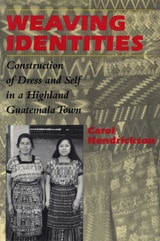
Weaving Identities
Construction of Dress and Self in a Highland Guatemala TownBy Carol Hendrickson
University of Texas Press, 1995
Traje, the brightly colored traditional dress of the highland Maya, is the principal visual expression of indigenous identity in Guatemala today. Whether worn in beauty pageants, made for religious celebrations, or sold in tourist markets, traje is more than "mere cloth"—it plays an active role in the construction and expression of ethnicity, gender, education, politics, wealth, and nationality for Maya and non-Maya alike.
Carol Hendrickson presents an ethnography of clothing focused on the traje—particularly women's traje—of Tecpán, Guatemala, a bi-ethnic community in the central highlands. She covers the period from 1980, when the recent round of violence began, to the early 1990s, when Maya revitalization efforts emerged.
Using a symbolic analysis informed by political concerns, Hendrickson seeks to increase the value accorded to a subject like weaving, which is sometimes disparaged as "craft" or "women's work." She examines traje in three dimensions—as part of the enduring images of the "Indian," as an indicator of change in the human life cycle and cloth production, and as a medium for innovation and creative expression.
From this study emerges a picture of highland life in which traje and the people who wear it are bound to tradition and place, yet are also actively changing and reflecting the wider world. The book will be important reading for all those interested in the contemporary Maya, the cultural analysis of material culture, and the role of women in culture preservation and change.
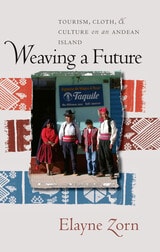
Weaving a Future
Tourism, Cloth, and Culture on an Andean IslandElayne Zorn
University of Iowa Press, 2004
The people of Taquile Island on the Peruvian side of beautiful Lake Titicaca, the highest navigable lake in the Americas, are renowned for the hand-woven textiles that they both wear and sell to outsiders. One thousand seven hundred Quechua-speaking peasant farmers, who depend on potatoes and the fish from the lake, host the forty thousand tourists who visit their island each year. Yet only twenty-five years ago, few tourists had even heard of Taquile. In Weaving a Future: Tourism, Cloth, and Culture on an Andean Island, Elayne Zorn documents the remarkable transformation of the isolated rocky island into a community-controlled enterprise that now provides a model for indigenous communities worldwide.
Over the course of three decades and nearly two years living on Taquile Island, Zorn, who is trained in both the arts and anthropology, learned to weave from Taquilean women. She also learned how gender structures both the traditional lifestyles and the changes that tourism and transnationalism have brought. In her comprehensive and accessible study, she reveals how Taquileans used their isolation, landownership, and communal organizations to negotiate the pitfalls of globalization and modernization and even to benefit from tourism. This multi-sited ethnography set in Peru, Washington, D.C., and New York City shows why and how cloth remains central to Andean society and how the marketing of textiles provided the experience and money for Taquilean initiatives in controlling tourism.
The first book about tourism in South America that centers on traditional arts as well as community control, Weaving a Future will be of great interest to anthropologists and scholars and practitioners of tourism, grassroots development, and the fiber arts.
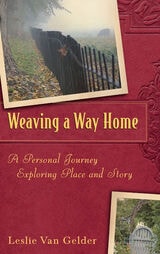
Weaving a Way Home
A Personal Journey Exploring Place and StoryLeslie Van Gelder
University of Michigan Press, 2008
An inquiry into how we engage with the world, and how solutions to environmental challenges can be found in the heart of our emotional relationships with places
"No one with a working heart will fail to be moved by Van Gelder. With passion and intelligence, she explores the way we story places and places story all life."
---Patrick Curry, Lecturer in Religious Studies, University of Kent, and author of Ecological Ethics: An Introduction and Defending Middle-Earth
"With grace and passion Leslie Van Gelder weaves together stories of her own encounters with an amazing variety of places---riverside meadows of Oxford, racially sundered Cyprus, fly-tormented Canadian muskeg, caves stroked by Paleolithic fingertips, derelict Coney Island, grasslands through which lion cubs follow the black tip of their mother’s tail---to show us how Place and Story are the warp and weft of our being as earth-dwellers."
---Tim Robinson, Folding Landscapes, and author of Connemara: Listening to the Wind
"Travel narrative, memoir, literary criticism, and anthropology fuse in this highly original and moving exploration of place and home."
---John Elder, author of Reading the Mountains of Home and Pilgrimage to Vallombrosa
"Van Gelder offers her most deeply personal stories as microcosmic examples of universal human experience, thus creating an empathic bond with her reader that conveys power and understanding simultaneously, and stimulates the reader's imagination toward reflection upon similarly personal stories of place. Van Gelder has modeled the relationship between story and place by telling placeful stories, and so has licensed the reader to do the same. Her writing throughout is rich and metaphoric. She is a gifted storyteller and a competent scholar, a combination to be treasured."
---Joseph W. Meeker, Professor Emeritus, College of Arts/Science, Union Institute and University, and author of The Spheres of Life, The Comedy of Survival, and Minding the Earth
Weaving a Way Home is an inquiry into the complex relationship between people, place, and story. In our memories and connections to a place, we are given one of the few opportunities to have deep relationships with place---relationships that cannot be described in words. Place can embody powerful emotions for us, and Leslie Van Gelder argues that we ourselves are places---geographical points possessing unique perspectives---that can feel displaced, replaced, or immovable. While the places of the external world can be accessed through maps and a good GPS system, our emotional landscapes are best reached through the sharing of stories.
In the tradition of writers Lewis Hyde, Barry Lopez, Peter Matthiessen, Joseph Meeker, Steven Mithen, Paul Shepard, Gary Snyder, and Terry Tempest Williams, Van Gelder uses both creative nonfiction narrative and evolutionary biological theory to explore complex terrain. Following Van Gelder's own travels, the book moves from the caves of the Dordogne lit only by the small beam of a flashlight, to an acacia thicket in Mozambique, to a black fly–infested bay inappropriately named Baie de Ha Ha in the inlands of Quebec, to the green line wrapped in barbed wire separating northern and southern Cyprus, to Abu Simbel's empty stone eyes in the Egyptian desert, and finally to the high road above Pelorus Sound on the rocky coasts of New Zealand. The author takes the reader to each place to create a storied landscape and explore new intellectual terrain. Van Gelder shows us that our collections of experiences, unique to us, can only be shared through the articulation of narrative.Weaving a Way Home will appeal to those deeply interested in knowing how we forge relationships with places and how that shapes who we are.
Jacket photographs: Garden gate: © iStockphoto.com/Richard Goerg. Iron fence: Christ Church Meadow in Oxford, Leslie Van Gelder.
Author photograph: Kevin Sharpe
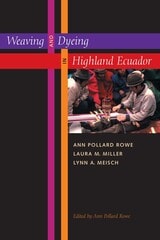
Weaving and Dyeing in Highland Ecuador
By Ann Pollard Rowe, Laura M. Miller, and Lynn A. Meisch
University of Texas Press, 2007
Although less well known than its much-admired counterparts in Peru and Bolivia, highland Ecuadorian weaving is an Andean tradition that has relationships with these more southern areas. A world away from the industrialized textile manufacturing of Euro-American society, these handmade pieces reflect the history and artistry of an ancient culture.
This comprehensive study, edited by Ann Pollard Rowe, is unrivaled in its detail and includes not only descriptions of the indigenous weaving and dyeing technology, but also an interpretation of its historical significance, as well as hundreds of photographs, drawings, and maps that inform the understanding of the process.
The principal focus is on backstrap-loom weaving, a major pre-Hispanic technology. Ecuadorian backstrap looms, which differ in various ways from those found elsewhere in the Andes, have previously only been treated in general terms. Here, the basic operation of this style of loom is covered, as are a variety of patterning techniques including warp-resist (ikat) dyeing, weaving belts with twill, and supplementary- and complementary-warp patterning. Spanish colonial treadle-loom weaving is also covered. The weaving techniques are explained in detail, so the reader can replicate them if desired.
Textiles have been an important art form among Andean peoples from remote prehistory up to the present. A greater understanding of their creation process can yield a more meaningful appreciation of the art itself.

Weaving the Threads of Life
The Khita Gyn-Eco-Logical Healing Cult among the YakaRené Devisch
University of Chicago Press, 1993
Drawing on many years among urban and rural Yaka, Devisch analyzes their understanding of existence as a fabric of firmly but delicately interwoven threads of nature, body, and society. The fertility healing ritual calls forth forces, feelings, and meanings that allow women to rejoin themselves to the complex pattern of social and cosmic life. These elaborate rites—whether simulating mortal agony and rebirth, gestation and delivery, or flowering and decay; using music and dance, steambath or massage, dream messages or scarification—are not based on symbols of traditional beliefs. Rather, Devisch shows, the rites themselves generate forces and meaning, creating and shaping the cosmic, physical, and social world of their participants.
In contrast to current theoretical methods such as postmodern or symbolical interpretation, Devisch's praxiological approach is unique in also using phenomenological insights into the intent and results of anthropological fieldwork. This innovative work will have ramifications beyond African studies, reaching into the anthropology of medicine and the body, comparative religious history, and women's studies.
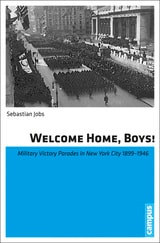
Welcome Home, Boys!
Military Victory Parades in New York City 1899-1946Sebastian Jobs
Campus Verlag, 2012
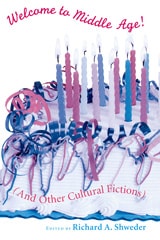
Welcome to Middle Age!
(And Other Cultural Fictions)Edited by Richard A. Shweder
University of Chicago Press, 1998
In this volume, anthropologists, behavioral scientists, and historians explore topics ranging from the Western ideology of "midlife decline" to cultural representations of mature adulthood that operate without the category of middle age. The result is a fascinating, panoramic collection that explores the myths surrounding and the representations of mature adulthood and of those years in the life span from thirty to seventy.
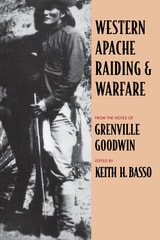
Western Apache Raiding and Warfare
From the Notes of Grenville Goodwin; Edited by Keith Basso
University of Arizona Press, 1971
Western Apache Witchcraft
Keith H. Basso
University of Arizona Press, 1969
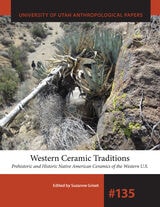
Western Ceramic Traditions
Prehistoric and Historic Native American Ceramics of the Western U.S.Edited by Suzanne Griset
University of Utah Press, 2021
This volume is dedicated to studies of plainwares—the undecorated ceramics that make up the majority of prehistoric ceramic assemblages worldwide. Early analyses of ceramics focused on changes in decorative design elements to establish chronologies and cultural associations. With the development of archaeometric techniques that allow direct dating of potsherds and identification of their elemental composition and residues, plainwares now provide a new source of information about the timing, manufacture, distribution, and use of ceramics.
This book investigates plainwares from the far west, stretching into the Great Basin and the northwestern and southwestern edges of Arizona. Contributors use and explain recent analytical methods, including neutron activation, electron microprobe analysis, and thin-section optical mineralogy. They examine native ceramic traditions and how they were influenced by the Spanish mission system, and they consider the pros and cons of past approaches to ware typology, presenting a vision of how plainware analysis can be improved by ignoring the traditional “typological” approach of early ceramicists working with decorated wares.
This work provides a much-needed update to plainware studies, with new hypotheses and data that will help set the stage for future research.

What About Mozart? What About Murder?
Reasoning From CasesHoward S. Becker
University of Chicago Press, 2014
Becker draws on a lifetime of sociological research and wisdom to show, in helpful detail, how to use a variety of kinds of cases to build sociological knowledge. With his trademark conversational flair and informal, personal perspective Becker provides a guide that researchers can use to produce general sociological knowledge through case studies. He champions research that has enough data to go beyond guesswork and urges researchers to avoid what he calls “skeleton cases,” which use fictional stories that pose as scientific evidence. Using his long career as a backdrop, Becker delivers a winning book that will surely change the way scholars in many fields approach their research.
What Are Poets For?
An Anthropology of Contemporary Poetry and PoeticsGerald L. Bruns
University of Iowa Press, 2012
Conceptions and practices of poetry change not only from time to time and from place to place but also from poet to poet. This has never been more the case than in recent years. Gerald Bruns’s magisterial What Are Poets For? explores typographical experiments that distribute letters randomly across a printed page, sound tracks made of vocal and buccal noises, and holographic poems that recompose themselves as one travels through their digital space. Bruns surveys one-word poems, found texts, and book-length assemblies of disconnected phrases; he even includes descriptions of poems that no one could possibly write, but which are no less interesting (or no less poetic) for all of that. The purpose of the book is to illuminate this strange poetic landscape, spotlighting and describing such oddities as they appear, anomalies that most contemporary poetry criticism ignores.
What Color Is the Sacred?
Michael Taussig
University of Chicago Press, 2009
Over the past thirty years, visionary anthropologist Michael Taussig has crafted a highly distinctive body of work. Playful, enthralling, and whip-smart, his writing makes ingenious connections between ideas, thinkers, and things. An extended meditation on the mysteries of color and the fascination they provoke, What Color Is the Sacred? is the next step on Taussig’s remarkable intellectual path.
Following his interest in magic and surrealism, his earlier work on mimesis, and his recent discussion of heat, gold, and cocaine in My Cocaine Museum,this book uses color to explore further dimensions of what Taussig calls “the bodily unconscious” in an age of global warming. Drawing on classic ethnography as well as the work of Benjamin, Burroughs, and Proust, he takes up the notion that color invites the viewer into images and into the world. Yet, as Taussig makes clear, color has a history—a manifestly colonial history rooted in the West’s discomfort with color, especially bright color, and its associations with the so-called primitive. He begins by noting Goethe’s belief that Europeans are physically averse to vivid color while the uncivilized revel in it, which prompts Taussig to reconsider colonialism as a tension between chromophobes and chromophiliacs. And he ends with the strange story of coal, which, he argues, displaced colonial color by giving birth to synthetic colors, organic chemistry, and IG Farben, the giant chemical corporation behind the Third Reich.
Nietzsche once wrote, “So far, all that has given colour to existence still lacks a history.” With What Color Is the Sacred? Taussig has taken up that challenge with all the radiant intelligence and inspiration we’ve come to expect from him.
What Goes Around Comes Around
edited by Kimberly J. Lau, Peter Tokofsky, and Stephen Winick
Utah State University Press, 2004
What Is Anthropology?
Second EditionThomas Hylland Eriksen
Pluto Press, 2017
The first section of the book presents the history of anthropology, and the second discusses core issues in greater detail, covering economics, morals, human nature, ecology, cultural relativism, and much more. Throughout, he reveals how seemingly enormous cultural differences actually conceal the deep unity of humanity. Perfect not only for students, but also for those who have never encountered anthropology before, What is Anthropology? presents the discipline in an exciting and innovative way.
What Is Paleolithic Art?
Cave Paintings and the Dawn of Human CreativityJean Clottes
University of Chicago Press, 2016
In this book, Jean Clottes, one of the most renowned figures in the study of cave paintings, pursues an answer to this “why” of Paleolithic art. While other books focus on particular sites and surveys, Clottes’s work is a contemplative journey across the world, a personal reflection on how we have viewed these paintings in the past, what we learn from looking at them across geographies, and what these paintings may have meant—what function they may have served—for their artists. Steeped in Clottes’s shamanistic theories of cave painting, What Is Paleolithic Art? travels from well-known Ice Age sites like Chauvet, Altamira, and Lascaux to visits with contemporary aboriginal artists, evoking a continuum between the cave paintings of our prehistoric past and the living rock art of today. Clottes’s work lifts us from the darkness of our Paleolithic origins to reveal, by firelight, how we think, why we create, why we believe, and who we are.
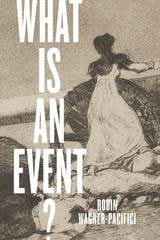
What Is an Event?
Robin Wagner-Pacifici
University of Chicago Press, 2017
What Is an Event? ranges across several disciplines, systematically analyzing the ways that events emerge, take shape, gain momentum, flow, and even get bogged down. As an exploration of how events are constructed out of ruptures, it provides a mechanism for understanding eventful forms and flows, from the micro-level of individual life events to the macro-level of historical revolutions, contemporary terrorist attacks, and financial crises. Wagner-Pacifici takes a close look at a number of cases, both real and imagined, through the reports, personal narratives, paintings, iconic images, political posters, sculptures, and novels they generate and through which they live on. What is ultimately at stake for individuals and societies in events, Wagner-Pacifici argues, are identities, loyalties, social relationships, and our very experiences of time and space. What Is an Event? provides a way for us all—as social and political beings living through events, and as analysts reflecting upon them—to better understand what is at stake in the formations and flows of the events that mark and shape our lives.
What Kinship Is-And Is Not
Marshall Sahlins
University of Chicago Press, 2013