Results by title
319 books match the query 'Communication Studies' and 17 start with w

We Are All Americans, Pure and Simple
Theodore Roosevelt and the Myth of AmericanismLeroy G. Dorsey
University of Alabama Press, 2008
Redefining American identity through Roosevelt’s words.
The turn of the 20th century represented one of the most chaotic periods in the nation's history, as immigrants, Native Americans, and African Americans struggled with their roles as Americans while white America feared their encroachments on national identity. This book examines Theodore Roosevelt’s public rhetoric—speeches, essays, and narrative histories—as he attempted to craft one people out of many. Leroy G. Dorsey observes that Roosevelt's solution to the problem appeared straightforward: everyone could become "Americans, pure and simple" if they embraced his notion of "Americanism." Roosevelt grounded his idea of Americanism in myth, particularly the frontier myth—a heroic combination of individual strength and character. When nonwhites and immigrants demonstrated these traits, they would become true Americans, earning an exalted status that they had heretofore been denied.
Dorsey’s analysis illuminates how Roosevelt's rhetoric achieved a number of delicate, if problematic, balancing acts. Roosevelt gave his audiences the opportunity to accept a national identity that allowed "some" room for immigrants and nonwhites, while reinforcing their status as others, thereby reassuring white Americans of their superior place in the nation. Roosevelt’s belief in an ordered and unified nation did not overwhelm his private racist attitudes, Dorsey argues, but certainly competed with them. Despite his private sentiments, he recognized that racist beliefs and rhetoric were divisive and bad for the nation’s progress. The resulting message he chose to propagate was thus one of a rhetorical, if not literal, melting pot.
By focusing on Roosevelt’s rhetorical constructions of national identity, as opposed to his personal exploits or his role as a policy maker, We Are All Americans offers new insights into Roosevelt’s use of public discourse to bind the nation together during one of the most polarized periods in its history.
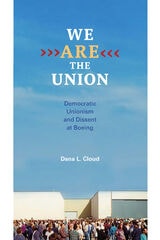
We Are the Union
Democratic Unionism and Dissent at BoeingDana L. Cloud
University of Illinois Press, 2011
We Are the Union is grounded in on-site research and interviews and focuses on the efforts by Unionists for Democratic Change to reform unions from within. Incorporating theory and methods from the fields of organizational communication as well as labor studies, Cloud methodically uncovers and analyzes the goals, strategies, and dilemmas of the dissidents who, while wanting to uphold the ideas and ideals of the union, took up the gauntlet to make it more responsive to workers and less conciliatory toward management, especially in times of economic stress or crisis. Cloud calls for a revival of militant unionism as a response to union leaders' embracing of management and training programs that put workers in the same camp as management, arguing that reform groups should look to the emergence of powerful industrial unions in the United States for guidance on revolutionizing existing institutions and building new ones that truly accommodate workers' needs.
We Can Do Better
Feminist Manifestos for Media and CommunicationLinda Steiner
Rutgers University Press, 2025
Web Writing
Why and How for Liberal Arts Teaching and LearningJack Dougherty and Tennyson O'Donnell, editors
University of Michigan Press, 2015

What Are Stem Cells?
Definitions at the Intersection of Science and PoliticsJohn Lynch
University of Alabama Press, 2011
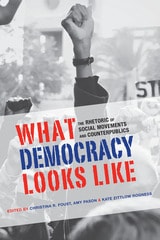
What Democracy Looks Like
The Rhetoric of Social Movements and CounterpublicsEdited by Christina R. Foust, Amy Pason, and Kate Zittlow Rogness
University of Alabama Press, 2017
Examining How Social Movements and Counterpublics Shape Democratic Change.
Recent protests around the world (such as the Arab Spring uprisings and Occupy Wall Street movements) have drawn renewed interest to the study of social change and, especially, to the manner in which words, images, events, and ideas associated with protestors can “move the social.” What Democracy Looks Like is an attempt to foster a more coherent understanding of social change among scholars of rhetoric and communication studies by juxtaposing the ideas of social movements and counterpublics—historically two key factors significant in the study of social change. Foust, Pason, and Zittlow Rogness’s volume compiles the voices of leading and new scholars who are contributing to the history, application, and new directions of these two concepts, all in conversation with a number of acts of resistance or social change.
The theories of social movements and counterpublics are related, but distinct. Social movement theories tend to be concerned with enacting policy and legislative changes. Scholars flying this flag have concentrated on the organization and language (for example, rallies and speeches) that are meant to enact social change. Counterpublic theory, on the other hand, focuses less on policy changes and more on the unequal distribution of power and resources among different protest groups, which is sometimes synonymous with subordinated identity groups such as race, gender, sexuality, and class.
Nonetheless, contributors argue that in recent years the distinctions between these two methods have become less evident. By putting the literatures of the two theories in conversation with one another, these scholars seek to promote and imagine social change outside the typical binaries.
What's Fair on the Air?
Cold War Right-Wing Broadcasting and the Public InterestHeather Hendershot
University of Chicago Press, 2011

Whenever Two or More Are Gathered
Relationship as the Heart of Ethical DiscourseMichael M. Harmon and O. C. McSwite
University of Alabama Press, 2011
A Scholarly Exploration of How Relationships Shape Moral Understanding.
Whenever Two or More Are Gathered focuses on the critical role of ethics and moral responsibility in the field of public administration. Michael M. Harmon and O. C. McSwite posit that administrative ethics, as presently conceived and practiced, is largely a failure, incapable of delivering on its original promise of effectively regulating official conduct in order to promote the public interest. They argue that administrative ethics is compromised at its very foundations by two core assumptions: that human beings act rationally and that language is capable of conveying clear, stable, and unambiguous principles of ethical conduct.
The result is the illusion that values, principles, and rules of ethical conduct can be specified in workably clear ways, in particular, through their formalization in official codes of ethics; that people are capable of comprehending and responding to them as they are intended; and that the rewards and punishments attached to them will be effective in structuring daily behavior.
In a series of essays that draw on both fiction and film, as well as the disciplines of pragmatism, organizational theory, psychoanalysis, structural linguistics, and economics, Harmon and McSwite make their case for human relationship as the proper foundation of administrative ethics. “Exercising responsible ethical practice requires attaining a special kind of relationship with other people. Relationship is how the pure freedom that resides in the human psyche—for ethical choice, creativity, or original action of any type—can be brought into the structured world of human social relations without damaging or destroying it.” Furthermore, they make the case for dropping the term “ethics” in favor of the term “responsibility,” as “responsibility accentuates the social [relational] nature of moral action.”
Where We Start
A Practical Guide to Technical Communication Program AdministrationK. Alex Ilyasova
Utah State University Press, 2026
Providing practical, pragmatic guidance for current and aspiring administrators, Where We Start is the first book in technical communication that professionalizes administrativework and practices, offering practical advice on curricular, undergraduate, and graduate program development.
Where We Start teaches by example with each chapter combining personal knowledge with published research to direct readers toward their own practices. Some ofthe most experienced program leaders in technical communication share strategies for program design, curriculum development, assessment, inclusivity, and external partnerships. The collection is divided into three main sections: Programmatic Development and Planning, which focuses on the foundational aspects of strategic planning, curriculum development, and programmatic assessment; Developing Differently, which highlights approaches to inclusivity, diversity, and unconventional career paths in program administration; and Building Beyond, which discusses strategies for expanding technical communication programs through partnerships with industry and international institutions.
A resource for administrators as well as graduate students and early-career faculty looking to understand the intricacies of program management, Where We Start fills a critical gap, offering insights from a uniquely technical communication perspective, where programmatic resources are scarce.
Where's the Rhetoric?
Imagining a Unified FieldS. Scott Graham
The Ohio State University Press, 2020
Building on this foundation, Graham then argues for a more unified approach to contemporary rhetorical inquiry—one that eschews disciplinary demarcations between rhetoric’s various subareas. Specifically, Graham uses his unified field theory to explore 1) the rise of the “tweetorial” as a parascientific genre, 2) inventional practices in new media design, 3) statistical approaches to understanding biomedical discourse, and 4) American electioneering rhetorics. The book overall demonstrates how seemingly disparate intellectual approaches within rhetoric can be made to speak productively to one another in the pursuit of shared scholarly goals around questions of genre, media, and political discourse—thereby providing a foundation for imagining a more unified field.
Wikipedia and the Politics of Openness
Nathaniel Tkacz
University of Chicago Press, 2014
But what does openness mean, and what would a political theory of openness look like? With Wikipedia and the Politics of Openness, Nathaniel Tkacz uses Wikipedia, the most prominent product of open organization, to analyze the theory and politics of openness in practice—and to break its spell. Through discussions of edit wars, article deletion policies, user access levels, and more, Tkacz enables us to see how the key concepts of openness—including collaboration, ad-hocracy, and the splitting of contested projects through “forking”—play out in reality.
The resulting book is the richest critical analysis of openness to date, one that roots media theory in messy reality and thereby helps us move beyond the vaporware promises of digital utopians and take the first steps toward truly understanding what openness does, and does not, have to offer.

Wikiworld
Juha Suoranta and Tere Vaden
Pluto Press, 2009
Wikiworld explores a revolution in the world of education. The way we learn is changing: institutionalised learning is transforming into new forms of critical learning and open collaboration. This book offers a historical and political framework to think about the future of learning and educational media.
The authors provide an overview of the use of new technologies and learning practices, and assess how the changing nature of education can lead to a more socially just future. At the same time, they place their analysis of education within a wider social and economic framework of contemporary capitalism.
Women for President
Media Bias in Eight CampaignsErika Falk
University of Illinois Press, 2007
When Hillary Clinton announced her 2008 bid for president she was the Democratic front-runner. Despite this, she received less coverage than Barack Obama, who trailed her in the polls. Such a disparity is indicative of the gender bias the media has demonstrated in covering women candidates since the first woman ran for America’s highest office in 1872. Tracing the campaigns of eight women who ran for president through 2004--Victoria Woodhull, Belva Lockwood, Margaret Chase Smith, Shirley Chisholm, Patricia Schroeder, Lenora Fulani, Elizabeth Dole, and Carol Moseley Braun--Erika Falk finds little progress in the fair treatment of women candidates. A thorough comparison of the women’s campaigns to those of their male opponents reveals a worrisome trend of sexism in press coverage--a trend that still persists today.
While women have been elected to the highest offices in countries such as England, Germany, and India, the idea that a woman could be president of the United States provokes scoffs and ridicule. The press portrays female candidates as unviable, unnatural, and incompetent, and often ignores or belittles women instead of reporting their ideas and intent. Since voters learn most details about presidential candidates through media outlets, Falk asserts that this prevailing bias calls into question the modern democratic assumption that men and women have comparable access to positions of power.
Women for President
Media Bias in Nine CampaignsErika Falk
University of Illinois Press, 2010
Newly updated to examine Hillary Clinton's formidable 2008 presidential campaign, Women for President analyzes the gender bias the media has demonstrated in covering women candidates since the first woman ran for America's highest office in 1872. Tracing the campaigns of nine women who ran for president through 2008--Victoria Woodhull, Belva Lockwood, Margaret Chase Smith, Shirley Chisholm, Patricia Schroeder, Lenora Fulani, Elizabeth Dole, Carol Moseley Braun, and Hillary Clinton--Erika Falk finds little progress in the fair treatment of women candidates. The press portrays female candidates as unviable, unnatural, and incompetent, and often ignores or belittles women instead of reporting their ideas and intent. This thorough comparison of men's and women's campaigns reveals a worrisome trend of sexism in press coverage--a trend that still persists today.
Writing Performance
Poeticizing the Researcher's BodyRonald J. Pelias
Southern Illinois University Press, 1999
Ronald J. Pelias is concerned with writing about performance, from the everyday performative routines to the texts on stage. He seeks to write performatively, to offer poetic or aesthetic renderings of performance events in order to capture some sense of their nature. In his quest for the spirit of theatrical performances, Pelias asks more of the written word than the word can deliver. Yet the attempt is both desirable—and necessary. To discuss performance without some accounting for its essence as art, he asserts, is at best misleading, at worst, fraud.
Pelias divides his efforts to present performance events into three general categories: "Performing Every Day," "On Writing and Performing," and "Being a Witness." "Performing Every Day" focuses on performances ranging from the daily business of enacting roles to the telling of tales that make life meaningful. It incorporates essays about the ongoing process of presenting oneself in everyday life; the gender script that insists that men enact manly performances; the classroom performances of teachers and students; stories of gender, class, and race that mark identity; and a performance installation entitled "A Day’s Talk."
"On Writing and Performing" examines the written script and performance practices. It includes a description of a struggle between a writer and a performer as they protect their own interests; an intimate look at an apprehensive performer; a short play entitled "The Audition"; and a chronicle of performance process from the perspective of an actor.
"Being a Witness" examines performance from the perspective of the audience and the director: being an audience member; viewing theatre in the context of New York City; directing and being directed by actors’ bodies; and watching The DEF Comedy Jam.
Writing as Punishment in Schools, Courts, and Everyday Life
Spencer Schaffner
University of Alabama Press, 2019
Writing tends to be characterized as a positive aspect of literacy that helps us to express our thoughts, to foster interpersonal communication, and to archive ideas. However, there is a vast array of evidence that emphasizes the counterbelief that writing has the power to punish, shame, humiliate, control, dehumanize, fetishize, and transform those who are subjected to it. In Writing as Punishment in Schools, Courts, and Everyday Life, Spencer Schaffner looks at many instances of writing as punishment, including forced tattooing, drunk shaming, court-ordered letters of apology, and social media shaming, with the aim of bringing understanding and recognition to the coupling of literacy and subjection.
Writing as Punishment in Schools, Courts, and Everyday Life is a fascinating inquiry into how sinister writing can truly be and directly questions the educational ideal that powerful writing is invariably a public good. While Schaffner does look at the darker side of writing, he neither vilifies nor supports the practice of writing as punishment. Rather, he investigates the question with humanistic inquiry and focuses on what can be learned from understanding the many strange ways that writing as punishment is used to accomplish fundamental objectives in everyday life.
Through five succinct case studies, we meet teachers, judges, parents, sex traffickers, and drunken partiers who have turned to writing because of its presumed power over writers and readers. Schaffner provides careful analysis of familiar punishments, such as schoolchildren copying lines, and more bizarre public rituals that result in ink-covered bodies and individuals forced to hold signs in public.
Schaffner argues that writing-based punishment should not be dismissed as benign or condemned as a misguided perversion of writing, but instead should be understood as an instrument capable of furthering both the aims of justice and degradation.

Writing in Disguise
Academic Life in SubordinationTerry Caesar
Ohio University Press, 1998
All of these texts have in common the imperative of disguise, represented as the most crucial consequence of dominant discourse, within which subordination might speak only by knowing its place, and write only by producing hidden transcripts.
Caustic, pointed, satiric, Writing in Disguise is an engaging critique of aspects of academia involving the misuse, misappropriation, and misappreciation of verbal communication in its many guises.