Results by title
158 books match the query 'Cultural assimilation' and 2 start with w
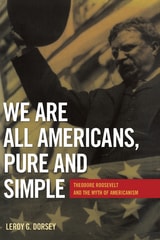
We Are All Americans, Pure and Simple
Theodore Roosevelt and the Myth of AmericanismLeroy G. Dorsey
University of Alabama Press, 2008
Redefining American identity through Roosevelt’s words.
The turn of the 20th century represented one of the most chaotic periods in the nation's history, as immigrants, Native Americans, and African Americans struggled with their roles as Americans while white America feared their encroachments on national identity. This book examines Theodore Roosevelt’s public rhetoric—speeches, essays, and narrative histories—as he attempted to craft one people out of many. Leroy G. Dorsey observes that Roosevelt's solution to the problem appeared straightforward: everyone could become "Americans, pure and simple" if they embraced his notion of "Americanism." Roosevelt grounded his idea of Americanism in myth, particularly the frontier myth—a heroic combination of individual strength and character. When nonwhites and immigrants demonstrated these traits, they would become true Americans, earning an exalted status that they had heretofore been denied.
Dorsey’s analysis illuminates how Roosevelt's rhetoric achieved a number of delicate, if problematic, balancing acts. Roosevelt gave his audiences the opportunity to accept a national identity that allowed "some" room for immigrants and nonwhites, while reinforcing their status as others, thereby reassuring white Americans of their superior place in the nation. Roosevelt’s belief in an ordered and unified nation did not overwhelm his private racist attitudes, Dorsey argues, but certainly competed with them. Despite his private sentiments, he recognized that racist beliefs and rhetoric were divisive and bad for the nation’s progress. The resulting message he chose to propagate was thus one of a rhetorical, if not literal, melting pot.
By focusing on Roosevelt’s rhetorical constructions of national identity, as opposed to his personal exploits or his role as a policy maker, We Are All Americans offers new insights into Roosevelt’s use of public discourse to bind the nation together during one of the most polarized periods in its history.
Writing Their Bodies
Restoring Rhetorical Relations at the Carlisle Indian SchoolSarah Klotz
Utah State University Press, 2020
This approach tracks the relationship between curriculum and resistance and enumerates an anti-assimilationist methodology for teachers and scholars of writing in contemporary classrooms. From the Carlisle archive emerges the concept of a rhetoric of relations, a set of Native American communicative practices that circulates in processes of intercultural interpretation and world-making. Klotz explores how embodied and material practices allowed Indigenous rhetors to maintain their cultural identities in the off-reservation boarding school system and critiques the settler fantasy of benevolence that propels assimilationist models of English education.
Writing Their Bodies moves beyond language and literacy education where educators standardize and limit their students’ means of communication and describes the extraordinary expressive repositories that Indigenous rhetors draw upon to survive, persist, and build futures in colonial institutions of education.