Results by title
240 books match the query 'Diaries' and 9 start with w
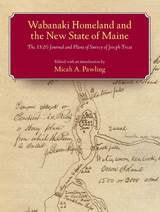
Wabanaki Homeland and the New State of Maine
The 1820 Journal and Plans of Survey of Joseph TreatMicah A. Pawling
University of Massachusetts Press, 2007
Edited, annotated, and with an introduction by Micah Pawling, this volume includes a complete transcription of Treat's journal, reproductions of dozens of hand-drawn maps, and records pertaining to the 1820 treaty between the Penobscot Nation and the governing authorities of Maine. As Pawling points out, Treat's journal offers more than the observations of a state agent conducting a survey. It re-creates a dialogue between Euro-Americans and Native peoples, showing how different perceptions of the land were negotiated and disseminated, and exposing the tensions that surfaced when assumptions and expectations clashed. In large part because of Neptune's influence, the maps, in addition to detailing the location of Wabanaki settlements, reflect a river-oriented Native perspective that would later serve as a key to Euro-American access to the region's interior.
The groundwork for cooperation between Treat and Neptune had been laid during the 1820 treaty negotiations, in which both men participated and which were successfully concluded just over a month before their expedition departed from Bangor, Maine. Despite conflicting interests and mutual suspicions, they were able to work together and cultivate a measure of trust as they traveled across northern Maine and western New Brunswick, mapping an old world together while envisioning its uncertain future.
Waiting On The Bounty
Dust Bowl Diary Mary DyckPamela Riney-Kehrberg
University of Iowa Press, 1999
Though she had only a fifth-grade education, Mary Knackstedt Dyck faithfully kept a diary. Written with pencil on lined notebook paper, her daily notations tell the story of farm life on the far western border of Kansas during the grim Dust Bowl years. Manuscript diaries from this era and region are extremely rare, and those written by farm women are even more so. From the point of view of a wife, mother, and partner in the farming enterprise, Dyck recorded the everyday events as well as the frustrations of living with drought and dust storms and the sadness of watching one's children leave the farm.
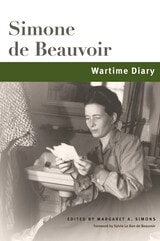
Wartime Diary
Simone de Beauvoir; Translation and Notes by Anne Deing Cordero; Edited by Margaret A. Simons and Sylvie Le Bon de Beauvoir; Foreword by Sylvie Le Bon de Beauvoir
University of Illinois Press, 2021
Provocative insights into Beauvoir's philosophical and personal development during wartime
Written from September 1939 to January 1941, Simone de Beauvoir’s Wartime Diary gives English readers unabridged access to a scandalous text that threatened to overturn traditional views of Beauvoir’s life and work.
Beauvoir's clandestine affair with Jacques Bost and sexual relationships with various young women challenge the conventional picture of Beauvoir as the devoted companion of Jean-Paul Sartre. At the same time, her account of completing her novel She Came to Stay at a time when Sartre had just begun Being and Nothingness questions the traditional view of Beauvoir’s novel as merely illustrating Sartre’s philosophy.
Wartime Diary also traces Beauvoir's philosophical transformation as she broke from the prewar solipsism of She Came to Stay in favor of the postwar political engagement of The Second Sex. Beauvoir's emerging existentialist ethics reflect the dramatic collective experiences of refugees fleeing German invasion and life under Nazi occupation. The evolution of her thought also reveals the courageous reaffirmation of her individuality in constructing a humanist ethics of freedom and solidarity.
This edition also features previously unpublished material, including her musings about consciousness and order, recommended reading lists, and notes on labor unions. In providing new insights into Beauvoir’s philosophical development, the Wartime Diary promises to rewrite a crucial chapter of Western philosophy and intellectual history.
Wartime in Burma
A Diary, January to June 1942Theippan Maung Wa
Ohio University Press, 2009
This diary, begun after the Japanese attack on Pearl Harbor and covering the invasion of Burma up to June 1942, is a moving account of the dilemmas faced by the well-loved and prolific Burmese author Theippan Maung Wa (a pseudonym of U Sein Tin) and his family. At the time of the Japanese invasion, U Sein Tin was deputy secretary in the Ministry of Home and Defense Affairs. An Oxford-trained member of the Indian Civil Service, working for the British administration on the eve of the invasion, he lived with his wife and three small children in Rangoon.
Wartime in Burma is a stirring memoir that presents a personal account of U Sein Tin’s feelings about the war, his anxiety for the safety of his family, the bombing of Rangoon, and what happened to them during the next six chaotic months of the British retreat. The author and his family leave Rangoon to live in a remote forest in Upper Burma with several other Burmese civil servants, their staff, and valuable possessions—rich pickings for robbers. His diary ends abruptly on June 5, his forty-second birthday; U Sein Tin was murdered on June 6 by a gang of Burmese bandits. The diary pages, scattered on the floor of the house, were rescued by his wife and eventually published in Burma in 1966. What survives is a unique account that shines new light on the military retreat from Burma.

We All Got History
The Memory Books of Amos WebberNick Salvatore
University of Illinois Press, 2006
Lost for over a hundred years until their rediscovery by Nick Salvatore, Amos Webber’s “Thermometer Books” recorded six decades of the daily experiences of a black freeman in nineteenth-century Philadelphia and Worcester, Massachusetts. These diaries form the basis for Salvatore’s vital portrait of an everyday hero who struggled unrelentingly for his people in a land that still considered blacks to be less than human.
In We All Got History, we see Amos Webber working as a janitor; rescuing fugitive slaves on the Underground Railroad; marching triumphantly into Richmond with the Fifth Massachusetts Cavalry; and active in the religious and fraternal organizations that became the cement of the African American community. What emerges from this moving history is not only a picture of Webber the man, but also of the vibrant African American culture that nurtured him.
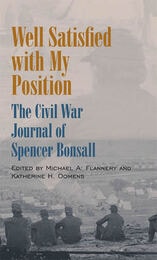
Well Satisfied with My Position
The Civil War Journal of Spencer BonsallEdited by Michael A. Flannery and Katherine H. Oomens
Southern Illinois University Press, 2007
Well Satisfied with My Position offers a first-person account of army life during the Civil War’s Peninsula Campaign and Battle of Fredericksburg. Spencer Bonsall, who joined the 81st Pennsylvania Infantry as a hospital steward, kept a journal from March 1862 until March 1863, when he abruptly ceased writing. Editors Michael A. Flannery and Katherine H. Oomens place his experiences in the context of the field of Civil War medicine and continue his story in an epilogue.
Trained as a druggist when he was in his early twenties, Bonsall traveled the world, spent eight years on a tea plantation in India, and settled in Philadelphia, where he worked in the city surveyor’s office. But in March 1862, when he was in his mid-forties, the lure of serving his country on the battlefield led Bonsall to join the 81st Pennsylvania Infantry as a hospital steward.
Bonsall enjoyed his life with the Union army at first, comparing bivouacking in the woods to merely picnicking on a grand scale. “We are about as jolly a set of old bachelors as can be found in Virginia,” Bonsall wrote. But his first taste of the aftermath of battle at Fair Oaks and the Seven Days’ Battles in Virginia changed his mind about the joys of soldiering—though he never lost his zeal for the Union cause.
Bonsall details the camp life of a soldier from firsthand experience, outlines the engagements of the 81st, and traces the Battle of Fredericksburg and the Peninsula Campaign. He records facts not available elsewhere about camp conditions, attitudes toward Union generals and Confederate soldiers, and troop movements.
From the end of June to late October 1862, Bonsall’s illness kept him from writing in his journal. He picked up the record again in December 1862, just before the Battle of Fredericksburg, Virginia, in which the Union suffered a staggering 10,200 casualties and the 81st Pennsylvania lost more than half its men. He vividly describes the bloody aftermath. Bonsall’s horse was shot out from underneath him at the battle of Gettysburg, injuring him seriously and ending his military career. Although he was listed as “sick in hospital” on the regiment’s muster rolls, he was labeled a deserter in the U.S. Army records. Indeed, after recovery from his injuries, Bonsall walked away from the army to resume life in Philadelphia with his wife and child.
Published for the first time, Bonsall’s journal offers an unusually personal glimpse into the circumstances and motives of a man physically ruined by the war. Seventeen illustrations, including some drawn by Bonsall himself, help bring this narrative to life.

Where the Wild Animals Is Plentiful
Diary of an Alabama Fur Trader's Daughter, 1912-1914May Jordan
University of Alabama Press, 2006
This rare find--a journal of a young backwoods woman--provides a unique picture of rural life in southwestern Alabama early in the 20th century.
"I am a little Alabama girl living on the frontier where the wild animals is plentiful," wrote May Jordan in 1912. During the hunting season her father traveled Washington County buying furs, and May--already 23--accompanied him on two of these trips, cooking meals, helping out with the business, and recording their experiences.
May's diary of these trips from December 1912 to March 1914 describes the routine of the fur trade and provides a vivid portrait of wilderness travel and social customs. Through May's eyes, readers can experience the sights and sounds of pine forests and swamps, the difficulty of wading through waist-deep mud, and the neighborliness of the people living in this isolated area. May also shares both the solace of religious faith and her love of laughter as reflected in the jokes she records.
Elisa Moore Baldwin provides an introduction that traces Jordan family history and describes economic, social, and political conditions during the period. Baldwin also includes annotations based on court records, census rolls, and other primary sources and photographs of many of the characters in May's narrative to provide a vivid picture of the times. Because few first-person accounts exist of the life of poor whites, this diary will be invaluable to students of southern and women's history; no comparable work exists for this part of Alabama during this era. May's journal takes us to another world and teaches us about the lively human spirit in the face of hardship and loneliness.
Worthy of the Cause for Which They Fight
The Civil War Diary of Brigadier General Harris Reynolds, 1861-1865Robert Patrick Bender
University of Arkansas Press, 2011
Writing Out My Heart
Selections from the Journal of Frances E. Willard, 1855-96Edited by Carolyn De Swarte Gifford
University of Illinois Press, 1995
Frances E. Willard's powerful leadership of the Woman's Christian Temperance Union (WCTU) made her one of the most commanding figures in the reform movements of the nineteenth century. World renowned and a force to be reckoned with, Willard grappled publicly and private with difficult issues, including temperance, slavery, women's rights, and her own sexuality. These selections from her forty-nine-volume journal reveal the private and confidential side of Willard for the first time. She comes to life in these pages--a person of character, passion, and self-determination who came to represent the woman of the dawning era.
Supplemented by an in-depth introduction and generous annotations, Writing Out My Heart sheds new light on an extraordinary individual and the lives of women in nineteenth-century America.