104 books match the query 'Earth' and 6 start with w
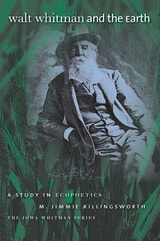
cover of Walt Whitman and the Earth: A Study of Ecopoetics

Walt Whitman and the Earth

A Study of Ecopoetics

M. Jimmie Killingsworth

University of Iowa Press, 2005

Now I am terrified at the Earth, it is that calm and patient,
It grows such sweet things out of such corruptions,
It turns harmless and stainless on its axis, with such endless successions of diseas’d corpses,
It distills such exquisite winds out of such infused fetor,
It renews with such unwitting looks its prodigal, annual, sumptuous crops,
It gives such divine materials to men, and accepts such leavings from them at last.
—Walt Whitman, from “This Compost”

How did Whitman use language to figure out his relationship to the earth, and how can we interpret his language to reconstruct the interplay between the poet and his sociopolitical and environmental world? In this first book-length study of Whitman’s poetry from an ecocritical perspective, Jimmie Killingsworth takes ecocriticism one step further into ecopoetics to reconsider both Whitman’s language in light of an ecological understanding of the world and the world through a close study of Whitman’s language.
Killingsworth contends that Whitman’s poetry embodies the kinds of conflicted experience and language that continually crop up in the discourse of political ecology and that an ecopoetic perspective can explicate Whitman’s feelings about his aging body, his war-torn nation, and the increasing stress on the American environment both inside and outside the urban world. He begins with a close reading of “This Compost”—Whitman’s greatest contribution to the literature of ecology,” from the 1856 edition of Leaves of Grass. He then explores personification and nature as object, as resource, and as spirit and examines manifest destiny and the globalizing impulse behind Leaves of Grass, then moves the other way, toward Whitman’s regional, even local appeal—demonstrating that he remained an island poet even as he became America’s first urban poet. After considering Whitman as an urbanizing poet, he shows how, in his final writings, Whitman tried to renew his earlier connection to nature.
Walt Whitman and the Earth reveals Whitman as a powerfully creative experimental poet and a representative figure in American culture whose struggles and impulses previewed our lives today.
[more]
cover of Way of All the Earth

Way of All the Earth

Anna Akhmatova

Ohio University Press, 2001

Anna Akhmatova is considered one of Russia’s greatest poets. Her life encompassed the turmoil of the Russian Revolution and the paranoia and persecution of the Stalinist era: her works embody the complexities of the age. At the same time, she was able to merge these complexities into a single, poetic voice to speak to the Russian people with whom she so closely and proudly identified. Way of All the Earth contains short poems written between 1909 and 1964, selected from Evening, Rosary, White Flock, Plantain, Anno Domini, Reed, and The Seventh Book. Intricately observed and unwavering in their emotional immediacy, these strikingly modern poems represent one of the twentieth century’s most powerful voices.
[more]
cover of We Cannot Escape History: Lincoln and the Last Best Hope of Earth

We Cannot Escape History

Lincoln and the Last Best Hope of Earth

Edited by James M. McPherson

University of Illinois Press, 1995

A classic collection examining Lincoln's commitment to preserving a union, free of slavery

A who's who of Lincoln scholars explores why Lincoln considered the Union the "last best hope of earth" and how his words and deeds have continued to shape the nation through modern times. Focusing on Lincoln's view of American history and his legacy for the United States and the world, this volume demonstrates the complexity of the problems Lincoln faced and the genius of his leadership in preserving the nation while purging it of slavery.
 
[more]
cover of Why Are We Created: Increasing Our Understanding of Humanity's Purpose on Earth

Why Are We Created

Increasing Our Understanding of Humanity's Purpose on Earth

Sir John Templeton

Templeton Press, 2003

While many books strive to stimulate thinking through provocative anecdotes and theories, Why Are We Created? takes a different path. It begins with a question and continues with a multitude of questions like these:

•What is the importance of recognizing the presence of the sacred within us and around us?
•How can individuals create a purposeful and fruitful way of life?
•How does happiness relate to one's purpose?
The intent of these questions is to encourage thoughtfulness, observation, and research that enlarges understanding while offering a sense of direction. The goal is to help individuals live a more useful and happy life.
Sir John and Reverend Dunlap use the questions to help readers explore the role of humility as a key to knowledge and progress. They look at the creative power of purposeful thinking and ask how life might be changed if we refuse to dwell on any thought we would not want objectified in our life. They pose questions related to consciously directing one's life.
Helping to shed light on the possible connection between spiritual principles and human concepts is commentary from a wide range of sources: the scriptures, Mother Teresa, Albert Einstein, Edward O. Wilson, Emanuel Swedenborg, Emmet Fox, A. H. Maslow, Sir Isaac Newton, Dr. Albert Schweitzer, and Archbishop Desmond Tutu, among many others.
Author Information


[more]
cover of Wisdom From World Religions: Pathways Toward Heaven On Earth

Wisdom From World Religions

Pathways Toward Heaven On Earth

John Marks Templeton

Templeton Press, 2002

Every religion acknowledges certain spiritual principles and records them in its sacred literature and traditions. This book curates these ancient teachings and shows how they apply to modern life with the help of parables, quotations, and commentaries.

By reading Wisdom from World Religions, people from all walks of life will be inspired to pursue their own spiritual growth and to contemplate questions central to our existence, such as how, through love and creativity, can we be agents of divinity on earth?

Uplifting and instructional, this is a book to be treasured, studied, and practiced.
[more]
cover of Working on Earth: Class and Environmental Justice

Working on Earth

Class and Environmental Justice

Christina Robertson

University of Nevada Press, 2015

This collection of essays examines the relationship between environmental injustice and the exploitation of working-class people. Twelve scholars from the fields of environmental humanities and the humanistic social sciences explore connections between the current and unprecedented rise of environmental degradation, economic inequality, and widespread social injustice in the United States and Canada.

The authors challenge prevailing cultural narratives that separate ecological and human health from the impacts of modern industrial capitalism. Essay themes range from how human survival is linked to nature to how the use and abuse of nature benefit the wealthy elite at the expense of working-class people and the working poor as well as how climate change will affect cultures deeply rooted in the land.

Ultimately, Working on Earth calls for a working-class ecology as an integral part of achieving just and sustainable human development.
[more]