Results by title
81 books match the query 'Farm life' and 6 start with w
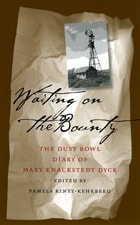
Waiting On The Bounty
Dust Bowl Diary Mary DyckPamela Riney-Kehrberg
University of Iowa Press, 1999
The daughter of German immigrants, Mary Knackstedt married Henry Dyck, a Mennonite farmer, and in 1905 moved west to a settlement near Lamont Township in Hamilton County, Kansas. For the next thirty years they enjoyed growth and prosperity. Then the drought and dust storms that had driven many farmers from the region in the early years of the century returned. The Dycks remained on their farm and witnessed the mass exodus of farmers and townspeople—including close friends and family—who fled the Kansas wheat country to find work.
Though she had only a fifth-grade education, Mary Knackstedt Dyck faithfully kept a diary. Written with pencil on lined notebook paper, her daily notations tell the story of farm life on the far western border of Kansas during the grim Dust Bowl years. Manuscript diaries from this era and region are extremely rare, and those written by farm women are even more so. From the point of view of a wife, mother, and partner in the farming enterprise, Dyck recorded the everyday events as well as the frustrations of living with drought and dust storms and the sadness of watching one's children leave the farm.
Though she had only a fifth-grade education, Mary Knackstedt Dyck faithfully kept a diary. Written with pencil on lined notebook paper, her daily notations tell the story of farm life on the far western border of Kansas during the grim Dust Bowl years. Manuscript diaries from this era and region are extremely rare, and those written by farm women are even more so. From the point of view of a wife, mother, and partner in the farming enterprise, Dyck recorded the everyday events as well as the frustrations of living with drought and dust storms and the sadness of watching one's children leave the farm.
A remarkable historical document, the diary describes a period in this century before the telephone and indoor plumbing were commonplace in rural homes—a time when farm families in the Plains states were isolated from world events, and radio provided an enormously important link between farmsteads and the world at large. Waiting on the Bounty brings us unusual insights into the agricultural and rural history of the United States, detailing the tremendous changes affecting farming families and small towns during the Great Depression.
Pamela Riney-Kehrberg has provided an edited version of the diary entries from 1936 to 1941. Her informative introduction tells the story of the Dycks' settlement in western Kansas and places the diary in its historical context.
[more]
We Have All Gone Away
Curtis Harnack
University of Iowa Press, 1973
In We Have All Gone Away, his emotionally moving memoir, Curtis Harnack tells of growing up during the Great Depression on an Iowa farm among six siblings and an extended family of relatives. With a directness and a beauty that recall Thoreau, Harnack balances a child’s impressions with the knowledge of an adult looking back to produce what Publishers Weekly called “a country plum of a book, written with genuine affection and vivid recall.”
In a community related by blood and harvest, rural life could be bountiful even when hard economic times threatened. The adults urged children to become educated and to keep an eye on tomorrow. “We were all taught to lean enthusiastically into the future,” Harnack recalls, which would likely be elsewhere, in distant cities. At the same time, the children were cultivating a resiliency that would serve them well in the unknown world of the second half of the twentieth century.
Inevitably, the Midwest’s small, diversified family farm gave way to large-scale agriculture, which soon changed the former intimate way of life. “Our generation, using the mulched dead matter of agrarian life like projectile fuel for our thrust into the future, became part of that enormous vitality springing out of rural America,” notes Harnack. Both funny and elegiac, We Have All Gone Away is a masterful memoir of the joys and sorrows of Iowa farm life at mid-century, a world now gone “by way of learning, wars, and marriage” but still a lasting part of America’s heritage.
[more]
Weave Me a Crooked Basket
A NovelCharles Goodrich
University of Nevada Press, 2023
A beautifully unconventional love story.
It’s the summer of 2008, and thirty-five-year-old Ursula Tunder, reeling from the breakup of a bad marriage, has abandoned her career as a botanist and moved home to the family farm to start a wholesale garden-plant greenhouse, and, perhaps more importantly, to care for her ailing father, Joe. Her younger brother, Bodie, now that a shoulder injury has ended his NFL career, comes home as well, to try his hand at organic farming. Their land at the edge of a prosperous college town is coveted by developers. Ursula wants to sell the farm to Camas Valley State University, which has promised to create a research facility on the land, but Bodie and his idealistic wife, Fleece, are committed to farming.
Enter Nu, Ursula and Bodie’s Vietnamese-American cousin by adoption, and an up-and-coming visual artist. When Nu gets arrested after a fight with a pair of dirt bikers, Joe persuades him to take refuge at the Tunder farm. Nu gets pressed into service helping Bodie with farm chores and taking care of Joe, so Ursula seizes the opportunity to get away from the farm, accepting a temporary job surveying native plants in the Cascades. But when Joe’s health plummets and Bodie’s finances crash, Ursula abandons her summer job to return home once again.
Facing bankruptcy, Ursula, Bodie, and Nu enlist a ragtag troupe of land-defenders in a festival of resistance in a last-ditch effort to save a way of life that may disappear forever.
[more]
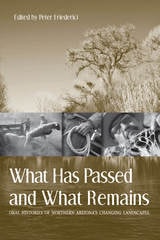
What Has Passed and What Remains
Oral Histories of Northern Arizona's Changing LandscapesEdited by Peter Friederici
University of Arizona Press, 2010
Ferrell Secakuku remembers the ancient farming rites of his Hopi people but saw them replaced by a cash economy. Sheep rancher Joe Manterola recalls watching hard scrabble farms on what is now tree-studded grassland on Garland Prairie. Navajo Rose Gishie once saw freshly dug holes fill with clean, drinkable water where none rises today. All over northern Arizona, people have seen the landscapes change, and livelihoods with them. In this remarkable book they share their stories.
Thirteen narratives—from ranchers, foresters, scientists, Native American farmers, and others—tell how northern Arizona landscapes and livelihoods reflect rapid social and environmental change. The twentieth century saw huge changes as Arizona’s human population swelled and vacation-home developments arose in the backcountry. Riparian areas dried up, cattle ranching declined, and some wildlife species vanished while others thrived. The people whose words are preserved here have watched it all happen.
The book is a product of Northern Arizona University’s Ecological Oral Histories project, which has been collecting remembrances of long-time area residents who have observed changes to the land from the 1930s to the present day. It carves a wide swath, from the Arizona Strip to the Mogollon Rim, from valleys near Prescott to the New Mexico line. It takes readers to the Bar Heart Ranch north of Williams and to the Doy Reidhead Ranch southeast of Holbrook, to the forests of Flagstaff and the mesas of Indian country.
Enhanced with more than fifty illustrations, this book brings environmental change down to earth by allowing us to see it through the eyes of those whose lives it has directly touched. What Has Passed and What Remains is a window on the past that carries important lessons for the future.
[more]
When Horses Pulled the Plow
Life of a Wisconsin Farm Boy, 1910–1929Olaf F. Larson
University of Wisconsin Press, 2011
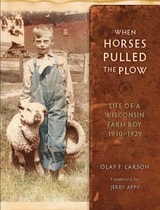
In 1910, when Olaf F. Larson was born to tenant livestock and tobacco farmers in Rock County, Wisconsin, the original barn still stood on the property. It was filled with artifacts of an earlier time—an ox yoke, a grain cradle, a scythe used to cut hay by hand. But Larson came of age in a brave new world of modern inventions—tractors, trucks, combines, airplanes—that would change farming and rural life forever.
When Horses Pulled the Plow is Larson’s account of that rural life in the early twentieth century. He weaves invaluable historical details—including descriptions of farm equipment, crops, and livestock—with wry tales about his family, neighbors, and the one-room schoolhouse he attended, revealing the texture of everyday life in the rural Midwest almost a century ago. This memoir, written by Larson in his ninth decade, provides a wealth of details recalled from an earlier era and an illuminating read for anyone with their own memories of growing up on a farm.
[more]
Works of Hesiod and the Homeric Hymns
Including Theogony and Works and DaysEdited by Daryl Hine
University of Chicago Press, 2004
The most faithful and lyrical translation of Works and Days, Theogony, and more
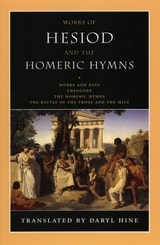
In Works of Hesiod and the Homeric Hymns, highly acclaimed poet and translator Daryl Hine brings to life the words of Hesiod and the world of Archaic Greece. While most available versions of these early Greek writings are rendered in prose, Hine's illuminating translations represent these early classics as they originally appeared, in verse. Since prose was not invented as a literary medium until well after Hesiod's time, presenting these works as poems more closely approximates not only the mechanics but also the melody of the originals.
This volume includes Hesiod's Works and Days and Theogony, two of the oldest non-Homeric poems to survive from antiquity. Works and Days is in part a farmer's almanac—filled with cautionary tales and advice for managing harvests and maintaining a good work ethic—and Theogony is the earliest comprehensive account of classical mythology—including the names and genealogies of the gods (and giants and monsters) of Olympus, the sea, and the underworld. Hine brings out Hesiod's unmistakable personality; Hesiod's tales of his escapades and his gritty and persuasive voice not only give us a sense of the author's own character but also offer up a rare glimpse of the everyday life of ordinary people in the eighth century BCE.
In contrast, the Homeric Hymns are more distant in that they depict aristocratic life in a polished tone that reveals nothing of the narrators' personalities. These hymns (so named because they address the deities in short invocations at the beginning and end of each) are some of the earliest examples of epyllia, or short stories in the epic manner in Greek.
This volume unites Hine's skillful translations of the Works of Hesiod and the Homeric Hymns—along with Hine's rendering of the mock-Homeric epic The Battle of the Frogs and the Mice—in a stunning pairing of these masterful classics.
[more]