Results by title
835 books match the query 'France' and 26 start with w

War, Judgment, and Memory in the Basque Borderlands, 1914-1945
Sandra Ott
University of Nevada Press, 2008
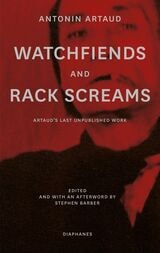
Watchfiends and Rack Screams
Artaud’s Last Unpublished WorkAntonin Artaud
Diaphanes, 2024
Antonin Artaud’s last large-scale work, published in its complete form in English for the first time.
Drawings on texts and letters dating from 1946, some of them written while he was still confined at the Rodez psychiatric hospital, Artaud devoted the months of November 1946 to February 1947 to completing his book through a long series of vocal improvisations titled Interjections, dictated at his pavilion on the edge of Paris. He cursed the assassins he believed were on their way there to steal his semen, to make his brain go “up in smoke as under the action of one of those machines created to suck up filth from the floor,” and finally to erase him. The publisher who had commissioned the book, Louis Broder, was horrified at reading its incandescent, fiercely obscene, and anti-religious manuscript and refused to publish it. Ambitious and experimental in scale, fragmentary and ferocious in intent, it was not published until 1978, in an edition prepared by Artaud’s close friend Paule Thévenin. Artaud commented that it was an “impossible” book, and that “nobody has ever read it from end to end, not even its own author.”
Clayton Eshleman, together with his translation collaborators such as David Rattray, began to work soon after 1978 on an English-language edition, with extracts appearing especially in Eshleman’s poetry magazine, Sulfur. This volume presents his translations with additional ones by Paul Buck, and Catherine Petit it in its complete form in English for the first time.
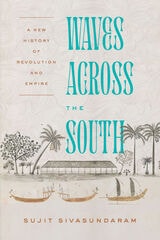
Waves Across the South
A New History of Revolution and EmpireSujit Sivasundaram
University of Chicago Press, 2020

We Only Know Men
The Rescue of Jews in France during the HolocaustPatrick Henry
Catholic University of America Press, 2007

We'll Always Have Paris
American Tourists in France since 1930Harvey Levenstein
University of Chicago Press, 2004
Harvey Levenstein takes us back to the 1930s, when, despite the Great Depression, France continued to be the stomping ground of the social elite of the eastern seaboard. After World War II, wealthy and famous Americans returned to the country in droves, helping to revive its old image as a wellspring of sophisticated and sybaritic pleasures. At the same time, though, thanks in large part to Communist and Gaullist campaigns against U.S. power, a growing sensitivity to French anti-Americanism began to color tourists' experiences there, strengthening the negative images of the French that were already embedded in American culture. But as the century drew on, the traditional positive images were revived, as many Americans again developed an appreciation for France's cuisine, art, and urban and rustic charms.
Levenstein, in his colorful, anecdotal style, digs into personal correspondence, journalism, and popular culture to shape a story of one nation's relationship to another, giving vivid play to Americans' changing response to such things as France's reputation for sexual freedom, haute cuisine, high fashion, and racial tolerance. He puts this tumultuous coupling of France and the United States in historical perspective, arguing that while some in Congress say we may no longer have french fries, others, like Humphrey Bogart in Casablanca, know they will always have Paris, and France, to enjoy and remember.

What Adolescents Ought to Know
Sexual Health Texts in Early Twentieth-Century AmericaJennifer Burek Pierce
University of Massachusetts Press, 2011
In 1901, Dr. Alfred Fournier committed an act both simple and revolutionary: he wrote ForOur Sons, When They Turn 18, a sexual and reproductive health treatise based on his clinical work at a leading Paris hospital. If this booklet aided adolescent understanding of health, it also encouraged reformers around the world to publish. By 1913, countless works on venereal disease prevention were available to adolescents.
During this period, authors wrestled with how to make still-developing scientific information available to a reader also in the process of maturing. What would convince a young person to avoid acting on desire? What norms should be employed in these arguments, when social and legal precedents warned against committing ideas about sex to print? How, in other words, could information about sex be made both decent and compelling? Health reformers struggled with these challenges as doctors' ability to diagnose diseases such as syphilis outpaced the production of medicines that could restore health. In this context, information represented the best and truest prophylactic. When publications were successful, from the perspective of information dissemination, they were translated and distributed worldwide.
What Adolescents Ought to Know explores the evolution of these printed materials—from a single tract, written by a medical researcher and given free to anyone, to a thriving commercial enterprise. It tells the story of how sex education moved from private conversation to purchased text in early twentieth-century America.
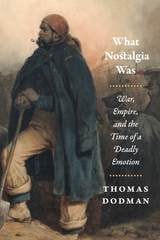
What Nostalgia Was
War, Empire, and the Time of a Deadly EmotionThomas Dodman
University of Chicago Press, 2017
What Nostalgia Was unearths that history. Thomas Dodman begins his story in Basel, where a nineteen-year-old medical student invented the new diagnosis, modeled on prevailing notions of melancholy. From there, Dodman traces its spread through the European republic of letters and into Napoleon's armies, as French soldiers far from home were diagnosed and treated for the disease. Nostalgia then gradually transformed from a medical term to a more expansive cultural concept, one that encompassed Romantic notions of the aesthetic pleasure of suffering. But the decisive shift toward its contemporary meaning occurred in the colonies, where Frenchmen worried about racial and cultural mixing came to view moderate homesickness as salutary. An afterword reflects on how the history of nostalgia can help us understand the transformations of the modern world, rounding out a surprising, fascinating tour through the history of a durable idea.
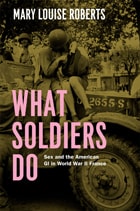
What Soldiers Do
Sex and the American GI in World War II FranceMary Louise Roberts
University of Chicago Press, 2013
That’s not the picture of the Greatest Generation that we’ve been given, but it’s the one Mary Louise Roberts paints to devastating effect in What Soldiers Do. Drawing on an incredible range of sources, including news reports, propaganda and training materials, official planning documents, wartime diaries, and memoirs, Roberts tells the fascinating and troubling story of how the US military command systematically spread—and then exploited—the myth of French women as sexually experienced and available. The resulting chaos—ranging from flagrant public sex with prostitutes to outright rape and rampant venereal disease—horrified the war-weary and demoralized French population. The sexual predation, and the blithe response of the American military leadership, also caused serious friction between the two nations just as they were attempting to settle questions of long-term control over the liberated territories and the restoration of French sovereignty.
While never denying the achievement of D-Day, or the bravery of the soldiers who took part, What Soldiers Do reminds us that history is always more useful—and more interesting—when it is most honest, and when it goes beyond the burnished beauty of nostalgia to grapple with the real lives and real mistakes of the people who lived it.
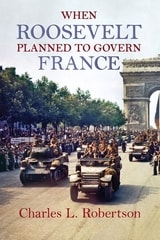
When Roosevelt Planned to Govern France
Charles L. Robertson
University of Massachusetts Press, 2011
This book tells the story of a plan put forth by President Franklin Roosevelt during World War II for an Allied military occupation of France in the aftermath of liberation, and of General Charles de Gaulle's efforts as self-appointed leader of the Free French Movement to thwart FDR's intentions. Charles L. Robertson frames the narrative as a mystery in which he plays the role of detective. He begins at a dinner party thirty years ago, where he first learned of the alleged plan from an elderly former aide to de Gaulle. Yet it wasn't until 2004, when he heard the same story repeated during the 60th commemoration of D-Day, that he set out to investigate whether it was true.
Many French are aware of this episode and believe, on the basis of later Gaullist officials' writings, that until the last moment a military occupation of their country was imminent. This view, across the years, has helped darken relations between France and the United States. Yet few if any Americans have ever heard of this plan, and in the event, no Allied military government of France was ever established.
How and why it never came to be, and why the French still believe it almost did, is the subject of this book. Robertson recounts how the president of the most powerful nation in the world was outmaneuvered in both his earlier plans for an occupation of France and his subsequent attempts to keep General de Gaulle from “seizing” power—in a France that ultimately, despite Roosevelt's intentions and expectations, regained its place among the victorious powers under de Gaulle's leadership.
When These Things Begin
Conversations with Michel TreguerRené Girard (Translated by Trevor Cribben Merrill)
Michigan State University Press, 2014
Women Against Napoleon
Historical and Fictional Responses to his Rise and LegacyEdited by Waltraud Maierhofer, Gertrud Roesch, and Caroline Bland
Campus Verlag, 2007
Women Lovers, or The Third Woman
Natalie Clifford Barney, Edited and translated by Chelsea Ray, Introduction by Melanie C. Hawthorne
University of Wisconsin Press, 2016

Women Together/Women Apart
Portraits of Lesbian ParisLatimer, Tirza True
Rutgers University Press, 2005
What does it mean to look like a lesbian? Though it remains impossible to conjure a definitive image that captures the breadth of this highly nuanced term, today at least we are able to consider an array of visual representations that have been put into circulation by lesbians themselves over the last six or seven decades. In the early twentieth century, though, no notion of lesbianism as a coherent social or cultural identity yet existed.
In Women Together/Women Apart, Tirza True Latimer explores the revolutionary period between World War I and World War II when lesbian artists working in Paris began to shape the first visual models that gave lesbians a collective sense of identity and allowed them to recognize each other. Flocking to Paris from around the world, artists and performers such as Romaine Brooks, Claude Cahun, Marcel Moore, and Suzy Solidor used portraiture to theorize and visualize a "new breed" of feminine subject. The book focuses on problems of feminine and lesbian self-representation at a time and place where the rights of women to political, professional, economic, domestic, and sexual autonomy had yet to be acknowledged by the law. Under such circumstances, same-sex solidarity and relative independence from men held important political implications.
Combining gender theory with visual, cultural, and historical analysis, Latimer draws a vivid picture of the impact of sexual politics on the cultural life of Paris during this key period. The book also illuminates the far-reaching consequences of lesbian portraiture on contemporary constructions of lesbian identity.
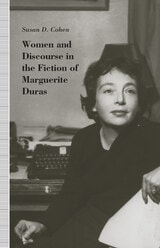
Women and Discourse in the Fiction of Marguerite Duras
Love, Legends, LanguageSusan D. Cohen
University of Massachusetts Press, 1993
One of the most famous living French writers, Marguerite Duras is renowned for her provocative and hauntingly beautiful works of fiction, drama, and cinema. This book offers the first comprehensive study of the narrative and stylistic characteristics of Duras's fiction. Susan D. Cohen examines the entire range of Duras's works, combining close textual analyses with a more general discussion of narrativity and its connections with gender, class, and race. The focus throughout is on language, representation, and difference, which Duras explores on every structural level.
Cohen shows how Duras's writings, even the controversial “erotic” works, expose and subvert the repression of women in traditional, dominant discourse and at the same time present an alternative, nonrepressive discursive model. She formulates a concept of creative “ignorance,” which she identifies as the generative principle of Duras's textual production and the approach to language it proposes. Cohen also explores the distinctive features of Duras's prose, describing how the writer achieves the ritual, legendary aura that characterizes her work.

Women in Contemporary Culture
Roles and identities in France and SpainEdited by Lesley Twomey
Intellect Books, 2000
Women in Revolutionary Paris, 1789-1795
Edited and translated by Darlene Gay Levy, Harriet Branson Applewhite, and Mary Durham Johnson
University of Illinois Press, 1979
"This unique collection of documents will be a boon to teachers of history and to scholars of the French Revolution. . . . Recommended."
-- Library Journal
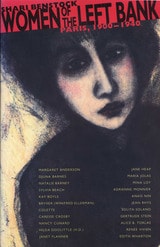
Women of the Left Bank
Paris, 1900-1940By Shari Benstock
University of Texas Press, 1986
Now available in a durable paperback edition, Shari Benstock's critically acclaimed, best-selling Women of the Left Bank is a fascinating exploration of the lives and works of some two dozen American, English, and French women whose talent shaped the Paris expatriate experience in the century's early years.
This ambitious historical, biographical, and critical study has taken its place among the foremost works of literary criticism. Maurice Beebe calls it "a distinguished contribution to modern literary history." Jane Marcus hails it as "the first serious literary history of the period and its women writers, making along the way no small contribution to our understanding of the relationships between women artists and their male counterparts, from Henry James to Hemingway, Joyce, Picasso, and Pound."

Women of the Twelfth Century, Volume 1
Eleanor of Aquitaine and Six OthersGeorges Duby
University of Chicago Press, 1997
The historical personages include Eleanor of Aquitaine whose several marriages brought her wealth and autonomy; the virtuous Héloïse; and the visionary recluse Juette. Duby also studies the literary figures of St. Marie-Madeleine, a composite figure who personified the essential female traits of frailty, ardent love, and evangelicalism; Iseut, literary beloved of Tristan; and two other emblematic figures, Dorée d'Amour and Phénix—women who became ladies through chivalrous love.
Provocative, informative, and entertaining, this book offers new insight on courtly love and the representations of women under medieval patriarchy.
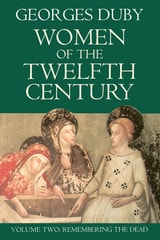
Women of the Twelfth Century, Volume 2
Remembering the DeadGeorges Duby
University of Chicago Press, 1997
The first section outlines the ways in which the dead—in both memory and legend—served to bond noble society in the twelfth century. Drawing on the Gesta by Dudo of Saint Quentin, the second section reflects on the roles that wives, concubines, and other women played during times of war and in the great exchanges of power that established the grand lineages of the Middle Ages. The third section reconstructs women as wives, mothers, and widows through the work of Lambert, Priest of Ardres.

Women's Words
Essay on French SingularityMona Ozouf
University of Chicago Press, 1997
Ozouf uses the woman's portrait, traditionally a male genre, to portray ten French women of letters whose lives span the period from the eve of the French Revolution to the resurgence of the feminist movement in the late twentieth century. She studies the letters and memoirs of Mme du Deffand, Mme de Charrière, Mme Roland, Mme de Staël, Mme de Rémusat, George Sand, Hubertine Auclert, Colette, Simone Weil, and Simone de Beauvoir. Rejecting the male constructions of femininity typical of this genre, Ozouf restores these women's voices in order to study their own often-conflicted attitudes toward education, marriage, motherhood, sex, and work, as well as the dilemma of writing in a literary world that did not support women's work.
Ozouf claims that a uniquely French feminism informed these women's lives, one that stems from the great egalitarian spirit of the French Revolution and is more tolerant of difference than its American counterparts. She argues that as a result, modern French culture has not isolated women from men in the same ways as American and British cultures have done.

Wordsworth's Second Nature
A Study of the Poetry and PoliticsJames Chandler
University of Chicago Press, 1984
Central to the discussion, which restores Wordsworth to both the French and English contexts in which he matured, is a consideration of his relation to Rousseau and Burke. Chandler maintains that by the time Wordsworth set forth his "program for poetry" in 1798, he had turned away from the Rousseauist idea of nature that had informed his early republican writings. He had already become a poet of what Burke called "second nature"–human nature cultivated by custom, habit, and tradition–and an opponent of the quest for first principles that his friend Coleridge could not forsake. In his analysis of the poetry, Chandler suggests that even Wordsworth's most apparently private moments, the lyrical "spots of time," ideologically embodied the uncalculated habits of an oral narrative discipline and a native English mind.
World Film Locations
ParisEdited by Marcelline Block
Intellect Books, 2011
Writing Faith
Text, Sign, and History in the Miracles of Sainte FoyKathleen Ashley and Pamela Sheingorn
University of Chicago Press, 1999
As Ashley and Sheingorn show, differing agendas shaped the miracle stories over time. The first author, Bernard of Angers, used his narratives to critique popular religion and to establish his own literary reputation, while the monks who continued the collection tried to enhance their monastery's prestige. Because these stories were rhetorical constructions, Ashley and Sheingorn argue, we cannot use them directly as sources of historical data. Instead, they demonstrate how analyzing representations common to groups of miracle stories—such as negative portrayals of Muslims on the eve of the Crusades—can reveal the traces of history.
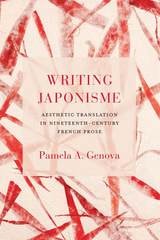
Writing Japonisme
Aesthetic Translation in Nineteenth-Century French ProsePamela A. Genova
Northwestern University Press, 2016
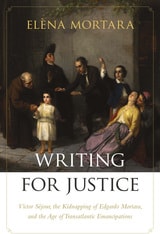
Writing for Justice
Victor Séjour, the Kidnapping of Edgardo Mortara, and the Age of Transatlantic EmancipationsElèna Mortara
Dartmouth College Press, 2015

Writing the Lost Generation
Expatriate Autobiography and American ModernismCraig Monk
University of Iowa Press, 2008
Much of what we know about these iconic literary figures comes from their own published letters and essays, revealing how adroitly they developed their own reputations by controlling the reception of their work. Surprisingly the literary world has paid less attention to their autobiographies.
In Writing the Lost Generation, Craig Monk unlocks a series of neglected texts while reinvigorating our reading of more familiar ones. Well-known autobiographies by Malcolm Cowley, Ernest Hemingway, and Gertrude Stein are joined here by works from a variety of lesser-known—but still important—expatriate American writers, including Sylvia Beach, Alfred Kreymborg, Samuel Putnam, and Harold Stearns. By bringing together the self-reflective works of the Lost Generation and probing the ways the writers portrayed themselves, Monk provides an exciting and comprehensive overview of modernist expatriates from the United States.