Results by title
71 books match the query 'Historical Events' and 7 start with w
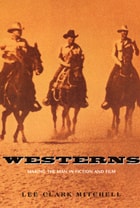
Westerns
Making the Man in Fiction and FilmLee Clark Mitchell
University of Chicago Press, 1996
Few genres are so closely identified with America as the Western. In this wide-ranging examination of the Western and its appeal, Lee Clark Mitchell ranges from the novels of James Fenimore Cooper to Louis L'Amour, and from classic films like Stagecoach to spaghetti Westerns like A Fistful of Dollar to show how Westerns helped assuage a series of crises in American culture. This landmark book shows that the Western owes its perennial appeal not to unchanging conventions but to the deftness with which it responds to the obsessions and fears of its audience. And no obsession, Lee Mitchell argues, has figured more prominently in the Western than what it means to be a man.
What Is Nietzsche's Zarathustra?
A Philosophical ConfrontationHeinrich Meier
University of Chicago Press, 2021
A masterful, nuanced, and novel examination of Nietzsche’s Zarathustra.
Thus Spoke Zarathustra is Nietzsche’s most famous and most puzzling work, one in which he makes the greatest use of poetry to explore the questions posed by philosophy. But in order to understand the movement of this drama, we must first understand the character of its protagonist: we must ask, What Is Nietzsche’s Zarathustra?
Heinrich Meier attempts to penetrate the core of the drama, following as a guiding thread the question of whether Zarathustra is a philosopher or a prophet, or, if he is meant to be both, whether Zarathustra is able to unite philosopher and prophet in himself. Via a close reading that uncovers the book’s hidden structure, Meier develops a highly stimulating and original interpretation of this much-discussed but still ill-understood masterwork of German poetic prose. In the process, he carefully overturns long-established canons in the academic discourse of Nietzsche interpretation. The result is a fresh and surprising grasp of Nietzsche’s well-known teachings of the overman, the will to power, and the eternal return.
Who's a Good Dog?
And How to Be a Better HumanJessica Pierce
University of Chicago Press, 2023
A guide to cultivating a shared life of joy and respect with our dogs.
Who’s a Good Dog? is an invitation to nurture more thoughtful and balanced relationships with our canine companions. By deepening our curiosity about what our dogs are experiencing, and by working together with them in a spirit of collaboration, we can become more effective and compassionate caregivers.
With sympathy for the challenges met by both dogs and their humans, bioethicist Jessica Pierce explores common practices of caring for dogs, including how we provide exercise, what we feed, how and why we socialize and train, and how we employ tools such as collars and leashes. She helps us both to identify potential sources of fear and anxiety in our dogs’ lives and to expand practices that provide physical and emotional nourishment. Who’s a Good Dog? also encourages us to think more critically about what we expect of our dogs and how these expectations can set everyone up for success or failure. Pierce offers resources to help us cultivate attentiveness and kindness, inspiring us to practice the art of noticing, of astonishment, of looking with fresh eyes at these beings we think we know so well. And more than this, she makes her findings relatable by examining facets of her relationship with Bella, the dog in her life. As Bella shows throughout, all dogs are good dogs, and we, as humans and dog guardians, could be doing a little bit better to get along with them and give them what they need.
Witchcraft in England, 1558-1618
Barbara Rosen
University of Massachusetts Press, 1991
Anyone interested in manifestations of witchcraft in Elizabethan and Jacobean England will find this book an invaluable source. Barbara Rosen has gathered and edited a rare collection of documents—pamphlets, reports, trial accounts, and other material—that describes the experience, interpretation, and punishment of witchcraft in the late sixteenth and early seventeenth centuries.
In her introduction, Rosen explores the full range of practices and beliefs associated with witchcraft and situates these phenomena in historical context. She explains how ignorance of science and medicine combined with social circumstance and religious ideology to shape popular perceptions and superstitions. Distinguishing between English and Continental forms of witchcraft, she also examines the legal definitions, disciplines, and punishments applied to wizards, witches, wise women, and conjures in the Elizabethan age.
The pamphlets and other original texts have been modernized in certain respects to make them more accessible to general readers. But the book retains its value for scholars: omissions are detailed in the notes and additions marked; obsolete words and grammar are explained in the glossary.
Originally published in England in 1970 under the title Witchcraft, this book appears now for the first time in paperback and includes a new preface by the editor.
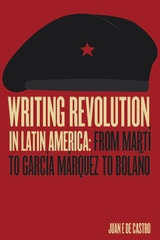
Writing Revolution in Latin America
From Martí to García Márquez to BolañoJuan E. De Castro
Vanderbilt University Press, 2019
In the politically volatile period from the 1960s through the end of the twentieth century, Latin American authors were in direct dialogue with the violent realities of their time and place. Writing Revolution in Latin America is a chronological study of the way revolution and revolutionary thinking is depicted in the fiction composed from the eye of the storm.
From Mexico to Chile, the gradual ideological evolution from a revolutionary to a neoliberal mainstream was a consequence of, on the one hand, the political hardening of the Cuban Revolution beginning in the late 1960s, and, on the other, the repression, dictatorships, and economic crises of the 1970s and beyond. Not only was socialist revolution far from the utopia many believed, but the notion that guerrilla uprisings would lead to an easy socialism proved to be unfounded. Similarly, the repressive Pinochet dictatorship in Chile led to unfathomable tragedy and social mutation.
This double-edged phenomenon of revolutionary disillusionment became highly personal for Latin American authors inside and outside Castro's and Pinochet's dominion. Revolution was more than a foreign affair, it was the stuff of everyday life and, therefore, of fiction.
Juan De Castro's expansive study begins ahead of the century with José Martí in Cuba and continues through the likes of Mario Vargas Llosa in Peru, Gabriel García Márquez in Colombia, and Roberto Bolaño in Mexico (by way of Chile). The various, often contradictory ways the authors convey this precarious historical moment speaks in equal measure to the social circumstances into which these authors were thrust and to the fundamental differences in the ways they themselves witnessed history.
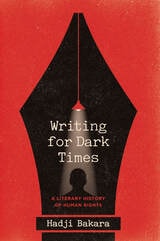
Writing for Dark Times
A Literary History of Human RightsHadji Bakara
University of Chicago Press, 2026
A history of human rights that places writers and their ideas at its center.
At Amnesty International’s headquarters in London hangs a large copy of Seamus Heaney’s “From the Republic of Conscience,” a poem that touches on neither imprisonment nor torture but instead suggests that acts of literary creation are themselves a form of human rights work, important for bringing new things into the world rather than removing evil from it. Why does a poem about the power of creation stand at the center of an organization known for publicizing atrocity? What can it tell us about human rights?
Hadji Bakara’s Writing for Dark Times tells the story of the writer’s distinct place in the history of human rights. It argues that the relationship between the creative work of writing and the pursuit of universal rights is an important but misunderstood dimension of both literary and human rights history over the past century. Following a diverse cast of writers from the First World War through the end of the Cold War, including Bertolt Brecht, Anna Seghers, Archibald MacLeish, Albert Camus, Czeslaw Milosz, Ngũgĩ wa Thiong’o, Seamus Heaney, Nadine Gordimer, and J.M. Coetzee, Bakara shows how their efforts to theorize and support human rights were bound up with changing ideas about the place of their own work in the world––the work of writing. And across the twentieth century, the book reveals, two central ideas about writing took shape around the politics of human rights. Writing creates something new and inspires the will for change.
For those who study human rights, Writing for Dark Times offers both an archive and a method for better understanding the influence of writers on the historical development of the concept. For those in literary studies, the book provides a new account of how human rights shaped the politics of twentieth-century literature. Few books have made as vivid a case for literature’s relevance to our most exalted ideals and institutions.
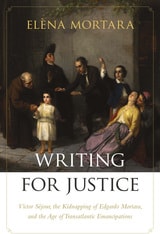
Writing for Justice
Victor Séjour, the Kidnapping of Edgardo Mortara, and the Age of Transatlantic EmancipationsElèna Mortara
Dartmouth College Press, 2015