Results by title
1993 books match the query 'Latin America' and 59 start with w
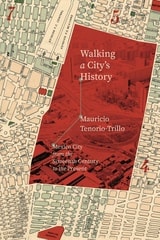
Walking a City's History
Mexico City from the Sixteenth Century to the PresentMauricio Tenorio-Trillo
University of Chicago Press, 2026
Walking a City’sHistory is both a richly documented panoramic view of Mexico City’s long history and an intimate essay on its social and cultural fabric. In this book, Mauricio Tenorio-Trillo uses his expertise as a historian and his talents as a storyteller to bring the city to life.
Using influential moments in Mexico City’s history from the Battle of Tenochtitlán in 1521 to the present, Tenorio-Trillo illustrates the capital’s transformations against a national and global background. Walking a City’s History offers an original, unique perspective on the social, architectural, artistic, and political dimensions of Mexico City, guided by chronicles, literary works, historical accounts, and the author’s own lifetime of walks through the city.
Walmart in the Global South
Workplace Culture, Labor Politics, and Supply ChainsEdited by Carolina Bank Muñoz, Bridget Kenny,and Antonio Stecher
University of Texas Press, 2018
As the largest private employer in the world, Walmart dominates media and academic debate about the global expansion of transnational retail corporations and the working conditions in retail operations and across the supply chain. Yet far from being a monolithic force conquering the world, Walmart must confront and adapt to diverse policies and practices pertaining to regulation, economy, history, union organization, preexisting labor cultures, and civil society in every country into which it enters. This transnational aspect of the Walmart story, including the diversity and flexibility of its strategies and practices outside the United States, is mostly unreported.
Walmart in the Global South presents empirical case studies of Walmart’s labor practices and supply chain operations in a number of countries, including Chile, Brazil, Argentina, Nicaragua, Mexico, South Africa, and Thailand. It assesses the similarities and differences in Walmart’s acceptance into varying national contexts, which reveals when and how state regulation and politics have served to redirect company practice and to what effect. Regulatory context, state politics, trade unions, local cultures, and global labor solidarity emerge as vectors with very different force around the world. The volume’s contributors show how and why foreign workers have successfully, though not uniformly, driven changes in Walmart’s corporate culture. This makes Walmart in the Global South a practical guide for organizations that promote social justice and engage in worker struggles, including unions, worker centers, and other nonprofit entities.

Wandering Paysanos
State Order and Subaltern Experience in Buenos Aires during the Rosas EraRicardo D. Salvatore
Duke University Press, 2003
Drawing extensively on judicial and military records, Salvatore reveals the state’s files on individual prisoners and recruits to be surprisingly full of personal stories directly solicited from paysanos. While consistently attentive to the fragmented and mediated nature of these archival sources, he chronicles how peons and peasants spoke to power figures—judges, police officers, and military chiefs—about issues central to their lives and to the emerging nation. They described their families and their wanderings across the countryside in search of salaried work, memories and impressions of the civil wars, and involvement with the Federalist armies. Their lamentations about unpaid labor, disrespectful government officials, the meaning of poverty, and the dignity of work provide vital insights into the contested nature of the formation of the Argentine Confederation. Wandering Paysanos discloses a complex world until now obscured—that of rural Argentine subalterns confronting the state.

Wandering Peoples
Colonialism, Ethnic Spaces, and Ecological Frontiers in Northwestern Mexico, 1700–1850Cynthia Radding
Duke University Press, 1997
Radding describes this colonial mission not merely as an instance of Iberian expansion but as a site of cultural and political confrontation. This alternative vision of colonialism emphasizes the economic links between mission communities and Spanish mercantilist policies, the biological consequences of the Spanish policy of forced congregación, and the cultural and ecological displacements set in motion by the practices of discipline and surveillance established by the religious orders. Addressing wider issues pertaining to ethnic identities and to ecological and cultural borders, Radding’s analysis also underscores the parallel production of colonial and subaltern texts during the course of a 150-year struggle for power and survival.
War Of Conquest
How it was Waged Here in MexicoArthur J. O. Anderson
University of Utah Press, 1978
War by Other Means
Aftermath in Post-Genocide GuatemalaCarlota McAllister and Diane M. Nelson, eds.
Duke University Press, 2013
Contributors consider a wide range of issues confronting present-day Guatemala: returning refugees, land reform, gang violence, neoliberal economic restructuring, indigenous and women's rights, complex race relations, the politics of memory, and the challenges of sustaining hope. From a sweeping account of Guatemalan elites' centuries-long use of violence to suppress dissent to studies of intimate experiences of complicity and contestation in richly drawn localities, War by Other Means provides a nuanced reckoning of the injustices that made genocide possible and the ongoing attempts to overcome them.
Contributors. Santiago Bastos, Jennifer Burrell, Manuela Camus, Matilde González-Izás, Jorge Ramón González Ponciano, Greg Grandin, Paul Kobrak, Deborah T. Levenson, Carlota McAllister, Diane M. Nelson, Elizabeth Oglesby, Luis Solano, Irmalicia Velásquez Nimatuj, Paula Worby
Warfare and the Fall of a Fortified Center
Archaeological Investigations at AguatecaTakeshi Inomata
Vanderbilt University Press, 2006
VIMA Series #3
Wari Imperialism in Middle Horizon Peru
Katharina J. Schreiber with a foreword by Jeffrey R. Parsons
University of Michigan Press, 1992

Wars, Parties and Nationalism
Essays on the Politics and Society of Nineteenth-century Latin AmericaEdited by Eduardo Posada-Carbo
University of London Press, 1995
Watering the Revolution
An Environmental and Technological History of Agrarian Reform in MexicoMikael D. Wolfe
Duke University Press, 2017
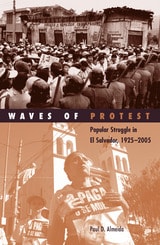
Waves of Protest
Popular Struggle in El Salvador, 1925–2005Paul D. Almeida
University of Minnesota Press, 2008
One of the first longitudinal studies of collective resistance in the developing world, Waves of Protest examines large-scale contentious action in El Salvador during critical eras in the country’s history.
Providing a compelling analysis of the massive waves of protests from the early twentieth century to the present in El Salvador, Paul D. Almeida fully chronicles one of the largest and most successful campaigns against globalization and privatization in the Americas. Drawing on original protest data from newspapers and other archival sources, Almeida makes an impassioned argument that regime liberalization organizes civil society and, conversely, acts of state-sponsored repression radicalize society. He correlates the ebb and flow of protest waves to the changes in regime liberalization and subsequent de-democratization and back to liberalization.
Almeida shows how institutional access and competitive elections create opportunity for civic organizations that become radicalized when authoritarianism increases, resulting at times in violent protest campaigns that escalate to revolutionary levels. In doing so, he brings negative political conditions and threats to the forefront as central forces driving social movement activity and popular contention in the developing world.
Paul D. Almeida is assistant professor of sociology at Texas A&M University. He is coeditor with Hank Johnston of Latin American Social Movements: Globalization, Democratization, and Transnational Networks.
We Alone Will Rule
Native Andean Politics in the Age of InsurgencySinclair Thomson
University of Wisconsin Press, 2003
We Are the Face of Oaxaca
Testimony and Social MovementsLynn Stephen
Duke University Press, 2013
The movement was met with violent repression. Participants were imprisoned, tortured, and even killed. Lynn Stephen emphasizes the crucial role of testimony in human rights work, indigenous cultural history, community and indigenous radio, and women's articulation of their rights to speak and be heard. She also explores transborder support for APPO, particularly among Oaxacan immigrants in Los Angeles. The book is supplemented by a website featuring video testimonials, pictures, documents, and a timeline of key events.

We Came Naked and Barefoot
The Journey of Cabeza de Vaca across North AmericaBy Alex D. Krieger
University of Texas Press, 2002
Second place, Presidio La Bahia Award, Sons of the Republic of Texas, 2003
Perhaps no one has ever been such a survivor as álvar Núñez Cabeza de Vaca. Member of a 600-man expedition sent out from Spain to colonize "La Florida" in 1527, he survived a failed exploration of the west coast of Florida, an open-boat crossing of the Gulf of Mexico, shipwreck on the Texas coast, six years of captivity among native peoples, and an arduous, overland journey in which he and the three other remaining survivors of the original expedition walked some 1,500 miles from the central Texas coast to the Gulf of California, then another 1,300 miles to Mexico City.
The story of Cabeza de Vaca has been told many times, beginning with his own account, Relación de los naufragios, which was included and amplified in Gonzalo Fernando de Oviedo y Váldez's Historia general de las Indias. Yet the route taken by Cabeza de Vaca and his companions remains the subject of enduring controversy. In this book, Alex D. Krieger correlates the accounts in these two primary sources with his own extensive knowledge of the geography, archaeology, and anthropology of southern Texas and northern Mexico to plot out stage by stage the most probable route of the 2,800-mile journey of Cabeza de Vaca.
This book consists of several parts, foremost of which is the original English version of Alex Krieger's dissertation (edited by Margery Krieger), in which he traces the route of Cabeza de Vaca and his companions from the coast of Texas to Spanish settlements in western Mexico. This document is rich in information about the native groups, vegetation, geography, and material culture that the companions encountered. Thomas R. Hester's foreword and afterword set the 1955 dissertation in the context of more recent scholarship and archaeological discoveries, some of which have supported Krieger's plot of the journey. Margery Krieger's preface explains how she prepared her late husband's work for publication. Alex Krieger's original translations of the Cabeza de Vaca and Oviedo accounts round out the volume.
We Cannot Remain Silent
Opposition to the Brazilian Military Dictatorship in the United StatesJames N. Green
Duke University Press, 2010
Green interviewed many of the activists who educated journalists, government officials, and the public about the abuses taking place under the Brazilian dictatorship. Drawing on those interviews and archival research from Brazil and the United States, he describes the creation of a network of activists with international connections, the documentation of systematic torture and repression, and the cultivation of Congressional allies and the press. Those efforts helped to expose the terror of the dictatorship and undermine U.S. support for the regime. Against the background of the political and social changes of the 1960s and 1970s, Green tells the story of a decentralized, international grassroots movement that effectively challenged U.S. foreign policy.
We Created Chávez
A People's History of the Venezuelan RevolutionGeo Maher
Duke University Press, 2013
Based on interviews with grassroots organizers, former guerrillas, members of neighborhood militias, and government officials, Ciccariello-Maher presents a new history of Venezuelan political activism, one told from below. Led by leftist guerrillas, women, Afro-Venezuelans, indigenous people, and students, the social movements he discusses have been struggling against corruption and repression since 1958. Ciccariello-Maher pays particular attention to the dynamic interplay between the Chávez government, revolutionary social movements, and the Venezuelan people, recasting the Bolivarian Revolution as a long-term and multifaceted process of political transformation.
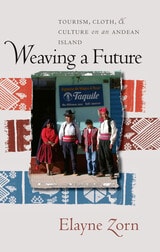
Weaving a Future
Tourism, Cloth, and Culture on an Andean IslandElayne Zorn
University of Iowa Press, 2004
The people of Taquile Island on the Peruvian side of beautiful Lake Titicaca, the highest navigable lake in the Americas, are renowned for the hand-woven textiles that they both wear and sell to outsiders. One thousand seven hundred Quechua-speaking peasant farmers, who depend on potatoes and the fish from the lake, host the forty thousand tourists who visit their island each year. Yet only twenty-five years ago, few tourists had even heard of Taquile. In Weaving a Future: Tourism, Cloth, and Culture on an Andean Island, Elayne Zorn documents the remarkable transformation of the isolated rocky island into a community-controlled enterprise that now provides a model for indigenous communities worldwide.
Over the course of three decades and nearly two years living on Taquile Island, Zorn, who is trained in both the arts and anthropology, learned to weave from Taquilean women. She also learned how gender structures both the traditional lifestyles and the changes that tourism and transnationalism have brought. In her comprehensive and accessible study, she reveals how Taquileans used their isolation, landownership, and communal organizations to negotiate the pitfalls of globalization and modernization and even to benefit from tourism. This multi-sited ethnography set in Peru, Washington, D.C., and New York City shows why and how cloth remains central to Andean society and how the marketing of textiles provided the experience and money for Taquilean initiatives in controlling tourism.
The first book about tourism in South America that centers on traditional arts as well as community control, Weaving a Future will be of great interest to anthropologists and scholars and practitioners of tourism, grassroots development, and the fiber arts.
When Rains Became Floods
A Child Soldier's StoryLurgio Gavilán Sánchez
Duke University Press, 2015
When States Kill
Latin America, the U.S., and Technologies of TerrorEdited by Cecilia Menjívar and Néstor Rodríguez
University of Texas Press, 2005
Since the early twentieth century, technological transfers from the United States to Latin American countries have involved technologies of violence for social control. As the chapters in this book illustrate, these technological transfers have taken various forms, including the training of Latin American military personnel in surveillance and torture and the provision of political and logistic support for campaigns of state terror. The human cost for Latin America has been enormous—thousands of Latin Americans have been murdered, disappeared, or tortured, and whole communities have been terrorized into silence.
Organized by region, the essays in this book address the topic of state-sponsored terrorism in a variety of ways. Most take the perspective that state-directed political violence is a modern development of a regional political structure in which U.S. political interests weigh heavily. Others acknowledge that Latin American states enthusiastically received U.S. support for their campaigns of terror. A few see local culture and history as key factors in the implementation of state campaigns of political violence. Together, all the essays exemplify how technologies of terror have been transferred among various Latin American countries, with particular attention to the role that the United States, as a "strong" state, has played in such transfers.
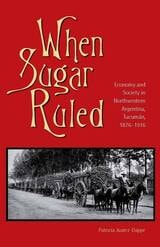
When Sugar Ruled
Economy and Society in Northwestern Argentina, Tucumán, 1876–1916Patricia Juarez-Dappe
Ohio University Press, 2010
Two tropical commodities—coffee and sugar—dominated Latin American export economies in the nineteenth and early twentieth centuries. When Sugar Ruled: Economy and Society in Northwestern Argentina, Tucumán, 1876–1916 presents a distinctive case that does not quite fit into the pattern of many Latin American sugar economies.
During the last quarter of the nineteenth century, the province of Tucumán emerged as Argentina’s main sugar producer, its industry catering almost exclusively to the needs of the national market and financed mostly by domestic capital. The expansion of the sugar industry provoked profound changes in Tucumán’s economy as sugar specialization replaced the province’s diversified productive structure. Since ingenios relied on outside growers for the supply of a large share of the sugarcane, sugar production did not produce massive land dispossession and resulted in the emergence of a heterogeneous planter group. The arrival of thousands of workers from neighboring provinces during the harvest season transformed rural society dramatically. As the most dynamic sector in Tucumán’s economy, revenues from sugar enabled the provincial government to participate in the modernizing movement sweeping turn-of-the-century Argentina.
Patricia Juarez-Dappe uncovers the unique features that characterized sugar production in Tucumán as well as the changes experienced by the province’s economy and society between 1876 and 1916, the period of most dramatic sugar expansion. When Sugar Ruled is an important addition to the literature on sugar economies in Latin America and Argentina.
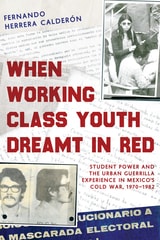
When Working Class Youth Dreamt in Red
Student Power and the Urban Guerrilla Experience in Mexico's Cold War, 1970–1982Fernando Herrera Calderón
University of Arizona Press, 2027
The 1970s in Mexico were turbulent from the start. Insurgent voices converged across cities and rural peripheries. Militant labor, urban popular sectors, and Indigenous collectives erupted in expressions of broad social exhaustion. Rebellion, rooted in the layered betrayals of the postrevolutionary state and the fractures of a deteriorating modernity under the Institutional Revolutionary Party (PRI), fermented and boiled over.
At the core of this moment, Mexican youth found their way to political-military organizations, coalescing around shared ecologies of dissent and embedded in broader currents of revolutionary struggle. When Working Class Youth Dreamt in Red reconstructs these insurgent youth cultures and guerrilla imaginaries, reorienting the historiographical lens to center radical working class youth—especially urban students—as protagonists in a wider saga of revolutionary experimentation and political rupture.
At its conceptual core, this book offers a bold new interpretation of a turbulent moment in Mexican history. It shows how class shaped the epistemic horizons through which proletarian youth understood themselves and makes visible their role as central actors at the vanguard of a revolutionary time.
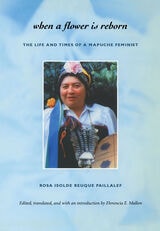
When a Flower Is Reborn
The Life and Times of a Mapuche FeministRosa Isolde Reuque Paillalef, Edited, translated, and with an introduction by Florencia E. Mallon
Duke University Press, 2002
A leading activist during the Pinochet dictatorship, Reuque—a woman, a Catholic, and a Christian Democrat—often felt like an outsider within the male-dominated, leftist Mapuche movement. This sense of herself as both participant and observer allows for Reuque’s trenchant, yet empathetic, critique of the Mapuche ethnic movement and of the policies regarding indigenous people implemented by Chile’s post-authoritarian government. After the 1990 transition to democratic rule, Reuque collaborated with the government in the creation of the Indigenous Development Corporation (CONADI) and the passage of the Indigenous Law of 1993. At the same time, her deepening critiques of sexism in Chilean society in general, and the Mapuche movement in particular, inspired her to found the first Mapuche feminist organization and participate in the 1996 International Women’s Conference in Beijing. Critical of the democratic government’s inability to effectively address indigenous demands, Reuque reflects on the history of Mapuche activism, including its disarray in the early 1990s and resurgence toward the end of the decade, and relates her hopes for the future.
An important reinvention of the testimonial genre for Latin America’s post-authoritarian, post-revolutionary era, When a Flower Is Reborn will appeal to those interested in Latin America, race and ethnicity, indigenous people’s movements, women and gender, and oral history and ethnography.
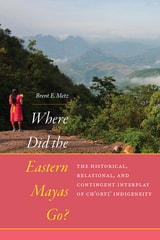
Where Did the Eastern Mayas Go?
The Historical, Relational, and Contingent Interplay of Ch’orti’ Indigeneityby Brent E. Metz
University Press of Colorado, 2022
Copublished with the Institute for Mesoamerican Studies, University of Albany
In Where Did the Eastern Mayas Go? Brent E. Metz explores the complicated issue of who is Indigenous by focusing on the sociohistorical transformations over the past two millennia of the population currently known as the Ch’orti’ Maya. Epigraphers agree that the language of elite writers in Classic Maya civilization was Proto-Ch’olan, the precursor of the Maya languages Ch’orti’, Ch’olti’, Ch’ol, and Chontal. When the Spanish invaded in the early 1500s, the eastern half of this area was dominated by people speaking various dialects of Ch’olti’ and closely related Apay (Ch’orti’), but by the end of the colonial period (1524–1821) only a few pockets of Ch’orti’ speakers remained.
From 2003 to 2018 Metz partnered with Indigenous leaders to conduct a historical and ethnographic survey of Ch’orti’ Maya identity in what was once the eastern side of the Classic period lowland Maya region and colonial period Ch’orti’-speaking region of eastern Guatemala, western Honduras, and northwestern El Salvador. Today only 15,000 Ch’orti’ speakers remain, concentrated in two municipalities in eastern Guatemala, but since the 1990s nearly 100,000 impoverished farmers have identified as Ch’orti’ in thirteen Guatemalan and Honduran municipalities, with signs of Indigenous revitalization in several Salvadoran municipalities as well. Indigenous movements have raised the ethnic consciousness of many non-Ch’orti’-speaking semi-subsistence farmers, or campesinos. The region’s inhabitants employ diverse measures to assess identity, referencing language, history, traditions, rurality, “blood,” lineage, discrimination, and more.
Where Did the Eastern Mayas Go? approaches Indigenous identity as being grounded in historical processes, contemporary politics, and distinctive senses of place. The book is an engaged, activist ethnography not on but, rather, in collaboration with a marginalized population that will be of interest to scholars of the eastern lowland Maya region, indigeneity generally, and ethnographic experimentation.
Where Social Identities Converge
Latin American and Latinx Youth on ScreenTraci Roberts-Camps
Vanderbilt University Press, 2024
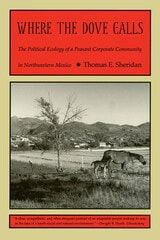
Where the Dove Calls
The Political Ecology of a Peasant Corporate Community in Northwestern MexicoThomas E. Sheridan
University of Arizona Press, 1988
Sheridan has written an ethnography of resource control, one that weds the approaches of political economy and cultural ecology in order to focus upon both the external linkages and internal adaptations that shape three peasant corporate communities. He examines the ecological and economic constraints which scarce and necessary resources place upon households in Cucurpe, and then investigates why many such households have formed corporate communities to insure their access to resources beyond their control. Finally, he identifies the class differences that exist within the corporate communities as well as between members of those organizations and the private ranchers who surround them.
Where the Dove Calls (the meaning of "Cucurpe" in the language of the Opata Indians), an important contribution to peasant studies, reveals the household as the basic unit of Cucurpe society. By viewing Cucurpe's corporate communities as organizations of fiercely independent domestic units rather than as expressions of communal solidarity, Sheridan shows that peasants are among the exploiters as well as the exploited. Cucurpe¤os struggle to maintain the autonomy of their households even as they join together to protect corporate grazing lands and irrigation water. Any attempt to weaken or destroy that independence is met with opposition that ranges from passive resistance to violence.
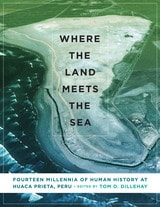
Where the Land Meets the Sea
Fourteen Millennia of Human History at Huaca Prieta, PeruEdited by Tom D. Dillehay
University of Texas Press, 2017
Huaca Prieta—one the world’s best-known, yet least understood, early maritime mound sites—and other Preceramic sites on the north coast of Peru bear witness to the beginnings of civilization in the Americas. Across more than fourteen millennia of human occupation, the coalescence of maritime, agricultural, and pastoral economies in the north coast settlements set in motion long-term biological and cultural transformations that led to increased social complexity and food production, and later the emergence of preindustrial states and urbanism. These developments make Huaca Prieta a site of global importance in world archaeology.
This landmark volume presents the findings of a major archaeological investigation carried out at Huaca Prieta, the nearby mound Paredones, and several Preceramic domestic sites in the lower Chicama Valley between 2006 and 2013 by an interdisciplinary team of more than fifty international specialists. The book’s contributors report on and analyze the extensive material records from the sites, including data on the architecture and spatial patterns; floral, faunal, and lithic remains; textiles; basketry; and more. Using this rich data, they build new models of the social, economic, and ontological practices of these early peoples, who appear to have favored cooperation and living in harmony with the environment over the accumulation of power and the development of ruling elites. This discovery adds a crucial new dimension to our understanding of emergent social complexity, cosmology, and religion in the Neolithic period.
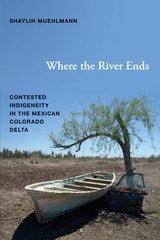
Where the River Ends
Contested Indigeneity in the Mexican Colorado DeltaShaylih Muehlmann
Duke University Press, 2013
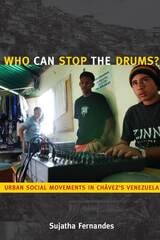
Who Can Stop the Drums?
Urban Social Movements in Chávez's VenezuelaSujatha Fernandes
Duke University Press, 2010
Fernandes portrays everyday life and politics in the shantytowns of Caracas through accounts of community-based radio, barrio assemblies, and popular fiestas, and the many interviews she conducted with activists and government officials. Most of the barrio activists she presents are Chávez supporters. They see the leftist president as someone who understands their precarious lives and has made important changes to the state system to redistribute resources. Yet they must balance receiving state resources, which are necessary to fund their community-based projects, with their desire to retain a sense of agency. Fernandes locates the struggles of the urban poor within Venezuela’s transition from neoliberalism to what she calls “post-neoliberalism.” She contends that in contemporary Venezuela we find a hybrid state; while Chávez is actively challenging neoliberalism, the state remains subject to the constraints and logics of global capital.
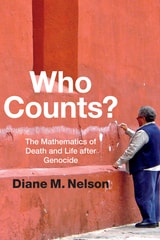
Who Counts?
The Mathematics of Death and Life after GenocideDiane M. Nelson
Duke University Press, 2015

Whose National Music?
Identity, Mestizaje, and Migration in EcuadorKetty Wong
Temple University Press, 2012
Musical genres, musical instruments, and even songs can often capture the essence of a country's national character. In Whose National Music?, the first book-length study of Ecuadorian popular music, Ketty Wong explores Ecuadorians' views of their national identity in the twentieth and early twenty-first centuries through an examination of the music labels they use. Wong deftly addresses the notion of música nacional, an umbrella term for Ecuadorian popular songs often defined by the socio-economic, ethnic, racial, and generational background of people discussing the music.
Wong shows how the inclusion or exclusion of elite and working-class musics within the scope of música nacional articulate different social, ethnic, and racial configurations of the nation for white, mestizo, indigenous, and Afro-Ecuadorian populations.
Presenting a macropicture of what música nacional is—or should be—Whose National Music? provides a lively historical trajectory of a country's diverse musical scene.
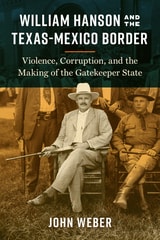
William Hanson and the Texas-Mexico Border
Violence, Corruption, and the Making of the Gatekeeper StateJohn Weber
University of Texas Press, 2024
An examination of the career of Texas Ranger and immigration official William Hanson illustrating the intersections of corruption, state-building, and racial violence in early twentieth century Texas.
At the Texas-Mexico border in the 1910s and 1920s, William Hanson was a witness to, and an active agent of, history. As a Texas Ranger captain and then a top official in the Immigration Service, he helped shape how US policymakers understood the border, its residents, and the movement of goods and people across the international boundary. An associate of powerful politicians and oil company executives, he also used his positions to further his and his patrons' personal interests, financial and political, often through threats and extralegal methods.
Hanson’s career illustrates the ways in which legal exclusion, white-supremacist violence, and official corruption overlapped and were essential building blocks of a growing state presence along the border in the early twentieth century. In this book, John Weber reveals Hanson’s cynical efforts to use state and federal power to proclaim the border region inherently dangerous and traces the origins of current nativist politics that seek to demonize the border population. In doing so, he provides insight into how a minor political appointee, motivated by his own ambitions, had lasting impacts on how the border was experienced by immigrants and seen by the nation.

Wind and Power in the Anthropocene
Dominic Boyer and Cymene Howe
Duke University Press, 2019
In his volume, Energopolitics, Boyer examines the politics of wind power and how it is shaped by myriad factors, from the legacies of settler colonialism and indigenous resistance to state bureaucracy and corporate investment. Drawing on interviews with activists, campesinos, engineers, bureaucrats, politicians, and bankers, Boyer outlines the fundamental impact of energy and fuel on political power. Boyer also demonstrates how large conceptual frameworks cannot adequately explain the fraught and uniquely complicated conditions on the Isthmus, illustrating the need to resist narratives of Anthropocenic universalism and to attend to local particularities.
In her volume, Ecologics, Howe narrates how an antidote to the Anthropocene became both failure and success. Tracking the development of what would have been Latin America's largest wind park, Howe documents indigenous people's resistance to the project and the political and corporate climate that derailed its renewable energy potential. Using feminist and more-than-human theories, Howe demonstrates how the dynamics of energy and environment cannot be captured without understanding how human aspirations for energy articulate with nonhuman beings, technomaterial objects, and the geophysical forces that are at the heart of wind and power.
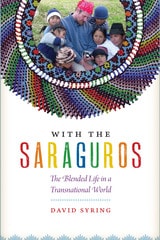
With the Saraguros
The Blended Life in a Transnational WorldBy David Syring
University of Texas Press, 2014
Highlighting globalization’s effects on humanity through the lens of Ecuador’s indigenous Saraguro people, With the Saraguros marks a compelling departure from conventional approaches to ethnography. While documenting and exploring the social patterns among the Saraguro, with an emphasis on the role of women beadworkers, David Syring blends storytelling, dialogue, poetry, and memoir to describe his own realm as a fieldworker in anthropology. As he considers the influence of women’s labor in a community in which the artistry of beadwork is richly symbolic, he also considers how the Saraguro view their observers—the anthropologists.
Probing the role of researchers in a time when basic humanistic questions now often reflect a critical balance between commerce and sustainability, With the Saraguros asks, “What does it mean to live ‘the good life’ in different cultural contexts, and how does our work life relate to this pursuit?” For those who have chosen a work life of anthropology, Syring captures the impact of fieldwork—which uproots the researcher from his or her daily routine—and its potential to deliver new levels of consciousness. The result constitutes more than just the first English-language book dedicated to the dynamic creativity of the Saraguro, contextualized by their social and political history; Syring’s work, which ranges from the ecological imagination to the metaphors of trade, is also a profound meditation on the ways we experience boundaries now that borders no longer create sharply drawn divides between cultural worlds, and “distant” no longer means “separate.”
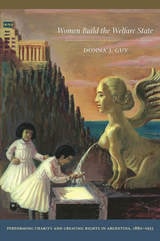
Women Build the Welfare State
Performing Charity and Creating Rights in Argentina, 1880–1955Donna J. Guy
Duke University Press, 2009
Drawing on extensive research in Argentine archives, Guy reveals significant continuities in Argentine history, including the rise of a liberal state that subsidized all kinds of women’s and religious groups. State and private welfare efforts became more organized in the 1930s and reached a pinnacle under Juan Perón, when men took over the welfare state and philanthropic and feminist women’s influence on child-welfare activities and policy declined. Comparing the rise of Argentina’s welfare state with the development of others around the world, Guy considers both why women’s child-welfare initiatives have not received more attention in historical accounts and whether the welfare state emerges from the top down or from the bottom up.
Women In Latin America
Christine Bose
Temple University Press, 1995
Women Legislators in Central America
Politics, Democracy, and PolicyBy Michelle A. Saint-Germain and Cynthia Chavez Metoyer
University of Texas Press, 2008
During the years between 1980 and 1999, in the midst of war and economic crisis, a record number of women were elected to national legislatures in Central American republics. Can quantitative increases in the presence of elected women in Central America produce qualitative political changes?
In this detailed study, Michelle A. Saint-Germain and Cynthia Chavez Metoyer explore the reasons for this unprecedented political rise of women, and what effect it has had on the region. Focusing on Costa Rica, El Salvador, Guatemala, Honduras, and Nicaragua, the authors analyze national and regional indicators to evaluate various hypotheses concerning the reasons for women's electoral success in the region, as well as to make comparisons with findings from other world regions. They find that the election of more women depends on three things: the presence of a crisis, a pool of politically experienced women, and a culture of gender consciousness. They also compare the characteristics of Central American women legislators to women in other national legislatures around the world.
The authors document how elected women have used their policy-making power to begin to change the lives of all Central Americans, women and men alike. In more than seventy-five in-depth, personal interviews, these women legislators reflect on their lives, political careers, and gender identities in their own words, providing deep insights into recent events in this region.

Women Who Live Evil Lives
Gender, Religion, and the Politics of Power in Colonial GuatemalaBy Martha Few
University of Texas Press, 2002
Women Who Live Evil Lives documents the lives and practices of mixed-race, Black, Spanish, and Maya women sorcerers, spell-casters, magical healers, and midwives in the social relations of power in Santiago de Guatemala, the capital of colonial Central America. Men and women from all sectors of society consulted them to intervene in sexual and familial relations and disputes between neighbors and rival shop owners; to counter abusive colonial officials, employers, or husbands; and in cases of inexplicable illness.
Applying historical, anthropological, and gender studies analysis, Martha Few argues that women's local practices of magic, curing, and religion revealed opportunities for women's cultural authority and power in colonial Guatemala. Few draws on archival research conducted in Guatemala, Mexico, and Spain to shed new light on women's critical public roles in Santiago, the cultural and social connections between the capital city and the countryside, and the gender dynamics of power in the ethnic and cultural contestation of Spanish colonial rule in daily life.

Women Writers of Latin America
Intimate HistoriesBy Magdalena García Pinto
University of Texas Press, 1991
What does it take for a woman to succeed as a writer? In these revealing interviews, first published in 1988 as Historias íntimas, ten of Latin America's most important women writers explore this question with scholar Magdalena García Pinto, discussing the personal, social, and political factors that have shaped their writing careers.
The authors interviewed are Isabel Allende, Albalucía Angel, Rosario Ferré, Margo Glantz, Sylvia Molloy, Elvira Orphée, Elena Poniatowska, Marta Traba, Luisa Valenzuela, and Ida Vitale. In intimate dialogues with each author, García Pinto draws out the formative experiences of her youth, tracing the pilgrimage that led each to a distinguished writing career.
The writers also reflect on their published writings, discussing the creative process in general and the motivating force behind individual works. They candidly discuss the problems they have faced in writing and the strategies that enabled them to reach their goals.
While obviously of interest to readers of Latin American literature, this book has important insights for students of women's literature and cultural studies, as well as for aspiring writers.
Women and Politics in Latin America
Craske, Nikki
Rutgers University Press, 1999
This book provides a comprehensive view of women's political participation in Latin America. Focusing on the latter half of the twentieth century, it examines five different arenas of action and debate: political institutions, workplaces, social movements, revolutions, and feminisms. Nikki Craske explores the ways in which women have become more effective in the public arena as the context of politics has altered.
Craske demonstrates how gender relations shape political institutions and practices while simultaneously being shaped by them. She examines the moments when women's action has challenged received ideas, and had a significant impact on the political life of Latin American nations. Women remain heavily underrepresented in political lie, despite their important role in popular movements against authoritarianism, Craske states, and posits that the economy is a substantial constraint on women's political participation. This powerful book analyzes the gains made since the 1950s while scrutinizing the challenges and difficulties which still constrain women's political participation.
Women and Social Movements in Latin America
Power from BelowBy Lynn Stephen
University of Texas Press, 1997
Women's grassroots activism in Latin America combines a commitment to basic survival for women and their children with a challenge to women's subordination to men. Women activists insist that issues such as rape, battering, and reproductive control cannot be divorced from women's concerns about housing, food, land, and medical care.
This innovative, comparative study explores six cases of women's grassroots activism in Mexico, El Salvador, Brazil, and Chile. Lynn Stephen communicates the ideas, experiences, and perceptions of women who participate in collective action, while she explains the structural conditions and ideological discourses that set the context within which women act and interpret their experiences. She includes revealing interviews with activists, detailed histories of organizations and movements, and a theoretical discussion of gender, collective identity, and feminist anthropology and methods.
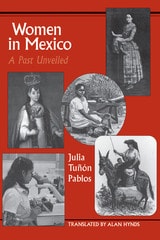
Women in Mexico
A Past UnveiledBy Julia Tuñón Pablos
University of Texas Press, 1999
Throughout Mexico's history, women have been subjected to a dual standard: exalted in myth, they remain subordinated in their social role by their biology. But this dualism is not so much a battle between the sexes as the product of a social system. The injustices of this system have led Mexican women to conclude that they deserve a better world, one worth struggling for.
Published originally in Spanish as Mujeres en México: Una historia olvidada, this work examines the role of Mexican women from pre-Cortés to the 1980s, addressing the interplay between myth and history and the gap between theory and practice. Pointing to such varied prototypes as the Virgin of Guadalupe, La Malinche, and Sor Juana, Tuñón contrasts what these women represent with more realistic but less-exalted counterparts such as Josefa Ortiz de Domínguez, La Güera Rodríguez, and Juana Belén Gutiérrez de Mendoza. She also discusses the identity transformation by which indigenous women come to see themselves as Mexicanas, and analyzes such issues as women's economic dislocation in the labor force, education, and self-image.
In challenging the illusion that historians have created of women in Mexico's history, Tuñón hopes to recover feminism—with its strengths and weaknesses, its vision of the world that is both intellectual and full of feeling. By examining the social world of Mexico, she also hopes to determine those situations that cause oppression, exploitation, and marginalization of women.
Women of the Mexican Countryside, 1850-1990
Creating Spaces, Shaping TransitionsHeather Fowler-Salamini
University of Arizona Press, 1994
Drawing on Mexican community studies, gender studies, and rural studies, these essays overturn the stereotypes of Mexican peasant women by exploring the complexity of their lives and roles and examining how these have changed over time. The book emphasizes the active roles of women in the periods of civil war, 1854-76, and the commercialization of agriculture, 1880-1910. It highlights their vigorous responses to the violence of revolution, their increased mobility, and their interaction with state reforms in the period from 1910 to 1940. The final essays focus on changing gender relations in the countryside under the impact of rapid urbanization and industrialization since 1940. Because histories of Latin American women have heretofore neglected rural areas, this volume will serve as a touchstone for all who would better understand women's lives in a region of increasing international economic importance. Women of the Mexican Countryside demonstrates that, contrary to the peasant stereotype, these women have accepted complex roles to meet constantly changing situations.
CONTENTS
I—Women and Agriculture in Nineteenth-Century Mexico
1. Exploring the Origins of Democratic Patriarchy in Mexico: Gender and Popular Resistance in the Puebla Highlands, 1850-1876, Florencia Mallon
2. "Cheaper Than Machines": Women and Agriculture in Porfirian Oaxaca (1880-1911), Francie R. Chassen-López
3. Gender, Work, and Coffee in C¢rdoba, Veracruz, 1850-1910, Heather Fowler-Salamini
4. Gender, Bridewealth, and Marriage: Social Reproduction of Peons on Henequen Haciendas in Yucatán (1870-1901), Piedad Peniche Rivero
II—Rural Women and Revolution in Mexico
5. The Soldadera in the Mexican Revolution: War and Men's Illusions, Elizabeth Salas
6. Rural Women's Literacy and Education During the Mexican Revolution: Subverting a Patriarchal Event?, Mary Kay Vaughan
7. Doña Zeferina Barreto: Biographical Sketch of an Indian Woman from the State of Morelos, Judith Friedlander
8. Seasons, Seeds, and Souls: Mexican Women Gardening in the American Mesilla (1900-1940), Raquel Rubio Goldsmith
III—Rural Women, Urbanization, and Gender Relations
9. Three Microhistories of Women's Work in Rural Mexico, Patricia Arias
10. Intergenerational and Gender Relations in the Transition from a Peasant Economy to a Diversified Economy, Soledad González Montes
11. From Metate to Despate: Rural Women's Salaried Labor and the Redefinition of Gendered Spaces and Roles, Gail Mummert
12. Changes in Rural Society and Domestic Labor in Atlixco, Puebla (1940-1990), Maria da Glória Marroni de Velázquez
13. Antagonisms of Gender and Class in Morelos, Mexico, JoAnn Martin
Women's Activism in Latin America and the Caribbean
Engendering Social Justice, Democratizing CitizenshipEdited and with an introduction by Elizabeth Maier and Nathalie Lebon
Rutgers University Press, 2010

Women's Lives in Colonial Quito
Gender, Law, and Economy in Spanish AmericaBy Kimberly Gauderman
University of Texas Press, 2003
What did it mean to be a woman in colonial Spanish America? Given the many advances in women's rights since the nineteenth century, we might assume that colonial women had few rights and were fully subordinated to male authority in the family and in society—but we'd be wrong. In this provocative study, Kimberly Gauderman undermines the long-accepted patriarchal model of colonial society by uncovering the active participation of indigenous, mestiza, and Spanish women of all social classes in many aspects of civil life in seventeenth-century Quito.
Gauderman draws on records of criminal and civil proceedings, notarial records, and city council records to reveal women's use of legal and extra-legal means to achieve personal and economic goals; their often successful attempts to confront men's physical violence, adultery, lack of financial support, and broken promises of marriage; women's control over property; and their participation in the local, interregional, and international economies. This research clearly demonstrates that authority in colonial society was less hierarchical and more decentralized than the patriarchal model suggests, which gave women substantial control over economic and social resources.
Women's Movement in international perspective
Latin America and BeyondMaxine Molyneux
University of London Press, 2003
Women's Ritual in Formative Oaxaca
Figurine-making, Divination, Death and the AncestorsJoyce Marcus
University of Michigan Press, 1998

Words and Worlds Turned Around
Indigenous Christianities in Colonial Latin AmericaDavid Tavárez
University Press of Colorado, 2017
A sophisticated, state-of-the-art study of the remaking of Christianity by indigenous societies, Words and Worlds Turned Around reveals the manifold transformations of Christian discourses in the colonial Americas. The book surveys how Christian messages were rendered in indigenous languages; explores what was added, transformed, or glossed over; and ends with an epilogue about contemporary Nahuatl Christianities.
In eleven case studies drawn from eight Amerindian languages—Nahuatl, Northern and Valley Zapotec, Quechua, Yucatec Maya, K'iche' Maya, Q'eqchi' Maya, and Tupi—the authors address Christian texts and traditions that were repeatedly changed through translation—a process of “turning around” as conveyed in Classical Nahuatl. Through an examination of how Christian terms and practices were made, remade, and negotiated by both missionaries and native authors and audiences, the volume shows the conversion of indigenous peoples as an ongoing process influenced by what native societies sought, understood, or accepted.
The volume features a rapprochement of methodologies and assumptions employed in history, anthropology, and religion and combines the acuity of of methodologies drawn from philology and historical linguistics with the contextualizing force of the ethnohistory and social history of Spanish and Portuguese America.
Contributors: Claudia Brosseder, Louise M. Burkhart, Mark Christensen, John F. Chuchiak IV, Abelardo de la Cruz, Gregory Haimovich, Kittiya Lee, Ben Leeming, Julia Madajczak, Justyna Olko, Frauke Sachse, Garry Sparks
Workers Like All the Rest of Them
Domestic Service and the Rights of Labor in Twentieth-Century ChileElizabeth Quay Hutchison
Duke University Press, 2022
Working Women in Mexico City
Public Discourses and Material Conditions, 1879-1931Susie S. Porter
University of Arizona Press, 2003
Working Women, Working Men
Sao Paulo & the Rise of Brazil’s Industrial Working Class, 1900–1955Joel Wolfe
Duke University Press, 1993
Drawing on a diverse range of sources—oral histories along with union, industry, and government archival materials—Wolfe's account focuses not only on labor leaders and formal Left groups, but considers the impact of grassroots workers' movements as well. He pays particular attention to the role of gender in the often-contested relations between leadership groups and thee rank and file. Wolfe's analysis illuminates how various class and gender ideologies influenced the development of unions, industrialists' strategies, and rank-and-file organizing and protest activities.
This study reveals how workers in Sào Paulo maintained a local grassroots social movement that, by the mid–1950s, succeeded in seizing control of Brazil's state-run official unions. By examining the actions of these workers in their rise to political prominence in the 1940s and 1950s, this book provides a new understanding of the sources and development of populist politics in Brazil.