Results by title
199 books match the query 'Peace' and 15 start with w
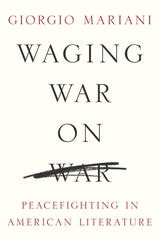
Waging War on War
Peacefighting in American LiteratureGiorgio Mariana
University of Illinois Press, 2015
Giorgio Mariani rigorously engages with the essential question of what makes a text explicitly anti-war. Ranging from Emerson and Joel Barlow to Maxine Hong Kingston and Tim O'Brien, Waging War on War explores why sustained attempts at identifying the anti-war text's formal and philosophical features seem to always end at an impasse. Mariani moves a step beyond to construct a theoretical model that invites new inquiries into America's nonviolent, nonconformist tradition even as it challenges the ways we study U.S. warmaking and the cultural reactions to it. In the process, he shows how the ideal of nonviolence and a dislike of war have been significant, if nonhegemonic, features of American culture since the nation's early days.
Ambitious and nuanced, Waging War on War at last defines anti-war literature while exploring the genre's role in an assertive peacefighting project that offered--and still offers--alternatives to violence.
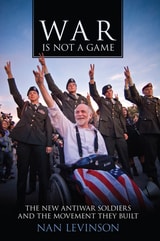
War Is Not a Game
The New Antiwar Soldiers and the Movement They BuiltLevinson, Nan
Rutgers University Press, 2016

War No More
Eliminating Conflict in the Nuclear AgeRobert Hinde and Joseph Rotblat
Pluto Press, 2003
Written by Nobel Peace prize winner and former nuclear physicist Joseph Rotblat, who was involved in the creation of the first atom bomb, and biologist/ psychologist Robert Hinde, War No More provides expert insight into the nature of modern warfare - including weapons of mass destruction. Examining the key factors that contribute to conflict, the authors explain how best to approach a peaceful future.
If war is ever to be eliminated, we must address key issues such as the gap between rich and poor; have fully effective arms controls, and above all we must have better education. The authors emphasise the United Nations - as well as NGOs, religious groups, and grassroots movements - also have important parts to play.
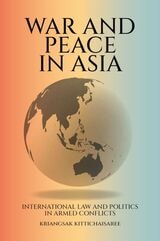
War and Peace in Asia
International Law and Politics in Armed ConflictsKriangsak Kittichaisaree
National University of Singapore Press, 2026
How do Asian states navigate the complex terrain between international legal obligations and strategic national interests in matters of war and peace? What justifications are invoked to wage war, and what are the legal frameworks used to restore peace? Do bilateral settlements comply with and support the development of international law, or do they undermine it? This comprehensive study examines conflict and peace-building across Asia since 1945, providing a distinctly Asian perspective on international law and relations.
War and Peace in Asia considers how Asian history, including the region's experience of colonialism, shapes ideas of international order. Kriangsak Kittichaisaree considers rules against the threat or use of force; management of sovereignty disputes over borders and territories; insurgencies or conflicts arising from groups seeking self-determination; annexations of one State’s territory by another State; conflicts under the guise of “humanitarian intervention” and the Responsibility to Protect (R2P) doctrine; self-defense against terrorists and non-state actors who are driven by ideology; and armed intervention by invitation. The book offers scholars, policymakers, and practitioners crucial insights into conflict dynamics in this geopolitically volatile region.
War and Peace in International Rivalry
Paul F. Diehl and Gary Goertz
University of Michigan Press, 2001
War, Peace, and Prosperity in the Name of God
The Ottoman Role in Europe's Socioeconomic EvolutionMurat Iyigun
University of Chicago Press, 2015
War, Peace, and Prosperity in the Name of God turns the focus on the “big three monotheisms”—Judaism, Islam, and Christianity—to consider these questions. Chronicling the relatively rapid spread of the Abrahamic religions among the Old World, Murat Iyigun shows that societies that adhered to a monotheistic belief in that era lasted longer, suggesting that monotheism brought some sociopolitical advantages. While the inherent belief in one true god meant that these religious communities had sooner or later to contend with one another, Iyigun shows that differences among them were typically strong enough to trump disagreements within. The book concludes by documenting the long-term repercussions of these dynamics for the organization of societies and their politics in Europe and the Middle East.
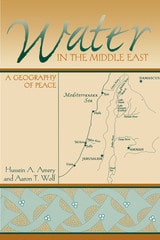
Water in the Middle East
A Geography of PeaceEdited by Hussein A. Amery and Aaron Wolf
University of Texas Press, 2000
Finding "streams in the desert" has never been more urgent for the peoples of the Middle East. Rapid population growth and a rising standard of living are driving water demand inexorably upward, while the natural supply has not increased since Biblical times. Ensuring a fair and adequate distribution of water in the region is vitally important for building a lasting peace among the nations of the Middle East.
Addressing water needs from a geographical perspective, the contributors to this book analyze and assess the impact of scarce water resources in the Jordan River basin countries and territories (Israel, Jordan, Lebanon, Palestine, and Syria) as these long-time antagonists work toward peace. After geographical and historical overviews, the authors envision the future-what the water issues may be when Israel and Syria begin negotiating, the "hydro-security" needs of each nation, and the difficulties of planning for uncertainty. Without proposing any one ideal scheme, they discuss the possibilities for cooperative sharing of water resources, while honestly acknowledging the political constraints that may limit such projects. The final essay speaks to the needs of the one party so rarely represented at the negotiating table—the Jordan River itself.
When Peace Is Not Enough
How the Israeli Peace Camp Thinks about Religion, Nationalism, and JusticeAtalia Omer
University of Chicago Press, 2013
When the State Fails
Studies on Intervention in the Sierra Leone Civil WarTunde Zack-Williams
Pluto Press, 2012
Compared with Iraq, Afghanistan and Kosovo, the recent western intervention in Sierra Leone has been largely forgotten. When the State Fails rectifies this, providing a comprehensive and critical analysis of the intervention.
The civil war in Sierra Leone began in 1991 and was declared officially over in 2002 after UK, UN and regional African military intervention. Some claimed it as a case of successful humanitarian intervention. The authors in this collection provide an informed analysis of the impact of the intervention on democracy, development and society in Sierra Leone. The authors take a particularly critical view of the imposition of neoliberalism after the conflict.
As NATO intervention in Libya shows the continued use of external force in internal conflicts, When the State Fails is a timely book for all students and scholars interested in Africa and the question of ‘humanitarian intervention’.
With Honor
Melvin Laird in War, Peace, and PoliticsVan Atta
University of Wisconsin Press, 2008
The first book ever to focus on Laird’s legacy, this authorized biography reveals his central and often unrecognized role in managing the crisis of national identity sparked by the Vietnam War—and the challenges, ethical and political, that confronted him along the way. Drawing on exclusive interviews with Laird, Henry Kissinger, Gerald Ford, and numerous others, author Dale Van Atta offers a sympathetic portrait of a man striving for open government in an atmosphere fraught with secrecy. Van Atta illuminates the inner workings of high politics: Laird’s behind-the-scenes sparring with Kissinger over policy, his decisions to ignore Nixon’s wilder directives, his formative impact on arms control and health care, his key role in the selection of Ford for vice president, his frustration with the country’s abandonment of Vietnamization, and, in later years, his unheeded warning to Donald Rumsfeld that “it’s a helluva lot easier to get into a war than to get out of one.”

Witness through Encounter
The Diplomacy of Benedict XVIBernard J. O'Connor
St. Augustine's Press, 2019
Appealing to dialogue is often just a safe way of referring to something negative, or at best blandly neutral: the avoidance of conflict, the denial of similarity, not stirring deep-seated disagreement, etc. When Bernard o’Connor says pope Benedict XVI facilitated dialogue, however, he means something quite positive, very much tangible and certainly transformative. In providing an account of the pope’s interactions with various groups of the international community, O’Connor attempts to convey Benedict XVI’s diplomacy as encounter, where even in the sphere of international relations exhortations to “dialogue” are invitations to see more clearly and be moved as much as move.
To dialogue is to embrace, revise perception such that our approaches to the great questions of our day are not simply shared but correct. As O’Connor writes, “Pope Benedict attempts to promote the outlook that a renewed emphasis upon objective, critical and structured philosophical reasoning positions practice, diplomatic and otherwise, to regain its lost foundation and framework. the quest for integrity, if nothing else, should motivate our fidelity to academic pursuit, to intellectual investigation, and to rigorous interdisciplinary inquiry. so influenced, practice will then reject what is arbitrary and be guided by what is time-tested and enduring.”
O’Connor illustrates true dialogue emerging from the encounter, and in turn provides scores of characteristics of this encounter as it unfolds in papal diplomacy. In providing scores of addresses and speeches to various bodies, O’Connor presents pope Benedict XVI as an example of effective diplomacy that treats the meetings on the world stage as engaging in true dialogue. encounter is the true basis of dialogue and one that allows it to open to what is truly a catalyst for change toward cooperation––witness, both personal and collective. As o’Connor shows, “where there is authentic encounter, as meeting in mutual trust, what arises is context for witness.” If authentic even the diplomatic encounter has the means to deepen and transform one’s being.
Witness Through Encounter intends to fulfill multiple needs. the diplomatic approach exemplified herein is singular and worthy of study among political scientists, sociologists, philosophers and diplomats eager to embrace a worldview that is more personal than simply humanistic. this work will also be useful in inter-religious settings. An additional advantage of O’Connor’s presentation of Benedict XVI’s diplomatic approach, his witness through encounter, is that it contains insight valuable to the scholar alongside the resources used.
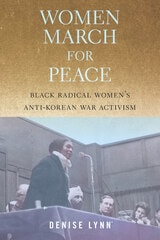
Women March for Peace
Black Radical Women’s Anti-Korean War ActivismDenise Lynn
University of Massachusetts Press, 2025
The Korean War is commonly known as the “forgotten war” because it supposedly had little impact on American culture in comparison to World War II or the American War in Vietnam. Yet from 1950–1953, the conflict produced vigorous anti-war activism, particularly among Black radical women. Informed by their experiences with racism and misogyny within the US, these women were convinced that peace was not just the absence of military aggression, but that it required the liberation of the most oppressed, including the end of capitalist exploitation of women and People of Color and the return of self-determination to colonized peoples—themes that later anti-war activists would echo and develop. Whether or not the Korean War has ever truly been forgotten, the visionary activism of these women has been largely overlooked.
In Women March for Peace, Denise Lynn examines the lives of seven Black women—Louise Thompson Patterson, Claudia Jones, Charlotta Bass, Shirley Graham Du Bois, Eslanda Robeson, Lorraine Hansberry, and Beulah Richardson—and their resistance to domestic and foreign US policies during the height of anticommunist hysteria. While much peace scholarship focuses on the threat of nuclear conflict, Lynn instead explores how these women connected issues of civil rights at home with international military campaigns, highlights the hypocrisy of containment policies that sought to secure the freedom and rights for Koreans when US citizens were still oppressed. Lynn traces their peace advocacy through their personal papers, local and national articles, Progressive Party documents, and global conventions. Women March for Peace recovers the radical activism of these Black women to understand a crucial chapter in the fight against American imperialism and white supremacy.

Women at The Hague
The International Congress of Women and Its ResultsJane Addams, Emily G. Balch, and Alice Hamilton
University of Illinois Press, 2003
Following the conference in The Hague, Addams and Balch traveled around Europe as members of delegations visiting various governmental leaders to demand an end to the war. In this book they describe the activities of these delegations, painting a vivid portrait of the emerging women's peace movement.
With the continuing growth of the peace movement, the essays in Women at the Hague remain as timely as they were when first published in 1915. Addams, Balch, and Hamilton write compellingly about the organizing methods and collaborative spirit of the women's peace movement, conveying a strong awareness of the responsibility of women to protect the global community from the devastating effects of war.
World War and World Peace in the Age of Digital Capitalism
By Christian Fuchs
University of Westminster Press, 2025
In World War and World Peace in the Age of Digital Capitalism, Christian Fuchs asks: how do violence and war manifest themselves in global digital capitalism? How do digital capitalism and digital technologies manifest themselves in violence and warfare? What are the prospects for world peace today?
To prevent world war and advance world peace we need a better understanding of war and violence and their contexts and causes. We need to ask what war is, what violence is, what war and peace look like today and how they have changed in the 21st century. This book addresses these urgent questions and provides possible answers.
Writing against War
Literature, Activism, and the British Peace MovementCharles Andrews
Northwestern University Press, 2017
The cataclysm of the First World War gave rise to the British Peace Movement, a spectrum of pacifist, internationalist, and antiwar organizations and individuals. Antiwar sentiments found expression not only in editorials, criticism, and journalism but also in novels and other works of literature. Writing against War examines the work of Aldous Huxley, Storm Jameson, Siegfried Sassoon, Rose Macaulay, and Virginia Woolf to analyze the effects of their attempts to employ fiction in the service of peace activism. It further traces how Huxley, Woolf, and others sought to reconcile their antiwar beliefs with implacable military violence.
The British Peace Movement's failure to halt the rise of fascism and the Second World War continues to cast a shadow over contemporary pacifist movements. Writing about War will fascinate scholars of peace studies and literature and offers valuable insights for current-day peace activists and artists who seek to integrate creativity with activism.