67 books match the query 'Segregation' and 5 start with w
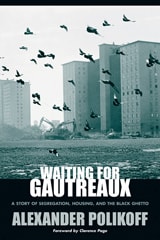
cover of Waiting for Gautreaux: A Story of Segregation, Housing, and the Black Ghetto

Waiting for Gautreaux

A Story of Segregation, Housing, and the Black Ghetto

Alexander Polikoff

Northwestern University Press, 2007

Winner, 2006 The American Lawyer Lifetime Achievement Award

On his thirty-ninth birthday in 1966, Alexander Polikoff, a volunteer ACLU attorney and partner in a Chicago law firm, met some friends to discuss a pro bono case. Over lunch, the four talked about the Chicago Housing Authority construction program. All the new public housing, it seemed, was going into black neighborhoods. If discrimination was prohibited in public schools, wasn't it also prohibited in public housing?

And so began Gautreaux v. CHA and HUD, a case that from its rocky beginnings would roll on year after year, decade after decade, carrying Polikoff and his colleagues to the nation's Supreme Court (to face then-solicitor general Robert Bork); establishing precedents for suits against the discriminatory policies of local housing authorities, often abetted by HUD; and setting the stage for a nationwide experiment aimed at ending the concentration--and racialization--of poverty through public housing. Sometimes Kafkaesque, sometimes simply inspiring, and never less than absorbing, the story of Gautreaux, told by its principal lawyer, moves with ease through local and national civil rights history, legal details, political matters, and the personal costs--and rewards--of a commitment to fairness, equality, and justice. Both the memoir of a dedicated lawyer, and the narrative of a tenacious pursuit of equality, this story--itself a critical, still-unfolding chapter in recent American history--urges us to take an essential step in ending the racial inequality that Alexis de Toqueville prophetically named America's "most formidable evil."
[more]
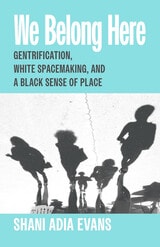
cover of We Belong Here: Gentrification, White Spacemaking, and a Black Sense of Place

We Belong Here

Gentrification, White Spacemaking, and a Black Sense of Place

Shani Adia Evans

University of Chicago Press, 2025

A landmark study that shows how Black residents experience and respond to the rapid transformation of historically Black places.
 
Although Portland, Oregon, is sometimes called “America’s Whitest city,” Black residents who grew up there made it their own. The neighborhoods of Northeast Portland, also called “Albina,” were a haven for and a hub of Black community life. But between 1990 and 2010, Albina changed dramatically—it became majority White.
 
In We Belong Here, sociologist Shani Adia Evans offers an intimate look at gentrification from the inside, documenting the reactions of Albina residents as the racial demographics of their neighborhood shift. As White culture becomes centered in Northeast, Black residents recount their experiences with what Evans refers to as “White watching,” the questioning look on the faces of White people they encounter, which conveys an exclusionary message: “What are you doing here?” This, Evans shows, is a prime example of what she calls “White spacemaking”: the establishment of White space—spaces in which Whiteness is assumed to be the norm and non-Whites are treated with suspicion—in formerly non-White neighborhoods. Evans also documents Black residents’ efforts to create and maintain places for Black belonging in White-dominated Portland. While gentrification typically describes socioeconomic changes that may have racial implications, White spacemaking allows us to understand racism as a primary mechanism of neighborhood change. We Belong Here illuminates why gentrification and White spacemaking should be examined as intersecting, but not interchangeable, processes of neighborhood change.
[more]
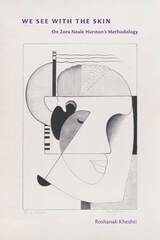
cover of We See with the Skin: On Zora Neale Hurston's Methodology

We See with the Skin

On Zora Neale Hurston's Methodology

Roshanak Kheshti

Duke University Press, 2026
Roshanak Kheshti opens her book with a line from one of Zora Neale Hurston’s earliest stories: “we see with the skin.” From this brief but potent line, Kheshti examines how Hurston’s understanding of Black skin as both seen and seeing offers radical insight into racialized perception and Black consciousness. Kheshti follows Hurston’s travels across the back woods of Florida, Georgia, Alabama, and Louisiana as a filmmaker and sensory ethnographer of the African diasporic spiritual practice of hoodoo. Through her travels, Hurston encountered a sensibility that could animate the object status of being colored with the power of a return gaze. Kheshti considers both how Hurston poetically exploited the synesthetic logic at the heart of race thinking—being colored—and how her embodied performance ethnography catalogued an outside to that logic. We See with the Skin is an original mapping of Hurston’s synesthetic theory and its broader implications for understanding minoritarian perception and thought.
[more]
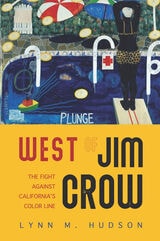
cover of West of Jim Crow: The Fight against California's Color Line

West of Jim Crow

The Fight against California's Color Line

Lynn M. Hudson

University of Illinois Press, 2020

African Americans who moved to California in hopes of finding freedom and full citizenship instead faced all-too-familiar racial segregation. As one transplant put it, "The only difference between Pasadena and Mississippi is the way they are spelled." From the beaches to streetcars to schools, the Golden State—in contrast to its reputation for tolerance—perfected many methods of controlling people of color.

Lynn M. Hudson deepens our understanding of the practices that African Americans in the West deployed to dismantle Jim Crow in the quest for civil rights prior to the 1960s. Faced with institutionalized racism, black Californians used both established and improvised tactics to resist and survive the state's color line. Hudson rediscovers forgotten stories like the experimental all-black community of Allensworth, the California Ku Klux Klan's campaign of terror against African Americans, the bitter struggle to integrate public swimming pools in Pasadena and elsewhere, and segregationists' preoccupation with gender and sexuality.
[more]
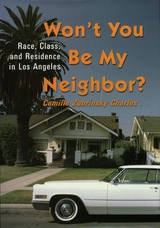
cover of Won't You be My Neighbor: Race, Class, and Residence in Los Angeles

Won't You be My Neighbor

Race, Class, and Residence in Los Angeles

Camille Zubrinksy Charles

Russell Sage Foundation, 2006

Los Angeles is a city of delicate racial and ethnic balance. As evidenced by the 1965 Watts violence, the 1992 Rodney King riots, and this year's award-winning film Crash, the city's myriad racial groups coexist uneasily together, often on the brink of confrontation. In fact, Los Angeles is highly segregated, with racial and ethnic groups clustered in homogeneous neighborhoods. These residential groupings have profound effects on the economic well-being and quality of life of residents, dictating which jobs they can access, which social networks they can tap in to, and which schools they attend. In Won't You Be My Neighbor?, sociologist Camille Zubrinsky Charles explores how modern racial attitudes shape and are shaped by the places in which people live. Using in-depth survey data and information from focus groups with members of L.A.'s largest racial and ethnic groups, Won't You Be My Neighbor? explores why Los Angeles remains a segregated city. Charles finds that people of all backgrounds prefer both racial integration and a critical mass of same-race neighbors. When asked to reveal their preferred level of racial integration, people of all races show a clear and consistent order of preference, with whites considered the most highly desired neighbors and blacks the least desirable. This is even true among recent immigrants who have little experience with American race relations. Charles finds that these preferences, which are driven primarily by racial prejudice and minority-group fears of white hostility, taken together with financial considerations, strongly affect people's decisions about where they live. Still, Charles offers reasons for optimism: over time and with increased exposure to other racial and ethnic groups, people show an increased willingness to live with neighbors of other races. In a racially and ethnically diverse city, segregated neighborhoods can foster distrust, reinforce stereotypes, and agitate inter-group tensions. Won't You Be My Neighbor? zeroes in on segregated neighborhoods to provide a compelling examination of the way contemporary racial attitudes shape, and are shaped by, the places where we live.
[more]