Results by title
862 books match the query 'Social History' and 59 start with w
WP vol 53 num 1
The University of Chicago Press
University of Chicago Press Journals, 2019
Waiting for Buddy Guy
Chicago Blues at the CrossroadsAlan Harper
University of Illinois Press, 2016
Walking East Harlem
A Neighborhood ExperienceChristopher Bell
Rutgers University Press, 2025
Now East Harlem native Christopher Bell takes you on a tour of his beloved neighborhood. He takes you on three separate walking tours, each visiting a different part of East Harlem and each full of stories about its theaters, museums, art spaces, schools, community centers, churches, mosques, and synagogues. You’ll also learn about the famous people who lived in El Barrio, such as actress Cecily Tyson, opera singer Marian Anderson, portrait artist Alice Neel, incomparable poet Julia De Burgos, and King of Latin Music Tito Puente.
Lavishly illustrated with over fifty photos, Walking East Harlem points out not only the many architectural and cultural landmarks in the neighborhood but also the historical buildings that have since been demolished. Whether you are a tourist or a resident, this guide will give you a new appreciation for El Barrio’s exciting history, cultural diversity, and continued artistic vibrancy.
Wanted—Correspondence
Women’s Letters to a Union SoldierNancy L. Rhoades
Ohio University Press, 2009
A unique collection of more than 150 letters written to an Ohio serviceman during the American Civil War that offers glimpses of women’s lives as they waited, worked, and wrote from the Ohio home front. The letters reveal fascinating details of the lives of mostly young, single women—friends, acquaintances, love interests, and strangers who responded to one Union soldier’s advertisement for correspondents. Almost all of the women who responded to Lieutenant Edwin Lewis Lybarger’s lonely-hearts newspaper advertisement lived in Ohio and supported the Union. Lybarger carried the collection of letters throughout three years of military service, preserved them through his life, and left them to be discovered in an attic trunk more than a century after Lee’s surrender.
Women’s letter writing functioned as a form of “war work” that bolstered the spirits of enlisted men and “kinship work” that helped forge romantic relationships and sustain community bonds across the miles. While men’s letters and diaries abound in Civil War history, less readily available are comprehensive collections of letters from middle-class and rural women that survived the weathering of marches, camp life, and battles to emerge unscathed from men’s knapsacks at war’s end.
The collection is accompanied by a detailed editorial introduction that highlights significant themes in the letters. Together, they contribute to the still-unfolding historical knowledge concerning Northern women’s lives and experiences during this significant period in American history.

Waterscapes
Reservoirs, Environment and Identity in Modern England and WalesAndrew McTominey
University of London Press, 2025
Carving vast lakes into the countryside, reservoirs have long reshaped the landscapes and communities of England and Wales. Waterscapes evaluates how these feats of engineering transformed rural and urban environments between the late nineteenth and early twentieth centuries, altering local ecologies and economies. Through studies of Leeds’s Washburn Valley, Liverpool’s Vyrnwy Reservoir, and Birmingham’s Elan Reservoir, Andrew McTominey addresses the environmental consequences of dam construction and the surprising ways in which reservoirs became sites of leisure and tourism.
McTominey explains that water management has never been a simple question of supply and demand, but a story of contested landscapes and the complex interplay between nature and human ambition. Drawing on environmental history and urban studies, Waterscapes demystifies the reservoirs that continue to shape Britain’s countryside and city life.
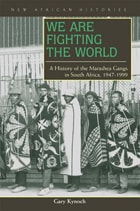
We Are Fighting the World
A History of the Marashea Gangs in South Africa, 1947–1999Gary Kynoch
Ohio University Press, 2005
Since the late 1940s, a violent African criminal society known as the Marashea has operated in and around South Africa’s gold mining areas. With thousands of members involved in drug smuggling, extortion, and kidnapping, the Marashea was more influential in the day-to-day lives of many black South Africans under apartheid than were agents of the state. These gangs remain active in South Africa.
In We Are Fighting the World: A History of the Marashea Gangs in South Africa, 1947–1999, Gary Kynoch points to the combination of coercive force and administrative weakness that characterized the apartheid state. As long as crime and violence were contained within black townships and did not threaten adjacent white areas, township residents were largely left to fend for themselves. The Marashea’s ability to prosper during the apartheid era and its involvement in political conflict led directly to the violent crime epidemic that today plagues South Africa.
Highly readable and solidly researched, We Are Fighting the World is critical to an understanding of South African society, past and present. This pioneering study challenges previous social history research on resistance, ethnicity, urban spaces, and gender in South Africa. Kynoch’s interviews with many current and former gang members give We Are Fighting the World an energy and a realism that are unparalleled in any other published work on gang violence in southern Africa.
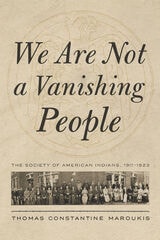
We Are Not a Vanishing People
The Society of American Indians, 1911–1923Thomas Constantine Maroukis
University of Arizona Press, 2021
Historian Thomas Constantine Maroukis discusses the goals, strategies, successes, and failures of the Indigenous intellectuals who came together to form the SAI. They engaged in lobbying, producing publications, informing the media, hundreds of speaking engagements, and annual conferences to argue for reform. Unfortunately, the forces of this era were against reforming federal policies: The group faced racism, a steady stream of negative stereotyping as a so-called vanishing race, and an indifferent federal bureaucracy. They were also beset by internal struggles, which weakened the organization.
This work sheds new light on the origins of modern protest in the twentieth century, and it shows how the intellectuals and activists associated with the SAI were able to bring Indian issues before the American public, challenging stereotypes and the “vanishing people” trope. Maroukis argues that that the SAI was not an assimilationist organization; they were political activists trying to free Indians from government wardship while maintaining their cultural heritage.
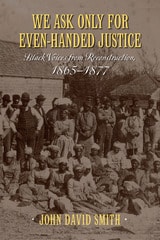
We Ask Only for Even-Handed Justice
Black Voices from Reconstruction, 1865-1877John David Smith
University of Massachusetts Press, 2014
The years following Appomattox offered the freed people numerous opportunities and challenges. Ex-slaves reconnected with relatives dispersed by the domestic slave trade and the vicissitudes of civil war. They sought their own farms and homesteads, education for their children, and legal protection from whites hostile to their new status. They negotiated labor contracts, established local communities, and, following the 1867 Reconstruction Acts, entered local, state, and national politics.
Though aided by Freedmen's Bureau agents and sympathetic whites, former slaves nevertheless faced daunting odds. Ku Klux Klansmen and others terrorized blacks who asserted themselves, many northerners lost interest in their plight, and federal officials gradually left them to their own resources. As a result, former Confederates regained control of the southern state governments following the 1876 presidential election.
We Ask Only for Even-Handed Justice is a substantially revised and expanded edition of a book originally published under the title Black Voices from Reconstruction, 1865–1877.
We Shall Not Be Moved/No nos moveran
Biography of a Song of StruggleDavid Spener
Temple University Press, 2016
The activist anthem “We Shall Not Be Moved” expresses resolve in the face of adversity; it helps members of social movements persevere in their struggles to build a better world. The exact origins of the song are unknown, but it appears to have begun as a Protestant revival song sung by rural whites and African slaves in the southeastern United States in the early nineteenth century. The song was subsequently adopted by U.S. labor and civil rights activists, students and workers opposing the Franco dictatorship in Spain, and by Chilean supporters of that country’s socialist government in the early 1970s.
In his fascinating biography, We Shall Not Be Moved, David Spener details the history and the role the song has played in each of the movements in which it has been sung. He analyzes its dissemination, function, and meaning through a number of different sociological and anthropological lenses to explore how songs can serve as an invaluable resource to participants in movements for social change.
We've Been Here All Along
Wisconsin's Early Gay HistoryR. Richard Wagner
Wisconsin Historical Society Press, 2020
In We’ve Been Here All Along, R. Richard Wagner draws on historical research and materials from his own extensive archive to uncover previously hidden stories of gay Wisconsinites. This book honors their legacy and confirms that they have been foundational to the development and evolution of the state since its earliest days
We, the People
Politics of National Peculiarity in Southeastern EuropeDiana Mishkova
Central European University Press, 2009
West Virginia's War
The Civil War in DocumentsWilliam Kerrigan
Ohio University Press, 2025
This book explores the unique history of West Virginia, the only state born out of the Civil War. Western Virginians faced a dual crisis of allegiance and identity, torn between their historical ties to the secessionist state of Virginia and their loyalty to the Union. The population included a significant number of enslaved people, for whom the conflict’s outcome would have major consequences. Many Civil War narratives focus on major battles, but William Kerrigan shifts attention to the civilians of Western Virginia—both free and enslaved—who endured military occupation, raids, and guerrilla warfare. Civilians faced loyalty oaths, arrests, property destruction, and invasions by soldiers and partisans from both sides. Enslaved individuals played an active role, providing intelligence and assistance to Union forces and risking their lives for their freedom. At the same time, political leaders grappled with complex legal and political questions, first rejecting secession from the Union and subsequently pursuing their own secession from Virginia to form the new state of West Virginia. Their challenges included framing a new government, defining the state’s borders, addressing the future of slavery, and securing federal recognition. Postwar reconstruction in West Virginia presented its own challenges, distinct from those of other border states, as the return of defeated Confederates threatened the stability of the new state. The book highlights how the experiences of Western Virginia’s noncombatants, political leaders, and enslaved people contributed to the region’s turbulent transformation during and after the Civil War.
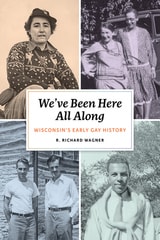
We’ve Been Here All Along
Wisconsin’s Early Gay HistoryR. Richard Wagner
Wisconsin Historical Society Press, 2019
In We’ve Been Here All Along, R. Richard Wagner draws on historical research and materials from his own extensive archive to uncover previously hidden stories of gay Wisconsinites. This book honors their legacy and confirms that they have been foundational to the development and evolution of the state since its earliest days
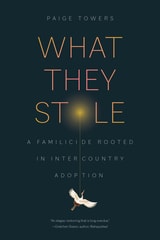
What They Stole
A Familicide Rooted in Intercountry AdoptionPaige Towers
University of Iowa Press, 2026
The Sueppels were among the families profoundly shaped by the legacy of the Holt Adoption Program. To their suburban Iowa City community, Steven and Sheryl Sueppel were kind and charitable, humble yet magnetic—seemingly ideal candidates to adopt. But in 2008, when Steven found himself facing federal embezzlement and money laundering charges, he murdered Sheryl and their adopted children before ending his own life.
Paige Towers traces the interwoven histories of the Holts and the Sueppels, exploring the deeper, often hidden complexities of intercountry adoption: the ethical gray zones, the influences of religion and race, and the global inequalities that made such large-scale child migration possible. Meticulously researched and sensitive with its storytelling, What They Stole examines how good intentions can coexist with systemic harm—and how the consequences of systems like the Holts’ can reverberate across generations.
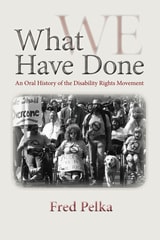
What We Have Done
An Oral History of the Disability Rights MovementFred Pelka
University of Massachusetts Press, 2012
“Nothing about us without us” has been a core principle of American disability rights activists for more than half a century. It represents a response by people with disabilities to being treated with scorn and abuse or as objects of pity, and to having the most fundamental decisions relating to their lives—where they would live; if and how they would be educated; if they would be allowed to marry or have families; indeed, if they would be permitted to live at all—made by those who were, in the parlance of the movement, “temporarily able-bodied.”
In What We Have Done: An Oral History of the Disability Rights Movement, Fred Pelka takes that slogan at face value. He presents the voices of disability rights activists who, in the period from 1950 to 1990, transformed how society views people with disabilities, and recounts how the various streams of the movement came together to push through the Americans with Disabilities Act of 1990, the most sweeping civil rights legislation since passage of the Civil Rights Act of 1964. Beginning with the stories of those who grew up with disabilities in the 1940s and '50s, the book traces how disability came to be seen as a political issue, and how people with disabilities—often isolated, institutionalized, and marginalized—forged a movement analogous to the civil rights, women's rights, and gay rights movements, and fought for full and equal participation in American society.
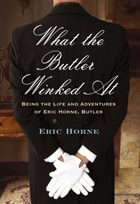
What the Butler Winked At
Being the Life and Adventures of Eric Horne, ButlerEric Horne
Westholme Publishing, 2011
A Memoir of the Real Downton Abbey Experience
Eric Horne served as a butler in some of the great English country manors from the 1860s until just after World War I, when many of the families whose heirs died in battle were forced to sell off their homes. Born in Southampton, Horne came from a humble family who valued education. Horne excelled in school and wished to go to sea, but lacking his parents’ permission, he instead ended up as a footboy for a local household. Over the years, Horne moved up in the service of the aristocracy: his goal was to become butler to the king of England, a position he very nearly secured. He did end up in the service of several distinguished households for many decades, and upon his retirement in 1922, he decided to write his memoir. Horne is a unique voice; not only did he have intimate contact with his employers and the household staff, he also possessed literary talent, so that his account provides authentic detail as well as shrewd—and often witty—views of the aristocracy, the servants, and their activities. Horne is not sentimental though; he does not think that he used his life wisely, having never learned a true trade. He reveals the plight of the servant class, where once a butler lost his employment—particularly following the devastation of World War I—he was likely to end up in a poorhouse, because employers did not usually provide pensions and servants were rarely able to save enough money to survive on their own. What the Butler Winked At is a fascinating and essential account of life in a country house during the height of the Victorian and Edwardian eras.
When Ethnicity Did Not Matter in the Balkans
A Study of Identity in Pre-Nationalist Croatia, Dalmatia, and Slavonia in the Medieval and Early-Modern PeriodsJohn V. A. Fine, Jr.
University of Michigan Press, 2006
-Steve Rapp, Associate Professor of Caucasian, Byzantine, and Eurasian History, and Director, Program in World History and Cultures Department of History, Georgia State University Atlanta
When Ethnicity Did Not Matter in the Balkans is a study of the people who lived in what is now Croatia during the Middle Ages (roughly 600-1500) and the early-modern period (1500-1800), and how they identified themselves and were identified by others. John V. A. Fine, Jr., advances the discussion of identity by asking such questions as: Did most, some, or any of the population of that territory see itself as Croatian? If some did not, to what other communities did they consider themselves to belong? Were the labels attached to a given person or population fixed or could they change? And were some people members of several different communities at a given moment? And if there were competing identities, which identities held sway in which particular regions?
In When Ethnicity Did Not Matter in the Balkans, Fine investigates the identity labels (and their meaning) employed by and about the medieval and early-modern population of the lands that make up present-day Croatia. Religion, local residence, and narrow family or broader clan all played important parts in past and present identities. Fine, however, concentrates chiefly on broader secular names that reflect attachment to a city, region, tribe or clan, a labeled people, or state.
The result is a magisterial analysis showing us the complexity of pre-national identity in Croatia, Dalmatia, and Slavonia. There can be no question that the medieval and early-modern periods were pre-national times, but Fine has taken a further step by demonstrating that the medieval and early-modern eras in this region were also pre-ethnic so far as local identities are concerned. The back-projection of twentieth-century forms of identity into the pre-modern past by patriotic and nationalist historians has been brought to light. Though this back-projection is not always misleading, it can be; Fine is fully cognizant of the danger and has risen to the occasion to combat it while frequently remarking in the text that his findings for the Balkans have parallels elsewhere.
John V. A. Fine, Jr. is Professor of History at the University of Michigan.
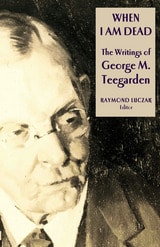
When I Am Dead
The Writings of George M. TeegardenRaymond Luczak
Gallaudet University Press, 2007
The Sixth Volume in the Gallaudet Classics in Deaf Studies Series
George M. Teegarden (1852-1936) taught at the Western Pennsylvania School for the Deaf for 48 years, established the printing department, and also served as the first editor of the school’s magazine. Despite these significant contributions, his greatest gift to deaf people was his skill as a writer and poet who was deaf, as readers will discover in When I Am Dead: The Writings of George M. Teegarden.
Editor Raymond Luczak selected Teegarden’s prose in When I Am Dead from several books, including Raindrop, and Stories, Old and New. Noting that these stories were never written for hearing readers, Luczak marvels at Teegarden’s ability to write English prose that the ASL-familiar reader would find incredibly easy to transliterate. By employing a rich blend of original stories and revisions of fables and myths, Teegarden taught his students the importance of improving their reading and writing skills to outfit them “for the battle of life.” He produced a body of work that Luczak characterizes as “a breath of fresh air: quick, painless, and usually told with a sense of wonder.”
Luczak’s choice of poems came from Teegarden’s self-published volume Vagrant Verses, a summation of his affection for Gallaudet College, the Deaf community, and all deaf people. The eponymous poem “When I Am Dead” articulates concisely the beliefs that directed Teegarden’s life of service:
“When I am dead, I hope to be
Remembered—this is true—
Not for my wit or vanities
But what I did for you.”
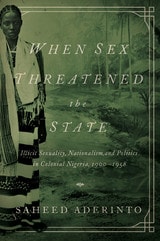
When Sex Threatened the State
Illicit Sexuality, Nationalism, and Politics in Colonial Nigeria, 1900-1958Saheed Aderinto
University of Illinois Press, 2015
As Saheed Aderinto shows, British colonizers saw prostitution as an African form of sexual primitivity and a problem to be solved as part of imperialism's "civilizing mission". He details the Nigerian response to imported sexuality laws and the contradictory ways both African and British reformers advocated for prohibition or regulation of prostitution. Tracing the tensions within diverse groups of colonizers and the colonized, he reveals how wrangling over prostitution camouflaged the negotiating of separate issues that threatened the social, political, and sexual ideologies of Africans and Europeans alike.
The first book-length project on sexuality in early twentieth century Nigeria, When Sex Threatened the State combines the study of a colonial demimonde with an urban history of Lagos and a look at government policy to reappraise the history of Nigerian public life.
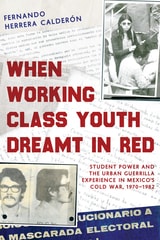
When Working Class Youth Dreamt in Red
Student Power and the Urban Guerrilla Experience in Mexico's Cold War, 1970–1982Fernando Herrera Calderón
University of Arizona Press, 2027
The 1970s in Mexico were turbulent from the start. Insurgent voices converged across cities and rural peripheries. Militant labor, urban popular sectors, and Indigenous collectives erupted in expressions of broad social exhaustion. Rebellion, rooted in the layered betrayals of the postrevolutionary state and the fractures of a deteriorating modernity under the Institutional Revolutionary Party (PRI), fermented and boiled over.
At the core of this moment, Mexican youth found their way to political-military organizations, coalescing around shared ecologies of dissent and embedded in broader currents of revolutionary struggle. When Working Class Youth Dreamt in Red reconstructs these insurgent youth cultures and guerrilla imaginaries, reorienting the historiographical lens to center radical working class youth—especially urban students—as protagonists in a wider saga of revolutionary experimentation and political rupture.
At its conceptual core, this book offers a bold new interpretation of a turbulent moment in Mexican history. It shows how class shaped the epistemic horizons through which proletarian youth understood themselves and makes visible their role as central actors at the vanguard of a revolutionary time.
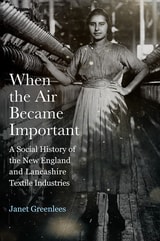
When the Air Became Important
A Social History of the New England and Lancashire Textile IndustriesJanet Greenlees
Rutgers University Press, 2019
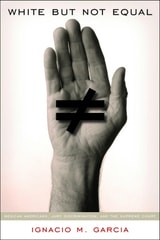
White But Not Equal
Mexican Americans, Jury Discrimination, and the Supreme CourtIgnacio M. García
University of Arizona Press, 2008
Ignacio García’s White But Not Equal explores this historic but mostly forgotten case, which became the first to recognize discrimination against Mexican Americans. Led by three dedicated Mexican American lawyers, the case argued for recognition of Mexican Americans under the 14th Amendment as a “class apart.” Despite a distinct history and culture, Mexican Americans were considered white by law during this period, yet in reality they were subjected to prejudice and discrimination. This was reflected in Hernández’s trial, in which none of the selected jurors were Mexican American. The concept of Latino identity began to shift as the demand for inclusion in the political and judicial system began.
García places the Hernández v. Texas case within a historical perspective and examines the changing Anglo-Mexican relationship. More than just a legal discussion, this book looks at the whole case from start to finish and examines all the major participants, placing the story within the larger issue of the fight for Mexican American civil rights.
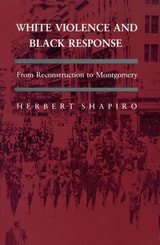
White Violence and Black Response
From Reconstruction to MontgomeryHerbert Shapiro
University of Massachusetts Press, 1988
We are taught that America is a society based on respect for the law and orderly procedures. That the Constitution stands as a safeguard of individual freedom, and the courts and the police are supposedly established to enforce the law. When a controversial issue arises in the American fabric, it is to be resolved not in the streets but through the democratic processes of elections. Yet, for blacks these liberal values have been turned into their opposites. The courts have most often stood silent in the face of racist violence or have turned their wrath against the victims, not the perpetrators; the police have protected the mob rather than the mobbed and have often either aided the lynchers or displayed amazing inability to identify them. Where race is concerned, legislative or judicial action to deal with controversial issues has often come late and been partial in nature, while white violence has continued to terrorize black Americans without hindrance.
In White Violence and Black Response: From Reconstruction to Montgomery, Herbert Shapiro explores the depths of violence generated by white racism and the irony of the American association with violence as a behavior of black people. Citing the nation's political leadership, educational institutions, and news media as institutions that fail to educate Americans about the oppressive social conditions that have root in these criminal acts, Shapiro is able to expose the ways in which white supremacy operates within American institutions and the responses by black people in this powerful read.
Why Everyone Hates White Liberals (Including White Liberals)
A HistoryKevin M. Schultz
University of Chicago Press, 2025
If there’s one thing most Americans can agree on, it’s that everyone hates white liberals. Conservatives hate them for being culturally tolerant and threatening to usher in communism. Libertarians hate them for believing in the power of the state. Socialists hate them for serving as capitalism’s beard. Even liberals hate liberals—either because they can’t manage to overcome their own prejudices, or precisely because they’re so self-hating.
This is the starting point for Kevin M. Schultz’s lively new history of white liberals in the United States. He efficiently lays out the array of objections to liberals—ineffective, spineless, judgmental, authoritarian, and more—in a historical frame that shows how protean the concept has been throughout the past hundred years. It turns out, he declares, that how you define a “white liberal” is less a reflection of reality and more a Rorschach test revealing your own anxieties.
Sharply assessing how decades of attacks on liberals and liberalism have steadily hollowed out the center of American political life, Schultz also explains precisely what needs to be done to avoid digging ourselves even further into the hole of polarization. The ultimate goal, he argues, is to achieve political fragmentation that will fuel the rise of a true multiparty system, where ideology will matter more, not less.
With a tight command of postwar American history and a spirited voice, Why Everyone Hates White Liberals (Including White Liberals) is a must-read for anyone wishing to understand—and envision a way forward in—the complicated landscape of American politics.
Why So Easily . . . Some Family Reasons for the Velvet Revolution
A Sociological EssayIvo Možný
Karolinum Press, 2023
Thirty-two years after its initial publication, this respected sociological essay, written in the history-making years of 1989 and 1990, is available for the first time in English. The essay tells the story of a despotic Socialist state expropriating the family (and with it the private sphere of life) only to be colonized by the very thing it expropriated forty years later. The essay plunges the reader into the pivotal time of the Velvet Revolution and provides valid explanations for the grassroots causes of the old regime’s downfall, examining the private aspirations and strategies of highly disparate groups of nameless social actors of the old regime that eventually sapped almost everyone of any interest in keeping the regime afloat.

Why the American Century?
Olivier Zunz
University of Chicago Press, 1998
"It should certainly be the task of historians to explain the nation's triumphs as effectively as they have explained its failures, and Zunz in this intelligent, learned and ambitious book suggests a valuable new model for doing so."—Alan Brinkley, Times Literary Supplement
"Zunz is evenhanded in his judgments. . . . His thesis is both imaginative and well grounded in the appropriate sources."—David M. Oshinsky, New York Times Book Review
"Zunz is an innovative and perceptive social critic. He crosses disciplinary boundaries with ease and felicity, and is particularly adept at illustrating large themes with unusual but telling details."—Kent Blaser, American Studies
"An eye-opening introduction to the shaping of modern America."—Foreign Affairs
Wife and Widow in Medieval England
Sue Sheridan Walker, Editor
University of Michigan Press, 1993
Winterthur Portfolio, volume 55 number 1 (Spring 2021)
The University of Chicago Press
University of Chicago Press Journals, 2021
Winterthur Portfolio, volume 55 number 23 (Summer/Autumn 2021)
The University of Chicago Press
University of Chicago Press Journals, 2021
Winterthur Portfolio, volume 55 number 4 (Winter 2021)
The University of Chicago Press
University of Chicago Press Journals, 2021
Winterthur Portfolio, volume 56 number 1 (Spring 2022)
The University of Chicago Press
University of Chicago Press Journals, 2022

Winterthur Portfolio, volume 56 number 23 (Summer/Autumn 2022)
The University of Chicago Press
University of Chicago Press Journals, 2022

Winterthur Portfolio, volume 56 number 4 (Winter 2022)
The University of Chicago Press
University of Chicago Press Journals, 2022
Winterthur Portfolio, volume 57 number 1 (Spring 2023)
The University of Chicago Press
University of Chicago Press Journals, 2023

Winterthur Portfolio, volume 57 number 23 (Summer/Autumn 2023)
The University of Chicago Press
University of Chicago Press Journals, 2023
Winterthur Portfolio, volume 57 number 4 (Winter 2023)
The University of Chicago Press
University of Chicago Press Journals, 2023
Winterthur Portfolio, volume 58 number 1 (Spring 2024)
The University of Chicago Press
University of Chicago Press Journals, 2024

Winterthur Portfolio, volume 58 number 23 (Summer/Autumn 2024)
The University of Chicago Press
University of Chicago Press Journals, 2024
Winterthur Portfolio, volume 58 number 4 (Winter 2024)
The University of Chicago Press
University of Chicago Press Journals, 2024
Winterthur Portfolio, volume 59 number 1 (Spring 2025)
The University of Chicago Press
University of Chicago Press Journals, 2025
Winterthur Portfolio, volume 59 number 23 (Summer/Autumn 2025)
The University of Chicago Press
University of Chicago Press Journals, 2025
Winterthur Portfolio, volume 59 number 4 (Winter 2025)
The University of Chicago Press
University of Chicago Press Journals, 2025
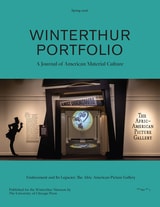
Winterthur Portfolio, volume 60 number 1 (Spring 2026)
The University of Chicago Press
University of Chicago Press Journals, 2026
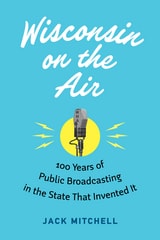
Wisconsin on the Air
100 Years of Public Broadcasting in the State That Invented ItJack Mitchell
Wisconsin Historical Society Press, 2016
On a wintry evening in 1917, university professor Earle Terry listened with guests as the popular music of the day filtered from a physics laboratory in Science Hall into a receiving set in his living room. Little did they know that one hundred years of public service broadcasting had just begun. Terry’s radio experiment blossomed into a pioneering endeavor to carry out the "Wisconsin Idea," a promise to make the university’s knowledge accessible to all Wisconsinites, in their homes, statewide, a Progressive-era principle that still guides public broadcasting in Wisconsin and throughout the nation. In 1947, television was added to this public service model with Channel 21 in Madison, produced, like radio, from the University of Wisconsin campus. By 1967, when the Public Broadcasting Act created the Public Broadcasting System (PBS) and National Public Radio (NPR), the Wisconsin stations had been broadcasting for fifty years. A history one hundred years in the making, Wisconsin on the Air introduces readers to the personalities and philosophies, the funding challenges and legislation, the original Wisconsin programming and pioneering technology that gave us public radio and television. Author Jack Mitchell, who developed All Things Considered for NPR before becoming the head of Wisconsin Public Radio, deftly maps public broadcasting’s hundred-year journey by charting Wisconsin’s transition from the early days of radio and television to educational broadcasting to the news, information, and music of Wisconsin Public Radio and Wisconsin Public Television.
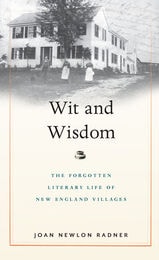
Wit and Wisdom
The Forgotten Literary Life of New England VillagesJoan Newlon Radner
University of Massachusetts Press, 2023
The lyceum movement gained momentum in the decades preceding the Civil War, presenting members with the opportunity to participate in literary life and engage with the issues of the day. While urban lyceums played host to a who’s who of nineteenth-century intellectual life, literary societies also cropped up in thousands of villages across the nation, acting as influential sites of learning, creativity, and community engagement. In rural New England, ordinary men and women, farmers and intelligentsia, selectmen and schoolchildren came together to write and perform poetry and witty parodies and debate a wide range of topics, from women’s rights and temperance to slavery, migration, and more.
Wit and Wisdom takes readers inside this long-forgotten tradition, providing new access to the vibrant voices, surprising talents, and understated humor on display on many a cold winter’s night. Having uncovered dozens of handwritten newspapers produced by village lyceums across Maine, New Hampshire, Vermont, and Massachusetts, Joan Newlon Radner proves that these close-knit groups offered a vital expression of the beliefs, ambitions, and resilience of rural New Englanders.

Witchcraft Mythologies and Persecutions
Gábor Klaniczay
Central European University Press, 2008
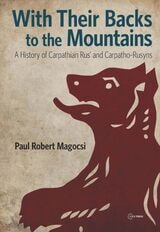
With Their Backs to the Mountains
A History of Carpathian Rus' and Carpatho-RusynsPaul Robert Magocsi
Central European University Press, 2016
This is a history of a stateless people, the Carpatho-Rusyns, and their historic homeland, Carpathian Rus’, located in the heart of central Europe. A little over 100,000 Carpatho-Rusyns are registered in official censuses but their population is estimated at around 1,000,000, the greater part in Ukraine and Slovakia. The majority of the diaspora—nearly 600,000—lives in the US.
At the present, when it is fashionable to speak of nationalities as “imagined communities” created by intellectuals or elites who may live in the historic homeland, Carpatho-Rusyns provide an ideal example of a people made—or some would say still being made—before our very eyes. The book traces the evolution of Carpathian Rus’ from earliest prehistoric times to the present, and the complex manner in which a distinct Carpatho-Rusyn people, since the mid-nineteenth century, came into being, disappeared, and then re-appeared in the wake of the revolutions of 1989 and the collapse of communist rule in central and eastern Europe.
To help guide the reader further there are 34 detailed maps plus an annotated discussion of relevant books, chapters, and journal articles.
Wives, Mothers, and the Red Menace
Conservative Women and the Crusade against CommunismMary Brennan
University Press of Colorado, 2027
Brennan details the actions and experiences of prominent anti-communists Jean Kerr McCarthy, Margaret Chase Smith, Freda Utley, Doloris Thauwald Bridges, Elizabeth Churchill Brown, and Phyllis Stewart Schlafly. She describes the Cold War context in which these women functioned and the ways in which women saw communism as a very real danger to domestic security and American families. Millions of women, Brennan notes, expanded their notions of household responsibilities to include the crusade against communism. From writing letters and hosting teas to publishing books and running for political office, they campaigned against communism and, incidentally, discovered the power they had to effect change through activism.
Brennan reveals how the willingness of these deeply conservative women to leave the domestic sphere and engage publicly in politics evinces the depth of America's postwar fear of communism. She further argues that these conservative, anti-communist women pushed the boundaries of traditional gender roles and challenged assumptions about women as political players by entering political life to publicly promote their ideals.Wives, Mothers, and the Red Menace offers a fascinating analysis of gender and politics at a critical point in American history. Brennan's work will instigate discussions among historians, political scientists, and scholars of women's studies.
Wobblies of the World
A Global History of the IWWEdited by Peter Cole, David Struthers, and Kenyon Zimmer
Pluto Press, 2017
Founded in 1905, Chicago's Industrial Workers of the World (IWW) is a union unlike any other. With members affectionately called "Wobblies" and an evolutionary and internationalist philosophy and tactics, it rapidly grew across the world. Considering the history of the IWW from an international perspective for the first time, Wobblies of the World brings together a group of leading scholars to present a lively collection of accounts from thirteen diverse countries, revealing a fascinating story of anarchism, syndicalism, and socialism. Chapters include:
*”A Cosmopolitan Crowd”: Transnational Anarchists, the IWW and the American Radical Press by Kenyon Zimmer
*Living Social Dynamite: Early Twentieth-Century IWW-South Asia Connections by Tariq Khan
*IWW Internationalism and Interracial Organizing in the Southwestern United States by David M. Struthers
*Spanish Anarchists and Maritime Workers in the IWW by Bieito Alonso
*The IWW and the Dilemmas of Labor Internationalism by Wayne Thorpe
*Wobblies Down Under: The IWW in Australia by Verity Burgmann
*Ki Nga Kaimahi Maori ('To All Maori Workers'): The New Zealand IWW and the Maori by Mark Derby
*Patrick Hodgens Hickey and the IWW: A Transnational Relationship by Peter Clayworth
*Edith Frenette: A Transnational Radical Life by Heather Mayer
*Tom Barker and Revolutionary Europe by Paula de Angelis
*P. J. Welinder and “American Syndicalism” in Interwar Sweden by Johan Pries
*Tramp, Tramp, Tramp: The Songs of Joe Hill Around the World by Bucky Halker
*And much, much more!
Drawing on many important figures of the movement—Har Dayal, James Larkin, William D. "Big Bill" Haywood, Enrique Flores Magón, and more—the contributors describe how the IWW and its ideals spread, exploring the crucial role the IWW played in industries such as shipping, mining, and agriculture.
Ultimately, the book illuminates Wobblie methods of organizing, forms of expression, practices, and transnational issues, offering a fascinating alternative history of the group
Women and Work in the North-Eastern Adriatic
Postwar TransitionsMarta Verginella
Central European University Press, 2025
The volume offers a comparative and transnational exploration of women's work in the twentieth century, concentrating especially on the turbulent periods after both World Wars and the Yugoslav wars in the 1990s. The spatial focus of the analysis is the northeastern Adriatic region, which includes the border areas of Italy and Austria, Croatia, and Slovenia. The study is one of the results of an international research project carried out with the support of the European Research Council.
The seven studies in the book represent a cross-section of specific professional groups of women. The spectrum ranges from female teachers, clerks, tobacco and textile workers to intellectual, artistic or entrepreneurial activities of women. Although “gender” is a central category of analysis in the book, the aspect of representativeness was also observed in relation to other social factors such as race, class, generations, educational and religious background, etc. The main question of the study was the extent to which new state affiliations, geopolitical boundaries, and the establishment of new political regimes affected the women's labor market in the three postwar constellations.