Results by title
454 books match the query 'Study and teaching (Higher)' and 37 start with w
WPAing in a Pandemic and Beyond
Revision, Innovation, and AdvocacyTodd Ruecker
Utah State University Press, 2025
The chapters in this collection include a variety of voices who have been involved in writing program administration in recent years to reflect on the work done in this moment of crisis. Through both short vignettes and longer chapters, this book explores the complicated interactions between WPA work and navigating times of crisis to provide insights for moving forward. Authors explore a variety of topics including professional development, curricular change, advocating in the face of intransigent administrations and others, caring for students, and taking time for self-care. Pointing to specific actions for continued advocacy, WPAing in a Pandemic and Beyond will be of great interest to WPAs and writing studies scholars.
Weathering the Storm
Independent Writing Programs in the Age of Fiscal AusterityRichard N. Matzen Jr.
Utah State University Press, 2019
Leading writing specialists at the University of Texas at Austin, Syracuse University, the University of Minnesota, and many other institutions document and think carefully about the on-the-ground obstacles that have made the creation of IWPs unique. From institutional naysayers in English departments to skeptical administrators, IWPs and the faculty within them have surmounted not only negative economics but also negative rhetorics. This collection charts the story of this journey as writing faculty continually make the case for the importance of writing in the university curriculum.
Independence has, for the most part, allowed IWPs to better respond to the Great Recession, but to do so they have had to define writing studies in relation to other disciplines and departments. Weathering the Storm will be of great interest to faculty and graduate students in rhetoric and composition, writing program administrators, and writing studies and English department faculty.
Contributors: Linda Adler-Kassner, Lois Agnew, Alice Batt, David Beard, Davida Charney, Amy Clements, Diane Davis, Frank Gaughan, Heidi Skurat Harris, George H. Jensen, Rodger LeGrand, Drew M. Loewe, Mark Garrett Longaker, Cindy Moore, Peggy O’Neill, Chongwon Park, Louise Wetherbee Phelps, Mary Rist, Valerie Ross, John J Ruszkiewicz, Eileen E. Schell, Madeleine Sorapure, Chris Thaiss, Patrick Wehner, Jamie White-Farnham, Carl Whithaus, Traci A. Zimmerman
What Do You Think, Mr. Ramirez?
The American Revolution in EducationGeoffrey Galt Harpham
University of Chicago Press, 2017
That, says Harpham, was the midcentury promise of American education, the deep current of commitment and aspiration that undergirded the educational system that was built in the postwar years, and is under extended assault today. The United States was founded, he argues, on the idea that interpreting its foundational documents was the highest calling of opinion, and for a brief moment at midcentury, the country turned to English teachers as the people best positioned to train students to thrive as interpreters—which is to say as citizens of a democracy. Tracing the roots of that belief in the humanities through American history, Harpham builds a strong case that, even in very different contemporary circumstances, the emphasis on social and cultural knowledge that animated the midcentury university is a resource that we can, and should, draw on today.
What We Are Becoming
Developments in Undergraduate Writing MajorsGreg Giberson and Thomas A. Moriarty
Utah State University Press, 2010
Contributors to the volume address a range of vital questions for undergraduate programs, including such issues as the competition for majors within departments, the job market for undergraduates, varying focuses and curricula of such majors, and the formation of them in departments separate from English. Other chapters discuss the importance of flexibility, consider arguments for a rhetorical or civic discourse core for the writing major, address the relationship between rhetoric and composition majors, and review the role of multiliteracies in the major.
The field of composition has not come to a consensus on the shape, content, or focus of the undergradutate major. But as individual programs develop and refine their curricula, one thing has become clear: we must think about them in ways that go beyond our particular circumstances, theorize them in ways that secure their place on our campuses and in our discipline for years to come. What We Are Becoming is an effort to do just that.
What We Really Value
Beyond Rubrics in Teaching and Assessing WritingBob Broad
Utah State University Press, 2003
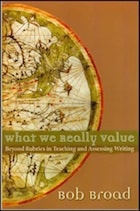
What We Really Value traces the origins of traditional rubrics within the theoretical and historical circumstances out of which they emerged, then holds rubrics up for critical scrutiny in the context of contemporary developments in the field. As an alternative to the generic character and decontextualized function of scoring guides, he offers dynamic criteria mapping, a form of qualitative inquiry by which writing programs (as well as individual instructors) can portray their rhetorical values with more ethical integrity and more pedagogical utility than rubrics allow.
To illustrate the complex and indispensable insights this method can provide, Broad details findings from his study of eighty-nine distinct and substantial criteria for evaluation at work in the introductory composition program at "City University." These chapters are filled with the voices of composition instructors debating and reflecting on the nature, interplay, and relative importance of the many criteria by which they judged students' texts. Broad concludes his book with specific strategies that can help writing instructors and programs to discover, negotiate, map, and express a more robust truth about what they value in their students' rhetorical performances.
What is Arts Research?
Gabriel Harp
A2RU Intervals, 2018
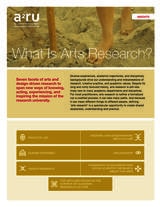
Diverse experiences, academic trajectories, and disciplinary backgrounds drive our understanding and interpretations of research, creative practice, and academic values. Despite its long and richly textured history, arts research is still relatively new to many academic departments and disciplines. For most practitioners, arts research is neither a formalized nor a codified process; it can take many paths. And because it can mean different things to different people, defining ‘arts research’ is a spectacular opportunity to create shared awareness, understanding and practice.
What is Research?
Gabriel Harp
A2RU Intervals, 2018
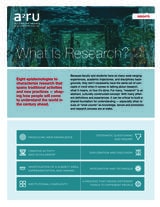
Because faculty and students have so many wide-ranging experiences, academic trajectories, and disciplinary backgrounds, they don’t necessarily have the same set of concepts in mind when it comes to talking about research, what it means, or how it’s done. For many, “research” is an abstract, culturally constructed concept. With many different definitions and experiences, it can be critical to build a shared foundation for understanding — especially when issues of “what counts” as knowledge, tenure and promotion, and research process are at stake.
White Boy
A MemoirMark D. Naison
Temple University Press, 2002
White Scholars/African American Texts
Edited by Lisa A. Long
Rutgers University Press, 2005
What makes someone an authority? What makes one person's knowledge more credible than another's? In the ongoing debates over racial authenticity, some attest that we can know each other's experiences simply because we are all "human," while others assume a more skeptical stance, insisting that racial differences create unbridgeable gaps in knowledge.
Bringing new perspectives to these perennial debates, the essays in this collection explore the many difficulties created by the fact that white scholars greatly outnumber black scholars in the study and teaching of African American literature. Contributors, including some of the most prominent theorists in the field as well as younger scholars, examine who is speaking, what is being spoken and what is not, and why framing African American literature in terms of an exclusive black/white racial divide is problematic and limiting.
In highlighting the "whiteness" of some African Americanists, the collection does not imply that the teaching or understanding of black literature by white scholars is definitively impossible. Indeed such work is not only possible, but imperative. Instead, the essays aim to open a much needed public conversation about the real and pressing challenges that white scholars face in this type of work, as well as the implications of how these challenges are met.
Whose Goals Whose Aspirations
Learning to Teach Underprepared Writers across the CurriculumStephen M. Fishman and Lucille McCarthy
Utah State University Press, 2002
Ever since Horace Mann promoted state supported schooling in the 1850s, the aims of U.S. public education have been the subject of heated national debate. Whose Goals? Whose Aspirations? joins this debate by exploring clashing educational aims in a discipline-based university classroom and the consequences of these clashes for "underprepared" writers.
In this close-up look at a White middle-class teacher and his ethnically diverse students, Fishman and McCarthy examine not only the role of Standard English in college writing instruction but also the underlying and highly charged issues of multiculturalism, race cognizance, and social class.
Why Art Cannot Be Taught
A Handbook for Art StudentsJames Elkins
University of Illinois Press, 2001
"Art can be taught, but it seems as if it can't be since so few students become outstanding artists."
"Art cannot be taught, but it can be fostered or helped along."
"Art cannot be taught or even nourished, but it is possible to teach right up to the beginnings of art so that students are ready to make art the moment they graduate."
"Great art cannot be taught, but more run-of-the-mill art can be."
Elkins traces the development (or invention) of the modern art school and considers how issues such as the question of core curriculum and the intellectual isolation of art schools affect the teaching and learning of art. He also addresses the phenomenon of art critiques as a microcosm for teaching art as a whole and dissects real-life critiques, highlighting presuppositions and dynamics that make them confusing and suggesting ways to make them more helpful.
Elkins's no-nonsense approach clears away the assumptions about art instruction that are not borne out by classroom practice. For example, he notes that despite much talk about instilling visual acuity and teaching technique, in practice neither teachers nor students behave as if those were their principal goals. He addresses the absurdity of pretending that sexual issues are absent from life-drawing classes and questions the practice of holding up great masters and masterpieces as models for students capable of producing only mediocre art. He also discusses types of art--including art that takes time to complete and art that isn't serious--that cannot be learned in studio art classes.
Why Art Cannot Be Taught is a response to Elkins's observation that "we know very little about what we do" in the art classroom. His incisive commentary illuminates the experience of learning art for those involved in it, while opening an intriguing window for those outside the discipline.
Wiki Writing
Collaborative Learning in the College ClassroomRobert E. Cummings and Matt Barton, Editors
University of Michigan Press, 2008
When most people think of wikis, the first---and usually the only---thing that comes to mind is Wikipedia. The editors of Wiki Writing: Collaborative Learning in the College Classroom, Robert E. Cummings and Matt Barton, have assembled a collection of essays that challenges this common misconception, providing an engaging and helpful array of perspectives on the many pressing theoretical and practical issues that wikis raise. Written in an engaging and accessible manner that will appeal to specialists and novices alike, Wiki Writing draws on a wealth of practical classroom experiences with wikis to offer a series of richly detailed and concrete suggestions to help educators realize the potential of these new writing environments.
Robert E. Cummings began work at Columbus State University in August 2006 as Assistant Professor of English and Director of First-Year Composition. Currently he also serves as the Writing Specialist for CSU's Quality Enhancement Plan, assisting teachers across campus in their efforts to maximize student writing in their curriculum. He recently concluded a three-year research study with the Inter/National Coalition for Electronic Portfolio Research and continues to research in the fields of computers and writing, writing across the curriculum, writing in the disciplines, and curricular reform in higher education.
Matt Barton is Assistant Professor, St. Cloud State University, Department of English-Rhetoric and Applied Writing Program. His research interests are rhetoric, new media, and computers and writing. He is the author of Dungeons and Desktops: A History of Computer Role-Playing Games and has published in the journals Text and Technology, Computers and Composition, Game Studies, and Kairos. He is currently serving as Associate Editor of Kairosnews and Managing Editor of Armchair Arcade.
"Wiki Writing will quickly become the standard resource for using wikis in the classroom."
---Jim Kalmbach, Illinois State University
digitalculturebooks is an imprint of the University of Michigan Press and the Scholarly Publishing Office of the University of Michigan Library dedicated to publishing innovative and accessible work exploring new media and their impact on society, culture, and scholarly communication. Visit the website at www.digitalculture.org.
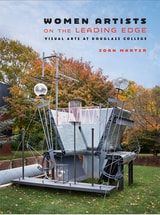
Women Artists on the Leading Edge
Visual Arts at Douglass CollegeJoan M. Marter
Rutgers University Press, 2020
How do students develop a personal style from their instruction in a visual arts program? Women Artists on the Leading Edge explores this question as it describes the emergence of an important group of young women artists from an innovative post-war visual arts program at Douglass College.
The women who studied with avant-garde artists at Douglas were among the first students in the nation to be introduced to performance art, conceptual art, Fluxus, and Pop Art. These young artists were among the first to experience new approaches to artmaking that rejected the predominant style of the 1950s: Abstract Expressionism. The New Art espoused by faculty including Robert Watts, Allan Kaprow, Roy Lichtenstein, Geoffrey Hendricks, and others advocated that art should be based on everyday life. The phrase “anything can be art” was frequently repeated in the creation of Happenings, multi-media installations, and video art. Experimental approaches to methods of creation using a remarkable range of materials were investigated by these young women. Interdisciplinary aspects of the Douglass curriculum became the basis for performances, videos, photography, and constructions. Sculpture was created using new technologies and industrial materials. The Douglass women artists included in this book were among the first to implement the message and direction of their instructors.
Ultimately, the artistic careers of these young women have reflected the successful interaction of students with a cutting-edge faculty. From this BA and MFA program in the Visual Arts emerged women such as Alice Aycock. Rita Myers, Joan Snyder, Mimi Smith, and Jackie Winsor, who went on to become lifelong innovators. Camaraderie was important among the Douglass art students, and many continue to be instructors within a close circle of associates from their college years. Even before the inception of the women’s art movement of the 1970s, these women students were encouraged to pursue professional careers, and to remain independent in their approach to making art. The message of the New Art was to relate one’s art production to life itself and to personal experiences. From these directions emerged a “proto-feminist” art of great originality identified with women’s issues. The legacy of these artists can be found in radical changes in art instruction since the 1950s, the promotion of non-hierarchical approaches to media, and acceptance of conceptual art as a viable art form.
Working Lives of New Writing Center Directors
Nicole I. Caswell
Utah State University Press, 2016
The first book-length empirical investigation of writing center directors’ labor, The Working Lives of New Writing Center Directors presents a longitudinal qualitative study of the individual professional lives of nine new directors. Inspired by Kinkead and Harris’s Writing Centers in Context (1993), the authors adopt a case study approach to examine the labor these directors performed and the varied motivations for their labor, as well as the labor they ignored, deferred, or sidelined temporarily, whether or not they wanted to.
The study shows directors engaged in various types of labor—everyday, disciplinary, and emotional—and reveals that labor is never restricted to a list of job responsibilities, although those play a role. Instead, labor is motivated and shaped by complex and unique combinations of requirements, expectations, values, perceived strengths, interests and desires, identities, and knowledge. The cases collectively distill how different institutions define writing and appropriate resources to writing instruction and support, informing the ongoing wider cultural debates about skills (writing and otherwise), the preparation of educators, the renewal/tenuring of educators, and administrative “bloat” in academe.
The nine new directors discuss more than just their labor; they address their motivations, their sense of self, and their own thoughts about the work they do, facets of writing center director labor that other types of research or scholarship have up to now left invisible. The Working Lives of New Writing Center Directors strikes a new path in scholarship on writing center administration and is essential reading for present and future writing center administrators and those who mentor them.
Working with Faculty Writers
Anne Ellen Geller and Michele Eodice
Utah State University Press, 2013
Contributors from a variety of institution types and perspectives consider who faculty writers are and who they may be in the future, reveal the range of locations and models of support for faculty writers, explore the ways these might be delivered and assessed, and consider the theoretical, philosophical, political, and pedagogical approaches to faculty writing support, as well as its relationship to student writing support.
With the pressure on faculty to be productive researchers and writers greater than ever, this is a must-read volume for administrators, faculty, and others involved in developing and assessing models of faculty writing support.
Writer's Style
A Rhetorical Field GuidePaul Butler
Utah State University Press, 2018
In a departure from the deficiency model associated with other commonly used style guides, author Paul Butler encourages writers to see style as a malleable device to use for their own purposes, rather than a domain of rules or privilege. He encourages writing instructors to present style as a practical, accessible, and rhetorical tool, working with models that connect to a broad range of writing situations—including traditional texts like essays, newspaper articles, and creative nonfiction as well as digital texts in the form of tweets, Facebook postings, texts, email, visual rhetoric, YouTube, and others.
Though designed for use in first-year composition courses in which students are learning to write for various audiences, purposes, and contexts, The Writer’s Style is a richly layered work that will serve anyone considering how style applies to their professional, personal, creative, or academic writing.
Writing Across Difference
Theory and InterventionJames Rushing Daniel
Utah State University Press, 2021
No text in composition has made such a sweeping attempt to place the multiple areas of translingualism, anti-racism, anticolonialism, interdisciplinarity, and disability into conversation or to represent the field as broadly unified around the concept of difference. The chapters in this book specifically explore how monolingual ideology is maintained in institutions and how translingual strategies can (re)include difference; how narrative-based interventions can promote writing across difference in classrooms and institutions by complicating dominant discourses; and how challenging dominant logics of class, race, ability, and disciplinarity can present opportunities for countering divisiveness.
Writing Across Difference offers writing scholars a sustained intellectual encounter with the crisis of difference and foregrounds the possibilities such an encounter offers for collective action toward a more inclusive and equitable society. It presents a variety of approaches for intervening in classrooms and institutions in the interest of focalizing, understanding, negotiating, and bridging difference. The book will be a valuable resource to those disturbed by the bigotry, violence, and fanaticism that mark our political culture and who are seeking inspiration, models, and methods for collective response.
Contributors: Anis Bawarshi, Jonathan Benda, Megan Callow, James Rushing Daniel, Cherice Escobar Jones, Laura Gonzales, Juan Guerra, Stephanie Kerschbaum, Katie Malcolm, Nadya Pittendrigh, Mya Poe, Candice Rai, Iris Ruiz, Ann Shivers-McNair, Neil Simpkins, Alison Y. L. Stephens, Sumyat Thu, Katherine Xue, Shui-yin Sharon Yam
Writing Centers and Racial Justice
A Guidebook for Critical PraxisTalisha Haltiwanger Morrison
Utah State University Press, 2023
In five thematically organized sections—Countering Racism and Colonialism in Higher Education; Recruitment, Hiring, and Retention; Tutor Education and Professional Development; Engaging with Campus and Community; and Holding Our Professional Organizations Accountable—scholars from a variety of institutions, both large and small, public and private, present critical reflection and concrete guidance on anti-racist writing center administrative policies and practices. Several chapters include sample materials, such as course syllabi, consultant education activities, and recruitment materials, to help current and aspiring writing center administrators implement changes in their own contexts.
Writing Centers and Racial Justice is the first book to offer clear and actionable advice on how writing centers and their staff can take up racial or social justice work that will result in real sustainable change. Writing center directors, professionals, and tutors, as well as administrators and decision makers at the institutional level, will benefit from this thoughtful and effective text.
Writing Centers and the New Racism
A Call for Sustainable Dialogue and ChangeLaura Greenfield and Karen Rowan
Utah State University Press, 2011
Laura Greenfield and Karen Rowan have created a rich resource for writing center tutors, administrators, and scholars. Motivated by a scholarly interest in race, literacy, and pedagogy, and by an ethical commitment to antiracism work, contributors address a series of related questions: How does institutionalized racism in American education shape the culture of literacy and language education in the writing center? How does racism operate in the discourses of writing center scholarship and lore, and in what ways are writing centers unwittingly complicit in racist practices? How can they meaningfully operationalize antiracist work? How do they persevere through the difficulty and messiness of negotiating race and racism in their daily practice?
The conscientious, nuanced attention to race in Writing Centers and the New Racism is meant to model what it means to be bold in engagement with these hard questions and to spur the kind of sustained, productive, multivocal, and challenging dialogue that, with a few important exceptions, has been absent from the field.
Writing Emergencies
Composing (Ourselves) in Times of CrisisHolly Hassel
Utah State University Press, 2026
Despite the adage “there are no writing emergencies,” at times situations invite or require immediate written response. In a modern era of social media and with the constancy of “crisis,” knowing when, how, and why to respond quickly is increasingly important. In Writing Emergencies, a diverse group of authors contribute scholarly, narrative-based discussions of writing emergencies, descriptions of more and less successful strategies, and a reflective conclusion that offers implications for writing studies praxis and theory.
In this collection, contributors demonstrate the reality of writing emergencies—in their own writing lives, classrooms, and programs—and they offer both self- and community-focused approaches for response. Chapters focus on discernment and prioritization, recognizing that all stressors are not necessarily emergencies. Instead, expanding our vocabulary for (and subsequent understanding) of the kinds of difficulties we come across can build our professional capacity and support greater career sustainability. The volume also illustrates the role of coalitions in navigating writing emergencies and how purposefully building and activating these coalitions subverts some challenges before they become emergencies, particularly those that are recurrent or manufactured.
Writing Emergencies both names and grapples with writing emergencies and offers insights for capacity-building in the acts of filtering and prioritizing competing urgent demands. The findings are meaningful for all leaders, students, and teachers who center care in their relationships with others.
Writing Expertise
A Research-Based Approach to Writing and Learning Across DisciplinesLinda Adler-Kassner
University Press of Colorado, 2023
In Writing Expertise, Linda Adler-Kassner and Elizabeth Wardle address the question, “How can instructors across disciplines best help students write well?” Drawing on research about how disciplines use writing to engage in shared ways of thinking, practicing, and demonstrating knowledge, the authors offer an approach that helps faculty across the disciplines invite students to bring new ideas and identities to their work. Throughout the book, Adler-Kassner and Wardle help instructors explore what it means to write well in their courses, fields, or disciplines and offer strategies and activities that can help them improve their assignments by infusing research-based writing activities into their courses.
Writing Expertise provides an innovative, equity- and research-based approach to writing in the disciplines that will enrich instructor and student thinking. Thoughtful discussions and well-designed activities provide the support needed to help instructors put disciplinary thinking into written form, develop systematic aways of learning about the students who write in their courses, and ultimately develop more effective, inclusive courses.
Writing Groups in the Writing Center
Negotiating Authority and Expertise in Collaborative LearningSara Wilder
Utah State University Press, 2025
As many higher education institutions strive to create spaces and systems that increase equity, accessibility, and diversity, they recognize the need for improved mentorship across academic levels. This book analyzes the significant benefits as well as the challenges faced by writing groups in providing such support. Wilder presents a nuanced account of how facilitators scaffold group practice, how members use and build genre knowledge across disciplines, and how institutional contexts shape emotional labor requirements.
For educators and tutors, the book provides an in-depth examination of the facilitator role, describing essential logistical, emotional, and intellectual practices, and addresses common conflicts and challenges. Administrators can find valuable material for training tutor-facilitators and frameworks for conceptualizing writing group functions on campus. For researchers, the book extends scholarship on writing groups, writing transfer, and collaborative learning, bridging writing center and broader writing studies research.
In an era of concern about generative AI’s role in writing education, Writing Groups in the Writing Center extends research on group facilitation, collaborative learning, and authority negotiation in writing center communities of practice and emphasizes the human connections that make collaborative writing meaningful and valuable for student writers.
Writing Groups
History, Theory, and ImplicationsAnne Ruggles Gere
Southern Illinois University Press, 1987
Drawing upon previously unpublished archival materials as well as historical accounts, Gere traces the history of writing groups in America, from their origins over a century ago to their recent reappearance in the works of Macrorie, Elbow, Murray, and others.
From this historical perspective Gere examines the theoretical foundations of writing groups, challenging the traditional concept of writing as an individual performance. She offers instead a broader view of authorship that includes both individual and social dimensions, with implications not only for the teaching of composition but also for theories of rhetoric and literacy.
Writing Majors
Eighteen Program ProfilesGreg Giberson
Utah State University Press, 2015
The writing major is among the most exciting scenes in the evolving American university. Writing Majors is a collection of firsthand descriptions of the origins, growth, and transformations of eighteen different programs. The chapters provide useful administrative insight, benchmark information, and even inspiration for new curricular configurations from a range of institutions.
A practical sourcebook for those who are building, revising, or administering their own writing majors , this volume also serves as a historical archive of a particular instance of growth and transformation in American higher education. Revealing bureaucratic, practical, and institutional matters as well as academic ideals and ideologies, each profile includes sections providing a detailed program review and rationale, an implementation narrative, and reflection and prospection about the program.
Documenting eighteen stories of writing major programs in various stages of formation, preservation, and reform and exposing the contingencies of their local and material constitution, Writing Majors speaks as much to the “how to” of building writing major programs as to the larger “what,” “why,” and “how” of institutional growth and change.
Writing Opportunities
Writing, Learning, and Rightful Presence in College TransitionsBrad Jacobson
Utah State University Press, 2026
Writing Opportunities presents in-depth text histories illustrating the interrelationship of writing, identities, and belonging in college writing transitions. Drawing on more than two years of research with three Latinx/a/o students transitioning from the same high school class to the local university, Brad Jacobson brings together analyses of interview transcripts, student writing, classroom genres, and institutional policies to foreground a sense of belonging as central to writing development and learning.
Including interviews with students and their instructors, Jacobson traces writing opportunities that Hercules, Jain, and Lucy were afforded as they transitioned from high school to college writing, particularly in general education courses. Chapters attend to multiple levels of interaction to show how policies, practices, and social histories can impact opportunities for learning. With attention to dominant discourses of writing that narrow what counts as good writing as well as positive opportunity structures that extend possibilities for identification, engagement, and deep learning, Jacobson also posits writing as an opportunity for writers to explore possibilities for who we are and who we may become.
Jacobson’s humanizing research invites readers to consider opportunity from multiple perspectives and shows how subtle shifts in relationships among students, instructors, and institutions can increase meaningful learning and provide a sense of belonging in educational contexts.
Writing Pathways to Student Success
Lillian Craton
University Press of Colorado, 2017
Teachers of first-year composition courses do essential work. Teaching argumentation and conventions of university-level writing; demystifying citation and punctuation; promoting reading comprehension and analysis. Yet such skills, as important as they are, do not reflect the full scope of our discipline. Some of the best learning in composition coursework relates to students' growth as successful individuals able to live and write in a complex world. Composition instructors demand civil discourse and respect for diversity. They coach students in time management and the creative process. They build up confidence, break down learning obstacles, and promote self-examination. The essays found in Writing Pathways for Student Success, written by and for instructors of college writing, examine life lessons that both students and instructors learn from first-year composition courses.
Contributors: Lori Brown, Kathryn Crowther, Casie Fedukovich, Rachel Anya Fomalhaut, Lynée Lewis Gaillet, Christopher Garland, Ruth A. Goldfine, Pamela Henney, Rachel McCoppin, Deborah Mixson-Brookshire, Karen Bishop Morris, Sarah O’Connor, Abigail G. Scheg, Lisa Whalen
Writing Program Architecture
Thirty Cases for Reference and ResearchBryna Siegel Finer
Utah State University Press, 2017
Writing Program Architecture offers an unprecedented abundance of information concerning the significant material, logistical, and rhetorical features of writing programs. Presenting the realities of thirty diverse and award-winning programs, contributors to the volume describe reporting lines, funding sources, jurisdictions, curricula, and other critical programmatic matters and provide insight into their program histories, politics, and philosophies.
Each chapter opens with a program snapshot that includes summary demographic and historical information and then addresses the profile of the WPA, program conception, population served, funding, assessment, technology, curriculum, and more. The architecture of the book itself makes comparison across programs and contexts easy, not only among the programs described in each chapter but also between the program in any given chapter and the reader’s own program. An online web companion to the book includes access to the primary documents that have been of major importance to the development or sustainability of the program, described in a “Primary Document” section of each chapter.
The metaphor of architecture allows us to imagine the constituent parts of a writing program as its foundation, beams, posts, scaffolding—the institutional structures that, alongside its people, anchor a program to the ground and keep it standing. The most extensive resource on program structure available to the field, Writing Program Architecture illuminates structural choices made by leaders of exemplary programs around the United States and provides an authoritative source of standard practice that a WPA might use to articulate programmatic choices to higher administration.
Contributors: Susan Naomi Bernstein, Remica Bingham-Risher, Brent Chappelow, Malkiel Choseed, Angela Clark-Oates, Patrick Clauss, Emily W. Cosgrove, Thomas Deans, Bridget Draxler, Leigh Ann Dunning, Greg A. Giberson, Maggie Griffin Taylor, Paula Harrington, Sandra Jamieson, Marshall Kitchens, Michael Knievel, Amy Lannin, Christopher LeCluyse, Sarah Liggett, Deborah Marrott, Mark McBeth, Tim McCormack, John McCormick, Heather McGrew, Heather McKay, Heidi A. McKee, Julianne Newmark, Lori Ostergaard, Joannah Portman-Daley, Jacqueline Preston, James P. Purdy, Ben Rafoth, Dara Regaignon, Nedra Reynolds, Shirley Rose, Bonnie Selting, Stacey Sheriff, Steve Simpson, Patricia Sullivan, Kathleen Tonry, Sanford Tweedie, Meg Van Baalen-Wood, Shevaun Watson, Christy I. Wenger, Lisa Wilkinson, Candace Zepeda
Writing With Elbow
edited by Pat Belanoff, Marcia Dickson, Sheryl I. Fontaine, & Charles Moran
Utah State University Press, 2002
Writing with Elbow is a must-read collection for composition scholars, teachers, English educationists, and graduate students.
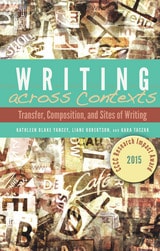
Writing across Contexts
Transfer, Composition, and Sites of WritingKathleen Yancey
Utah State University Press, 2014
Addressing how composers transfer both knowledge about and practices of writing, Writing across Contexts explores the grounding theory behind a specific composition curriculum called Teaching for Transfer (TFT) and analyzes the efficacy of the approach. Finding that TFT courses aid students in transfer in ways that other kinds of composition courses do not, the authors demonstrate that the content of this curriculum, including its reflective practice, provides a unique set of resources for students to call on and repurpose for new writing tasks.
The authors provide a brief historical review, give attention to current curricular efforts designed to promote such transfer, and develop new insights into the role of prior knowledge in students' ability to transfer writing knowledge and practice, presenting three models of how students respond to and use new knowledge—assemblage, remix, and critical incident.
A timely and significant contribution to the field, Writing across Contexts will be of interest to graduate students, composition scholars, WAC and writing-in-the-disciplines scholars, and writing program administrators.
Writing and School Reform
Writing Instruction in the Age of Common Core and Standardized TestingJoanne Addison
University Press of Colorado, 2017
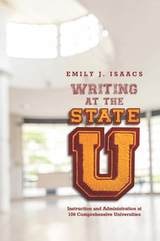
Writing at the State U
Instruction and Administration at 106 Comprehensive UniversitiesEmily Isaacs
Utah State University Press, 2017
Writing at the State U presents a comprehensive, empirical examination of writing programs at 106 universities. Rather than using open survey calls and self-reporting, Emily Isaacs uses statistical analysis to show the extent to which established principles of writing instruction and administration have been implemented at state comprehensive universities, the ways in which writing at those institutions has differed from writing at other institutions over time, and how state institutions have responded to major scholarly debates concerning first-year composition and writing program administration.
Isaacs’s findings are surprising: state university writing programs give lip service to important principles of writing research, but many still emphasize grammar instruction and a skills-based approach, classes continue to be outsized, faculty development is optional, and orientation toward basic writing is generally remedial. As such, she considers where a closer match between writing research and writing instruction might help to expose and remedy these difficulties and identifies strategies and areas where faculty or writing program administrators are empowered to enact change.
Unique in its wide scope and methodology, Writing at the State U sheds much-needed light on the true state of the writing discipline at state universities and demonstrates the advantages of more frequent and rigorous quantitative studies of the field.
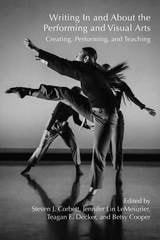
Writing in and about the Performing and Visual Arts
Creating, Performing, and TeachingSteven J. Corbett
University Press of Colorado, 2020
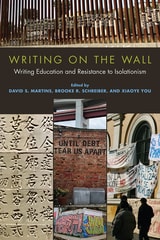
Writing on the Wall
Writing Education and Resistance to Isolationismedited by David S. Martins, Brooke R. Schreiber & Xiaoye You
Utah State University Press, 2022
The collection extends existing scholarship and research about the ways racist and colonial rhetorics impact writing education; the impact of translingual, transnational, and cosmopolitan ideologies on student learning and student writing; and the role international educational partnerships play in pushing back against isolationist ideologies. Established and early-career scholars who work in a broad range of institutional contexts highlight the historical connections among monolingualism, racism, and white nationalism and introduce community- and classroom-based practices that writing teachers use to resist isolationist beliefs and tendencies.
“Writing on the wall” serves as a metaphor for the creative, direct action writing education can provide and invokes border spaces as sites of identity expression, belonging, and resistance. The book connects transnational writing education with the fight for racial justice in the US and around the world and will be of significance to secondary and postsecondary writing teachers and graduate students in English, linguistics, composition, and literacy studies.
Contributors: Olga Aksakalova, Sara P. Alvarez, Brody Bluemel, Tuli Chatterji, Keith Gilyard, Joleen Hanson, Florianne Jimenez Perzan, Rebecca Lorimer Leonard, Layli Maria Miron, Tony D. Scott, Kate Vieira, Amy J. Wan
Writing the Classroom
Pedagogical Documents as Rhetorical Genresedited by Stephen E. Neaderhiser
Utah State University Press, 2022
The contributors to this unique collection employ a wide range of methodological frameworks to demonstrate how pedagogical genres—even ones as seemingly straightforward as the class syllabus—have lives extending well beyond the classroom as they become part of how college teachers represent their own academic identities, advocate for pedagogical values, and negotiate the many external forces that influence the act of teaching. Writing the Classroom shines a light on genres that are often treated as two-dimensional, with purely functional purposes, arguing instead that genres like assignment prompts, course proposals, teaching statements, and policy documents play a fundamental role in constructing the classroom and the broader pedagogical enterprise within academia.
Writing the Classroom calls on experienced teachers and faculty administrators to critically consider their own engagement with pedagogical genres and offers graduate students and newer faculty insight into the genres that they may only now be learning to inhabit as they seek to establish their personal teacherly identities. It showcases the rhetorical complexity of the genres written in the service of pedagogy not only for students but also for the many other audiences within academia that have a role in shaping the experience of teaching.
Contributors: Michael Albright, Lora Arduser, Lesley Erin Bartlett, Logan Bearden, Lindsay Clark, Dana Comi, Zack K. De Piero, Matt Dowell, Amy Ferdinandt Stolley, Mark A. Hannah, Megan Knight, Laura R. Micciche, Cindy Mooty, Dustin Morris, Kate Navickas, Kate Nesbit, Jim Nugent, Lori A. Ostergaard, Cynthia Pengilly, Jessica Rivera-Mueller, Christina Saidy, Megan Schoen, Virginia Schwarz, Christopher Toth
Writing with Authority
Students' Roles as Writers In Cross-National PerspectiveDavid Foster
Southern Illinois University Press, 2006
Writing with Authority: Students’ Roles as Writers in Cross-National Perspective offers a comparison of student writers in two university cultures—one German and one American—as the students learn to connect their writing to academic content. David Foster demonstrates the effectiveness of using cross-cultural comparisons to assess differences in literacy activities and suggests teaching approaches that will help American students better develop their roles as writers in knowledge-based communities. He proposes that American universities make stronger efforts to nurture the autonomy of American undergraduates as learner-writers and to create apprenticeship experiences that more closely reflect the realities of working in the academic community.
This comparative analysis identifies crucial differences in the ways German and American students learn to become academic writers, emphasizing two significant issues: the importance of self-directed, long-term planning and goal setting in developing knowledge-based projects and the impact of time structures on students’ writing practices. Foster suggests that students learn to write as knowledge makers, using cumulative, recursive task development as reflexive writing practices. He argues for the full integration of extended, self-managed, knowledge-based writing tasks into the American undergraduate curriculum from the onset of college study.
A cross-national perspective offers important insights into the conditions that influence novice writers, Foster says, including secondary preparations and transitions to postsecondary study. Foster proposes that students be challenged to write transformatively—to master new forms of authorship and authority based on self-directed planning, researching, and writing in specific academic communities. The text also addresses contested issues of power relations in students’ roles as academic writers and their perception of personal authority and freedom as writers.
A course model incorporates significant, self-directed writing projects to help students build sustainable roles as transformative writers, outlines “change goals” to help teachers develop curricular structures that support cumulative writing projects across the undergraduate curriculum, and shows how teachers can develop self-directed writing projects in a variety of program environments.
Writing-Enriched Curricula
Models of Faculty-Driven and Departmental Transformationedited by Chris M. Anson, and Pamela Flash
University Press of Colorado, 2022
Writing-Intensive
Becoming W-Faculty in a New Writing CurriculumWendy Strachan
Utah State University Press, 2008
Wendy Strachan documents this campus cultural transformation, exploring successes and impasses with equal interest. The study identifies factors to be considered to avoid isolating the teaching of writing in writing-intensive courses; to engender a university-wide culture that naturalizes writing as a vital part of learning across all disciplines; and to keep the teaching of writing organic and reflected upon in a scholarly manner across campus.
A valuable case history for scholars in writing studies, WAC/WID, and curricular change studies.