Results by title
250 books match the query 'Subjects' and 14 start with w

Walking in Art Education
Ecopedagogical and A/r/tographical Encounters.Edited by Nicole Rallis, Ken Morimoto, Michele Sorensen, Valerie Triggs, and Rita Irwin
Intellect Books, 2024
In Walking in Art Education, authors explore walking and a/r/tography in their local contexts. As a result, the book finds that kinship and relationality are significant themes that permeate across a/r/tographic practices focused on ecopedagogy and learning with the land. These walking practices serve as ecopedagogical moments that attune us to human-land and more-than-human relationships, while also moving us past Western-centric understandings of land and place. More than this, the book situates this work in a/r/tographic practices taking up walking as one method for engagement.
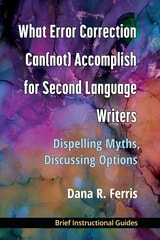
What Error Correction Can(not) Accomplish for Second Language Writers
Dispelling Myths, Discussing OptionsDana R. Ferris
University of Michigan Press, 2018
What Should Schools Teach?
Disciplines, Subjects and the Pursuit of TruthEdited by Alka Sehgal Cuthbert and Alex Standish
University College London, 2021
The design of school curricula involves deep thought about the nature of knowledge and its value to learners and society. Such a serious responsibility raises a number of questions: What is knowledge for? What knowledge is important for children to learn? How do we decide what knowledge matters in each school subject? The blurring of distinctions between pedagogy and curriculum, as well as that between experience and knowledge, has resulted in a confusing message for teachers about the part that each plays in the education of children. This book aims to dispel confusion through a robust rationale for what schools should teach, offering key understanding to teachers of the relationship between knowledge and their own pedagogy. This second edition includes new chapters on chemistry, drama, music, and religious education, as well as an updated chapter on biology. A revised introduction reflects on the emerging discourse around decolonizing the curriculum and on the relationship between the knowledge that children encounter at school and in their homes.
What We Are Becoming
Developments in Undergraduate Writing MajorsGreg Giberson and Thomas A. Moriarty
Utah State University Press, 2010
Contributors to the volume address a range of vital questions for undergraduate programs, including such issues as the competition for majors within departments, the job market for undergraduates, varying focuses and curricula of such majors, and the formation of them in departments separate from English. Other chapters discuss the importance of flexibility, consider arguments for a rhetorical or civic discourse core for the writing major, address the relationship between rhetoric and composition majors, and review the role of multiliteracies in the major.
The field of composition has not come to a consensus on the shape, content, or focus of the undergradutate major. But as individual programs develop and refine their curricula, one thing has become clear: we must think about them in ways that go beyond our particular circumstances, theorize them in ways that secure their place on our campuses and in our discipline for years to come. What We Are Becoming is an effort to do just that.

Whither College Sports
Amateurism, Athlete Safety, and Academic IntegrityAndrew Zimbalist
Rutgers University Press, 2022

Wisconsin
Our State CLASSROOM SET 1E spanish (w/spnsh SAG)Bobbie Malone
Wisconsin Historical Society Press, 2016
Classroom set includes 25 copies of the Spanish textbook (978-0-87020-512-5) PLUS 1 copy of the Teacher's Edition in English (978-0-87020-379-4) and 1 copy of the Student Activity Guide DVD in Spanish (978-0-87020-688-7)
Wisconsin
Our State SAG 2E engBobbie Malone
Wisconsin Historical Society Press, 2016
"Wisconsin: Our State, Our Story" brings history to life! Thinking Like a Historian questions in each chapter encourage critical thinking. Scores of artifacts and documents invite students to become eyewitnesses to the past.
Lively, classroom-tested text will engross students. The rich content aligns with relevant, cross-curricular Wisconsin Model Academic Standards. The specially designed Teacher's Edition and Student Activity Guide provide additional tools to reach all learners.
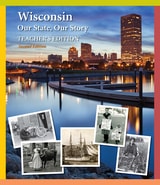
Wisconsin
Our State TE 2EBobbie Malone
Wisconsin Historical Society Press, 2016
The Teacher's Edition provides educators with the background, literacy, and other skill-building strategies to teach "Wisconsin: Our State, Our Story" in both social studies and literacy classes.
"Wisconsin: Our State, Our Story" textbook promotes content-focused reading to address both social studies and language arts standards for the state of Wisconsin.
The Teacher's Edition draws on the research-based pedagogy in both literacy development and in historical inquiry to help reach the many different levels of learners in today's classrooms.
- Differentiated Learning Approaches The Teacher's Edition draws together and charts a compendium of literacy strategies, historical thinking skills, and differentiated learning approaches in the introductory section.
- Supports Both Literacy and History Learning Each of the early chapters focuses on a different literacy skill. Students have the opportunity to practice and master each skill as they progress through the textbook. Though each chapter differs in length, they all have the same components, so that students can learn to make connections. Major, overarching questions drive the content of each chapter.
- An Inquiry-Based History Approach Each topic is inquiry-based. Students quickly learn that the historian plays the role of detective: asking questions and amassing enough clues to put together a "picture" of some historical event or personality and to weave these into a sufficiently broad understanding.
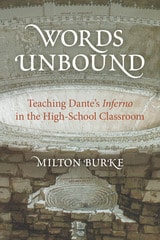
Words Unbound
Teaching Dante's Inferno in the High School ClassroomMilton Burke
University of Arkansas Press, 2017
Words Unbound draws on Milton Burke’s thirty years of teaching experience to help educators bring Inferno alive for today’s young reader. In a conversational, “colleague-to-colleague” style, Burke shares the interpretations, questions, and exercises he found effective in his high-school classroom, emphasizing group discussion to help students, no matter their religious or philosophical moorings, engage meaningfully with the notoriously difficult text.
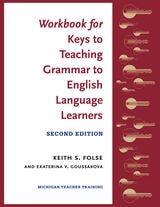
Workbook for Keys to Teaching Grammar to English Language Learners, Second Ed.
Keith S. Folse and Ekaterina V. Goussakova
University of Michigan Press, 2017
The Workbook has been updated to reflect new content in the Second Edition of the Handbook and once again features exercises that carefully follow the sequence of material in the Handbook. To facilitate use of the Workbook with the Handbook, each exercise is coded with the corresponding pages for the material in the Handbook. Reflecting the different learning styles in any given class, the exercises practice identifying grammatical features in a variety of different ways, including many charts, matching activities, and short answer questions. In addition, the Workbook has a variety of exercises consisting of sentences typical of English language learners so that teachers can become familiar with specific types of errors that ESL students make with certain grammar points.
The Workbook also features some action research projects to guide teachers in collecting small samples of data from their target student populations.
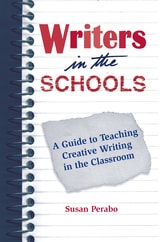
Writers in the Schools
A Guide to Teaching Creative Writing in the ClassroomSusan Perabo
University of Arkansas Press, 1997
The lesson in this valuable text is that the imagination is the greatest tool a student possesses. Instead of lectures, the book relies on hands-on exercises and time tested activity plans that start students writing within minutes of discussing the basics of the writing process. Included are dozens of ideas to spark student creativity and hone rough drafts into finished poems and short stories.
The chapters proceed from a beginning level through intermediate and advanced levels and are useful to students in any grade from elementary through high school. Written and compiled by Susan Perabo, a former Writers in the Schools director, this volume is both a wonderful aid to teachers wishing to expand their classroom strategies in language arts and a perfect guide for writing program participants as they work with children to encourage powerful written expression in every discipline.
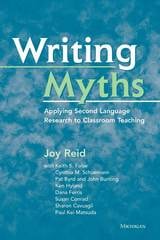
Writing Myths
Applying Second Language Research to Classroom TeachingJoy Reid with Keith S. Folse, Cynthia M. Schuemann, Pat Byrd and John Bunting, Ken Hyland, Dana Ferris, Susan Conrad, Sharon Cavusgil, Paul Kei Matsuda
University of Michigan Press, 2008
This volume was conceived as a "best practices" resource for writing teachers in the way that Vocabulary Myths by Keith S. Folse is one for reading and vocabulary teachers. It was written to help ensure that writing teachers are not perpetuating the myths of teaching writing.
Each author is a practicing teacher who selected his or her "myth" based on classroom experience and expertise. Both the research and pedagogy in this book are based on the newest research in, for example, teacher preparation, EAP and ESP, and corpus linguistics. The myths discussed in this book are:
§ Teaching vocabulary is not the writing teacher's job. (Keith S. Folse)
§ Teaching citation is someone else's job. (Cynthia M. Schuemann)
§ Where grammar is concerned, one size fits all. (Pat Byrd and John Bunting)
§ Academic writing should be assertive and certain. (Ken Hyland)
§ Students must learn to correct all their writing errors. (Dana Ferris)
§ Corpus-based research is too complicated to be useful for writing teachers. (Susan Conrad)
§ Academic writing courses should focus on paragraph and essay development. (Sharon Cavausgil)
§ International and U.S. resident ESL writers cannot be taught in the same class. (Paul Kei Matsuda)
The book concludes with a discussion of students' myths about academic writing and teaching written by Joy Reid.
Writing Opportunities
Writing, Learning, and Rightful Presence in College TransitionsBrad Jacobson
Utah State University Press, 2026
Writing Opportunities presents in-depth text histories illustrating the interrelationship of writing, identities, and belonging in college writing transitions. Drawing on more than two years of research with three Latinx/a/o students transitioning from the same high school class to the local university, Brad Jacobson brings together analyses of interview transcripts, student writing, classroom genres, and institutional policies to foreground a sense of belonging as central to writing development and learning.
Including interviews with students and their instructors, Jacobson traces writing opportunities that Hercules, Jain, and Lucy were afforded as they transitioned from high school to college writing, particularly in general education courses. Chapters attend to multiple levels of interaction to show how policies, practices, and social histories can impact opportunities for learning. With attention to dominant discourses of writing that narrow what counts as good writing as well as positive opportunity structures that extend possibilities for identification, engagement, and deep learning, Jacobson also posits writing as an opportunity for writers to explore possibilities for who we are and who we may become.
Jacobson’s humanizing research invites readers to consider opportunity from multiple perspectives and shows how subtle shifts in relationships among students, instructors, and institutions can increase meaningful learning and provide a sense of belonging in educational contexts.
Writing across Contexts
Transfer, Composition, and Sites of WritingKathleen Yancey
Utah State University Press, 2014
Addressing how composers transfer both knowledge about and practices of writing, Writing across Contexts explores the grounding theory behind a specific composition curriculum called Teaching for Transfer (TFT) and analyzes the efficacy of the approach. Finding that TFT courses aid students in transfer in ways that other kinds of composition courses do not, the authors demonstrate that the content of this curriculum, including its reflective practice, provides a unique set of resources for students to call on and repurpose for new writing tasks.
The authors provide a brief historical review, give attention to current curricular efforts designed to promote such transfer, and develop new insights into the role of prior knowledge in students' ability to transfer writing knowledge and practice, presenting three models of how students respond to and use new knowledge—assemblage, remix, and critical incident.
A timely and significant contribution to the field, Writing across Contexts will be of interest to graduate students, composition scholars, WAC and writing-in-the-disciplines scholars, and writing program administrators.