Results by title
133 books match the query 'Vietnam War, 1961-1975' and 9 start with w

War in the Villages
The U.S. Marine Corps Combined Action PlatoonsTed Easterling
University of North Texas Press, 2021
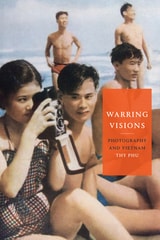
Warring Visions
Photography and VietnamThy Phu
Duke University Press, 2021
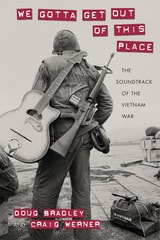
We Gotta Get Out of This Place
The Soundtrack of the Vietnam WarDoug Bradley
University of Massachusetts Press, 2015
Rolling Stone's #1 Music Book of 2015
For a Kentucky rifleman who spent his tour trudging through Vietnam's Central Highlands, it was Nancy Sinatra's “These Boots Are Made for Walkin'.” For a “tunnel rat” who blew smoke into the Viet Cong's underground tunnels, it was Jimi Hendrix's “Purple Haze.” For a Black Marine distraught over the assassination of Martin Luther King Jr., it was Aretha Franklin's “Chain of Fools.” And for countless other Vietnam vets, it was “I Feel Like I'm Fixin' to Die,” “Who'll Stop the Rain,” or the song that gives this book its title.
In We Gotta Get Out of This Place, Doug Bradley and Craig Werner place popular music at the heart of the American experience in Vietnam. They explore how and why U.S. troops turned to music as a way of connecting to each other and the World back home and of coping with the complexities of the war they had been sent to fight. They also demonstrate that music was important for every group of Vietnam veterans—black and white, Latino and Native American, men and women, officers and “grunts”—whose personal reflections drive the book's narrative. Many of the voices are those of ordinary soldiers, airmen, seamen, and marines. But there are also “solo” pieces by veterans whose writings have shaped our understanding of the war—Karl Marlantes, Alfredo Vea, Yusef Komunyakaa, Bill Ehrhart, Arthur Flowers—as well as songwriters and performers whose music influenced soldiers' lives, including Eric Burdon, James Brown, Bruce Springsteen, Country Joe McDonald, and John Fogerty. Together their testimony taps into memories—individual and cultural—that capture a central if often overlooked component of the American war in Vietnam.
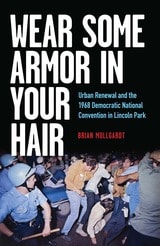
Wear Some Armor in Your Hair
Urban Renewal and the 1968 Democratic National Convention in Lincoln ParkBrian Mullgardt
Southern Illinois University Press, 2024
WINNER, 2025 Illinois State Historical Society Russell P. Strange Book of the Year Award!
Police brutality, gentrification, and grassroots activism in 1960s Chicago
In August of 1968, approximately 7,000 people protested the Vietnam War against the backdrop of the Democratic National Convention in Chicago. This highly televised event began peacefully but quickly turned into what was later termed a “police riot.” Brian Mullgardt’s investigation of this event and the preceding tensions shines a light on the ministers, Yippies, and community members who showed up and stood together against the brutality of the police. Charting a complex social history, Wear Some Armor in Your Hair brings together Chicago history, the 1960s, and urbanization, focusing not on the national leaders, but on the grassroots activists of the time.
Beginning in 1955, two competing visions of urban renewal existed, and the groups that propounded each clashed publicly, but peacefully. One group, linked to city hall, envisioned a future Lincoln Park that paid lip service to diversity but actually included very little. The other group, the North Side Cooperative Ministry, offered a different vision of Lincoln Park that was much more diverse in terms of class and race. When the Yippies announced anti-war protests for the summer of ‘68, the North Side Cooperative Ministry played an instrumental role. Ultimately, the violence of that week altered community relations and the forces of gentrification won out.
Mullgardt’s focus on the activists and community members of Lincoln Park, a neighborhood at the nexus of national trends, broadens the scope of understanding around a pivotal and monumental chapter of our history. The story of Lincoln Park, Chicago, is in many ways the story of 1960s activism writ small, and in other ways challenges us to view national trends differently.
When America Turned
Reckoning with 1968David Wyatt
University of Massachusetts Press, 2013
Wyatt explores these questions as he retraces the decisive moments of 1968—the Tet Offensive, the McCarthy campaign, the assassinations of Martin Luther King Jr. and Robert Kennedy, the student revolt at Columbia, the "police riot" at the Democratic Convention in Chicago, Lyndon Johnson's capitulation, and Richard Nixon's ascendency to power. Seeking to recover the emotions surrounding these events as well as analyze their significance, Wyatt draws on the insights of what Michael Herr has called "straight" and "secret" histories. The first category consists of work by professional historians, traditional journalists, public figures, and political operatives, while the second includes the writings of novelists, poets, New Journalists, and memoirists.
The aim of this parallel approach is to uncover two kinds of truth: a "scholarly truth" grounded in the documented past and an "imaginative truth" that occupies the more ambiguous realm of meaning. Only by reckoning with both, Wyatt believes, can Americans come to understand the true legacy of the 1960s.
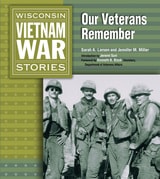
Wisconsin Vietnam War Stories
Our Veterans RememberSarah Larsen
Wisconsin Historical Society Press, 2010
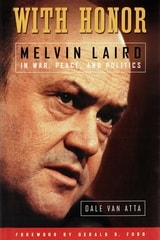
With Honor
Melvin Laird in War, Peace, and PoliticsVan Atta
University of Wisconsin Press, 2008
The first book ever to focus on Laird’s legacy, this authorized biography reveals his central and often unrecognized role in managing the crisis of national identity sparked by the Vietnam War—and the challenges, ethical and political, that confronted him along the way. Drawing on exclusive interviews with Laird, Henry Kissinger, Gerald Ford, and numerous others, author Dale Van Atta offers a sympathetic portrait of a man striving for open government in an atmosphere fraught with secrecy. Van Atta illuminates the inner workings of high politics: Laird’s behind-the-scenes sparring with Kissinger over policy, his decisions to ignore Nixon’s wilder directives, his formative impact on arms control and health care, his key role in the selection of Ford for vice president, his frustration with the country’s abandonment of Vietnamization, and, in later years, his unheeded warning to Donald Rumsfeld that “it’s a helluva lot easier to get into a war than to get out of one.”
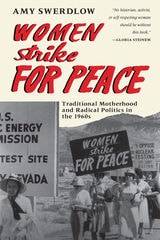
Women Strike for Peace
Traditional Motherhood and Radical Politics in the 1960sAmy Swerdlow
University of Chicago Press, 1993
Women Strike for Peace began on November 1, 1961, when thousands of white, middle-class women walked out of their kitchens and off their jobs in a one-day protest against Soviet and American nuclear policies. The protest led to a national organization of women who fought against nuclear arms and U.S. intervention in Vietnam. While maintaining traditional maternal and feminine roles, members of WSP effectively challenged national policies—defeating a proposal for a NATO nuclear fleet, withstanding an investigation by the House Committee on Un-American Activities, and sending one of its leaders to Congress as a peace candidate.
As a study of a dissident group grounded in prescribed female culture, and the struggle of its members to avoid being trapped within that culture, this book adds a crucial new dimension to women's studies. In addition, this account of WSP's success as a grass roots, nonhierarchical movement will be of great interest to historians, political scientists, and anyone interested in peace studies or conflict resolution.
"Swerdlow has re-created a unique piece of American political history, a chapter of the international peace movement, and an origin of the modern feminist movement. No historian, activist, or self-respecting woman should be without Women Strike for Peace. It shows not only how one group of women created change, but also how they inevitably changed themselves."—Gloria Steinem
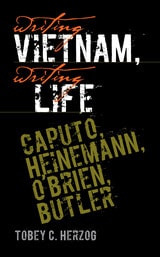
Writing Vietnam, Writing Life
Caputo, Heinemann, O'Brien, ButlerTobey C. Herzog
University of Iowa Press, 2008
Philip Caputo, Larry Heinemann, Tim O'Brien, and Robert Olen Butler: four young midwestern Americans coming of age during the 1960s who faced a difficult personal decision—whether or not to fight in Vietnam. Each chose to participate. After coming home, these four veterans became prizewinning authors telling the war stories and life stories of soldiers and civilians. The four extended conversations included in Writing Vietnam, Writing Life feature revealing personal stories alongside candid assessments of each author's distinct roles as son, soldier, writer, and teacher of creative writing.
As Tobey Herzog's thoughtful interviews reveal, these soldier-authors have diverse upbringings, values, interests, writing careers, life experiences, and literary voices. They hold wide-ranging views on, among other things, fatherhood, war, the military, religion, the creative process, the current state of the world, and the nature of both physical and moral courage. For each author, the conversation and richly annotated chronology provide an overview of the writer's life, the intersection of memory and imagination in his writing, and the path of his literary career. Together, these four life stories also offer mini-tableaux of the fascinating and troubling time of 1960s and 1970s America. Above all, the conversations reveal that each author is linked forever to the Vietnam War, the country of Vietnam, and its people.