Results by title
51 books match the query 'Woman' and 9 start with w
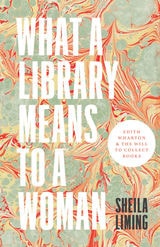
What a Library Means to a Woman
Edith Wharton and the Will to Collect BooksSheila Liming
University of Minnesota Press, 2020
Examining the personal library and the making of self
When writer Edith Wharton died in 1937, without any children, her library of more than five thousand volumes was divided and subsequently sold. Decades later, it was reassembled and returned to The Mount, her historic Massachusetts estate. What a Library Means to a Woman examines personal libraries as technologies of self-creation in modern America, focusing on Wharton and her remarkable collection of books.
Sheila Liming explores the connection between libraries and self-making in late nineteenth- and early twentieth-century American culture, from the 1860s to the 1930s. She tells the story of Wharton’s library in concert with Wharton scholarship and treatises from this era concerning the wider fields of book history, material and print culture, and the histories (and pathologies) of collecting. Liming’s study blends literary and historical analysis while engaging with modern discussions about gender, inheritance, and hoarding. It offers a review of the many meanings of a library collection, while reading one specific collection in light of its owner’s literary celebrity.
What a Library Means to a Woman was born from Liming’s ongoing work digitizing the Wharton library collection. It ultimately argues for a multifaceted understanding of authorship by linking Wharton’s literary persona to her library, which was, as she saw it, the site of her self-making.
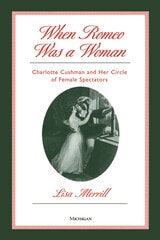
When Romeo Was a Woman
Charlotte Cushman and Her Circle of Female SpectatorsLisa Merrill
University of Michigan Press, 2000
Lisa Merrill examines Cushman's personal correspondence to shed new light on the actress's relationships and in turn on our understandings of the nature of women's "romantic friendships." She demonstrates how Cushman's androgynous presence served as a symbol to many of her contemporaries, and revealed their multiple and often contradictory attitudes toward female performers, women, and the unspeakable possibilities of same-sex desire.
The biography draws upon unpublished archival material as well as on current critical work to view Cushman's career, relationships, and posthumous reception. When Romeo Was a Woman examines as autobiographical performance Cushman's own narratives, the stories she authorized others to write, and the letters she wrote to intimates. The book is richly illustrated with many previously unpublished portraits of Cushman in her various stage roles, including Romeo and Lady Macbeth, and other revealing photographs of her family, lovers and friends.
When Romeo Was a Woman will find an appreciative audience among general readers as well as specialists in gay/lesbian history, women's history, theater and performance, popular culture, Victorian studies, and American studies.
"A fascinating story, and a major contribution to our understanding of lesbian history. . . . The work done on archival resources is both impressive in its extent and wholly convincing in its effect." --Jacky Bratton, University of London
Lisa Merrill is Associate Professor of Communication and Performance Studies, Hofstra University. She is the coauthor of The Power to Communicate: Gender Differences as Barriers, and the author of Untying the Tongue: Power, Gender, and the Word, forthcoming.

Woman Of The Boundary Waters
Canoeing, Guiding, Mushing, and SurvivingJustine Kerfoot
University of Minnesota Press, 1994
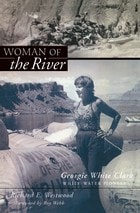
Woman Of The River
Georgie White Clark, Whitewater PioneerRichard Westwood
Utah State University Press, 1997
Georgie White Clark-adventurer, raconteur, eccentric--first came to know the canyons of the Colorado River by swimming portions of them with a single companion. She subsequently hiked and rafted portions of the canyons, increasingly sharing her love of the Colorado River with friends and acquaintances. At first establishing a part-time guide service as a way to support her own river trips, she went on to become perhaps the canyons' best-known river guide, introducing their rapids to many others-on the river, via her large-capacity rubber rafts, and across the nation, via magazine articles and movies. Georgie Clark saw the river and her sport change with the building of Glen Canyon Dam, enormous increases in the popularity of river running, and increased National Park Service regulation of rafting and river guides. Adjusting, though not always easily, to the changes, she helped transform an elite adventure sport into a major tourist activity.
Woman and Chinese Modernity
The Politics of Reading between West and EastRey Chow
University of Minnesota Press, 1991
Examines the relationship of “woman” to issues of non-western culture.
Examines the relationship of "woman" to issues of non-Western culture: ethnic spectatorship, popular literature, the construction of literary history, and the revolutionary production and emotional reception of national literature.
Woman in Levi's
Eulalia Bourne
University of Arizona Press, 1967
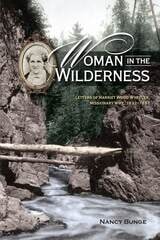
Woman in the Wilderness
Letters of Harriet Wood Wheeler, Missonary Wife, 1832-1892Nancy Bunge
Michigan State University Press, 2010
Harriet's letters reveal her experiences with actors and institutions that played pivotal roles in the history of American women: the nascent literate female work force at the mills in Lowell, Massachusetts; the Ipswich Female Seminary, which was one of the first schools for women teachers; women's associations, especially in churches; and the close and enduring ties that characterized women's relationships in the late nineteenth century.
Harriet's letters also provide an intimate view of the relationships between American Indians and Euro-Americans in the Great Lakes region, where she settled with her Christian missionary husband.
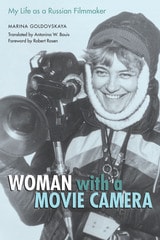
Woman with a Movie Camera
My Life as a Russian FilmmakerBy Marina Goldovskaya
University of Texas Press, 2006
Marina Goldovskaya is one of Russia's best-known documentary filmmakers. The first woman in Russia (and possibly the world) to combine being a director, writer, cinematographer, and producer, Goldovskaya has made over thirty documentary films and more than one hundred programs for Russian, European, Japanese, and American television. Her work, which includes the award-winning films The House on Arbat Street, The Shattered Mirror, and Solovky Power, has garnered international acclaim and won virtually every prize given for documentary filmmaking.
In Woman with a Movie Camera, Goldovskaya turns her lens on her own life and work, telling an adventurous, occasionally harrowing story of growing up in the Stalinist era and subsequently documenting Russian society from the 1960s, through the Thaw and Perestroika, to post-Soviet Russia. She recalls her childhood in a Moscow apartment building that housed famous filmmakers, being one of only three women students at the State Film School, and working as an assistant cameraperson on the first film of Andrei Tarkovsky, Russia's most celebrated director. Reviewing her professional filmmaking career, which began in the 1960s, Goldovskaya reveals her passion for creating films that presented a truthful picture of Soviet life, as well as the challenges of working within (and sometimes subverting) the bureaucracies that controlled Russian film and television production and distribution. Along the way, she describes a host of notable figures in Russian film, theater, art, and politics, as well as the technological evolution of filmmaking from film to video to digital media.
A compelling portrait of a woman who broke gender and political barriers, as well as the eventful four decades of Russian history she has documented, Woman with a Movie Camera will be fascinating reading for a wide audience.
Writing Like a Woman
Alicia Ostriker
University of Michigan Press, 1983