Results by title
1441 books match the query 'World' and 60 start with w
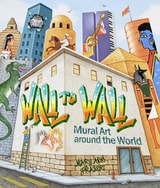
Wall to Wall
Mural Art around the WorldMary Ann Fraser
J. Paul Getty Trust, The, 2024
People have been drawing on walls since ancient times. They do it to create beauty, to tell a story, to make a statement, or just to say, “I was here.” You can find wall art in a remote cave in Patagonia and a desert castle in Jordan, a kingly palace in the Republic of Benin and the National Palace of Mexico, a miles-long flood channel in Los Angeles and a sky-high rooftop in Norway.
In Wall to Wall, award-winning author, illustrator, and muralist Mary Ann Fraser takes readers on a worldwide journey through time, stopping to see amazing mural art along the way. Stunning color illustrations and fascinating photographs illuminate both famous and little-known examples, and lighthearted text tells engaging stories about the people who inspired or created them. A glossary, selected bibliography, and section about the preservation of murals conclude the book. No reader will ever again pass by a mural—whether in a historic building, a museum, or out on the street—without stopping to take a closer look.
Ages ten to fourteen
Walt Whitman and the World
Gay Wilson Allen
University of Iowa Press, 1995
Walter Ralegh's "History of the World" and the Historical Culture of the Late Renaissance
Nicholas Popper
University of Chicago Press, 2012
Nicholas Popper uses Ralegh’s History as a touchstone in this lively exploration of the culture of history writing and historical thinking in the late Renaissance. From Popper we learn why early modern Europeans ascribed heightened value to the study of the past and how scholars and statesmen began to see historical expertise as not just a foundation for political practice and theory, but as a means of advancing their power in the courts and councils of contemporary Europe. The rise of historical scholarship during this period encouraged the circulation of its methods to other disciplines, transforming Europe’s intellectual—and political—regimes. More than a mere study of Ralegh’s History of the World, Popper’s book reveals how the methods that historians devised to illuminate the past structured the dynamics of early modernity in Europe and England.
War Against the People
Israel, the Palestinians and Global PacificationJeff Halper
Pluto Press, 2015
Modern warfare has a new form. The days of international combat are fading. So how do major world powers maintain control over their people today?
This book is a disturbing insight into the new ways world powers such as the US, Israel, Britain and China forge war today. It is a subliminal war of surveillance and whitewashed terror, conducted through new, high-tech military apparatuses, designed and first used in Israel against the Palestinian population. Including nano-technology, hidden camera systems, information databases on civilian activity, automated targeting systems and unmanned drones, it is used to control the very people the nation's leaders profess to serve.
Jeff Halper reveals that this practice is much more insidious than was previously thought. As Western governments claw back individual liberties, War Against the People is a reminder that fundamental human rights are being compromised for vast sections of the world, and that this is a subject that should concern everyone.
War and Collapse
World War I and the Ottoman StateEdited by M. Hakan Yavuz with Feroz Ahmad
University of Utah Press, 2015
Wasted Wombs
Navigating Reproductive Interruptions in CameroonErica van der Sijpt
Vanderbilt University Press, 2017
Providing an intimate look into these processes, Wasted Wombs shows how Gbigbil women constantly shift their interpretations of when a pregnancy starts, what it contains, and what is lost in case of a reproductive interruption, in contrast to Western conceptions of fertility and loss. Depending on the context and on their life aspirations—be it marriage and motherhood, or an educational trajectory and employment, or profitable sexual affairs with so-called "big fish"—women negotiate and manipulate the meanings and effects of reproductive interruptions. Paradoxically, they often do so while portraying themselves as powerless. Wasted Wombs carefully analyzes such tactics in relation to the various social predicaments that emerge around reproductive interruptions, as well as the capricious workings of women's physical bodies.

Waters of the World
The Story of the Scientists Who Unraveled the Mysteries of Our Oceans, Atmosphere, and Ice Sheets and Made the Planet WholeSarah Dry
University of Chicago Press, 2019
From the glaciers of the Alps to the towering cumulonimbus clouds of the Caribbean and the unexpectedly chaotic flows of the North Atlantic, Waters of the World is a tour through 150 years of the history of a significant but underappreciated idea: that the Earth has a global climate system made up of interconnected parts, constantly changing on all scales of both time and space. A prerequisite for the discovery of global warming and climate change, this idea was forged by scientists studying water in its myriad forms. This is their story.
Linking the history of the planet with the lives of those who studied it, Sarah Dry follows the remarkable scientists who summited volcanic peaks to peer through an atmosphere’s worth of water vapor, cored mile-thick ice sheets to uncover the Earth’s ancient climate history, and flew inside storm clouds to understand how small changes in energy can produce both massive storms and the general circulation of the Earth’s atmosphere. Each toiled on his or her own corner of the planetary puzzle. Gradually, their cumulative discoveries coalesced into a unified working theory of our planet’s climate.
We now call this field climate science, and in recent years it has provoked great passions, anxieties, and warnings. But no less than the object of its study, the science of water and climate is—and always has been—evolving. By revealing the complexity of this history, Waters of the World delivers a better understanding of our planet’s climate at a time when we need it the most.
Ways of the World
A History of the World's Roads and of the Vehicles that Used ThemLay, M. G.
Rutgers University Press, 1999
This is the first comprehensive history of the world's roads, highways, bridges, and the people and vehicles that traverse them, from prehistoric times to the present. Encyclopedic in its scope, fascinating in its details, Ways of the World is a unique work for reference and browsing. Maxwell Lay considers the myriad aspects of roads and their users: the earliest pathways, the rise of wheeled vehicles and animals to pull them, the development of surfaced roads, the motives for road and bridge building, and the rise of cars and their influence on roads, cities, and society. The work is amply illustrated, well indexed and cross-referenced, and includes a chronology of road history and a full bibliography.
It is indispensable for anyone interested in travel, history, geography, transportation, cars, or the history of technology.
We Alone Will Rule
Native Andean Politics in the Age of InsurgencySinclair Thomson
University of Wisconsin Press, 2003
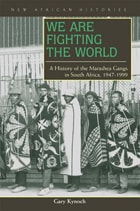
We Are Fighting the World
A History of the Marashea Gangs in South Africa, 1947–1999Gary Kynoch
Ohio University Press, 2005
Since the late 1940s, a violent African criminal society known as the Marashea has operated in and around South Africa’s gold mining areas. With thousands of members involved in drug smuggling, extortion, and kidnapping, the Marashea was more influential in the day-to-day lives of many black South Africans under apartheid than were agents of the state. These gangs remain active in South Africa.
In We Are Fighting the World: A History of the Marashea Gangs in South Africa, 1947–1999, Gary Kynoch points to the combination of coercive force and administrative weakness that characterized the apartheid state. As long as crime and violence were contained within black townships and did not threaten adjacent white areas, township residents were largely left to fend for themselves. The Marashea’s ability to prosper during the apartheid era and its involvement in political conflict led directly to the violent crime epidemic that today plagues South Africa.
Highly readable and solidly researched, We Are Fighting the World is critical to an understanding of South African society, past and present. This pioneering study challenges previous social history research on resistance, ethnicity, urban spaces, and gender in South Africa. Kynoch’s interviews with many current and former gang members give We Are Fighting the World an energy and a realism that are unparalleled in any other published work on gang violence in southern Africa.
We Are Meant to Rise
Voices for Justice from Minneapolis to the WorldCarolyn Holbrook
University of Minnesota Press, 2021
A brilliant and rich gathering of voices on the American experience of this past year and beyond, from Indigenous writers and writers of color from Minnesota
In this significant collection, Indigenous writers and writers of color bear witness to one of the most unsettling years in the history of the United States. Essays and poems vividly reflect and comment on the traumas we endured in 2020, beginning with the arrival of the COVID-19 pandemic crisis, deepened by the blatant murder of George Floyd by Minneapolis police officers and the uprisings that immersed our city into the epicenter of passionate, worldwide demands for justice. In inspired and incisive writing these contributors speak unvarnished truths not only to the original and pernicious racism threaded through the American experience but also to the deeply personal, in essays about family, loss, food culture, economic security, and mental health. Their call and response is united here to rise and be heard.
We Are Meant to Rise lifts up the astonishing variety of BIPOC writers in Minnesota. From authors with international reputations to newly emerging voices, it features people from many cultures, including Indigenous Dakota and Anishinaabe, African American, Hmong, Somali, Afghani, Lebanese, Korean, Vietnamese, Japanese, Puerto Rican, Colombian, Mexican, transracial adoptees, mixed race, and LGBTQ+ perspectives. Most of the contributors have participated in More Than a Single Story, a popular and insightful conversation series in Minneapolis that features Indigenous and people of color speaking on what most concerns their communities.
We Are Meant to Rise meets the events of the day, the year, the centuries before, again and again, with powerful testament to the intrinsic and unique value of the human voice.
Contributors: Suleiman Adan, Mary Moore Easter, Louise Erdrich, Anika Fajardo, Safy-Hallan Farah, Said Farah, Sherrie Fernandez-Williams, Pamela R. Fletcher Bush, Shannon Gibney, Kathryn Haddad, Tish Jones, Ezekiel Joubert III, Douglas Kearney, Ed Bok Lee, Ricardo Levins Morales, Arleta Little, Resmaa Menakem, Tess Montgomery, Ahmad Qais Munhazim, Melissa Olson, Alexs Pate, Bao Phi, Mona Susan Power, Samantha Sencer-Mura, Said Shaiye, Erin Sharkey, Sun Yung Shin, Michael Torres, Diane Wilson, Kao Kalia Yang, and Kevin Yang.
We Are Not South African
Mediating National Identity in a Postcolonial and Postapartheid StateRachel Lara van der Merwe
Rutgers University Press, 2026
We Are Not South African explores how national identity functions as a colonial tool of communication, control, and power. Author Rachel Lara van der Merwe examines how humans and the planet are integrally shaped by the idea of the nation and speculates on how different sociopolitical imaginaries, instead of the nation, could inform ways of being-together in the world.
Linking national identity to colonialism, the book broadens the idea of the nation to include its impact on all forms of life, human and more-than-human. Van der Merwe builds her argument on three central observations: that nations are made up of conflicting and fractured imaginaries, not unified, cohesive ones; the nation is divisive by nature, tracing back to its colonial origins; and the nation, along with the state, exploits both humans and more-than-humans. In order to build a more just and sustainable planetary society, she argues, liberation from such colonial formations is vital. In response, the book asks, How could we reimagine how we organize our societies through values of relationality and mutual care rather than rigid borders? What sociopolitical imaginaries do we need, or already possess, that might inform new configurations of community?
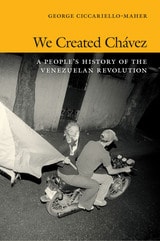
We Created Chávez
A People's History of the Venezuelan RevolutionGeo Maher
Duke University Press, 2013
Based on interviews with grassroots organizers, former guerrillas, members of neighborhood militias, and government officials, Ciccariello-Maher presents a new history of Venezuelan political activism, one told from below. Led by leftist guerrillas, women, Afro-Venezuelans, indigenous people, and students, the social movements he discusses have been struggling against corruption and repression since 1958. Ciccariello-Maher pays particular attention to the dynamic interplay between the Chávez government, revolutionary social movements, and the Venezuelan people, recasting the Bolivarian Revolution as a long-term and multifaceted process of political transformation.
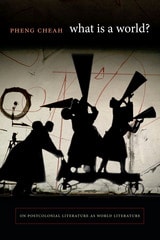
What Is a World?
On Postcolonial Literature as World LiteraturePheng Cheah
Duke University Press, 2016
What is Modern Israel?
Yakov M. Rabkin
Pluto Press, 2016
Drawing on many overlooked pages of history, including English, French, Hebrew, Yiddish and Russian sources, Yakov Rabkin shows that Zionism was conceived as a sharp break with Judaism and Jewish continuity. Israel’s past and present must be seen in the context of European ethnic nationalism, colonial expansion and geopolitical interests, rather than as an incarnation of Biblical prophecies or a culmination of Jewish history.

When Home Is a Photograph
Blackness and Belonging in the WorldLeigh Raiford
Duke University Press, 2026
When Informal Institutions Change
Institutional Reforms and Informal Practices in the Former Soviet UnionHuseyn Aliyev
University of Michigan Press, 2017
When Informal Institutions Change engages with a growing body of literature on informal practices and institutions in political science, economics, sociology, and beyond. Aliyev proposes expanding the analysis of the impact of institutional reforms on informal institutions beyond disciplinary boundaries, and combines theoretical insights from comparative politics with economic and social theories on informal relations. In addition, Aliyev offers insights that are relevant to democratization, institutionalism, and human geography. Detailed case studies of three transitional post-Soviet regimes—Georgia, Moldova, and Ukraine—illustrate the contentious relationship between democratic institutional reforms and informality in the broader post-Soviet context.
Aliyev shows that in order for institutional reform to succeed in strengthening, democratizing, and formalizing institutions, it is important to approach informal practices and institutions as instrumental for its effectiveness. These findings have implications not only for hybrid regimes, but also for other post-Soviet or post-communist countries.
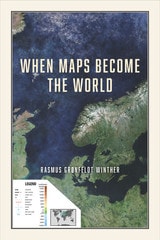
When Maps Become the World
Rasmus Grønfeldt Winther
University of Chicago Press, 2020
This book is about the promises and perils of map thinking. Maps are purpose-driven abstractions, discarding detail to highlight only particular features of a territory. By preserving certain features at the expense of others, they can be used to reinforce a privileged position.
When Maps Become the World shows us how the scientific theories, models, and concepts we use to intervene in the world function as maps, and explores the consequences of this, both good and bad. We increasingly understand the world around us in terms of models, to the extent that we often take the models for reality. Winther explains how in time, our historical representations in science, in cartography, and in our stories about ourselves replace individual memories and become dominant social narratives—they become reality, and they can remake the world.
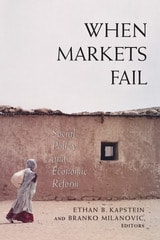
When Markets Fail
Social Policy and Economic ReformEthan B. Kapstein
Russell Sage Foundation, 2002

When Peace Is Not Enough
How the Israeli Peace Camp Thinks about Religion, Nationalism, and JusticeAtalia Omer
University of Chicago Press, 2013
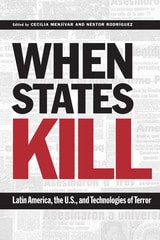
When States Kill
Latin America, the U.S., and Technologies of TerrorEdited by Cecilia Menjívar and Néstor Rodríguez
University of Texas Press, 2005
Since the early twentieth century, technological transfers from the United States to Latin American countries have involved technologies of violence for social control. As the chapters in this book illustrate, these technological transfers have taken various forms, including the training of Latin American military personnel in surveillance and torture and the provision of political and logistic support for campaigns of state terror. The human cost for Latin America has been enormous—thousands of Latin Americans have been murdered, disappeared, or tortured, and whole communities have been terrorized into silence.
Organized by region, the essays in this book address the topic of state-sponsored terrorism in a variety of ways. Most take the perspective that state-directed political violence is a modern development of a regional political structure in which U.S. political interests weigh heavily. Others acknowledge that Latin American states enthusiastically received U.S. support for their campaigns of terror. A few see local culture and history as key factors in the implementation of state campaigns of political violence. Together, all the essays exemplify how technologies of terror have been transferred among various Latin American countries, with particular attention to the role that the United States, as a "strong" state, has played in such transfers.
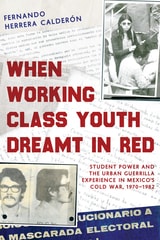
When Working Class Youth Dreamt in Red
Student Power and the Urban Guerrilla Experience in Mexico's Cold War, 1970–1982Fernando Herrera Calderón
University of Arizona Press, 2027
The 1970s in Mexico were turbulent from the start. Insurgent voices converged across cities and rural peripheries. Militant labor, urban popular sectors, and Indigenous collectives erupted in expressions of broad social exhaustion. Rebellion, rooted in the layered betrayals of the postrevolutionary state and the fractures of a deteriorating modernity under the Institutional Revolutionary Party (PRI), fermented and boiled over.
At the core of this moment, Mexican youth found their way to political-military organizations, coalescing around shared ecologies of dissent and embedded in broader currents of revolutionary struggle. When Working Class Youth Dreamt in Red reconstructs these insurgent youth cultures and guerrilla imaginaries, reorienting the historiographical lens to center radical working class youth—especially urban students—as protagonists in a wider saga of revolutionary experimentation and political rupture.
At its conceptual core, this book offers a bold new interpretation of a turbulent moment in Mexican history. It shows how class shaped the epistemic horizons through which proletarian youth understood themselves and makes visible their role as central actors at the vanguard of a revolutionary time.
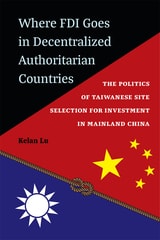
Where FDI Goes in Decentralized Authoritarian Countries
The Politics of Taiwanese Site Selection for Investment in Mainland ChinaKelan Lu
University of Michigan Press, 2023
Among all the decentralized authoritarian countries, China is distinctive not only because of its emergence as one of the largest foreign direct investment (FDI) recipient countries with one of the highest levels of fiscal decentralization, but also because of the combination of its fiscal decentralization and the cadre promotion system as incentive institutions for attracting FDI inflows. China is an important case to empirically investigate the impact of fiscal autonomy on adversarial investment because it has become the largest investment destination of its long-term adversary, Taiwan, with Taiwanese FDI being among the largest FDI in mainland China. Given the special role played by local Chinese governments in attracting and hosting Taiwanese FDI, it is important to study the differences between where Taiwanese FDI and other FDI goes.
Given the uniqueness of the China case and that of Taiwanese investment in mainland China, this book explores the following questions. What determines where FDI goes in authoritarian countries like China? Fiscal decentralization has been argued to be a driving force of skyrocketing FDI inflows in China due to its impact on local governments’ incentives. However, is the impact of fiscal autonomy on FDI monolithic with the dynamically changing levels of FDI inflows at the lower administrative levels in China, especially with its special cadre management system? Does the impact of fiscal decentralization on FDI strengthen or weaken or stay the same when attracting FDI inflows from adversarial states? And what are the implications of such adversarial investment—especially as it diffuses from coastal cities to the interior regions, or from key cities to peripheral regions—of decentralized authoritarian countries targeted by this investment?
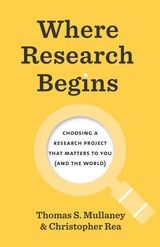
Where Research Begins
Choosing a Research Project That Matters to You (and the World)Thomas S. Mullaney and Christopher Rea
University of Chicago Press, 2022
Plenty of books tell you how to do research. This book helps you figure out WHAT to research in the first place, and why it matters.
The hardest part of research isn't answering a question. It's knowing what to do before you know what your question is. Where Research Begins tackles the two challenges every researcher faces with every new project: How do I find a compelling problem to investigate—one that truly matters to me, deeply and personally? How do I then design my research project so that the results will matter to anyone else?
This book will help you start your new research project the right way for you with a series of simple yet ingenious exercises. Written in a conversational style and packed with real-world examples, this easy-to-follow workbook offers an engaging guide to finding research inspiration within yourself, and in the broader world of ideas.
Read this book if you (or your students):
- have difficulty choosing a research topic
- know your topic, but are unsure how to turn it into a research project
- feel intimidated by or unqualified to do research
- worry that you’re asking the wrong questions about your research topic
- have plenty of good ideas, but aren’t sure which one to commit to
- feel like your research topic was imposed by someone else
- want to learn new ways to think about how to do research.
Under the expert guidance of award-winning researchers Thomas S. Mullaney and Christopher Rea, you will find yourself on the path to a compelling and meaningful research project, one that matters to you—and the world.

Which Socialism, Whose Detente?
West European Communism and the Czechoslovak Crisis of 1968Maud Bracke
Central European University Press, 2007
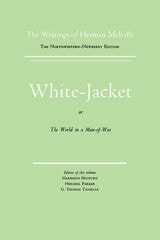
White Jacket, or The World in a Man-of-War
Volume Five, Scholarly EditionHerman Melville
Northwestern University Press, 1970
Already that same summer Melville had written Redburn, and he regarded the books as "two jobs, which I have done for money--being forced to it, as other men are to sawing wood." The reviewers were not as hard on White-Jacket as Melville himself was. The English liked its praise of British seamen. The Americans were more interested in Melville's attack on naval abuses, particularly flogging, and his advocacy of humanitarian causes. Soon Melville was acclaimed the best sea writer of the day.
Part autobiography, part epic fiction, White-Jacket remains a brilliantly imaginative social novel by one of the great writers of the sea. This text of the novel is an Approved Text of the Center for Editions of American Authors (Modern Language Association of America).
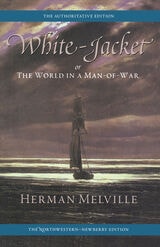
White-Jacket; or, The World in a Man-of-War
Volume FiveHerman Melville
Northwestern University Press, 2000
Already that same summer Melville had written Redburn, and he regarded the books as "two jobs, which I have done for money--being forced to it, as other men are to sawing wood." The reviewers were not as hard on White-Jacket as Melville himself was. The English liked its praise of British seamen. The Americans were more interested in Melville's attack on naval abuses, particularly flogging, and his advocacy of humanitarian causes. Soon Melville was acclaimed the best sea writer of the day.
Part autobiography, part epic fiction, White-Jacket remains a brilliantly imaginative social novel by one of the great writers of the sea. This text of the novel is an Approved Text of the Center for Editions of American Authors (Modern Language Association of America).
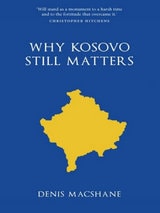
Why Kosovo Matters
Denis MacShane
Haus Publishing, 2011
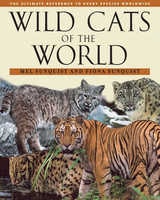
Wild Cats of the World
Mel Sunquist and Fiona Sunquist
University of Chicago Press, 2002
Wild Cats of the World is a treasure trove of answers to questions like these, and many others, for anyone who's interested in learning more about the world's felids, including the ones with whom we share our homes. Mel and Fiona Sunquist have spent more than a decade gathering information about cats from every available source, many of them quite difficult to find, including scientific papers, descriptions of hunts, archeological findings, observations by naturalists and travelers, reports from government agencies, and newsletters from a wide variety of organizations. Weaving information from these sources together with their own experiences observing wild cats around the world, the Sunquists have created the most comprehensive reference on felids available. Each of their accounts of the 36 species of cat contains a description of the cat, including human interactions with it, as well as detailed data on its distribution, ecology and behavior, status in the wild, and efforts to conserve it. Numerous photographs, including more than 40 in full color, illustrate these accounts.
Ranging from the two-pound black-footed cat to the five-hundred-pound tiger, and from the African serval with its satellite-dish ears to the web-footed fishing cat of Asia, Wild Cats of the World will fascinate and educate felid fans of any stripe (or spot).

Windows On The World
World News Reporting 1900-1920Robert W. Desmond
University of Iowa Press, 1981
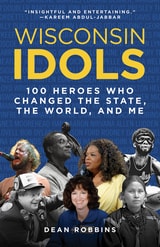
Wisconsin Idols
100 Heroes Who Changed the State, the World, and MeDean Robbins
Wisconsin Historical Society Press, 2025
Discover intriguing true tales of legends and trailblazers with Wisconsin connections who left their mark on the world, including the Beatles, Georgia O’Keeffe, Kareem Abdul-Jabbar, Harrison Ford, Joni Mitchell, Abraham Lincoln, Oprah Winfrey, Bob Dylan, Jackie Robinson, Orson Welles, and many more. Marvel at Elvis Presley’s miracle on the streets of Madison, applaud the award-winning acting of Reedsburg’s Agnes Moorehead, follow fearless quarterback Bart Starr to the gates of hell in Green Bay, and join Joshua Glover in Racine on his daring escape from enslavers. These brief narratives—whether poignant or humorous—also offer personal reflections on the impact of each featured idol.
Author Dean Robbins has spent a lifetime researching and revering these prominent figures and visiting exhibits, shrines, historic homes, and other sites dedicated to their achievements. Wisconsin Idols gathers all of Robbins’s obsessions into one collection, enhanced by dozens of photographs. Taken together, these stories of musicians, activists, artists, athletes, actors, and great thinkers irrefutably establish Wisconsin as a crossroads for extraordinary people who changed the world.
Wobblies of the World
A Global History of the IWWEdited by Peter Cole, David Struthers, and Kenyon Zimmer
Pluto Press, 2017
Founded in 1905, Chicago's Industrial Workers of the World (IWW) is a union unlike any other. With members affectionately called "Wobblies" and an evolutionary and internationalist philosophy and tactics, it rapidly grew across the world. Considering the history of the IWW from an international perspective for the first time, Wobblies of the World brings together a group of leading scholars to present a lively collection of accounts from thirteen diverse countries, revealing a fascinating story of anarchism, syndicalism, and socialism. Chapters include:
*”A Cosmopolitan Crowd”: Transnational Anarchists, the IWW and the American Radical Press by Kenyon Zimmer
*Living Social Dynamite: Early Twentieth-Century IWW-South Asia Connections by Tariq Khan
*IWW Internationalism and Interracial Organizing in the Southwestern United States by David M. Struthers
*Spanish Anarchists and Maritime Workers in the IWW by Bieito Alonso
*The IWW and the Dilemmas of Labor Internationalism by Wayne Thorpe
*Wobblies Down Under: The IWW in Australia by Verity Burgmann
*Ki Nga Kaimahi Maori ('To All Maori Workers'): The New Zealand IWW and the Maori by Mark Derby
*Patrick Hodgens Hickey and the IWW: A Transnational Relationship by Peter Clayworth
*Edith Frenette: A Transnational Radical Life by Heather Mayer
*Tom Barker and Revolutionary Europe by Paula de Angelis
*P. J. Welinder and “American Syndicalism” in Interwar Sweden by Johan Pries
*Tramp, Tramp, Tramp: The Songs of Joe Hill Around the World by Bucky Halker
*And much, much more!
Drawing on many important figures of the movement—Har Dayal, James Larkin, William D. "Big Bill" Haywood, Enrique Flores Magón, and more—the contributors describe how the IWW and its ideals spread, exploring the crucial role the IWW played in industries such as shipping, mining, and agriculture.
Ultimately, the book illuminates Wobblie methods of organizing, forms of expression, practices, and transnational issues, offering a fascinating alternative history of the group
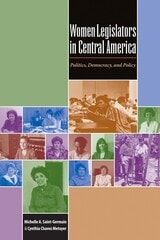
Women Legislators in Central America
Politics, Democracy, and PolicyBy Michelle A. Saint-Germain and Cynthia Chavez Metoyer
University of Texas Press, 2008
During the years between 1980 and 1999, in the midst of war and economic crisis, a record number of women were elected to national legislatures in Central American republics. Can quantitative increases in the presence of elected women in Central America produce qualitative political changes?
In this detailed study, Michelle A. Saint-Germain and Cynthia Chavez Metoyer explore the reasons for this unprecedented political rise of women, and what effect it has had on the region. Focusing on Costa Rica, El Salvador, Guatemala, Honduras, and Nicaragua, the authors analyze national and regional indicators to evaluate various hypotheses concerning the reasons for women's electoral success in the region, as well as to make comparisons with findings from other world regions. They find that the election of more women depends on three things: the presence of a crisis, a pool of politically experienced women, and a culture of gender consciousness. They also compare the characteristics of Central American women legislators to women in other national legislatures around the world.
The authors document how elected women have used their policy-making power to begin to change the lives of all Central Americans, women and men alike. In more than seventy-five in-depth, personal interviews, these women legislators reflect on their lives, political careers, and gender identities in their own words, providing deep insights into recent events in this region.
Women and Slavery, Volume One
Africa, the Indian Ocean World, and the Medieval North AtlanticGwyn Campbell
Ohio University Press, 2007
Women enslaved in the Americas came to bear highly gendered reputations among whites—as “scheming Jezebels,” ample and devoted “mammies,” or suffering victims of white male brutality and sexual abuse—that revealed more about the psychology of enslaving than about the courage and creativity of the women enslaved. These strong images of modern New World slavery contrast with the equally expressive virtual invisibility of the women enslaved in the Old—concealed in harems, represented to meddling colonial rulers as “wives” and “nieces,” taken into African families and kin-groups in subtlely nuanced fashion.
Women and Slavery presents papers developed from an international conference organized by Gwyn Campbell.
Volume 1 Contributors: Sharifa Ahjum, Richard B. Allen, Katrin Bromber, Gwyn Campbell, Catherine Coquery-Vidrovitch, Jan-Georg Deutsch, Timothy Fernyhough, Philip J. Havik, Elizabeth Grzymala Jordan, Martin A. Klein, George Michael La Rue, Paul E. Lovejoy, Fred Morton, Richard Roberts, Kirsten A. Seaver
Women and Slavery, Volume Two
The Modern AtlanticGwyn Campbell
Ohio University Press, 2008
Women enslaved in the Americas came to bear highly gendered reputations among whites—as “scheming Jezebels,” ample and devoted “mammies,” or suffering victims of white male brutality and sexual abuse—that revealed more about the psychology of enslaving than about the courage and creativity of the women enslaved. These strong images of modern New World slavery contrast with the equally expressive virtual invisibility of the women enslaved in the Old—concealed in harems, represented to meddling colonial rulers as “wives” and “nieces,” taken into African families and kin-groups in subtlely nuanced fashion.
Volume 2 Contributors: Henrice Altin,k Laurence Brown, Myriam Cottias, Laura F. Edwards, Richard Follett, Tara Inniss, Barbara Krauthamer, Joseph C. Miller, Bernard Moitt, Kenneth Morgan, Claire Robertson, Marsha Robinson, Felipe Smith, and Mariza de Carvalho Soares.
Women in Contemporary Mexican Politics
By Victoria E. Rodríguez
University of Texas Press, 2003
Since the mid-1980s, a dramatic opening in Mexico's political and electoral processes, combined with the growth of a new civic culture, has created unprecedented opportunities for women and other previously repressed or ignored groups to participate in the political life of the nation. In this book, Victoria Rodríguez offers the first comprehensive analysis of how Mexican women have taken advantage of new opportunities to participate in the political process through elected and appointed office, nongovernmental organizations, and grassroots activism.
Drawing on scores of interviews with politically active women conducted since 1994, Rodríguez looks at Mexican women's political participation from a variety of angles. She analyzes the factors that have increased women's political activity: from the women's movement, to the economic crises of the 1980s and 1990s, to increasing democratization, to the victory of Vicente Fox in the 2000 presidential election. She maps out the pathways that women have used to gain access to public life and also the roadblocks that continue to limit women's participation in politics, especially at higher levels of government. And she offers hopeful, yet realistic predictions for women's future participation in the political life of Mexico.
Women's Cinema, World Cinema
Projecting Contemporary FeminismsPatricia White
Duke University Press, 2015
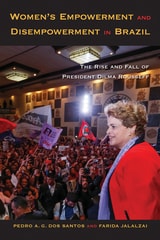
Women's Empowerment and Disempowerment in Brazil
The Rise and Fall of President Dilma RousseffPedro A. G. dos Santos and Farida Jalalzai
Temple University Press, 2021
In 2010, Dilma Rousseff was the first woman to be elected President in Brazil. She was re-elected in 2014 before being impeached in 2016 for breaking budget laws. Her popularity and controversy both energized and polarized the country. In Women’s Empowerment and Disempowerment in Brazil, dos Santos and Jalalzai examine Rousseff’s presidency and what it means for a woman to hold (and lose) the country’s highest power.
The authors examine the ways Rousseff exercised dominant authority and enhanced women’s political empowerment. They also investigate the extent her gender played a role in the events of her presidency, including the political and economic crises and her ensuing impeachment. Emphasizing women’s political empowerment rather than representation, the authors assess the effects of women executives to more directly impact female constituencies—how they can empower women by appointing them to government positions; make policies that advance women’s equality; and, through visibility, create greater support for female politicians despite rampant sexism.
Women’s Empowerment and Disempowerment in Brazil uses Rousseff’s presidency as a case study to focus on the ways she succeeded and failed in using her authority to empower women. The authors’ findings have implications throughout the world.
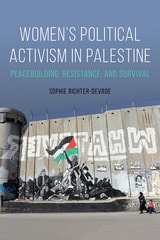
Women's Political Activism in Palestine
Peacebuilding, Resistance, and SurvivalSophie Richter-Devroe
University of Illinois Press, 2018
Richter-Devroe's ethnographic approach draws from revealing in-depth interviews and participant observation in Palestine. The result: a forceful critique of mainstream conflict resolution methods and the failed woman-to-woman peacebuilding projects so lauded around the world. The liberal faith in dialogue as core of "the political" and the assumption that women's "nurturing" nature makes them superior peacemakers, collapse in the face of past and ongoing Israeli state violences.
Instead, women confront Israeli settler colonialism directly and indirectly in their popular and everyday acts of resistance. Richter-Devroe's analysis zooms in on the intricate dynamics of daily life in Palestine, tracing the emergent politics that women articulate and practice there. In shedding light on contemporary gendered "politics from below" in the region, the book invites a rethinking of the workings, shapes, and boundaries of the political.
Words in Motion
Toward a Global LexiconCarol Gluck and Anna Lowenhaupt Tsing, eds.
Duke University Press, 2009
Such words as security in Brazil, responsibility in Japan, community in Thailand, and hijāb in France changed the societies in which they moved even as the words were changed by them. Some words threatened to launch wars, as injury did in imperial Britain’s relations with China in the nineteenth century. Others, such as secularism, worked in silence to agitate for political change in twentieth-century Morocco. Words imposed or imported from abroad could be transformed by those who wielded them to oppose the very powers that first introduced them, as happened in Turkey, Indonesia, and the Philippines. Taken together, this selection of fourteen essays reveals commonality as well as distinctiveness across modern societies, making the world look different from the interdisciplinary and transnational perspective of “words in motion.”
Contributors. Mona Abaza, Itty Abraham, Partha Chatterjee, Carol Gluck, Huri Islamoglu, Claudia Koonz, Lydia H. Liu, Driss Maghraoui, Vicente L. Rafael, Craig J. Reynolds, Seteney Shami, Alan Tansman, Kasian Tejapira, Anna Lowenhaupt Tsing
Words to Create a World
Daniel Hoffman
University of Michigan Press, 1993
Between these are discussions of books by and about founding modernists (Pound, Moore, Sitwell, Frost, Graves, Auden) who do not “succumb to the imitative fallacy and gibber at the window because the house is on fire.” Hoffman’s historical imagination elucidates the work of many other contemporary American and British poets, including his own. Words to Create a World will appeal to the reader who enjoys poetry and who hopes for guidance over the sprawling terrain of verse in the twentieth century.
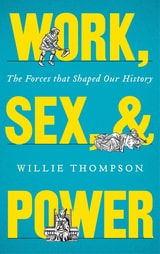
Work, Sex, and Power
The Forces that Shaped Our HistoryWillie Thompson
Pluto Press, 2015
It expertly explores the foundations of our developing society by showing how these grand themes have recurred throughout the various phases of global history. From communities of Palaeolithic hunter-gatherers, through feudalism and onto the capitalistic machine-civilisation of recent centuries, Willie Thompson takes us on a journey that is fundamentally opposed to mainstream histories which concentrate on monarchs, politicians and military commanders.
At the centre of this book lies the interaction between humans and their environment. By exploring history in this way, it reveals a simple yet powerful materialist understanding of how we got to where we are today, and opens a door to a different reading of our world.
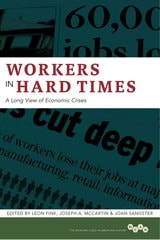
Workers in Hard Times
A Long View of Economic CrisesEdited by Leon Fink, Joseph A. McCartin, and Joan Sangster
University of Illinois Press, 2020
Since the Industrial Revolution, contributors argue, factors such as race, sex, and state intervention have mediated both the effect of economic depressions on workers' lives and workers' responses to those depressions. Contributors also posit a varying dynamic between political upheaval and economic crises, and between workers and the welfare state.
The volume ends with an examination of today's "Great Recession": its historical distinctiveness, its connection to neoliberalism, and its attendant expressions of worker status and agency around the world. A sobering conclusion lays out a likely future for workers--one not far removed from the instability and privation of the nineteenth century.
The essays in this volume offer up no easy solutions to the challenges facing today's workers. Nevertheless, they make clear that cogent historical thinking is crucial to understanding those challenges, and they push us toward a rethinking of the relationship between capital and labor, the waged and unwaged, and the employed and jobless.
Contributors are Sven Beckert, Sean Cadigan, Leon Fink, Alvin Finkel, Wendy Goldman, Gaetan Heroux, Joseph A. McCartin, David Montgomery, Edward Montgomery, Scott Reynolds Nelson, Melanie Nolan, Bryan D. Palmer, Joan Sangster, Judith Stein, Hilary Wainright, and Lu Zhang.
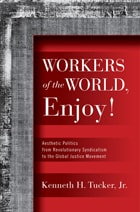
Workers of the World, Enjoy!
Aesthetic Politics from Revolutionary Syndicalism to the Global Justice MovementKenneth H. Tucker, Jr.
Temple University Press, 2012
The aesthetic politics of social movements turn public life into a public stage, where mutual displays of performance often trump rational debate, and urban streets become sites of festivals and carnival. In his penetrating new book, Workers of the World, Enjoy!, Kenneth Tucker provides a new model for understanding social change in our image-saturated and aesthetically charged world. As emotional and artistic images inform our perceptions and evaluation of politics, art and performance often provide new and creative ways of understanding self and society.
Spanning the nineteenth, twentieth, and twenty-first centuries, Workers of the World, Enjoy! uses examples from major social movements that have dramatically changed the dominant capitalist society—often in the name of labor. Tucker investigates how class and culture develop as he raises questions about what it means for public life and social movements when politics and drama come together.
Tucker catalogues how aesthetic politics influences social movements—from French Revolutionary syndicalism and fascism to the selling of the President and the street theater of the contemporary global justice movement. He also discusses the work of political theorists including Jurgen Habermas, Jeffrey Alexander, and Nancy Fraser to critique the ways public sphere has been studied.
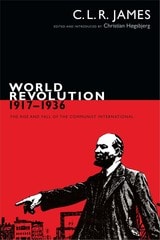
World Revolution, 1917–1936
The Rise and Fall of the Communist InternationalC. L. R. James
Duke University Press, 2017
World Rule
Accountability, Legitimacy, and the Design of Global GovernanceJonathan GS Koppell
University of Chicago Press, 2010
Dilemmas from climate change to financial meltdowns make it clear that global interconnectedness is the norm in the twenty-first century. As a result, global governance organizations (GGOs)—from the World Trade Organization to the Forest Stewardship Council—have taken on prominent roles in the management of international affairs. These GGOs create and promulgate rules to address a host of pressing problems. But as World Rule reveals, they struggle to meet two challenges: building authority despite limited ability to impose sanctions and maintaining legitimacy while satisfying the demands of key constituencies whose support is essential to a global rulemaking regime.
Through a novel empirical study of twenty-five GGOs, Jonathan GS Koppell provides a clearer picture of the compromises within and the competition among these influential institutions by focusing attention on their organizational design. Analyzing four aspects of GGO organization in depth—representation and administration, the rulemaking process, adherence and enforcement, and interest group participation—Koppell describes variation systemically, identifies patterns, and offers explanations that link GGO design to the fundamental challenge of accountability in global governance.
World in the Balance
Behind the Scenes of World War IIGerhard L. Weinberg
Brandeis University Press, 1981
World of Dew
Lindsay Stuart Hill
University of Wisconsin Press, 2025
World of Fairs
The Century-of-Progress ExpositionsRobert W. Rydell
University of Chicago Press, 1993
World of Fairs continues Robert W. Rydell's unique cultural history—begun in his acclaimed All the World's a Fair—this time focusing on the interwar exhibitions. He shows how the ideas of a few—particularly artists, architects, and scientists—were broadcast to millions, proclaiming the arrival of modern America—a new empire of abundance build on old foundations of inequality.
Rydell revisits several fairs, highlighting the 1926 Philadelphia Sesquicentennial, the 1931 Paris Colonial Exposition, the 1933-34 Chicago Century of Progress Exposition, the 1935-36 San Diego California Pacific Exposition, the 1936 Dallas Texas Centennial Exposition, the 1937 Cleveland Great Lakes and International Exposition, the 1939-40 San Francisco Golden Gate International Exposition, the 1939-40 New York World's Fair, and the 1958 Brussels Universal Exposition.
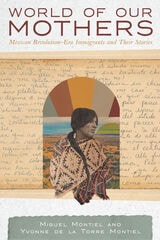
World of Our Mothers
Mexican Revolution–Era Immigrants and Their StoriesMiguel Montiel and Yvonne de la Torre Montiel
University of Arizona Press, 2022
While the women share a historic immigration journey, each story provides unique details and circumstances that testify to the diversity of the immigrant experience. The oral histories, a project more than forty years in the making, let these women speak for themselves, while historical information is added to support and illuminate the women’s voices.
The book, which includes a foreword by Irasema Coronado, director of the School of Transborder Studies, and Chris Marin, professor emeritus, both at Arizona State University, is divided into four parts. Part 1 highlights the salient events of the Revolution; part 2 presents an overview of what immigrants inherited upon their arrival to the United States; part 3 identifies challenges faced by immigrant families; and part 4 focuses on stories by location—Arizona mining towns, Phoenix barrios, and Midwestern colonias—all communities that immigrant women helped create. The book concludes with ideas on how readers can examine their own family histories. Readers are invited to engage with one another to uncover alternative interpretations of the immigrant experience and through the process connect one generation with another.