Results by title
139 books match the query 'World War, 1914-1918' and 6 start with w
War and Collapse
World War I and the Ottoman StateEdited by M. Hakan Yavuz with Feroz Ahmad
University of Utah Press, 2015
War and Collapse is the third and final volume in a series that covers the last years of the Ottoman Empire. This book stems from a three-day international conference held in May 2012 at which scholars examined the causes and consequences of World War I, with a distinctive focus on how these events pertained to the Ottoman state and society. Fifty-three scholars—both new and established—contributed to this collection, with the goal of explaining what happened within the Ottoman Empire before and during WWI and how ethnic and national groups constructed these events to enhance their identities, promote their interests, and situate their collective selves in the international system. The chapters provide insight into the mindset and experiences of Ottoman peoples from the end of the Balkan Wars through the end of World War I, showing how earlier events set in motion the Ottoman response to the war and how continued engagement in conflict had devastating, irreversible effects on Ottoman society. The articles in this volume include a wide variety of ideas and points of view, thus presenting a comprehensive picture of the events.
[more]
War's Waste
Rehabilitation in World War I AmericaBeth Linker
University of Chicago Press, 2011
With US soldiers stationed around the world and engaged in multiple conflicts, Americans will be forced for the foreseeable future to come to terms with those permanently disabled in battle. At the moment, we accept rehabilitation as the proper social and cultural response to the wounded, swiftly returning injured combatants to their civilian lives. But this was not always the case, as Beth Linker reveals in her provocative new book, War’s Waste.
Linker explains how, before entering World War I, the United States sought a way to avoid the enormous cost of providing injured soldiers with pensions, which it had done since the Revolutionary War. Emboldened by their faith in the new social and medical sciences, reformers pushed rehabilitation as a means to “rebuild” disabled soldiers, relieving the nation of a monetary burden and easing the decision to enter the Great War. Linker’s narrative moves from the professional development of orthopedic surgeons and physical therapists to the curative workshops, or hospital spaces where disabled soldiers learned how to repair automobiles as well as their own artificial limbs. The story culminates in the postwar establishment of the Veterans Administration, one of the greatest legacies to come out of the First World War.
[more]
War, Judgment, and Memory in the Basque Borderlands, 1914-1945
Sandra Ott
University of Nevada Press, 2008
During the first half of the twentieth century, the French Basque province of Xiberoa was a place of refuge, conflict, transit, exile and foreign occupation. At the Liberation of France in 1944, many Xiberoans confronted ongoing local divisiveness, rooted in the interwar years, and faced new conflicts arising from legal and civic judgments made during Vichy and German occupation. This book traces the roots of their divided memories to local and official interpretations of what constituted legitimate judgment, legitimate behavior and justice during those troubled times. In order to capture a sense of the diverse ways in which Xiberoan Basques responded to the Germans in their midst, the author explores and contrasts the experiences of people in four different communities located within a fifteen mile radius.
[more]

Windows On The World
World News Reporting 1900-1920Robert W. Desmond
University of Iowa Press, 1981
[more]

Women at The Hague
The International Congress of Women and Its ResultsJane Addams, Emily G. Balch, and Alice Hamilton
University of Illinois Press, 2003
In the midst of World War I, from April 28 to May 1, 1915, more than a thousand women from Europe and North America gathered in The Hague to discuss proposals for a peaceful end to the war. As one of the founders of the Woman's Peace Party, Jane Addams was among the attendees at the International Congress of Women, along with fellow social reformers and peace activists Emily G. Balch and Alice Hamilton. This book contains their journalistic accounts of the Congress's proceedings and results as well as their personal reflections on peace, war, politics, and the central role of women in the preservation of peace.
Following the conference in The Hague, Addams and Balch traveled around Europe as members of delegations visiting various governmental leaders to demand an end to the war. In this book they describe the activities of these delegations, painting a vivid portrait of the emerging women's peace movement.
With the continuing growth of the peace movement, the essays in Women at the Hague remain as timely as they were when first published in 1915. Addams, Balch, and Hamilton write compellingly about the organizing methods and collaborative spirit of the women's peace movement, conveying a strong awareness of the responsibility of women to protect the global community from the devastating effects of war.
[more]
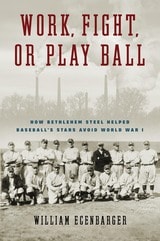
Work, Fight, or Play Ball
How Bethlehem Steel Helped Baseball's Stars Avoid World War IEcenbarger, William
Temple University Press, 2024
In 1918, Bethlehem Steel started the world’s greatest industrial baseball league. Appealing to Major League Baseball players looking to avoid service in the Great War, teams employed “ringers” like Babe Ruth, Rogers Hornsby, and Shoeless Joe Jackson in what became scornfully known as “safe shelter” leagues. In Work, Fight, or Play Ball, William Ecenbarger fondly recounts this little-known story of how dozens of athletes faced professional conflicts and a difficult choice in light of public perceptions and war propaganda.
Some players used the steel mill and shipyard leagues to avoid wartime military duty, irking Major League owners, who saw their rosters dwindling. Bethlehem Steel President Charles Schwab (no relation to the financier) saw the league as a means to stave off employee and union organizing. Most fans loudly criticized the ballplayers, but nevertheless showed up to watch the action on the diamond.
Ecenbarger traces the 1918 Steel League’s season and compares the fates of the players who defected to industry or continued to play stateside with the travails of the Major Leaguers, such as Christy Mathewson, Ty Cobb, and Grover Cleveland Alexander, who served during the war.
Work, Fight, or Play Ball reveals the home field advantage brought on by the war, which allowed companies to profit from Major League players.
[more]