Results by title
3576 books match the query 'American' and 207 start with w
Welfare Politics in Boston, 1910-1940
Susan Traverso
University of Massachusetts Press, 2009
Between 1910 and 1940, Boston's growing immigrant population repeatedly clashed with the city's traditional elite over how to provide assistance to the needy. While Yankee politicians and the leaders of Protestant charities argued that relief should be delivered by private organizations, Irish politicians and officials at Catholic and Jewish charities advocated extensive public welfare programs. Competing views of gender roles further complicated these disagreements. The campaign for widows' pensions, for example, won wide popular support even as public welfare programs that would primarily benefit men-such as unemployment insurance and old age assistance-failed to gain acceptance.
In the 1920s, the debate over welfare shifted focus as prolonged periods of unemployment brought demands for aid to men who had lost their jobs, particularly those with families to support. Using the rhetoric of the Mothers' Aid campaign, Irish politicians broadened the idea of "acceptable dependency" to include men who needed jobs to provide for their own dependents. By lessening the stigma of male dependency on public welfare, these gendered arguments encouraged the expansion of public aid and set the stage for New Deal welfare programs of the 1930s. During that decade, Traverso contends, the idealized family headed by a male breadwinner became the basis for a shared vision of gender relations that mediated the political and ethnic debate over welfare policy.
Wendell Castle Remastered
Wendell Castle
The Artist Book Foundation, 2015
Wendell Castle (1932–2018), master furniture maker, designer, sculptor, and educator, was in the sixth decade of his extraordinary creativity when an emblematic exhibition of his signature works was mounted by the Museum of Art and Design in 2016. It blended the artist's seminal works with his latest collection, produced with digital technology. In part a self-reflection, this eponymous, full-color companion book examines some of Castle's historically representative works as well as significant contemporary furniture pieces, continuing his highly respected and acclaimed sculptural/functional dialogue. Castle, ever the innovator, was remarkable for his openness to new technologies; he not only embraced an initially complex practice but has "remastered" it. His vast oeuvre represents a prodigious lifework that began in 1958 and aligns with the development of the American art furniture movement.
The solo exhibition was a somewhat self-reflective examination of his early ground-breaking works that tested the boundaries of traditional furniture making by presenting his later innovations using new digital technologies such as 3D scanning and modeling, and computer-controlled milling—a digital "remastering" of his immense oeuvre. Unique perspectives on the master's work are presented by informative essays by authors well-versed on Castle's celebrated career.

Wendell Castle
A Catalogue Raisonné, 1958–2012Wendell Castle
The Artist Book Foundation, 2014
Sculptor and furniture designer Wendell Castle (1932–2018) carved a distinct path in furniture making over nearly six decades of a distinguished career, and this long-awaited recording of his oeuvre, Wendell Castle: A Catalogue Raisonné, 1958–2012, beautifully presents the extraordinary scope of his artistry and craftsmanship. The voluminous accounting of his works, beginning with Castle's earliest, mid-century works through to his unabashed experiments with unconventional materials (gel-coated fiberglass and metallic automobile paint) and his latest signature wood laminations, is comprehensive and detailed. Three essays of varying perpectives introduce the catalogue raisonné followed by an extensive accounting of his enormous oeuvre, his exhibitions, numerous awards, and the collections of his works, as well as a substantive bibliography.
With his organic and whimsical approach to his various mediums, Castle seamlessly merged sculpture and design into one discipline, obscuring the distinction between the two. He invented the technique of carving stacked laminations of wood, and his later explorations into the qualities of fiberglass as a sculptural medium are unparalleled.
West of 98
Living and Writing the New American WestEdited by Lynn Stegner and Russell Rowland
University of Texas Press, 2011
What does it mean to be a westerner? With all the mythology that has grown up about the American West, is it even possible to describe "how it was, how it is, here, in the West—just that," in the words of Lynn Stegner? Starting with that challenge, Stegner and Russell Rowland invited several dozen members of the western literary tribe to write about living in the West and being a western writer in particular. West of 98 gathers sixty-six literary testimonies, in essays and poetry, from a stellar collection of writers who represent every state west of the 98th parallel—a kind of Greek chorus of the most prominent voices in western literature today, who seek to "characterize the West as each of us grew to know it, and, equally important, the West that is still becoming."
In West of 98, western writers speak to the ways in which the West imprints itself on the people who live there, as well as how the people of the West create the personality of the region. The writers explore the western landscape—how it has been revered and abused across centuries—and the inescapable limitations its aridity puts on all dreams of conquest and development. They dismantle the boosterism of manifest destiny and the cowboy and mountain man ethos of every-man-for-himself, and show instead how we must create new narratives of cooperation if we are to survive in this spare and beautiful country. The writers seek to define the essence of both actual and metaphoric wilderness as they journey toward a West that might honestly be called home.
A collective declaration not of our independence but of our interdependence with the land and with each other, West of 98 opens up a whole new panorama of the western experience.
West of Center
Art and the Counterculture Experiment in America, 1965–1977Elissa Auther
University of Minnesota Press, 2012
In the heady and hallucinogenic days of the 1960s and ’70s, a diverse range of artists and creative individuals based in the American West—from the Pacific coast to the Rocky Mountains and the Southwest—broke the barriers between art and lifestyle and embraced the new, hybrid sensibilities of the countercultural movement. Often created through radically collaborative artistic practices, such works as Paolo Soleri’s earth homes, the hand-built architecture of the Drop City and Libre communes, Yolanda López’s political posters, the multisensory movement workshops of Anna and Lawrence Halprin, and the immersive light shows and video-based work by the Ant Farm and Optic Nerve collectives were intended to generate new life patterns that pointed toward social and political emancipation.
In West of Center, Elissa Auther and Adam Lerner bring together a prominent group of scholars to elaborate the historical and artistic significance of these counterculture projects within the broader narrative of postwar American art, which skews heavily toward New York’s avant-garde art scene. This west of center countercultural movement has typically been associated with psychedelic art, but the contributors to this book understand this as only one dimension of the larger, artistically oriented, socially based phenomenon. At the same time, they reveal the disciplinary, geographic, and theoretical biases and assumptions that have led to the dismissal of countercultural practices in the history of art and visual culture, and they detail how this form of cultural and political activity found its place in the West.
A companion to an exhibition originating at the Museum of Contemporary Art Denver, this book illuminates how, in the western United States, the counterculture’s unique integration of art practices, political action, and collaborative life activities serves as a linchpin connecting postwar and contemporary artistic endeavors.
West of the Border
The Multicultural Literature of the Western American FrontiersNoreen Groover Lape
Ohio University Press, 2000
Expanding the scope of American borderland and frontier literary scholarship, West of the Border examines the writings of nineteenth- and turn-of-the-century Native, African, Asian, and Anglo American frontier writers. This book views frontiers as “human spaces” where cultures make contact as it considers multicultural frontier writers who speak from “west of the border.”
James P. Beckwourth, a half-black fur trader; Sarah Winnemucca Hopkins, a Paiute translator; Salishan author Mourning Dove; Cherokee novelist John Rollin Ridge; Sui Sin Far, an Anglo-Chinese short story writer, and her sister, romance novelist Onoto Watanna; and Mary Austin, a white southwestern writer- each of these intercultural writers faces a rite of passage into a new social order. Their writings negotiate their various frontier ordeals: the encroachment of pioneers on the land; reservation life; assimilation; Christianity; battles over territories and resources; exclusion; miscegenation laws; and the devastation of the environment.
In West of the Border, Noreen Groover Lape raises issues inherent in American pluralism today by broaching timely concerns about American frontier politics, conceptualizing frontiers as intercultural contact zones, and expanding the boundaries of frontier literary studies by giving voice to minority writers.
Western Subjects
Autobiographical Writing In North American WestGioia Woods
University of Utah Press, 2005
Western Weird
Mark Todd
University Press of Colorado, 2015
The 2015 theme for Manifest West’s annual anthology is “Western Weird.” The works in this collection reflect both myths and suspected truths about the part of the United States we call “the West.” But this year’s edition focuses entirely on the tradition of the strange. To borrow from Jeff VanderMeer’s definition for speculative fiction’s “New Weird,” this volume creates a new parallel genre for work that subverts the traditional romanticized ideas about place, playing with clichés about the West in order to put these elements to discomfiting, rather than consoling, ends.
Topics included in this collection of poetry, fiction, and creative nonfiction range from the West’s numinous fascination with E.T., Bigfoot, and ghosts and its celebration of its indigenous fauna and deadly landscapes to its uncomfortable relationships with its own marginalized peoples and its unforgiving and sometimes violent traditions. The tone of these works ranges from light—even campy—to chilling, but all allow readers to gaze straight into the many faces of what makes the West a weird place.
For the first time in the series, this volume includes solicited work as well as open submissions, including a number of established and award-winning writers and serving its mission by giving voice to brand-new writers.
Western Weird is the fourth volume in Western Press Books’ literary anthology series, Manifest West. The press, affiliated with Western State Colorado University, annually produces one anthology focused on Western regional writing
Contributors:
Bredt Bredthauer, Bartholomew Brinkman, Amy Brunvand, George David Clark, Michael Luis Dauro, Carol V. Davis, Russell Davis, Joe DiBuduo, Michael Engelhard, Daniel Ervin, Mel Goldberg, R. S. Gwynn, Aline Kaplan, Don Kunz , Nate Liederbach, Ellaraine Lockie, Nathan Alling Long, Robert McBrearty, Teresa Milbrodt, Lance Nizami, William Notter, Marlene Olin, C. R. Resetarits, Kate Robinson, Michaela Roessner, David J. Rothman, Matt Schumacher, Renée Thompson, Wendy Videlock, Vivian Wagner, Kirby Wright
Whale
K.L. Evans
University of Minnesota Press, 2003
An entirely fresh approach to Moby Dick, by way of Ludwig Wittgenstein
The aim of this thoroughly unconventional work is to demonstrate that Herman Melville’s Moby Dick and Ludwig Wittgenstein’s Philosophical Investigations share the same projects and are, in effect, one and the same book. Confounding and improbable as such an enterprise might seem, Whale! not only successfully reveals the vital intersections between Melville and Wittgenstein but also, more important, makes a compelling argument for why such intersections are essential to understanding common political projects in literature and philosophy.
Written with grace, passion, and wit, Whale! manages to produce a startling and remarkably original reading of one of the most written-about and interpreted books in the American canon. K. L. Evans explores Melville’s vast work as a tale not of vengeance but of affection, and Ahab’s near-pathological agitation as indicative of his refusal to accept the world as unknowable. Between Ahab and the whale, Evans traces a longing for connection and meaning and finds a forceful response to the skeptical view that language is bankrupt and knowledge is uncertain. In Ahab’s hunt for Moby Dick, Whale! discovers a way to reconnect matter with meaning, object with knowledge.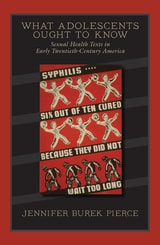
What Adolescents Ought to Know
Sexual Health Texts in Early Twentieth-Century AmericaJennifer Burek Pierce
University of Massachusetts Press, 2011
In 1901, Dr. Alfred Fournier committed an act both simple and revolutionary: he wrote ForOur Sons, When They Turn 18, a sexual and reproductive health treatise based on his clinical work at a leading Paris hospital. If this booklet aided adolescent understanding of health, it also encouraged reformers around the world to publish. By 1913, countless works on venereal disease prevention were available to adolescents.
During this period, authors wrestled with how to make still-developing scientific information available to a reader also in the process of maturing. What would convince a young person to avoid acting on desire? What norms should be employed in these arguments, when social and legal precedents warned against committing ideas about sex to print? How, in other words, could information about sex be made both decent and compelling? Health reformers struggled with these challenges as doctors' ability to diagnose diseases such as syphilis outpaced the production of medicines that could restore health. In this context, information represented the best and truest prophylactic. When publications were successful, from the perspective of information dissemination, they were translated and distributed worldwide.
What Adolescents Ought to Know explores the evolution of these printed materials—from a single tract, written by a medical researcher and given free to anyone, to a thriving commercial enterprise. It tells the story of how sex education moved from private conversation to purchased text in early twentieth-century America.
What Clever Friends
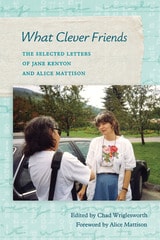
The Selected Letters of Jane Kenyon and Alice MattisonEdited by Chad Wriglesworth
University of Michigan Press, 2026
Witty, tender, and aware; tempestuous and lyrical, these letters trace the evolution of a deep and largely unknown friendship that situates Kenyon’s work within a collaborative environment of other poets and novelists who were committed to the flourishing of contemporary women’s writing. With more than 500 edited and annotated letters, a retrospective foreword written by Alice Mattison, and a scholarly introduction written by Chad Wriglesworth, What Clever Friends conveys a compelling story that will interest readers and writers.
What Democracy Looks Like
A New Critical Realism for a Post-Seattle WorldLang, Amy
Rutgers University Press, 2006
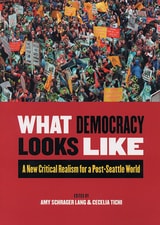
The convergence of activists in Seattle during the World Trade Organization meetings captured the headlines in 1999. These demonstrations marked the first major expression on U.S. soil of worldwide opposition to inequality, privatization, and political and intellectual repression. This turning point in world politics coincided with an ongoing quandary in academia-particularly in the humanities where the so-called "death of theory" has left the field on tenuous footing.
In What Democracy Looks Like, the editors and twenty-seven contributors argue that these crises-in the world and the academy-are not unrelated. The essays insist that, in the wake of "Seattle," teachers and scholars of American literature and culture are faced with the challenge of addressing new points of intersection between American studies and literary studies. The narrative, the poem, the essay, and the drama need to be reexamined in ways that are relevant to the urgent social and political issues of our time.
Collectively urging scholars and educators to pay fresh attention to the material conditions out of which literature arises, this path-breaking book inaugurates a new critical realism in American literary studies. It provides a crucial link in the growing need to merge theory and practice with the goal of reconnecting the ivory tower elite to the activists on the street.
What Flies Want
PoemsEmily Pérez
University of Iowa Press, 2022
In What Flies Want, disaster looms in domesticity: a family grapples with its members’ mental health, a marriage falters, and a child experiments with self-harm. With its backdrop of school lockdown drills, #MeToo, and increasing political polarization, the collection asks how these private and public tensions are interconnected.
The speaker, who grew up in a bicultural family on the U.S./Mexico border, learns she must play a role in a culture that prizes whiteness, patriarchy, and chauvinism. As an adult she oscillates between performed confidence and obedience. As a wife, she bristles against the expectations of emotional labor. As a mother, she attempts to direct her white male children away from the toxic power they are positioned to inherit, only to find how deeply she is also implicated in these systems. Tangled in a family history of depression, a society fixated on guns, a rocky relationship, and her own desire to ignore and deny the problems she must face, this is a speaker who is by turns defiant, defeated, self-implicating, and hopeful.
What Is What Was
Richard Stern
University of Chicago Press, 2002
In the book's seven sections are analyses of the Wimbledon tennis tournament as an Anglification machine, of Silicon Valley at its shaky peak, of James and Dante as travel writers, a Lucretian look at today's cosmology, American fiction in detail and depth, a "thought experiment" for Clarence Thomas, a salvation scheme for Ross Perot, a semi-confession of the writer.
The book contains but isn't philosophy, criticism, opinion, reportage, or autobiography (although the author says it is as much of this as he plans to write). There is a recurrent theme, the ways in which actuality is made and remade in description, argument and narration, fictional and nonfictional, but above all, What Is What Was is a provocative entertainment by a writer who, as Philip Roth once said, "knows as much as anyone writing American prose about family mischief, intellectual shenanigans, love blunders—and about writing American prose."
What Middletown Read
Print Culture in an American Small CityFrank Felsenstein
University of Massachusetts Press, 2015
The discovery of a large cache of circulation records from the Muncie, Indiana, Public Library in 2003 offers unprecedented detail about American reading behavior at the turn of the twentieth century. Frank Felsenstein and James J. Connolly have mined these records to produce an in-depth account of print culture in Muncie, the city featured in the famed “Middletown” studies conducted by Robert and Helen Lynd almost a century ago. Using the data assembled and made public through the What Middletown Read Database (www.bsu.edu/libraries/wmr), a celebrated new resource the authors helped launch, Felsenstein and Connolly analyze the borrowing choices and reading culture of social groups and individuals.
What Middletown Read is much more than a statistical study. Felsenstein and Connolly dig into diaries, meeting minutes, newspaper reports, and local histories to trace the library's development in relation to the city's cosmopolitan aspirations, to profile individual readers, and to explore such topics as the relationship between children's reading and their schooling and what books were discussed by local women's clubs. The authors situate borrowing patterns and reading behavior within the contexts of a rapidly growing, culturally ambitious small city, an evolving public library, an expanding market for print, and the broad social changes that accompanied industrialization in the United States. The result is a rich, revealing portrait of the place of reading in an emblematic American community.
What Night Brings
Carla Trujillo
Northwestern University Press, 2003
What Saves Us
Bruce Weigl
Northwestern University Press, 1994
In these wrenching, elegant poems, Bruce Weigl writes out of uncompromising memory and vision. His subject is both the transport and anguish of being open to the lived and living moment. From bars and bedrooms, in Ohio and Nicaragua and Vietnam, his voice rises through the noise of history and habit to reach us with impeccable grace and remarkable invention.
What Shines
Sydney Lea
Four Way Books, 0
What Water Knows
PoemsJacqueline Jones LaMon
Northwestern University Press, 2021
LaMon’s skillful embodiment of character and her signature use of personae invite the reader to experience the unfathomable. Prepare to go over Niagara Falls in a barrel. Prepare to feel the force of a fire hose on your bare legs. Prepare to experience what happens when greed gets in the way of reason. What Water Knows is a canonical poetic achievement that will remind us of what it means to be human in a world that often forgets.
What a Book Can Do
The Publication and Reception of "Silent Spring"Priscilla Coit Murphy
University of Massachusetts Press, 2005
Murphy reviews the publishing history of the Houghton Mifflin edition and the prior New Yorker serialization, describing Carson's approach to her project as well as the views and expectations of her editors. She also documents the response of opponents to Carson's message, notably the powerful chemical industry, including efforts to undermine, delay, or stop publication altogether.
Murphy then investigates the media's role, showing that it went well beyond providing a forum for debate. In addition, she analyzes the perceptions and expectations of the public at large regarding the book, the debate, and the media. By probing all of these perspectives, Murphy sheds new light on the dynamic between newsmaking books, the media, and the public. In the process, she addresses a host of broader questions about the place of books in American culture, past, present, and future.
What a Library Means to a Woman
Edith Wharton and the Will to Collect BooksSheila Liming
University of Minnesota Press, 2020
Examining the personal library and the making of self
When writer Edith Wharton died in 1937, without any children, her library of more than five thousand volumes was divided and subsequently sold. Decades later, it was reassembled and returned to The Mount, her historic Massachusetts estate. What a Library Means to a Woman examines personal libraries as technologies of self-creation in modern America, focusing on Wharton and her remarkable collection of books.
Sheila Liming explores the connection between libraries and self-making in late nineteenth- and early twentieth-century American culture, from the 1860s to the 1930s. She tells the story of Wharton’s library in concert with Wharton scholarship and treatises from this era concerning the wider fields of book history, material and print culture, and the histories (and pathologies) of collecting. Liming’s study blends literary and historical analysis while engaging with modern discussions about gender, inheritance, and hoarding. It offers a review of the many meanings of a library collection, while reading one specific collection in light of its owner’s literary celebrity.
What a Library Means to a Woman was born from Liming’s ongoing work digitizing the Wharton library collection. It ultimately argues for a multifaceted understanding of authorship by linking Wharton’s literary persona to her library, which was, as she saw it, the site of her self-making.

What is Symbolism?
By Henri Peyre, translated by Emmett Parker
University of Alabama Press, 1980
"This splendid work is highly recommended." —Choice
Peyre's beautiful introduction to the Symbolist movement, which emerged in the late 19th century. A literary and artistic movement that sought to express the ineffable and the mysterious aspects of human experience, Symbolism originated in France and spread across Europe, influencing various forms of art, including poetry, painting, and music. Prominent figures in the Symbolist movement include poets like Charles Baudelaire, Stéphane Mallarmé, and Paul Verlaine, as well as artists like Gustave Moreau and Odilon Redon. The Symbolist movement had a profound impact on later artistic and literary movements, such as Modernism and Surrealism, shaping the way artists and writers approached the exploration of the human psyche and the mysteries of existence.
What the Body Told
Rafael Campo
Duke University Press, 1996
Lost in the Hospital
It’s not that I don’t like the hospital.
Those small bouquets of flowers, pert and brave.
The smell of antiseptic cleansers.
The ill, so wistful in their rooms, so true.
My friend, the one who’s dying, took me out
To where the patients go to smoke, IV’s
And oxygen tanks attached to them—
A tiny patio for skeletons. We shared
A cigaratte, which was delicious but
Too brief. I held his hand; it felt
Like someone’s keys. How beautiful it was,
The sunlight pointing down at us, as if
We were important, full of life, unbound.
I wandered for a moment where his ribs
Had made a space for me, and there, beside
The thundering waterfall of is heart,
I rubbed my eyes and thought “I’m lost.”
What's Your Road, Man?
Critical Essays on Jack Kerouac's On the RoadEdited by Hilary Holladay and Robert Holton
Southern Illinois University Press, 2008
The ten essays in this groundbreaking compilation cover a broad range of topics, employing a variety of approaches, including theoretical interpretations and textual and comparative analysis, to investigate such issues as race, class, gender, and sexuality, as well as the novel's historical and literary contexts. What's Your Road, Man? Critical Essays on Jack Kerouac's "On the Road" illustrates the richness of the critical work currently being undertaken on this vital American narrative.
Combining essays from renowned Kerouac experts and emerging scholars, What's Your Road, Man? draws on an enormous amount of research into the literary, social, cultural, biographical, and historical contexts of Kerouac's canonical novel. Since its publication in 1957, On the Road has remained in print and has continued to be one of the most widely read twentieth-century American novels.
Several essays enhance understanding of the book by comparing it with alternative versions of the text, like the original 1951 scroll manuscript and some of Kerouac's other novels, and with works by Kerouac's contemporaries such as Sylvia Plath's The Bell Jar. Further studies explore ethnicity, identity, and the novel's place in American literature as well as its relevance to twenty-first century readers.
On the Road has inspired readers for more than fifty years, and the new research included in What's Your Road, Man? introduces fresh perspectives on this classic work of American literature. Editors Hilary Holladay and Robert Holton have successfully woven little-known material with new understandings of familiar topics that will enlighten current and future generations of Kerouac enthusiasts and scholars for years to come.
When I Came to Die
Process and Prophecy in Thoreau's Vision of DyingAudrey Raden
University of Massachusetts Press, 2017
When I Came to Die suggests that throughout his writings, Thoreau communicated that knowing how to die properly is an art and a lifelong study, a perspective that informed his ideas about politics, nature, and individualism. With this insight, Raden opens a dialogue that will engage both Thoreauvians and those interested in American literature and thought.
When I Reach for Your Pulse
Rushi Vyas
Four Way Books, 2023
In this electrifying debut, lyric works to untangle slippery personal and political histories in the wake of a parent’s suicide. “When my father finally / died,” Vyas writes, “we [...] burned, / like an effigy, the voiceless body.” Grief returns us to elemental silence, where “the wind is a muted vowel in the brush of pine / branches” across American landscapes. These poems extend formal experimentation, caesurae, and enjambment to reach into the emptiness and fractures that remain. This language listens as much as it sings, asking: can we recover from the muting effects of British colonialism, American imperialism, patriarchy, and caste hierarchies? Which cultural legacies do we release in order to heal? Which do we keep alive, and which keep us alive? A monument to yesterday and a missive to tomorrow, When I Reach for Your Pulse reminds us of both the burden and the promise of inheritance. “[T]he wail outlasts / the dream,” but time falls like water and so “the stream survives its source.”
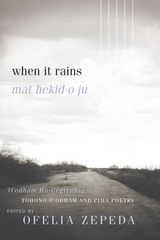
When It Rains
Tohono O'odham and Pima PoetryEdited by Ofelia Zepeda
University of Arizona Press, 1982
The poems capture brief moments of beauty, the loving bond between family members, and a deep appreciation of Tohono O’odham culture and traditions, as well as reverent feelings about the landscape and wildlife native to the Southwest. A motif of rain and water is woven throughout the poetry in When It Rains, tying in the collection’s title to the importance of this life-giving and sustaining resource to the Tohono O’odham people. With the poems in both O’odham and English, the volume serves as an important reminder of the beauty and changeability of the O’odham language.
The themes and experiences expressed by the language educators in this volume capture still-rural community life: children are still bussed for miles to school, and parents still have hours-long daily commutes to work. The Sonoran Desert also remains an important part of daily life—seasons, rain on desert plants, and sacred mountains serve as important markers.
In a new foreword to the volume, Sun Tracks editor Ofelia Zepeda reflects on how meaningful this volume was when it was first published and its continued importance. “Things have changed but many things remain the same,” writes Zepeda. “The pieces in this collection will be meaningful to many still.”
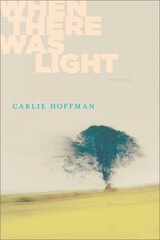
When There Was Light
Carlie Hoffman
Four Way Books, 2023
While Hoffman’s debut collection interrogated the mythos built around grief, inhabiting an Alaska of the mind, her stunning sophomore collection When There Was Light looks at the past for what it was.These poems map out a topography where global movements of diaspora and war live alongside personal reckonings: a house’s foreclosure, parents’ divorce, the indelible night spent drunk with a best friend “[lying] down inside a chronic row of corn.” Here, her father’s voice “is the stray dog barking / at the snow, believing the little strawberries grow wilder / against a field.” In these pages, she points to Russia and Poland and Germany, saying, “It was / another time. My people / another time. The synagogues burn decades / of new snow.” The brilliance of this collection illuminates the relationship between memory and language; “another time” means different, back then, gone and lost to us, and it means over and over, always, again. With this linguistic dexterity and lyrical tenderness, Hoffman’s work bridges private and public histories, reminding us of the years cloaked in shadows and the years when there was light.
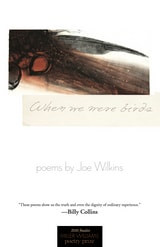
When We Were Birds
PoemsJoe Wilkins
University of Arkansas Press, 2016
Finalist, 2016 Miller Williams Poetry Prize, edited by Billy Collins
In When We Were Birds, Joe Wilkins wrests his attention away from the griefs, deprivations, and high prairies of his Montana childhood and turns toward “the bean-rusted fields & gutted factories of the Midwest,” toward ordinary injustice and everyday sadness, toward the imminent birth of his son and his own confusions in taking up the mantle of fatherhood, toward faith and grace, legacy and luck.
A panoply of voices are at play—the escaped convict, the late-night convenience store clerk, and the drowned child all have their say—and as this motley chorus rises and crests, we begin to understand something of what binds us and makes us human: while the world invariably breaks all our hearts, Wilkins insists that is the very “place / hope lives, in the breaking.”
Within a notable range of form, concern, and voice, the poems here never fail to sing. Whether praiseful or interrogating, When We Were Birds is a book of flight, light, and song. “When we were birds,” Wilkins begins, “we veered & wheeled, we flapped & looped— / it’s true, we flew.”
Winner, 2017 Stafford/Hall Award for Poetry, Oregon Book Awards
When You’re Deep in a Thing
Anthony Cappo
Four Way Books, 2022
Where Clouds Are Formed
Ofelia Zepeda
University of Arizona Press, 2008
Zepeda is as clear-eyed about the past as she is about the present. She recalls waiting for the school bus on a cold morning inside her father’s truck, listening to the sounds of the engine, the windshield wipers, and the “soft rain on the hood.” She remembers celebrating Mass on the “cold dirt floor of the Winter Solstice.” In the present, she sees both the frustration and the humor in a woman she observes trying to eat pancakes with one hand while her other resides in a cast: “Watching her, I realize eating pancakes is a two-handed job.”
Whatever she sees, she filters through her second set of eyes, which keep the past always present. She tells of traveling to Waw Giwulig, the most sacred mountain of the Tohono O’odham, to ask for blessings—and forgiveness. She writes that one should always bring music to the mountains, “so they are generous with the summer rains.” And, still, “the scent of burning wood / holds the strongest memory. / Mesquite, cedar, piñon, juniper, . . . / we catch the scent of burning wood; / we are brought home.” It is a joy to see the world afresh through her eyes.
Where No Flag Flies
Donald Davidson and the Southern ResistanceMark Royden Winchell
University of Missouri Press, 2000
Donald Davidson (1893-1968) may well be the most unjustifiably neglected figure in twentieth-century southern literature. One of the most important poets of the Fugitive movement, he also produced a substantial body of literary criticism, the libretto for an American folk opera, a widely used composition textbook, and the recently discovered novel The Big Ballad Jamboree. As a social and political activist, Davidson had significant impact on conservative thought in this century, imfluencing important scholars from Cleanth Brooks to M. E. Bradford.
Despite these accomplishments, Donald Davidson has received little critical attention from either the literary or the southern scholarly community. Where No Flag Flies is Mark Royden Winchell's redress of this critical disservice. A comprehensive intellectual biography of Davidson, this seminal work offers a complete narrative of Davidson's life with all of its triumphs and losses, frustrations and fulfillments.
Winchell provides the reader with more than a simple study of a man and his achievements; he paints a complete portrait of the times in which Davidson published, from the 1930s to the early 1960s. Davidson was more directly involved in political and social activities than most writers of his generation, and Winchell provides the context, both literary and historical, in which Davidson's opinions and works developed. At the same time, Winchell offers detailed evaluations of Davidson's poetry, fiction, historical writings, and essays.
Drawing upon a wealth of previously unpublished archival material, including Davidson's letters and diary, Where No Flag Flies provides unique access to one of the most original minds of the twentieth-century South. Donald Davidson may not have achieved the recognition he deserved, but this remarkable biography finally makes it possible for a considerable literary audience to discover his true achievement.
Where She Always Was
Frannie Lindsay
Utah State University Press, 2005
Where the Southern Cross the Yellow Dog
On Writers and WritingLouis D. Rubin, Jr.
University of Missouri Press, 2005
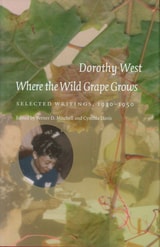
Where the Wild Grape Grows
Selected Writings, 1930–1950Dorothy West. Edited by Cynthia Davis and Verner D. Mitchell
University of Massachusetts Press, 2026
When Where the Wild Grape Grows was published in 2005 by the University of Massachusetts Press, it was the first book-length critical study of Dorothy West. Since then, the publication of more volumes on West and her circle testify to popular and academic interest in under-represented artists of the Harlem Renaissance, many of whom appeared first in West’s literary magazine, Challenge (1934-1937). Challenge included poems by West’s cousin Helene Johnson as well as by her friends Lucia Mae Pitts, Waring Cuney, Pauli Murray, Grace Walker, Mae Cowdery, Marcia Prendergast, and Bessie Calhoun Bird. West also published work by her romantic partner Marian Minus and by Juanita DeShields (the first Black Canadian graduate of McGill University) and the Trinidadian author Alfred Mendes. She included artwork by Mildred Jones and journalism by Eslanda Robeson and Dorothy Peterson. In addition to her editorial activities, West corresponded with important African American musicians including Maud Cuney Hare, Alberta Hunter, and Henry T. Burleigh, and with sculptors Augusta Savage and Richmond Barthé. Just as West mentored others, she was encouraged by such academic luminaries as Columbia Professors Blanche Colton Williams and Dorothy Scarborough, and by the controversial novelist Erskine Caldwell.
The new Introduction to Wild Grape will include fresh research on these individuals, many of whom formed part of West’s social and artistic circle. Lucia Pitts, for example, was a poet who served in the famous WAC (Women’s Army Corps) 6888th Battalion. The work of Marian Minus and Mae Cowdery has received critical attention recently and they also merit closer investigation. The Boston writer and musicologist Maud Cuney Hare was an artistic mentor to West; her cousin Waring Cuney was a close friend: both will receive more attention in the paperback edition. The artist Mildred Jones accompanied West and twenty other young African Americans to Russia in 1932 as participants in an ultimately aborted propaganda film on race relations in America; Jones studied with the important Russian Modernist painter Aleksandr Deyneka.
The original edition of Wild Grape cites two stories about West’s Russian experiences (penned under the pseudonym Mary Christopher in 1934), “Room in Red Square” and “Russian Correspondence,” but the volume does not include the actual stories. The stories are interesting because they shed light on West’s unrequited romance with Langston Hughes and her relationships with other members of the group, and they offer a unique perspective on daily life in the U.S.S.R. Both stories will be published in the new edition, along with a detailed discussion of new research about West’s visit to Russia.
A third uncollected story, “Cook” (1934), written by West under the pseudonym Jane Isaac will also be included. This story is extremely important to West’s oeuvre and her artistic development; it includes characters, themes, tropes, and plot lines that she expanded and developed in her two novels, The Living Is Easy (1948) and The Wedding (1995).
Since 2005, new material has been added to the West archive in Harvard’s Schlesinger Library. The section of Wild Grape devoted to West’s correspondence will include additional unpublished letters which underscore West’s dedication to African American art and culture.
The book includes the Benson-West family tree in Appendix II. Several scholars have expressed appreciation for this information which has not been published elsewhere; the chart will be updated to include the birth of several of West’s descendants.
Where the World Is Not
Cultural Authority and Democratic Desire in Modern American LiteratureKim Savelson
The Ohio State University Press, 2009
Whispers of a Savage Sort
And Other Plays about the Deaf American ExperienceRaymond Luczak
Gallaudet University Press, 2009
“Oh, why can’t the deaf community be more like a family?” is the plaint of a character in Raymond Luczak’s title play Whispers of a Savage Sort. It also goes far in characterizing the main thread that runs through his remarkable collection of work offered in this new volume. Whispers of a Savage Sort and Other Plays about the Deaf American Experience presents a progression of plays that depict Deaf people in situations well-known by the community’s members. Written to be signing-driven, these plays feature Deaf characters from the various strata of Deaf society. Each play centers on different yet equally familiar issues.
Snooty brings to life the difficulties of surviving the social pecking order in a deaf residential school. The main character’s only escape is a rich fantasy life in which he is in control. Doogle confronts its characters with the intrusion of technological communication devices parallel to the virtually forced intimacy of such a small, close community. Brought into stark focus by the specter of AIDS, Love in My Veins explores how trust, betrayal, and ultimately forgiveness can transform a Deaf couple’s love for each other in a Deaf community. The collection’s eponymous Whispers of a Savage Sort reveals the relentless damage that rumor and innuendo can do to a diverse group of Deaf individuals. The emotions, identities, and consequences created by Luczak in these dramas illuminate the Deaf American community in fascinating detail rarely seen in any medium today.
White Scholars/African American Texts
Edited by Lisa A. Long
Rutgers University Press, 2005
What makes someone an authority? What makes one person's knowledge more credible than another's? In the ongoing debates over racial authenticity, some attest that we can know each other's experiences simply because we are all "human," while others assume a more skeptical stance, insisting that racial differences create unbridgeable gaps in knowledge.
Bringing new perspectives to these perennial debates, the essays in this collection explore the many difficulties created by the fact that white scholars greatly outnumber black scholars in the study and teaching of African American literature. Contributors, including some of the most prominent theorists in the field as well as younger scholars, examine who is speaking, what is being spoken and what is not, and why framing African American literature in terms of an exclusive black/white racial divide is problematic and limiting.
In highlighting the "whiteness" of some African Americanists, the collection does not imply that the teaching or understanding of black literature by white scholars is definitively impossible. Indeed such work is not only possible, but imperative. Instead, the essays aim to open a much needed public conversation about the real and pressing challenges that white scholars face in this type of work, as well as the implications of how these challenges are met.
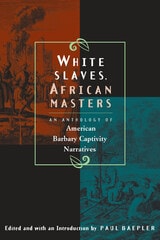
White Slaves, African Masters
An Anthology of American Barbary Captivity NarrativesEdited by Paul Baepler
University of Chicago Press, 1999
Though Barbary privateers began to seize North American colonists as early as 1625, Barbary captivity narratives did not begin to flourish until after the American Revolution. During these years, stories of Barbary captivity forced the U.S. government to pay humiliating tributes to African rulers, stimulated the drive to create the U.S. Navy, and brought on America's first post-revolutionary war. These tales also were used both to justify and to vilify slavery.
The accounts collected here range from the 1798 tale of John Foss, who was ransomed by Thomas Jefferson's administration for tribute totaling a sixth of the annual federal budget, to the story of Ion Perdicaris, whose (probably staged) abduction in Tangier in 1904 prompted Theodore Roosevelt to send warships to Morocco and inspired the 1975 film The Wind and the Lion. Also included is the unusual story of Robert Adams, a light-skinned African American who was abducted by Arabs and used by them to hunt negro slaves; captured by black villagers who presumed he was white; then was sold back to a group of Arabs, from whom he was ransomed by a British diplomat.
Long out of print and never before anthologized, these fascinating tales open an entirely new chapter of early American literary history, and shed new light on the more familiar genres of Indian captivity narrative and American slave narrative.
White Summer
Joelle Biele
Southern Illinois University Press, 2002
In White Summer, Joelle Biele investigates the problems of personal and cultural memory. Rich with images of flight and displacement, Biele’s poems show a love for words, their music and physicality. In lyric addresses, historical meditations, and autobiographical narratives, she takes readers on a journey that includes stops at a dinner party in ancient Rome, a market square in Germany, an Italian feast in the Bronx, and the main concourse of Manhattan’s Grand Central Station. She shows a sharp eye for the telling detail whether she is studying the migrations of birds or sketching portraits of people wishing to escape the confines of their lives. Throughout her first collection, Biele reveals and revels in the power of language to shape and create experience.
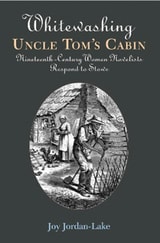
Whitewashing Uncle Tom's Cabin
Nineteenth-Century Women Novelists Respond to StoweJoy Jordan-Lake
Vanderbilt University Press, 2005
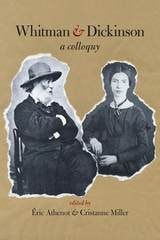
Whitman & Dickinson
A ColloquyEric Athenot and Cristanne Miller
University of Iowa Press, 2018
Essays included in this book cover the topics of mentoring influence on each poet, religion, the Civil War, phenomenology, the environment, humor, poetic structures of language, and Whitman’s and Dickinson’s twentieth- and twenty-first–century reception—including prolonged engagement with Adrienne Rich’s response to this “strange uncoupled couple” of poets who stand at the beginning of an American national poetic.
Contributors Include:
Marina Camboni
Andrew Dorkin
Vincent Dussol
Betsy Erkkilä
Ed Folsom
Christine Gerhardt
Jay Grossman
Jennifer Leader
Marianne Noble
Cécile Roudeau
Shira Wolosky
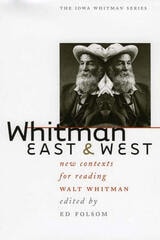
Whitman East and West
New Contexts for Reading Walt WhitmanEd Folsom
University of Iowa Press, 2002
Confirming the growing international spirit of American studies, the essays in Whitman East and West developed out of a landmark conference in Beijing, the first major conference in China to focus on an American poet. Scholars from Asia, Europe, and North America set out to track the ways in which Whitman's poetry has become part of China's cultural landscape as well as the literary landscapes of other countries. By describing his assimilation into other cultures and his resulting transformation into a hybrid poet, these essayists celebrate Whitman's multiple manifestations in other languages and contexts.
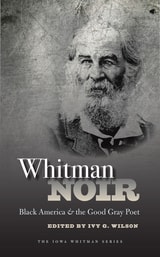
Whitman Noir
Black America and the Good Gray PoetIvy Wilson
University of Iowa Press, 2014
Whitman Noir: Black America and the Good Gray Poet explores the meaning of blacks and blackness in Whitman’s imagination and, equally significant, also illuminates the aura of Whitman in African American letters from Langston Hughes to June Jordan, Margaret Walker to Yusef Komunyakaa. The essays, which feature academic scholars and poets alike, address questions of literary history, the textual interplay between author and narrator, and race and poetic influence. The volume as a whole reveals the mutual engagement with a matrix of shared ideas, contradictions, and languages to expose how Whitman influenced African American literary production as well as how African American Studies brings to bear new questions and concerns for evaluating Whitman.
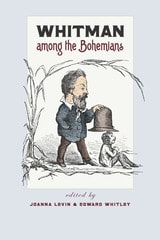
Whitman among the Bohemians
Joanna Levin and Edward Whitley
University of Iowa Press, 2014
In this milieu, Whitman found sympathetic supporters of his poetic vision, professional connections, rivals, romantic partners, and close friends, and left a lasting impression on poet and critic Edmund Clarence Stedman, an erstwhile bohemian who later in the century emerged as a tastemaker of American poetry. Yet for many years, the bohemians associated with Pfaff’s have served merely as minor background characters in Whitman scholarship. Whitman among the Bohemians corrects that by exploring in depth the connections Whitman made at Pfaff’s and the impact they had on him, his poetry, and his career. In telling the story of these intersecting social and professional links that converged at Pfaff’s in the late 1850s and early 1860s, the essays in this volume powerfully demonstrate just how much we can learn about Whitman and his work by viewing him within the context of American bohemia.
CONTRIBUTORS: Stephanie Blalock, Ruth Bohan, Leif Eckstrom, Logan Esdale, Amanda Gailey, Karen Karbiener, Joanna Levin, Mary Loeffelholz, Eliza Richards, Ingrid Satelmajer, Robert J. Scholnick, Edward Whitley
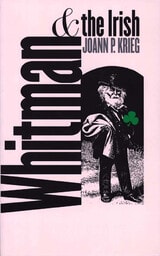
Whitman and the Irish
Joann P. Krieg
University of Iowa Press, 2000
Though Walt Whitman created no Irish characters in his early works of fiction, he did include the Irish as part of the democratic portrait of America that he drew in Leaves of Grass. He could hardly have done otherwise. In 1855, when the first edition of Leaves of Grass was published, the Irish made up one of the largest immigrant populations in New York City and, as such, maintained a cultural identity of their own. All of this “Irishness” swirled about Whitman as he trod the streets of his Mannahatta, ultimately becoming part of him and his poetry. As members of the working class, famous authors, or close friends, the Irish left their mark on Whitman the man and poet. In Whitman and the Irish, Joann Krieg convincingly establishes their importance within the larger framework of Whitman studies.
Focusing on geography rather than biography, Krieg traces Whitman's encounters with cities where the Irish formed a large portion of the population—New York City, Boston, Camden, and Dublin—or where, as in the case of Washington, D.C., he had exceptionally close Irish friends. She also provides a brief yet important historical summary of Ireland and its relationship with America.
Whitman and the Irish does more than examine Whitman's Irish friends and acquaintances: it adds a valuable dimension to our understanding of his personal world and explores a number of vital questions in social and cultural history. Krieg places Whitman in relation to the emerging labor culture of ante-bellum New York, reveals the relationship between Whitman's cultural nationalism and the Irish nationalism of the late nineteenth century, and reflects upon Whitman's involvement with the Union cause and that of Irish American soldiers.
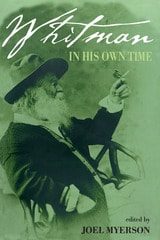
Whitman in His Own Time
A Biographical Chronicle of His Own Life, Drawn from Recollections, Memoirs, and Interviews by Friends and AssociatesJoel Myerson
University of Iowa Press, 2000
Few American writers were as concerned with their public image as was Walt Whitman. He praised his own work in unsigned reviews; he included engravings or photographs of himself in numerous editions of his work; and he assisted in the writing of two biographies of himself. Whitman was also written about extensively by others throughout his lifetime. Whitman in His Own Time is a collection of these contemporary accounts of the "good gray poet."
The interviews with and recollections of Whitman collected by Joel Myerson represent a wide spectrum of accounts—visitors from America and abroad; newspaper interviewers; Whitman's doctor and nurse during his final illness; his literary executors; a student from his early schoolteaching days; and such well-known authors as Bronson Alcott, John Burroughs, and Henry David Thoreau. The selections also paint a well-rounded picture of Whitman, from his early days as a schoolteacher to the moment of his death, and demonstrate a varying range of attitudes toward the poet. Yet throughout the entire collection, Whitman himself holds center stage, and he is seen as vividly today as he was over one hundred years ago. Myerson's introduction to this expanded edition places these accounts of Whitman within the context of the time and discusses new scholarship on Whitman's life.
Whitman's & Dickinson's Contemporaries
An Anthology of their VerseEdited and with an Introduction by Robert Bain
Southern Illinois University Press, 1996
Emily Dickinson and Walt Whitman were not the poetic stars of their day; only a few friends knew that Dickinson wrote, and Whitman’s following was minuscule, if influential. But the contemporaries who eclipsed these major poets now have largely disappeared from our literary landscape.
In this distinctive anthology, Robert Bain gathers together thirteen other scholars to re-present the poetry of these former luminaries, allowing readers to rediscover them, reconstruct the poetic contexts of their age, and better understand why Whitman and Dickinson now overshadow other poets of their time.
Arranged chronologically according to the birth dates of the poets, this anthology introduces each poet’s work, providing biographical information and discussing the major forms and themes of the work. Each introduction places the poet in a literary and historical context with Whitman and Dickinson and provides a bibliography of secondary sources.
This remarkable book recovers a part of our literary heritage that has been lost.

Whitman's Drama of Consensus
Kerry C. Larson
University of Chicago Press, 1988
Who Follow the Gleam
PoemsChristian Wessels
University of Massachusetts Press, 2026
A dazzling debut that blends folklore with the everyday
Drifting between the past and present, the material and the otherworldly, Who Follow the Gleam melts lore and magic with history to shape distinctive narratives of childhood, fatherhood, and personhood. In his debut poetry collection, Christian Wessels crosses centuries and takes his readers with him to Germany’s Black Forest, burning hotels, chromatic casinos, and Long Island’s dazing Sound. Uncanny elements of folklore and dreamlike stories are grounded in the atmosphere of the natural world as Wessels turns the sun, moss, and clouds into characters connecting his poems: “maybe I myself am the sun; am / the brilliant silence engraved / in stone; am the arc / through which the future becomes / legible.”
In the world of this collection, intuition, feelings, dreams, and spells mimic cycles, patterns, rules, and structure as the speaker disappears in the magic of language, only to resurface in the everyday. In four sections, Wessels reckons with a changing world, evolving and sometimes unfamiliar, while coming to terms with the uncertain future: “The cloud looks / like me, it looks like me because / the present moves, the present moves.” This collection is a sensitive meditation on the power of passed-down knowledge—personal and collective, factual and mythical—and how such knowledge finds its embodiment in the world.