Results by title
8812 books match the query 'Political Science' and 354 start with w
What Democracy Looks Like
The Rhetoric of Social Movements and CounterpublicsEdited by Christina R. Foust, Amy Pason, and Kate Zittlow Rogness
University of Alabama Press, 2017
Examining How Social Movements and Counterpublics Shape Democratic Change.
Recent protests around the world (such as the Arab Spring uprisings and Occupy Wall Street movements) have drawn renewed interest to the study of social change and, especially, to the manner in which words, images, events, and ideas associated with protestors can “move the social.” What Democracy Looks Like is an attempt to foster a more coherent understanding of social change among scholars of rhetoric and communication studies by juxtaposing the ideas of social movements and counterpublics—historically two key factors significant in the study of social change. Foust, Pason, and Zittlow Rogness’s volume compiles the voices of leading and new scholars who are contributing to the history, application, and new directions of these two concepts, all in conversation with a number of acts of resistance or social change.
The theories of social movements and counterpublics are related, but distinct. Social movement theories tend to be concerned with enacting policy and legislative changes. Scholars flying this flag have concentrated on the organization and language (for example, rallies and speeches) that are meant to enact social change. Counterpublic theory, on the other hand, focuses less on policy changes and more on the unequal distribution of power and resources among different protest groups, which is sometimes synonymous with subordinated identity groups such as race, gender, sexuality, and class.
Nonetheless, contributors argue that in recent years the distinctions between these two methods have become less evident. By putting the literatures of the two theories in conversation with one another, these scholars seek to promote and imagine social change outside the typical binaries.

What Future for Human Rights in a Non-Western World?
Edited by Simon Bennett and Eadaoin O'Brien
University of London Press, 2012
What Government Can Do
Dealing with Poverty and InequalityBenjamin I. Page and James R. Simmons
University of Chicago Press, 2000

What Holds Europe Together?
Krzysztof Michalski
Central European University Press, 2006
What Is Africa’s Problem
Yoweri K. Museveni
University of Minnesota Press, 2000
The president of Uganda addresses key questions about Africa’s future.
Recent seismic shifts in Congo and Rwanda have exposed the continued volatility of the state of affairs in central Africa. As African states have shaken off their postcolonial despots, new leaders with sweeping ideas about a pan-African alliance have emerged-and yet the internecine struggles go on. What is Africa’s problem? As one of the leaders expressing a broad and forceful vision for Africa’s future, Uganda’s Yoweri K. Museveni is perhaps better placed than anyone in the world to address the very question his book poses.
In 1986, after more than a decade of armed struggle, a rebellion led by Museveni toppled the dictatorship of Idi Amin, and Museveni, at 42, became president of Uganda, a country at that time in near total disarray. Since then, Uganda has made remarkable strides in political, civic, and economic arenas, and Museveni has assumed the role of "the éminence grise of the new leadership in central Africa" (Philip Gourevitch, New Yorker). As such, he has proven a powerful force for change, not just in Uganda but across the turbulent span of African states.This collection of Museveni’s writings and speeches lays out the possibilities for social change in Africa. Working with a broad historical understanding and an intimate knowledge of the problems at hand, Museveni describes how movements can be formed to foster democracy, how class consciousness can transcend tribal differences in the development of democratic institutions, and how the politics of identity operate in postcolonial Africa. Museveni’s own contributions to the overthrow of Zaire’s Mobutu Sese Seko and to the political transformation of Uganda suggest the kind of change that may sweep Africa in decades to come. What Is Africa’s Problem? gives a firsthand look at what those changes might be, how they might come about, and what they might mean.
What Is Fascism?
On the Institutionalization of IdeologyGeorge L. Mosse
University of Wisconsin Press, 2026
In 1963, nearly two decades after the end of the most destructive war in human history, George L. Mosse assembled a group of interdisciplinary scholars from diverse backgrounds to answer a seemingly simple question: What is fascism? The landmark seminar that followed, held at Stanford University, came to define the intellectual conversation about European fascism throughout the postwar era. Mosse strove to better understand the legacy of fascism by debating its origins—often contentiously—with the sharpest minds of his generation.
In this volume, which collects Mosse’s lectures as well as his peers’ responses, Mosse and his colleagues wrestle with fascism’s origins and impact. The straightforward question that launched the seminar quickly expands to deeper debates: What are the intellectual foundations of right-wing populist political movements? How had these particular movements risen to power so quickly and then left so much devastation in their wakes? Were charismatic leaders like Hitler and Mussolini driving forces or did the various incarnations of fascism throughout Europe and beyond constitute a broader “revolution”? What was the relationship of religious and cultural institutions to fascism’s rise and cataclysmic fall?
As the word “fascism” takes on new meaning in the twenty-first century, it is more urgent than ever to revisit the work of scholars who witnessed its birth—and its defeat. In the foreword, Stanley G. Payne situates the lively debate in its historical context, and in the critical introduction, James J. Sheehan shares his own memories of the seminar and reflects on how the experience drove Mosse’s later work.
What Is Islamophobia?
Racism, Social Movements and the StateEdited by Narzanin Massoumi, Tom Mills and David Miller
Pluto Press, 2017
Israel claims it is a security measure to protect Israeli citizens from terrorist attacks. Opponents point to the serious impact on the rights of Palestinians, depriving them of their land, mobility and access to health and educational services.
This book explores the Palestinian experience of the Wall in their international context. What are the real intentions behind the Israeli security argument? Is it a means of securing territory permanently through an illegal annexation of East Jerusalem? The West Bank Wall is a cutting account of the impact of the wall and how it affects prospects of a future peace in the Middle East.

What Makes or Breaks a Democracy
Lessons from HungaryAndras Schweitzer
Central European University Press, 2026
Hungary is unique in that it democratized quickly and thoroughly in 1989–1990, then, after two decades, it turned into an electoral autocracy. A new democratic era could be in the making after the April 2026 election. This book evaluates potential factors involved in these turnarounds by analyzing the post-1989 Hungarian trajectory and comparing it to other countries of the region.
If the dramatic backsliding is connected to social cultural aspects, how could democracy take root after 1989? If constitutional arrangements helped the subsequent autocratization, how was the Hungarian setup different from that in neighboring countries? Did Budapest mismanage the economy? Is Viktor Orbán unique? The findings in this book lead to universal lessons on how to build and protect democracy.
What Role for Government?
Lessons from Policy ResearchRichard J. Zeckhauser and Derek Leebaert, eds.
Duke University Press, 1983

What We Are Fighting For
A Radical Collective ManifestoEdited by Federico Campagna and Emanuele Campiglio
Pluto Press, 2012
From the pens of major figures of the anti-austerity movement, comes the first radical, collective manifesto of the new decade.
From participatory democracy to media reform, from direct action to communal living, What Are We Fighting For is a bold look at alternatives to the economic, social and political travesty of contemporary capitalism. Chapters from Owen Jones, David Graeber, John Holloway, Nina Power, Mark Fisher, Franco Berardi Bifo and Marina Sitrin show a multifaceted but collective desire for a better world.
Anarchists, communists, feminists and autonomists come together to inspire us to think beyond neoliberalism.
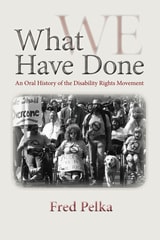
What We Have Done
An Oral History of the Disability Rights MovementFred Pelka
University of Massachusetts Press, 2012
“Nothing about us without us” has been a core principle of American disability rights activists for more than half a century. It represents a response by people with disabilities to being treated with scorn and abuse or as objects of pity, and to having the most fundamental decisions relating to their lives—where they would live; if and how they would be educated; if they would be allowed to marry or have families; indeed, if they would be permitted to live at all—made by those who were, in the parlance of the movement, “temporarily able-bodied.”
In What We Have Done: An Oral History of the Disability Rights Movement, Fred Pelka takes that slogan at face value. He presents the voices of disability rights activists who, in the period from 1950 to 1990, transformed how society views people with disabilities, and recounts how the various streams of the movement came together to push through the Americans with Disabilities Act of 1990, the most sweeping civil rights legislation since passage of the Civil Rights Act of 1964. Beginning with the stories of those who grew up with disabilities in the 1940s and '50s, the book traces how disability came to be seen as a political issue, and how people with disabilities—often isolated, institutionalized, and marginalized—forged a movement analogous to the civil rights, women's rights, and gay rights movements, and fought for full and equal participation in American society.
What Women Want
Gender and Voting in Britain, Japan and the United StatesGill Steel
University of Michigan Press, 2022
What Women Want analyzes decades of voting preferences, values, and policy preferences to debunk some of the media and academic myths about gender gaps in voting and policy preferences. Findings show that no single theory explains when differences in women’s and men’s voting preferences emerge, when they do not, or when changes—or the lack thereof—occur over time. Steel extends existing theories to create a broader framework for thinking about gender and voting behavior to provide more analytical purchase in understanding gender and its varying effects on individual voters’ preferences. She incorporates the long-term effects of party identification and class politics on political decision-making, particularly in how they influence preferences on social provision and on expectations of the state. She also points to the importance of symbolic politics
What Work Is
Robert Bruno
University of Illinois Press, 2024
For more than twenty years, Robert Bruno has taught labor history and labor studies to union members from a wide range of occupations and demographic groups. In the class, he asked his students to finish the question “Work is—?” in six words or less. The thousands of responses he collected provide some of the rich source material behind What Work Is. Bruno draws on the thoughts and feelings experienced by workers in the present day to analyze how we might design a future of work. He breaks down perceptions of work into five categories: work and time; the space workers occupy; the impact of work on our lives; the sense of purpose that motivates workers; and the people we work for, in all senses of the term.
Far-seeing and sympathetic, What Work Is merges personal experiences with research, poetry, and other diverse sources to illuminate workers’ lives in the present and envision what work could be in the future.
What Workers Say
Decades of Struggle and How to Make Real Opportunity NowRoberta Rehner Iversen
Temple University Press, 2022
What have jobs really been like for the past 40 years and what do the workers themselves say about them? In What Workers Say, Roberta Iversen shows that for employees in labor market industries—like manufacturing, construction, printing—as well as those in service-producing jobs, like clerical work, healthcare, food service, retail, and automotive—jobs are often discriminatory, are sometimes dangerous and exploitive, and seldom utilize people’s full range of capabilities. Most importantly, they fail to provide any real opportunity for advancement.
What Workers Say takes its cue from Studs Terkel’s Working, as Iversen interviewed more than 1,200 workers to present stories about their labor market jobs since 1980. She puts a human face on the experiences of a broad range of workers indicating what their jobs were and are truly like. Iversen reveals how transformations in the political economy of waged work have shrunk or eliminated opportunity for workers, families, communities, and productivity. What Workers Say also offers an innovative proposal for compensated civil labor that could enable workers, their communities, labor market organizations, and the national infrastructure to actually flourish.
What Works for Workers?
Public Policies and Innovative Strategies for Low-Wage WorkersStephanie Luce
Russell Sage Foundation, 2014
What a Book Can Do
The Publication and Reception of "Silent Spring"Priscilla Coit Murphy
University of Massachusetts Press, 2005
Murphy reviews the publishing history of the Houghton Mifflin edition and the prior New Yorker serialization, describing Carson's approach to her project as well as the views and expectations of her editors. She also documents the response of opponents to Carson's message, notably the powerful chemical industry, including efforts to undermine, delay, or stop publication altogether.
Murphy then investigates the media's role, showing that it went well beyond providing a forum for debate. In addition, she analyzes the perceptions and expectations of the public at large regarding the book, the debate, and the media. By probing all of these perspectives, Murphy sheds new light on the dynamic between newsmaking books, the media, and the public. In the process, she addresses a host of broader questions about the place of books in American culture, past, present, and future.
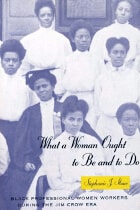
What a Woman Ought to Be and to Do
Black Professional Women Workers during the Jim Crow EraStephanie J. Shaw
University of Chicago Press, 1996
What a Woman Ought to Be and to Do brings to life a world in which African-American families, communities, and schools worked to encourage the self-confidence, individual initiative, and social responsibility of girls. Shaw shows us how, in a society that denied black women full professional status, these girls embraced and in turn defined an ideal of "socially responsible individualism" that balanced private and public sphere responsibilities. A collective portrait of character shaped in the toughest circumstances, this book is more than a study of the socialization of these women as children and the organization of their work as adults. It is also a study of leadership—of how African American communities gave their daughters the power to succeed in and change a hostile world.

What is European?
On Overcoming Colonial and Romantic Modes of ThoughtDag Nikolaus Hasse
Amsterdam University Press, 2025
The book promotes an inclusive vision of Europe that reflects its long history of multiethnic cities, offers a cultural home to a wider range of people across the continent, and extends attention and respect to other continents, thus laying a more respectful foundation for shaping the future together.
At the same time, Hasse demonstrates that overcoming colonial ways of thinking does not and should not result in anti-Europeanism. Criticising European arrogance may well go hand in hand with feeling culturally at home in other traditions of Europe. For this, it does not matter whether one is a resident of the European continent or not. There is no privileged access to European culture or to the culture of any other continent.

What is Modern Israel?
Yakov M. Rabkin
Pluto Press, 2016
Drawing on many overlooked pages of history, including English, French, Hebrew, Yiddish and Russian sources, Yakov Rabkin shows that Zionism was conceived as a sharp break with Judaism and Jewish continuity. Israel’s past and present must be seen in the context of European ethnic nationalism, colonial expansion and geopolitical interests, rather than as an incarnation of Biblical prophecies or a culmination of Jewish history.
What is Political Philosophy? And Other Studies
Leo Strauss
University of Chicago Press, 1988
What Is Political Philosophy?—a collection of ten essays and lectures and sixteen book reviews written between 1943 and 1957—contains some of Leo Strauss's most famous writings and some of his most explicit statements of the themes that made him famous. The title essay records Strauss's sole extended articulation of the meaning of political philosophy itself. Other essays discuss the relation of political philosophy to history, give an account of the political philosophy of the non-Christian Middle Ages and of classic European modernity, and present his theory of esoteric writing.

What the Anti-Federalists Were For
The Political Thought of the Opponents of the ConstitutionHerbert J. Storing
University of Chicago Press, 1981
Storing here offers a brilliant introduction to the thought and principles of the Anti-Federalists as they were understood by themselves and by other men and women of their time. His comprehensive exposition restores to our understanding the Anti-Federalist share in the founding its effect on some of the enduring themes and tensions of American political life. The concern with big government and infringement of personal liberty one finds in the writings of these neglected Founders strikes a remarkably timely note.

What's Fair on the Air?
Cold War Right-Wing Broadcasting and the Public InterestHeather Hendershot
University of Chicago Press, 2011
What's Left of the Left
Democrats and Social Democrats in Challenging TimesJames Cronin, George Ross, and James Shoch, eds.
Duke University Press, 2011
Contributors. Sheri Berman, James Cronin, Jean-Michel de Waele, Arthur Goldhammer, Christopher Howard, Jane Jenson, Gerassimos Moschonas, Sofia Pérez, Jonas Pontusson, George Ross, James Shoch, Sorina Soare, Ruy Teixeira
What's Queer about Queer Studies Now?, Volume 23
David L. Eng, Judith Halberstam and José Esteban Muñoz
Duke University Press, 0
In sixteen timely essays, the contributors map out an urgent intellectual and political terrain for queer studies and the contemporary politics of identity, family, and kinship. Collectively, these essays examine the limits of queer epistemology, the potentials of queer diasporas, and the emergence of queer liberalism. They rethink queer critique in relation to the war on terrorism and the escalation of U.S. imperialism; the devolution of civil rights and the rise of the prison-industrial complex; the continued dismantling of the welfare state; the recoding of freedom in terms of secularization, domesticity, and marriage; and the politics of citizenship, migration, and asylum in a putatively postracial and postidentity age.
Contributors. Michael Cobb, David L. Eng, Roderick A. Ferguson, Elizabeth Freeman, Gayatri Gopinath, Judith Halberstam, Janet R. Jakobsen, Joon Oluchi Lee, Martin F. Manalansan IV, José Esteban Muñoz, Tavia Nyong’o, Hiram Perez, Jasbir K. Puar, Chandan Reddy, Teemu Ruskola, Nayan Shah, Karen Tongson, Amy Villarejo
What's Wrong with Rights?
Social Movements, Law and Liberal ImaginationsRadha D'Souza
Pluto Press, 2018
How can these conflicting attitudes towards rights be reconciled? Radha D’Souza lays out the problem and the solution in this book, applying legal thought to human rights to bridge the gap between rights in the abstract and their institutional context. Through close looks at real struggles, D’Souza shows how the left around the world can develop new strategies and tactics to achieve the goals embodied by rights discourse without giving cover to globalization.
Whatever Happened to Antisemitism?
Redefinition and the Myth of the 'Collective Jew'Antony Lerman
Pluto Press, 2020
'This elegantly written, erudite book is essential reading for all of us, whatever our identifications' - Lynne Segal
Antisemitism is one of the most controversial topics of our time. The public, academics, journalists, activists and Jewish people themselves are divided over its meaning. Antony Lerman shows that this is a result of a 30-year process of redefinition of the phenomenon, casting Israel, problematically defined as the 'persecuted collective Jew', as one of its main targets.
This political project has taken the notion of the 'new antisemitism' and codified it in the flawed International Holocaust Remembrance Alliance's 'working definition' of antisemitism. This text is the glue holding together an international network comprising the Israeli government, pro-Israel advocacy groups, Zionist organizations, Jewish communal defence bodies and sympathetic governments fighting a war against those who would criticize Israel.
The consequences of this redefinition have been alarming, supressing free speech on Palestine/Israel, legitimizing Islamophobic right-wing forces, and politicizing principled opposition to antisemitism.
Whatever Happened to Antisemitism?
Redefinition and the Myth of the 'Collective Jew'Antony Lerman
Pluto Press, 2020
'This elegantly written, erudite book is essential reading for all of us, whatever our identifications' - Lynne Segal
Antisemitism is one of the most controversial topics of our time. The public, academics, journalists, activists and Jewish people themselves are divided over its meaning. Antony Lerman shows that this is a result of a 30-year process of redefinition of the phenomenon, casting Israel, problematically defined as the ‘persecuted collective Jew’, as one of its main targets.
This political project has taken the notion of the ‘new antisemitism’ and codified it in the flawed International Holocaust Remembrance Alliance’s ‘working definition’ of antisemitism. This text is the glue holding together an international network comprising the Israeli government, pro-Israel advocacy groups, Zionist organizations, Jewish communal defence bodies and sympathetic governments fighting a war against those who would criticize Israel.
The consequences of this redefinition have been alarming, supressing free speech on Palestine/Israel, legitimizing Islamophobic right-wing forces, and politicizing principled opposition to antisemitism.
Whatever Happened to Party Government?
Controversies in American Political ScienceMark Wickham-Jones
University of Michigan Press, 2018
In 1950, the Committee on Political Parties of the American Political Science Association (APSA) published its much-anticipated report, Toward a More Responsible Two-Party System. Highly critical of the existing state of affairs, the report became extremely controversial: before publication, scholars attacked the committee’s draft and suggested it should be suppressed. When released it received a barrage of criticisms. Most academics concluded it was an ill-conceived and mistaken initiative.
Mark Wickham-Jones provides the first full, archival-based assessment of the arguments within APSA about political parties and the 1950 report. He details the report’s failure to generate wider discussion between media, politicians, and the White House. He examines whether it was dominated by a dogmatic attachment to “party government,” and charts the relationship between behavioralists and institutionalists. He also discusses the political dimension to research during the McCarthyite years, and reflects on the nature of American political science in the years after 1945, the period in which behavioralism (which privileges the influence of individuals over institutions) became dominant.
Detailing APSA’s most direct and significant intervention in the political process, Wickham-Jones makes an important contribution to debates that remain in the forefront of discussions about American politics.
Wheeling's Polonia
Reconstructing Polish Community in a West Virginia Steel TownWilliam Hal Gorby
West Virginia University Press, 2020
Wheeling was a center of West Virginia’s labor movement, and Polish immigrants became a crucial element within the city’s active working-class culture. Arriving at what was also the center of the state’s Roman Catholic Diocese, Poles built religious and fraternal institutions to support new arrivals and to seek solace in times of economic strain and family hardship. The city’s history of crime and organized vice also affected new immigrants, who often lived in neighborhoods targeted for selective enforcement of Prohibition.
At once a deeply textured evocation of the city’s ethnic institutions and an engagement with larger questions about belonging, change, and justice, Wheeling’s Polonia is an inspiring account of a diverse working-class culture and the immigrants who built it.
When Are You Coming Home?
How Young Children Cope When Parents Go to JailHilary Cuthrell
Rutgers University Press, 2023
When Bad Things Happen to Privileged People
Race, Gender, and What Makes a Crisis in AmericaDara Z. Strolovitch
University of Chicago Press, 2023
A deep and thought-provoking examination of crisis politics and their implications for power and marginalization in the United States.
From the climate crisis to the opioid crisis to the Coronavirus crisis, the language of crisis is everywhere around us and ubiquitous in contemporary American politics and policymaking. But for every problem that political actors describe as a crisis, there are myriad other equally serious ones that are not described in this way. Why has the term crisis been associated with some problems but not others? What has crisis come to mean, and what work does it do?
In When Bad Things Happen to Privileged People, Dara Z. Strolovitch brings a critical eye to the taken-for-granted political vernacular of crisis. Using systematic analyses to trace the evolution of the use of the term crisis by both political elites and outsiders, Strolovitch unpacks the idea of “crisis” in contemporary politics and demonstrates that crisis is itself an operation of politics. She shows that racial justice activists innovated the language of crisis in an effort to transform racism from something understood as natural and intractable and to cast it instead as a policy problem that could be remedied. Dominant political actors later seized on the language of crisis to compel the use of state power, but often in ways that compounded rather than alleviated inequality and injustice. In this eye-opening and important book, Strolovitch demonstrates that understanding crisis politics is key to understanding the politics of racial, gender, and class inequalities in the early twenty-first century.
When Bad Things Happen to Privileged People
Race, Gender, and What Makes a Crisis in AmericaDara Z. Strolovitch
University of Chicago Press, 2023
A deep and thought-provoking examination of crisis politics and their implications for power and marginalization in the United States.
From the climate crisis to the opioid crisis to the Coronavirus crisis, the language of crisis is everywhere around us and ubiquitous in contemporary American politics and policymaking. But for every problem that political actors describe as a crisis, there are myriad other equally serious ones that are not described in this way. Why has the term crisis been associated with some problems but not others? What has crisis come to mean, and what work does it do?
In When Bad Things Happen to Privileged People, Dara Z. Strolovitch brings a critical eye to the taken-for-granted political vernacular of crisis. Using systematic analyses to trace the evolution of the use of the term crisis by both political elites and outsiders, Strolovitch unpacks the idea of “crisis” in contemporary politics and demonstrates that crisis is itself an operation of politics. She shows that racial justice activists innovated the language of crisis in an effort to transform racism from something understood as natural and intractable and to cast it instead as a policy problem that could be remedied. Dominant political actors later seized on the language of crisis to compel the use of state power, but often in ways that compounded rather than alleviated inequality and injustice. In this eye-opening and important book, Strolovitch demonstrates that understanding crisis politics is key to understanding the politics of racial, gender, and class inequalities in the early twenty-first century.
When Courts and Congress Collide
The Struggle for Control of America's Judicial SystemCharles Gardner Geyh
University of Michigan Press, 2009
"This is quite simply the best study of judicial independence that I have ever read; it is erudite, historically aware, and politically astute."
-Malcolm M. Feeley, Claire Sanders Clements Dean's Professor, Boalt Hall School of Law, University of California at Berkeley
"Professor Geyh has written a wise and timely book that is informed by the author's broad and deep experience working with the judicial and legislative branches, by the insights of law, history and political science, and by an appreciation of theory and common sense."
-Stephen B. Burbank, David Berger Professor for the Administration of Justice, University of Pennsylvania Law School
With Congress threatening to "go nuclear" over judicial appointments, and lawmakers accusing judges of being "arrogant, out of control, and unaccountable," many pundits see a dim future for the autonomy of America's courts. But do we really understand the balance between judicial independence and Congress's desire to limit judicial reach? Charles Geyh's When Courts and Congress Collide is the most sweeping study of this question to date, and an unprecedented analysis of the relationship between Congress and our federal courts.
Efforts to check the power of the courts have come and gone throughout American history, from the Jeffersonian Congress's struggle to undo the work of the Federalists, to FDR's campaign to pack the Supreme Court, to the epic Senate battles over the Bork and Thomas nominations. If legislators were solely concerned with curbing the courts, Geyh suggests, they would use direct means, such as impeaching uncooperative judges, gerrymandering their jurisdictions, stripping the bench's oversight powers, or slashing judicial budgets. Yet, while Congress has long been willing to influence judicial decision-making indirectly by blocking the appointments of ideologically unacceptable nominees, it has, with only rare exceptions, resisted employing more direct methods of control. When Courts and Congress Collide is the first work to demonstrate that this balance is governed by a "dynamic equilibrium": a constant give-and-take between Congress's desire to control the judiciary and its respect for historical norms of judicial independence.
It is this dynamic equilibrium, Geyh says, rather than what the Supreme Court or the Constitution says about the separation of powers, that defines the limits of the judiciary's independence. When Courts and Congress Collide is a groundbreaking work, requiring all of us to consider whether we are on the verge of radically disrupting our historic balance of governance.
Charles Gardner Geyh is Professor of Law and Charles L. Whistler Faculty Fellow at Indiana University at Bloomington. He has served as director of the American Judicature Society's Center for Judicial Independence, reporter to the American Bar Association Commission on Separation of Powers and Judicial Independence, and counsel to the Judiciary Committee of the U.S. House of Representatives.
When Democrats Won the Heartland
Progressive Populism in the Age of Reagan, 1978-1992Cory Haala
University of Illinois Press, 2026
This left-oriented movement resurrected the imagery and policies of twentieth-century radical parties like the Minnesota Farmer-Labor Party and Robert La Follette’s Wisconsin Idea. Delving into progressive populist ideas and tactics, Haala illuminates the work of the activists and politicians who led protests, founded a congressional caucus, and backed presidential campaigns that sought to advance their cause. Haala’s account moves from Iron Range union halls to Iowa farmhouses to South Dakota reservations to revise views of Democratic Party history, the Midwest’s political culture, and populism’s role in US politics.
A counter to established political narratives, When Democrats Won the Heartland takes readers into the history of an unexpected political moment.
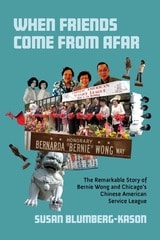
When Friends Come From Afar
The Remarkable Story of Bernie Wong and Chicago's Chinese American Service LeagueSusan Blumberg-Kason
University of Illinois Press, 2024
At once intimate and broad in scope, When Friends Come from Afar uses one woman’s life to illuminate a bedrock Chicago institution.
When Good Jobs Go Bad
Globalization, De-unionization, and Declining Job Quality in the North American Auto IndustryRothstein, Jeffrey S
Rutgers University Press, 2016
When History Is A Nightmare
Lives and Memories of Ethnic Cleansing in Bosnia-HerzegovinaStevan M. Weine, M.D.
Rutgers University Press, 1999
Weine investigates the survivors’ attempts to reconcile the contrasting, collective memories of having lived in a smoothly functioning, multiethnic society with the later memories of the ethnic atrocities. He discusses the little-known group concept of merhamet. Denoting compassion, forgiveness, and charity, merhamet was a critical cultural value for the Bosnian Muslims.
Weine also explores how ethnic cleansing was justified from the vantage point of psychiatrists who played prominent roles in instigating the horrors. He also provides personal portraits of leaders such as Jovan Raskovic and Radovan Karadzic. He concludes by describing the recovery efforts of survivors—how they work to confront the destructive nature of their memories while trying to bring about healing, both individually and collectively.
When I Look into the Mirror and See You
Women, Terror, and ResistanceMargaret Randall
Rutgers University Press, 2002
In the early 1980s, in the midst of Central America’s decades of dirty wars, Nora Miselem of Honduras and Maria Suárez Toro of Costa Rica were kidnapped and subjected to rape and other tortures. Of the nearly two hundred disappeared persons in Honduras in those years, they are, remarkably, two of only five survivors. Fourteen years after their ordeal, Suárez and Miselem’s chance meeting at a conference on human rights was witnessed by and is now retold in Margaret Randall’s When I Look into the Mirror andSee You.
Through direct testimony, vivid prose, and evocative photographs, Randall recounts the terror, resistance, and survival of Suárez and Miselem. The book details the abuses suffered by them, the ruses they used to foil their captors, the support that they gave each other while imprisoned, the means they used to escape, and their attempts to reconstruct their lives. For the first time, Suárez and Miselem explore the pain and trauma of their past and Randall has done the service of adding these remarkable voices to the global campaign to bring the world’s attention to women’s human rights.
When Informal Institutions Change
Institutional Reforms and Informal Practices in the Former Soviet UnionHuseyn Aliyev
University of Michigan Press, 2017
When Informal Institutions Change engages with a growing body of literature on informal practices and institutions in political science, economics, sociology, and beyond. Aliyev proposes expanding the analysis of the impact of institutional reforms on informal institutions beyond disciplinary boundaries, and combines theoretical insights from comparative politics with economic and social theories on informal relations. In addition, Aliyev offers insights that are relevant to democratization, institutionalism, and human geography. Detailed case studies of three transitional post-Soviet regimes—Georgia, Moldova, and Ukraine—illustrate the contentious relationship between democratic institutional reforms and informality in the broader post-Soviet context.
Aliyev shows that in order for institutional reform to succeed in strengthening, democratizing, and formalizing institutions, it is important to approach informal practices and institutions as instrumental for its effectiveness. These findings have implications not only for hybrid regimes, but also for other post-Soviet or post-communist countries.
When Markets Fail
Social Policy and Economic ReformEthan B. Kapstein
Russell Sage Foundation, 2002

When Peace Is Not Enough
How the Israeli Peace Camp Thinks about Religion, Nationalism, and JusticeAtalia Omer
University of Chicago Press, 2013
When Protest Makes Policy
How Social Movements Represent Disadvantaged GroupsS. Laurel Weldon
University of Michigan Press, 2012
"A must-read for scholars across a broad sweep of disciplines. Laurel Weldon weaves together skillfully the theoretical strands of gender equality policy, intersectionality, social movements, and representation in a multimethod/level comparative study that unequivocally places women's movements at the center of our understanding of democracy and social change."
---Amy G. Mazur, Washington State University
"Laurel Weldon's When Protest Makes Policy expands and enriches our understanding of representation by stressing social movements as a primary avenue for the representation of marginalized groups. With powerful theory backed by persuasive analysis, it is a must-read for anyone interested in democracy and the representation of marginalized groups."
---Pamela Paxton, University of Texas at Austin
"This is a bold and exciting book. There are many fine scholars who look at women's movements, political theorists who make claims about democracy, and policy analysts who do longitudinal treatments or cross-sectional evaluations of various policies. I know of no one, aside from Weldon, who is comfortable with all three of these roles."
---David Meyer, University of California, Irvine
What role do social movements play in a democracy? Political theorist S. Laurel Weldon demonstrates that social movements provide a hitherto unrecognized form of democratic representation, and thus offer a significant potential for deepening democracy and overcoming social conflict.
Through a series of case studies of movements conducted by women, women of color, and workers in the United States and other member nations of the Organisation for Economic Co-operation and Development (OECD), Weldon examines processes of representation at the local, state, and national levels. She concludes that, for systematically disadvantaged groups, social movements can be as important---sometimes more important---for the effective articulation of a group perspective as political parties, interest groups, or the physical presence of group members in legislatures.
When Protest Makes Policy contributes to the emerging scholarship on civil society as well as the traditional scholarship on representation. It will be of interest to anyone concerned with advancing social cohesion and deepening democracy and inclusion as well as those concerned with advancing equality for women, ethnic and racial minorities, the working class, and poor people.
S. Laurel Weldon is Professor of Political Science at Purdue University.
When Riot Cops Are Not Enough
The Policing and Repression of Occupy OaklandKing, Mike
Rutgers University Press, 2017
Drawn from King’s intensive field work, the book focuses on the physical, legal, political, and ideological dimensions of repression—in the streets, in courtrooms, in the media, in city hall, and within the movement itself—When Riot Cops Are Not Enough highlights the central role of political legitimacy, both for mass movements seeking to create social change, as well as for governmental forces seeking to control such movements. Although Occupy Oakland was different from other Occupy sites in many respects, King shows how the contradictions it illuminated within both social movement and police strategies provide deep insights into the nature of protest policing generally, and a clear map to understanding the full range of social control techniques used in North America in the twenty-first century.
When Roosevelt Planned to Govern France
Charles L. Robertson
University of Massachusetts Press, 2011
This book tells the story of a plan put forth by President Franklin Roosevelt during World War II for an Allied military occupation of France in the aftermath of liberation, and of General Charles de Gaulle's efforts as self-appointed leader of the Free French Movement to thwart FDR's intentions. Charles L. Robertson frames the narrative as a mystery in which he plays the role of detective. He begins at a dinner party thirty years ago, where he first learned of the alleged plan from an elderly former aide to de Gaulle. Yet it wasn't until 2004, when he heard the same story repeated during the 60th commemoration of D-Day, that he set out to investigate whether it was true.
Many French are aware of this episode and believe, on the basis of later Gaullist officials' writings, that until the last moment a military occupation of their country was imminent. This view, across the years, has helped darken relations between France and the United States. Yet few if any Americans have ever heard of this plan, and in the event, no Allied military government of France was ever established.
How and why it never came to be, and why the French still believe it almost did, is the subject of this book. Robertson recounts how the president of the most powerful nation in the world was outmaneuvered in both his earlier plans for an occupation of France and his subsequent attempts to keep General de Gaulle from “seizing” power—in a France that ultimately, despite Roosevelt's intentions and expectations, regained its place among the victorious powers under de Gaulle's leadership.

When Rules Change
The Economics of RetroactivityDaniel Shaviro
University of Chicago Press, 2000
Daniel Shaviro tackles these tough questions, bringing legal, economic, and political perspectives to bear on a persistent problem not often given serious attention. When Rules Change: An Economic and Political Analysis of Transition Relief and Retroactivity focuses on tax law changes to develop an in-depth understanding of the transitional issues inherent in any substantive rule change and also to advance a set of normative policy guidelines applicable to any such circumstance. Shaviro reframes traditional approaches to the problem of retroactivity and offers new insights into both the theory and policy of legislative transitions.
When States Kill
Latin America, the U.S., and Technologies of TerrorEdited by Cecilia Menjívar and Néstor Rodríguez
University of Texas Press, 2005
Since the early twentieth century, technological transfers from the United States to Latin American countries have involved technologies of violence for social control. As the chapters in this book illustrate, these technological transfers have taken various forms, including the training of Latin American military personnel in surveillance and torture and the provision of political and logistic support for campaigns of state terror. The human cost for Latin America has been enormous—thousands of Latin Americans have been murdered, disappeared, or tortured, and whole communities have been terrorized into silence.
Organized by region, the essays in this book address the topic of state-sponsored terrorism in a variety of ways. Most take the perspective that state-directed political violence is a modern development of a regional political structure in which U.S. political interests weigh heavily. Others acknowledge that Latin American states enthusiastically received U.S. support for their campaigns of terror. A few see local culture and history as key factors in the implementation of state campaigns of political violence. Together, all the essays exemplify how technologies of terror have been transferred among various Latin American countries, with particular attention to the role that the United States, as a "strong" state, has played in such transfers.
When Working Class Youth Dreamt in Red
Student Power and the Urban Guerrilla Experience in Mexico's Cold War, 1970–1982Fernando Herrera Calderón
University of Arizona Press, 2027
The 1970s in Mexico were turbulent from the start. Insurgent voices converged across cities and rural peripheries. Militant labor, urban popular sectors, and Indigenous collectives erupted in expressions of broad social exhaustion. Rebellion, rooted in the layered betrayals of the postrevolutionary state and the fractures of a deteriorating modernity under the Institutional Revolutionary Party (PRI), fermented and boiled over.
At the core of this moment, Mexican youth found their way to political-military organizations, coalescing around shared ecologies of dissent and embedded in broader currents of revolutionary struggle. When Working Class Youth Dreamt in Red reconstructs these insurgent youth cultures and guerrilla imaginaries, reorienting the historiographical lens to center radical working class youth—especially urban students—as protagonists in a wider saga of revolutionary experimentation and political rupture.
At its conceptual core, this book offers a bold new interpretation of a turbulent moment in Mexican history. It shows how class shaped the epistemic horizons through which proletarian youth understood themselves and makes visible their role as central actors at the vanguard of a revolutionary time.

When and Where They Enter
Black Women's Candidate Emergence at the State LevelJamil S. Scott-Cummings
University of Michigan Press, 2027
While Black women are often called the backbone of American democracy, their journeys to political office remain understudied. When and Where They Enter offers a way to develop our understanding of the women transforming American politics. By focusing on state-level elections, it explores what motivates Black women to run for public office, the biases they navigate in the public eye, and the structural factors that help or hinder their path to victory.
By deliberately departing from traditional, single-axis models of political ambition, Jamil Scott-Cummings frames candidate emergence through an explicit intersectional lens, treating Black women’s political agency as a dynamic interplay between psychological motivations, institutional factors, personal characteristics, and race-gender bias. She introduces a new conceptual model that challenges standard strategic entry theories: the intentional candidacy framework. Incorporating experiments, observational data, and elite interviews, When and Where They Enter offers robust empirical evidence of how race-gender identity shapes modern electoral supply. An essential read for voters, changemakers, and future leaders, the book offers a roadmap for understanding identity, power, and the future of political representation in America.
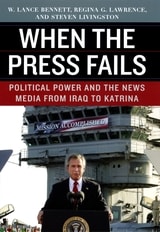
When the Press Fails
Political Power and the News Media from Iraq to KatrinaW. Lance Bennett, Regina G. Lawrence, and Steven Livingston
University of Chicago Press, 2007
“The hand-in-glove relationship of the U.S. media with the White House is mercilessly exposed in this determined and disheartening study that repeatedly reveals how the press has toed the official line at those moments when its independence was most needed.”—George Pendle, Financial Times
“Bennett, Lawrence, and Livingston are indisputably right about the news media’s dereliction in covering the administration’s campaign to take the nation to war against Iraq.”—Don Wycliff, Chicago Tribune
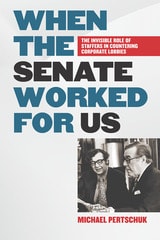
When the Senate Worked for Us
The Invisible Role of Staffers in Countering Corporate LobbiesMichael Pertschuk
Vanderbilt University Press, 2017
What has remained untold is the major behind-the-scenes contribution of entrepreneurial Congressional staff, who planted the seeds of public interest bills in their bosses' minds and maneuvered to counteract the influence of lobbyists to pass laws in consumer protection, public health, and other policy arenas crying out for effective government regulation. They infuriated Nixon's advisor, John Ehrlichman, who called them "bumblebees," a name they wore as a badge of honor.
For his insider account, Pertschuk draws on many interviews, as well as his fifteen years serving on the staff of the Senate Commerce Committee that Senator Warren Magnuson chaired and as the committee's Democratic Staff Director. That committee became, in Ralph Nader's words, "the Grand Central Station for consumer protection advocates."