Results by title
4038 books match the query 'Social aspects' and 161 start with w

Wrigley Regulars
Finding Community in the BleachersHolly Swyers
University of Illinois Press, 2010

Writing A Wider War
Rethinking Gender, Race, and Identity in the South African War, 1899–1902Greg Cuthbertson
Ohio University Press, 2002
Writing a Wider War presents a dramatically new interpretation of the role of Boer women in the conflict and profoundly changes how we look at the making of Afrikaner nationalism. African experiences of the war are also examined, highlighting racial subjugation in the context of colonial war and black participation, and showcasing important new research by African historians.
The collection includes a reassessment of British imperialism and probing essays on J. A. Hobson; the masculinist nature of life on commando among Boer soldiers; Anglo-Jewry; secularism; health and medicine; nursing, women, and disease in the concentration camps; and the rivalry between British politicians and generals. An examination of the importance of the South African War in contemporary British political economy, and the part played by imperial propaganda, rounds off a thoroughly groundbreaking reinterpretation of this formative event in South Africa's history.
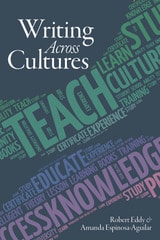
Writing Across Cultures
Robert Eddy
Utah State University Press, 2019
Robert Eddy and Amanda Espinosa-Aguilar offer a new framework for teaching that acknowledges the changing demographics of US college classrooms as the field of writing studies moves toward real equity and expanding diversity. Writing Across Cultures utilizes a streamlined cross-racial and interculturally tested method of introducing students to academic writing via sequenced assignments that are not confined by traditional and static approaches. They focus on helping students become engaged members of a new culture—namely, the rapidly changing collegiate discourse community. The book is based on a multi-racial rhetoric that assumes that writing is inherently a social activity. Students benefit most from seeing composing as an act of engaged communication, and this text uses student samples, not professionally authored ones, to demonstrate this framework in action.
Writing Across Cultures will be a significant contribution to the field, aiding teachers, students, and administrators in navigating the real challenges and wonderful opportunities of multi-racial learning spaces.
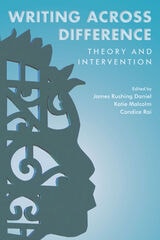
Writing Across Difference
Theory and InterventionJames Rushing Daniel
Utah State University Press, 2021
No text in composition has made such a sweeping attempt to place the multiple areas of translingualism, anti-racism, anticolonialism, interdisciplinarity, and disability into conversation or to represent the field as broadly unified around the concept of difference. The chapters in this book specifically explore how monolingual ideology is maintained in institutions and how translingual strategies can (re)include difference; how narrative-based interventions can promote writing across difference in classrooms and institutions by complicating dominant discourses; and how challenging dominant logics of class, race, ability, and disciplinarity can present opportunities for countering divisiveness.
Writing Across Difference offers writing scholars a sustained intellectual encounter with the crisis of difference and foregrounds the possibilities such an encounter offers for collective action toward a more inclusive and equitable society. It presents a variety of approaches for intervening in classrooms and institutions in the interest of focalizing, understanding, negotiating, and bridging difference. The book will be a valuable resource to those disturbed by the bigotry, violence, and fanaticism that mark our political culture and who are seeking inspiration, models, and methods for collective response.
Contributors: Anis Bawarshi, Jonathan Benda, Megan Callow, James Rushing Daniel, Cherice Escobar Jones, Laura Gonzales, Juan Guerra, Stephanie Kerschbaum, Katie Malcolm, Nadya Pittendrigh, Mya Poe, Candice Rai, Iris Ruiz, Ann Shivers-McNair, Neil Simpkins, Alison Y. L. Stephens, Sumyat Thu, Katherine Xue, Shui-yin Sharon Yam
Writing Centers and Racial Justice
A Guidebook for Critical PraxisTalisha Haltiwanger Morrison
Utah State University Press, 2023
In five thematically organized sections—Countering Racism and Colonialism in Higher Education; Recruitment, Hiring, and Retention; Tutor Education and Professional Development; Engaging with Campus and Community; and Holding Our Professional Organizations Accountable—scholars from a variety of institutions, both large and small, public and private, present critical reflection and concrete guidance on anti-racist writing center administrative policies and practices. Several chapters include sample materials, such as course syllabi, consultant education activities, and recruitment materials, to help current and aspiring writing center administrators implement changes in their own contexts.
Writing Centers and Racial Justice is the first book to offer clear and actionable advice on how writing centers and their staff can take up racial or social justice work that will result in real sustainable change. Writing center directors, professionals, and tutors, as well as administrators and decision makers at the institutional level, will benefit from this thoughtful and effective text.
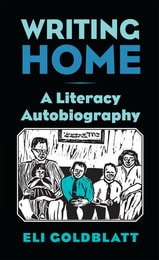
Writing Home
A Literacy AutobiographyEli Goldblatt
Southern Illinois University Press, 2012
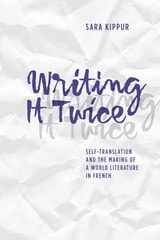
Writing It Twice
Self-Translation and the Making of a World Literature in FrenchSara Kippur
Northwestern University Press, 2015
Though the practice of self-translation long predates modernity, it has found new forms of expression in the global literary market of the late twentieth and early twenty-first century. The international renown of self-translating authors Samuel Beckett, Joseph Brodsky, and Vladimir Nabokov has offered motivation to a new generation of writers who actively translate themselves.
Intervening in recent debates in world literature and translation studies, Writing It Twice establishes the prominence and vitality of self-translation in contemporary French literature. Because of its intrinsic connection to multiple literary communities, self-translation prompts a reexamination of the aesthetics and politics of reading across national lines. Kippur argues that self-translated works should be understood as the paradigmatic example of world literature and, as such, crucial for interpreting the dynamics of literary circulation into and out of French.
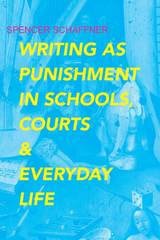
Writing as Punishment in Schools, Courts, and Everyday Life
Spencer Schaffner
University of Alabama Press, 2019
Writing tends to be characterized as a positive aspect of literacy that helps us to express our thoughts, to foster interpersonal communication, and to archive ideas. However, there is a vast array of evidence that emphasizes the counterbelief that writing has the power to punish, shame, humiliate, control, dehumanize, fetishize, and transform those who are subjected to it. In Writing as Punishment in Schools, Courts, and Everyday Life, Spencer Schaffner looks at many instances of writing as punishment, including forced tattooing, drunk shaming, court-ordered letters of apology, and social media shaming, with the aim of bringing understanding and recognition to the coupling of literacy and subjection.
Writing as Punishment in Schools, Courts, and Everyday Life is a fascinating inquiry into how sinister writing can truly be and directly questions the educational ideal that powerful writing is invariably a public good. While Schaffner does look at the darker side of writing, he neither vilifies nor supports the practice of writing as punishment. Rather, he investigates the question with humanistic inquiry and focuses on what can be learned from understanding the many strange ways that writing as punishment is used to accomplish fundamental objectives in everyday life.
Through five succinct case studies, we meet teachers, judges, parents, sex traffickers, and drunken partiers who have turned to writing because of its presumed power over writers and readers. Schaffner provides careful analysis of familiar punishments, such as schoolchildren copying lines, and more bizarre public rituals that result in ink-covered bodies and individuals forced to hold signs in public.
Schaffner argues that writing-based punishment should not be dismissed as benign or condemned as a misguided perversion of writing, but instead should be understood as an instrument capable of furthering both the aims of justice and degradation.
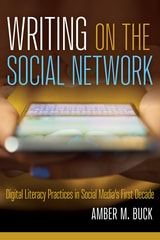
Writing on the Social Network
Digital Literacy Practices in Social Media's First DecadeAmber M. Buck
Utah State University Press, 2023
Through qualitative case study research, Buck explores how literate activities on social network sites coalesced around three areas crucial for writing in digital environments: (1) a heightened awareness of audience and an ability to tailor messages to specific audiences; (2) an understanding of how personal data is collected and circulated in online spaces; and (3) a means through which to use the first two skills for self-promotion and self-presentation in both personal and professional settings. She identifies several distinct literacy practices and strategies used by participants to communicate effectively and addresses how these strategies can help writing researchers and internet scholars understand the impact of social media’s first decade and can inform the ways they will research and understand social media’s second decade.
Social media platforms represent important locations where the different influences on writing become visible. Writing on the Social Network is a close study of the rich literate practices individuals have engaged in on social network sites over the last ten years that allows for a better understanding of the role social media plays in shaping digital literacy.
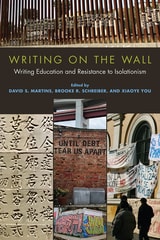
Writing on the Wall
Writing Education and Resistance to Isolationismedited by David S. Martins, Brooke R. Schreiber & Xiaoye You
Utah State University Press, 2022
The collection extends existing scholarship and research about the ways racist and colonial rhetorics impact writing education; the impact of translingual, transnational, and cosmopolitan ideologies on student learning and student writing; and the role international educational partnerships play in pushing back against isolationist ideologies. Established and early-career scholars who work in a broad range of institutional contexts highlight the historical connections among monolingualism, racism, and white nationalism and introduce community- and classroom-based practices that writing teachers use to resist isolationist beliefs and tendencies.
“Writing on the wall” serves as a metaphor for the creative, direct action writing education can provide and invokes border spaces as sites of identity expression, belonging, and resistance. The book connects transnational writing education with the fight for racial justice in the US and around the world and will be of significance to secondary and postsecondary writing teachers and graduate students in English, linguistics, composition, and literacy studies.
Contributors: Olga Aksakalova, Sara P. Alvarez, Brody Bluemel, Tuli Chatterji, Keith Gilyard, Joleen Hanson, Florianne Jimenez Perzan, Rebecca Lorimer Leonard, Layli Maria Miron, Tony D. Scott, Kate Vieira, Amy J. Wan

Writings on Media
History of the PresentStuart Hall
Duke University Press, 2021