Results by title
18284 books match the query 'United States' and 882 start with w
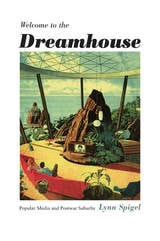
Welcome to the Dreamhouse
Popular Media and Postwar SuburbsLynn Spigel
Duke University Press, 2001
The volume considers not only how the media portrayed suburban family life, but also how both middle-class ideals and a perceived division between private and public worlds helped to shape the visual forms, storytelling practices, and reception of postwar media and consumer culture. Spigel also explores those aspects of suburban culture that media typically render invisible. She looks at the often unspoken assumptions about class, nation, ethnicity, race, and sexual orientation that underscored both media images (like those of 1960s space missions) and social policies of the mass-produced suburb. Issues of memory and nostalgia are central in the final section as Spigel considers how contemporary girls use television reruns as a source for women’s history and then analyzes the current nostalgia for baby boom era family ideals that runs through contemporary images of new household media technologies.
Containing some of Spigel’s well-known essays on television’s cultural history as well as new essays on a range of topics dealing with popular visual culture, Welcome to the Dreamhouse is important reading for students and scholars of media and communications studies, popular culture, American studies, women’s studies, and sociology.
Welcoming New Americans?
Local Governments and Immigrant IncorporationAbigail Fisher Williamson
University of Chicago Press, 2018
Abigail Fisher Williamson explores why and how local governments across the country are taking steps to accommodate immigrants, sometimes despite serious political opposition. Drawing on case studies of four new immigrant destinations—Lewiston, Maine; Wausau, Wisconsin; Elgin, Illinois; and Yakima, Washington—as well as a national survey of local government officials, she finds that local capacity and immigrant visibility influence whether local governments take action to respond to immigrants. State and federal policies and national political rhetoric shape officials’ framing of immigrants, thereby influencing how municipalities respond. Despite the devolution of federal immigration enforcement and the increasingly polarized national debate, local officials face on balance distinct legal and economic incentives to welcome immigrants that the public does not necessarily share. Officials’ efforts to promote incorporation can therefore result in backlash unless they carefully attend to both aiding immigrants and increasing public acceptance. Bringing her findings into the present, Williamson takes up the question of whether the current trend toward accommodation will continue given Trump’s anti-immigrant rhetoric and changes in federal immigration policy.
Welfare Discipline
Discourse, Governance and GlobalizationSanford F. Schram
Temple University Press, 2005
In Welfare Discipline, Schram argues that it is time to take stock of the new forms of welfare and to develop even better methods to understand them. He argues for a more contextualized approach to examining welfare policy, from the use of the idea of globalization to justify cutbacks, to the increasing employment of U.S. policy discourse overseas, to the development of asset-based approaches to helping the poor.
Stressing the importance of understanding the ways we talk about welfare, how we study it, and, critically, what we do not discuss and why, Schram offers recommendations for making welfare policy both just and effective.
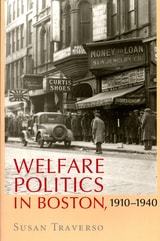
Welfare Politics in Boston, 1910-1940
Susan Traverso
University of Massachusetts Press, 2009
Between 1910 and 1940, Boston's growing immigrant population repeatedly clashed with the city's traditional elite over how to provide assistance to the needy. While Yankee politicians and the leaders of Protestant charities argued that relief should be delivered by private organizations, Irish politicians and officials at Catholic and Jewish charities advocated extensive public welfare programs. Competing views of gender roles further complicated these disagreements. The campaign for widows' pensions, for example, won wide popular support even as public welfare programs that would primarily benefit men-such as unemployment insurance and old age assistance-failed to gain acceptance.
In the 1920s, the debate over welfare shifted focus as prolonged periods of unemployment brought demands for aid to men who had lost their jobs, particularly those with families to support. Using the rhetoric of the Mothers' Aid campaign, Irish politicians broadened the idea of "acceptable dependency" to include men who needed jobs to provide for their own dependents. By lessening the stigma of male dependency on public welfare, these gendered arguments encouraged the expansion of public aid and set the stage for New Deal welfare programs of the 1930s. During that decade, Traverso contends, the idealized family headed by a male breadwinner became the basis for a shared vision of gender relations that mediated the political and ethnic debate over welfare policy.
Welfare Reform and Political Theory
Lawrence M. Mead
Russell Sage Foundation, 2005
Welfare in America
How Social Science Fails the PoorWilliam M. Epstein
University of Wisconsin Press, 1997
William M. Epstein charges that most current social welfare programs are not held to credible standards in their design or their results. Rather than spending less on such research and programs, however, Epstein suggests we should spend much more, and do the job right.
The American public and policymakers need to rely on social science research for objective, credible information when trying to solve problems of employment, affordable housing, effective health care, and family integrity. But, Epstein contends, politicians treat welfare issues as ideological battlegrounds; they demand immediate results from questionable data and implement policies long before social researchers can complete their analyses. Social scientists often play into the political agenda, supporting poorly conceived programs and doing little to test and revise them. Analyzing Aid to Families with Dependent Children (AFDC) and the recent welfare reform act, Food Stamps, Medicaid, job training, social services, and other programs, Epstein systematically challenges the conservative’s vain hope that neglect is therapeutic for the poor, as well as the liberal’s conceit that a little bit of assistance is sufficient.
Well Satisfied with My Position
The Civil War Journal of Spencer BonsallEdited by Michael A. Flannery and Katherine H. Oomens
Southern Illinois University Press, 2007
Well Satisfied with My Position offers a first-person account of army life during the Civil War’s Peninsula Campaign and Battle of Fredericksburg. Spencer Bonsall, who joined the 81st Pennsylvania Infantry as a hospital steward, kept a journal from March 1862 until March 1863, when he abruptly ceased writing. Editors Michael A. Flannery and Katherine H. Oomens place his experiences in the context of the field of Civil War medicine and continue his story in an epilogue.
Trained as a druggist when he was in his early twenties, Bonsall traveled the world, spent eight years on a tea plantation in India, and settled in Philadelphia, where he worked in the city surveyor’s office. But in March 1862, when he was in his mid-forties, the lure of serving his country on the battlefield led Bonsall to join the 81st Pennsylvania Infantry as a hospital steward.
Bonsall enjoyed his life with the Union army at first, comparing bivouacking in the woods to merely picnicking on a grand scale. “We are about as jolly a set of old bachelors as can be found in Virginia,” Bonsall wrote. But his first taste of the aftermath of battle at Fair Oaks and the Seven Days’ Battles in Virginia changed his mind about the joys of soldiering—though he never lost his zeal for the Union cause.
Bonsall details the camp life of a soldier from firsthand experience, outlines the engagements of the 81st, and traces the Battle of Fredericksburg and the Peninsula Campaign. He records facts not available elsewhere about camp conditions, attitudes toward Union generals and Confederate soldiers, and troop movements.
From the end of June to late October 1862, Bonsall’s illness kept him from writing in his journal. He picked up the record again in December 1862, just before the Battle of Fredericksburg, Virginia, in which the Union suffered a staggering 10,200 casualties and the 81st Pennsylvania lost more than half its men. He vividly describes the bloody aftermath. Bonsall’s horse was shot out from underneath him at the battle of Gettysburg, injuring him seriously and ending his military career. Although he was listed as “sick in hospital” on the regiment’s muster rolls, he was labeled a deserter in the U.S. Army records. Indeed, after recovery from his injuries, Bonsall walked away from the army to resume life in Philadelphia with his wife and child.
Published for the first time, Bonsall’s journal offers an unusually personal glimpse into the circumstances and motives of a man physically ruined by the war. Seventeen illustrations, including some drawn by Bonsall himself, help bring this narrative to life.
Well Worth Saving
How the New Deal Safeguarded Home OwnershipPrice Fishback, Jonathan Rose, and Kenneth Snowden
University of Chicago Press, 2013
Well Worth Saving tells the story of the disastrous housing market during the Great Depression and the extent to which an immensely popular New Deal relief program, the Home Owners’ Loan Corporation (HOLC), was able to stem foreclosures by buying distressed mortgages from lenders and refinancing them. Drawing on historical records and modern statistical tools, Price Fishback, Jonathan Rose, and Kenneth Snowden investigate important unanswered questions to provide an unparalleled view of the mortgage loan industry throughout the 1920s and early ’30s. Combining this with the stories of those involved, the book offers a clear understanding of the HOLC within the context of the housing market in which it operated, including an examination of how the incentives and behaviors at play throughout the crisis influenced the effectiveness of policy.
More than eighty years after the start of the Great Depression, when politicians have called for similar programs to quell the current mortgage crisis, this accessible account of the Home Owners’ Loan Corporation holds invaluable lessons for our own time.
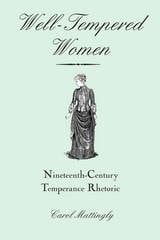
Well-Tempered Women
Nineteenth-Century Temperance RhetoricCarol Mattingly
Southern Illinois University Press, 2000
In this richly illustrated study, Carol Mattingly examines the rhetoric of the temperance movement, the largest political movement of women in the nineteenth century.
Tapping previously unexplored sources, Mattingly uncovers new voices and different perspectives, thus greatly expanding our knowledge of temperance women in particular and of nineteenth-century women and women's rhetoric in general. Her scope is broad: she looks at temperance fiction, newspaper accounts of meetings and speeches, autobiographical and biographical accounts, and minutes of national and state temperance meetings.
The women's temperance movement was first and foremost an effort by women to improve the lives of women. Twentieth-centuty scholars often dismiss temperance women as conservative and complicit in their own oppression. As Mattingly demonstrate, however, the opposite is true: temperance women made purposeful rhetorical choices in their efforts to improve the lives of women. They carefully considered the life circumstances of all women and sought to raise consciousness and achieve reform in an effective manner. And they were effective, gaining legal, political, and social improvements for women as they became the most influential and most successful group of women reformers in the nineteenth and early twentieth centuries.
Mattingly finds that, for a large number of women who were unhappy with their status in the nineteenth century, the temperance movement provided an avenue for change. Examining the choices these women made in their efforts to better conditions for women, Mattingly looks first at oral rhetoric among nineteenth-century temperance women. She examines the early temperance speeches of activists like Susan B. Anthony and Elizabeth Cady Stanton, who later chose to concentrate their effort in the suffrage organizations, and those who continued to work on behalf of women primarily through the temperance topic, such as Amelia Bloomer and Clarina Howard Nichols. Finally, she examines the rhetoric of members of the Woman’s Christian Temperance Union—the largest organization of women in the nineteenth century.
Mattingly then turns to the rhetoric from perspectives outside those of mainstream, middle-class women. She focuses on racial conflicts and alliances as an increasingly diverse membership threatened the unity and harmony in the WCTU. Her primary source for this discussion is contemporary newspaper accounts of temperance speeches.
Fiction by temperance writers also proves to be a fertile source for Mattingly's investigation. Insisting on greater equality between men and women, this fiction candidly portrayed injustice toward women. Through the temperance issue, Mattingly discovers, women could broach otherwise clandestine topics openly. She also finds that many of the concerns of nineteenth-century temperance women are remarkably similar to concerns of today’s feminists.
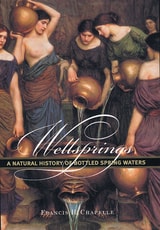
Wellsprings
A Natural History of Bottled Spring WatersChapelle, Francis H.
Rutgers University Press, 2005
As Francis H. Chapelle reveals in this delightful and informative volume, a complex story of geology, hydrology, and history lies behind every bottle of spring water. The book chronicles the history of the bottled water industry in America from its beginnings in Europe hundreds of years ago to the present day. Subsequent chapters describe the chemical characteristics that make some waters desirable, and provide an overview of the geologic circumstances that produce them. Wellsprings explains how these geologic conditions vary throughout the country, and how this affects the kinds and quality of bottled water that are available. Finally, Chapelle shows how the bottled water industry uses this natural history, together with the perceived health benefits of spring waters, to market their products.
Accessibly written and well illustrated, Wellsprings is both a revealing account and a user’s guide to natural spring waters. Regardless of your drinking preference, this timely exploration will make your next drink of water refreshingly informed.
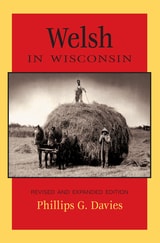
Welsh in Wisconsin
Phillips G. Davies
Wisconsin Historical Society Press, 2006
Between 1840 and 1890, many Welsh looked to Wisconsin for relief where they could purchase inexpensive, productive land. With large Welsh landowners controlling most of the arable land in Wales and Corn Laws, which prohibited importation of cheap food, domestic food prices increased dramatically and left the typical tenant-farming family with fields full of grain but empty cupboards. Once in Wisconsin, the newcomers kept to themselves, maintained their native language and national traditions and worshipped together in close-knit communities.
This addition to the People of Wisconsin series weaves period letters from the Owen family and Private John Jones, who served in the Union army in the Civil War, into the narration. Welsh in Wisconsin also contains anecdotes from early immigrant life and photographs depicting Welsh churches in Wisconsin.
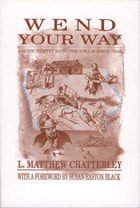
Wend Your Way
A Guide To Sites Along The Iowa Mormon TrailL. Matthew Chatterley
University of Iowa Press, 2007
Wend Your Way: A Guide to Sites Along the Mormon Trail tells the story of this great movement through Iowa. Tracing the trail from east to west through 12 counties the guide includes:
• Mormon Trail history for each county•Directs visitors to the 27 interpretive roadside panels that were constructed on the trail by U.S. National Park Service and Iowa Mormon Trails Association
•Reproduces the poignant illustrations that author L. Matthew Chatterley drew for these wayside exhibits
•Provides a map and directions by county to guide travelers to the route of the Mormon Trail, sites of Mormon camps and settlements and the interpretive roadside panels
•Lists other locations in southern Iowa that visitors will want to explore

Wendell Castle Remastered
Wendell Castle
The Artist Book Foundation, 2015
Wendell Castle (1932–2018), master furniture maker, designer, sculptor, and educator, was in the sixth decade of his extraordinary creativity when an emblematic exhibition of his signature works was mounted by the Museum of Art and Design in 2016. It blended the artist's seminal works with his latest collection, produced with digital technology. In part a self-reflection, this eponymous, full-color companion book examines some of Castle's historically representative works as well as significant contemporary furniture pieces, continuing his highly respected and acclaimed sculptural/functional dialogue. Castle, ever the innovator, was remarkable for his openness to new technologies; he not only embraced an initially complex practice but has "remastered" it. His vast oeuvre represents a prodigious lifework that began in 1958 and aligns with the development of the American art furniture movement.
The solo exhibition was a somewhat self-reflective examination of his early ground-breaking works that tested the boundaries of traditional furniture making by presenting his later innovations using new digital technologies such as 3D scanning and modeling, and computer-controlled milling—a digital "remastering" of his immense oeuvre. Unique perspectives on the master's work are presented by informative essays by authors well-versed on Castle's celebrated career.
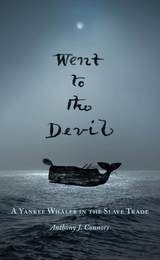
Went to the Devil
A Yankee Whaler in the Slave TradeAnthony J. Connors
University of Massachusetts Press, 2019
In this riveting biography, Anthony J. Connors explores this question by detailing not only the troubled, adventurous life of this man but also the turbulent times in which he lived. Set in an era of social and political fragmentation and impending civil war, when changes in maritime law and the economics of whaling emboldened slaving agents to target captains and their vessels for the illicit trade, Davoll's story reveals the deadly combination of greed and racial antipathy that encouraged otherwise principled Americans to participate in the African slave trade.
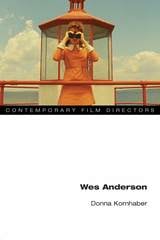
Wes Anderson
Donna Kornhaber
University of Illinois Press, 2017
Donna Kornhaber approaches Anderson's style as the necessary product of the narrative and thematic concerns that define his body of work. Using Anderson's focus on collecting, Kornhaber situates the director as the curator of his filmic worlds, a prime mover who artfully and conscientiously arranges diverse components into cohesive collections and taxonomies. Anderson peoples each mise-en-scéne in his ongoing ""Wesworld"" with characters orphaned, lost, and out of place amidst a riot of handmade clutter and relics. Within, they seek a wholeness and collective identity they manifestly lack, with their pain expressed via an ordered emotional palette that, despite being muted, cries out for attention. As Kornhaber shows, Anderson's films offer nothing less than a fascinating study in the sensation of belonging--told by characters who possess it the least.
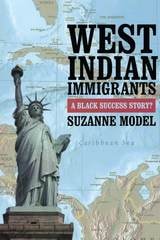
West Indian Immigrants
A Black Success Story?Suzanne Model
Russell Sage Foundation, 2008
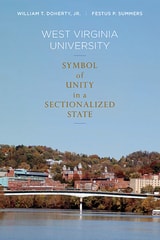
West Virginia University
Symbol of Unity in a Sectionalized StateWilliam T. Doherty, Jr
West Virginia University Press, 2013
West Virginia and the Captains of Industry
John A. Williams
West Virginia University Press, 2003
The first period of the twentieth century - that stretch of years beginning in the 1870s and ending with the United States' entry into World War I - is known as the Gilded Age. This was the era of the "Robber Barons" and the origin of modern America. These were the years in which developments in coal, steam, oil, and gas forged our national infrastructure. West Virginia and the Captains of Industry show how the excesses of the Gilded Age and the latitude our government accorded industrialists of the time created an impact on the fragile economy of our new state that accounts for much of the political and economic landscape of modern West Virginia. Gracefully written and thoroughly researched, West Virginia and the Captains of Industry has become a classic work of West Virginia history since its first publication by the West Virginia University Press in 1975. Anyone interested in the history of our state must read this revised edition; then again, so must anyone interested in the future of West Virginia.
West Virginia's War
The Civil War in DocumentsWilliam Kerrigan
Ohio University Press, 2025
This book explores the unique history of West Virginia, the only state born out of the Civil War. Western Virginians faced a dual crisis of allegiance and identity, torn between their historical ties to the secessionist state of Virginia and their loyalty to the Union. The population included a significant number of enslaved people, for whom the conflict’s outcome would have major consequences. Many Civil War narratives focus on major battles, but William Kerrigan shifts attention to the civilians of Western Virginia—both free and enslaved—who endured military occupation, raids, and guerrilla warfare. Civilians faced loyalty oaths, arrests, property destruction, and invasions by soldiers and partisans from both sides. Enslaved individuals played an active role, providing intelligence and assistance to Union forces and risking their lives for their freedom. At the same time, political leaders grappled with complex legal and political questions, first rejecting secession from the Union and subsequently pursuing their own secession from Virginia to form the new state of West Virginia. Their challenges included framing a new government, defining the state’s borders, addressing the future of slavery, and securing federal recognition. Postwar reconstruction in West Virginia presented its own challenges, distinct from those of other border states, as the return of defeated Confederates threatened the stability of the new state. The book highlights how the experiences of Western Virginia’s noncombatants, political leaders, and enslaved people contributed to the region’s turbulent transformation during and after the Civil War.
West Virginia
A HistoryJohn A. Williams
West Virginia University Press, 2003
John Alexander Williams's West Virginia: A History is widely considered one of the finest books ever written about our state. In his clear, eminently readable style, Williams organizes the tangled strands of West Virginia's past around a few dramatic events-the battle of Point Pleasant, John Brown's insurrection in Harper's Ferry, the Paint Creek labor movement, the Hawk's Nest and Buffalo Creek disasters, and more. Williams uses these pivotal events as introductions to the larger issues of statehood, Civil War, unionism, and industrialization. Along the way, Williams conveys a true feel for the lives of common West Virginians, the personalities of the state's memorable characters, and the powerful influence of the land itself on its own history.
West Virginia
Its Farms and Forests, Mines and Oil-WellsJ. R. Dodge
West Virginia University Press, 2011
West Virginia: Its Farms and Forests, Mines and Oil-Wells celebrates the state of West Virginia. Originally published in 1865 as a series of studies on mineral resources, observations on agriculture, and interviews with businessmen, West Virginia details the industrial statistics, terrain, and population of a state during its infancy. With no record of natural wealth or reported transactions of agriculture or geography prior to this overview, West Virginia sparked the curiosity of non-residents, enticing investment and settlement through descriptions of abundant natural resources and an agreeable industrial condition. With an introduction by Kenneth R. Bailey, this new edition reminds us of the state’s alluring beginning and rich, yet often exploited development.
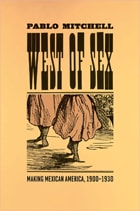
West of Sex
Making Mexican America, 1900-1930Pablo Mitchell
University of Chicago Press, 2012
Sex can be an oppressive force, a tool to shame, divide, and control a population. But it can also be a force for change, for the legal and physical challenge of inequity and injustice. In West of Sex, Pablo Mitchell uses court transcripts and criminal cases to provide the first coherent picture of Mexican-American sexuality at the turn of the twentieth century, and a truly revelatory look at sexual identity in the borderlands.
As Mexicans faced a rising tide of racial intolerance in the American West, some found cracks in the legal system that enabled them to assert their rights as full citizens, despite institutional hostility. In these chapters, Mitchell offers a rare glimpse into the inner workings of ethnicity and power in the United States, placing ordinary Mexican women and men at the center of the story of American sex, colonialism, and belonging.
Other chapters discuss topics like prostitution, same-sex intimacy, sexual violence, interracial romance, and marriage with an impressive level of detail and complexity. Written in vivid and accessible prose, West of Sex offers readers a new vision of sex and race in American history.
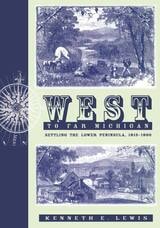
West to Far Michigan
Settling the Lower Peninsula, 1815-1860Kenneth E. Lewis
Michigan State University Press, 2001
Employing numerous primary sources, West to Far Michigan traces changes and patterns of settlement crucial to documenting the large-scale development of southern Michigan as a region. Diaries, letters, memoirs, gazetteers, and legal documents serve to transform the more abstract elements of economic and social change into more human terms. Through the experiences of the early Agriculturists process, we can gain insight into how their triumphs played out in communities within the region to produce small-scale elements that comprise the fabric of the larger cultural landscape.
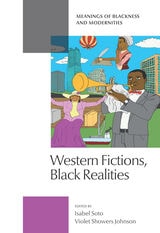
Western Fictions, Black Realities
Meanings of Blackness and ModernitiesIsabel Soto
Michigan State University Press, 2012
This anthology interrogates two salient concepts in studying the black experience. Ushered in with the age of New World encounters, modernity emerged as brutal and complex, from its very definition to its manifestations. Equally challenging is blackness, which is forever dangling between the range of uplifting articulations and insidious degradation. The essays in Western Fictions address the conflicting confluences of these two terms. Questioning Eurocentric and mainstream American interpretations, they reveal the diverse meanings of modernities and blackness from a wide range of milieus of the black experience. Interdisciplinary and wide-ranging in thematic and epochal scope, they use theoretical and empirical studies of a range of subjects to demonstrate that, indeed, blackness is relevant for understanding modernities and vice versa.
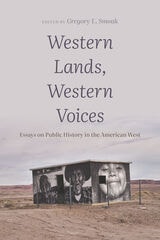
Western Lands, Western Voices
Essays on Public History in the American WestEdited by Gregory E. Smoak
University of Utah Press, 2021
Inspired by the fiftieth anniversary of the University of Utah’s American West Center, the oldest regional studies center in the United States, Western Lands, Western Voices explores the many dimensions of public history. This collection of thirteen essays is rooted in the real-world experiences of the authors and is the first volume to focus specifically on regional public history.
Contributors include tribal government officials, state and federal historians, independent scholars and historical consultants, and academics. Some are distinguished historians of the American West and others are emerging voices that will shape publicly engaged scholarship in the years to come. Among the issues they address are community history and public interpretation, tribal sovereignty, and the importance of historical research for land management. The volume will be indispensable to researchers and general readers interested in museum studies, Native American studies, and public lands history and policy.
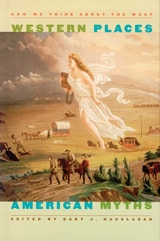
Western Places, American Myths
How We Think About The WestGary J. Hausladen
University of Nevada Press, 2006
In Western Places, American Myths: How We Think About the West, geographer Gary J. Hausladen brings together leading scholars to consider how popular perceptions about the West contribute to our understanding of the region’s geography. Topics include ranching, gambling, cinema, the National Park System, and the roles of minorities in Western expansion. The essays are divided into three sections. “Continuity and Change” addresses themes that are relevant to the entire region including the relationship between the American West and the academic field of historical geography. In part two, “Enduring Regional Voices,” the essays depart from predominantly white Euro-American male interpretations to study other perspectives, namely those of women, Mormons, Mexican Americans, and Native Americans. “The West as Visionary Place” investigates the culture of the region.
Drawing from diverse media, contributors explore various images and their contributions to our understanding about the American West. In the final chapter, key western movies are used to examine the issues of settlement and utopianism, as well as empire and territorial expansion. As a collection, these twelve essays reflect the eclectic nature of Western scholarship, examining diverse topics—some historical, some contemporary—from sometimes conflicting perspectives, with widely divergent scope and voices. Western Places, American Myths brings together geography, history, popular culture, and a comprehensive view of the region, bridging the humanities and social sciences.
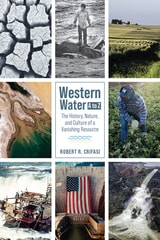
Western Water A to Z
The History, Nature, and Culture of a Vanishing Resourceby Robert R. Crifasi
University Press of Colorado, 2022
Organized as a collection of terms, the book addresses the most salient water issues and provides helpful background information regarding their origins and implications. Photographs serve a vital role in the cultural dialogue on water and stand as an equal partner to the text. Each subject is covered in about one page and is accompanied by one or two striking images from famous photographers like Margaret Bourke-White, Carleton E. Watkins, Arthur Rothstein, William Henry Jackson, and Dorothea Lang as well as Crifasi’s own work. Water often finds itself at the center of our cultural discourse in art, cinema, and literature, which play essential roles in shaping our understanding and experience of Western water. Crifasi also engages personalities that are nearly synonymous with Western water—John Wesley Powell, Elwood Mead, and Floyd Dominy, among others—to show how their lives intertwined with and often influenced the course of water development across the region.
Travelers, adventurers, students, and anyone interested in water will find Western Water A to Z a handy and entertaining reference guide.
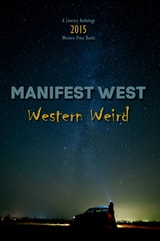
Western Weird
Mark Todd
University Press of Colorado, 2015
The 2015 theme for Manifest West’s annual anthology is “Western Weird.” The works in this collection reflect both myths and suspected truths about the part of the United States we call “the West.” But this year’s edition focuses entirely on the tradition of the strange. To borrow from Jeff VanderMeer’s definition for speculative fiction’s “New Weird,” this volume creates a new parallel genre for work that subverts the traditional romanticized ideas about place, playing with clichés about the West in order to put these elements to discomfiting, rather than consoling, ends.
Topics included in this collection of poetry, fiction, and creative nonfiction range from the West’s numinous fascination with E.T., Bigfoot, and ghosts and its celebration of its indigenous fauna and deadly landscapes to its uncomfortable relationships with its own marginalized peoples and its unforgiving and sometimes violent traditions. The tone of these works ranges from light—even campy—to chilling, but all allow readers to gaze straight into the many faces of what makes the West a weird place.
For the first time in the series, this volume includes solicited work as well as open submissions, including a number of established and award-winning writers and serving its mission by giving voice to brand-new writers.
Western Weird is the fourth volume in Western Press Books’ literary anthology series, Manifest West. The press, affiliated with Western State Colorado University, annually produces one anthology focused on Western regional writing
Contributors:
Bredt Bredthauer, Bartholomew Brinkman, Amy Brunvand, George David Clark, Michael Luis Dauro, Carol V. Davis, Russell Davis, Joe DiBuduo, Michael Engelhard, Daniel Ervin, Mel Goldberg, R. S. Gwynn, Aline Kaplan, Don Kunz , Nate Liederbach, Ellaraine Lockie, Nathan Alling Long, Robert McBrearty, Teresa Milbrodt, Lance Nizami, William Notter, Marlene Olin, C. R. Resetarits, Kate Robinson, Michaela Roessner, David J. Rothman, Matt Schumacher, Renée Thompson, Wendy Videlock, Vivian Wagner, Kirby Wright

Western Window in the Arab World
By Leon Borden Blair
University of Texas Press, 1970
Since November 8, 1942, when American troops in Operation Torch first landed on the beaches of North Africa, almost a million Americans—military personnel and their dependents—have lived in Morocco. Their impact on the political and social evolution of Morocco has been significant, but historians and political scientists before this book had made little effort to chart its course or to assess its outcome.
The naval base at Port Lyautey in Morocco was the first foreign base captured by American troops in World War II, and United States objectives in Morocco continued to be primarily military. In 1942, as the price for French support against the Axis, the United States pledged its support for the restoration of the prewar French colonial empire. In 1950, faced with the threat of Soviet aggression, the United States negotiated an agreement with France and built four United States Air Force bases in Morocco without consultation with or notification of the Moroccan government.
In spite of its sterile diplomatic policy and both Communist and Moroccan nationalist demands for evacuation of United States military bases, the United States retained essential military facilities in Morocco for many years. Leon Blair concludes that American military personnel and their dependents favorably conditioned Moroccan public opinion. By their egalitarianism, humanitarianism, and evident interest, they reinforced the idealistic image of the United States that was held by the majority of Moroccans.
These Americans were neither individually nor collectively conscious agents in a campaign to modify Moroccan public opinion; they were simply a Western window in the Arab world, through which two civilizations might view one another. In the long run, they made a greater contribution in peace than in war.
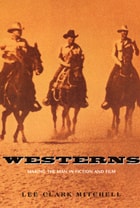
Westerns
Making the Man in Fiction and FilmLee Clark Mitchell
University of Chicago Press, 1996
Few genres are so closely identified with America as the Western. In this wide-ranging examination of the Western and its appeal, Lee Clark Mitchell ranges from the novels of James Fenimore Cooper to Louis L'Amour, and from classic films like Stagecoach to spaghetti Westerns like A Fistful of Dollar to show how Westerns helped assuage a series of crises in American culture. This landmark book shows that the Western owes its perennial appeal not to unchanging conventions but to the deftness with which it responds to the obsessions and fears of its audience. And no obsession, Lee Mitchell argues, has figured more prominently in the Western than what it means to be a man.
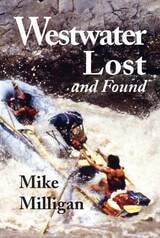
Westwater Lost and Found
Mike Milligan
Utah State University Press, 2004
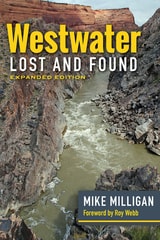
Westwater Lost and Found
Expanded EditionMike Milligan
Utah State University Press, 2024
This expanded edition brings to light historical events and explores how Westwater’s location greatly contributed to early Grand (Upper) Colorado River boaters’ knowledge and how the lush Westwater Valley and Cisco became critical stops for water, wood, and grass along the North Branch of the Old Spanish Trail. Other new additions include explorer Ellsworth Kolb’s unpublished manuscript describing his 1916–1917 boating experiences on the Grand and Gunnison Rivers; two stories relating to Outlaw Cave, one of which expands upon the mystery of the outlaw brothers; a letter from James E. Miller to Frederick S. Dellenbaugh in 1906 revealing new information about his boating excursion with Oro DeGarmo Babcock on the Grand River in 1897; and a portion of botanist Frederick Kreutzfeld’s little-known journal of 1853 that describes Captain John W. Gunnison’s railroad survey.
Loaded with extensive information and river-running history, Milligan’s guide is sure to enhance readers’ knowledge of the Upper Colorado River and Grand Canyon regions. Boaters, river guides, scholars of the American West, and historians of the Colorado, Green, and Gunnison Rivers or the Old Spanish Trail will gain much from this new edition.
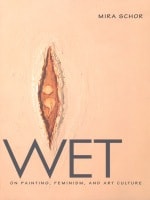
Wet
On Painting, Feminism, and Art CultureMira Schor
Duke University Press, 1997
Bridging the gap between art practice, artwork, and critical theory, Wet includes some of Schor’s most influential essays that have made a significant contribution to debates over essentialism. Articles range from discussions of contemporary women artists Ida Applebroog, Mary Kelly, and the Guerrilla Girls, to "Figure/Ground," an examination of utopian modernism’s fear of the "goo" of painting and femininity. From the provocative "Representations of the Penis," which suggests novel readings of familiar images of masculinity and introduces new ones, to "Appropriated Sexuality," a trenchant analysis of David Salle’s depiction of women, Wet is a fascinating and informative collection.
Complemented by over twenty illustrations, the essays in Wet reveal Schor’s remarkable ability to see and to make others see art in a radically new light.
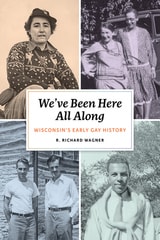
We’ve Been Here All Along
Wisconsin’s Early Gay HistoryR. Richard Wagner
Wisconsin Historical Society Press, 2019
In We’ve Been Here All Along, R. Richard Wagner draws on historical research and materials from his own extensive archive to uncover previously hidden stories of gay Wisconsinites. This book honors their legacy and confirms that they have been foundational to the development and evolution of the state since its earliest days
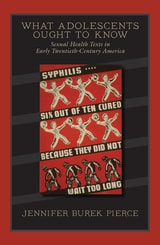
What Adolescents Ought to Know
Sexual Health Texts in Early Twentieth-Century AmericaJennifer Burek Pierce
University of Massachusetts Press, 2011
In 1901, Dr. Alfred Fournier committed an act both simple and revolutionary: he wrote ForOur Sons, When They Turn 18, a sexual and reproductive health treatise based on his clinical work at a leading Paris hospital. If this booklet aided adolescent understanding of health, it also encouraged reformers around the world to publish. By 1913, countless works on venereal disease prevention were available to adolescents.
During this period, authors wrestled with how to make still-developing scientific information available to a reader also in the process of maturing. What would convince a young person to avoid acting on desire? What norms should be employed in these arguments, when social and legal precedents warned against committing ideas about sex to print? How, in other words, could information about sex be made both decent and compelling? Health reformers struggled with these challenges as doctors' ability to diagnose diseases such as syphilis outpaced the production of medicines that could restore health. In this context, information represented the best and truest prophylactic. When publications were successful, from the perspective of information dissemination, they were translated and distributed worldwide.
What Adolescents Ought to Know explores the evolution of these printed materials—from a single tract, written by a medical researcher and given free to anyone, to a thriving commercial enterprise. It tells the story of how sex education moved from private conversation to purchased text in early twentieth-century America.
What Begins with Bird
FictionsFlournoy Holland
University of Alabama Press, 2005

What Did You Hear?
The Music of Bob DylanSteven Rings
University of Chicago Press, 2025
Named one of PopMatters’ Best Books of 2025! Discover a new side of the songs of Bob Dylan by exploring the virtues of rough sounds, peculiar intonation, and a raspy voice.
Folk troubadour, rock star, country crooner—for a musician who adopted so many personas, Bob Dylan always sounds like himself. While he’s written many of the most iconic and impactful lyrics of the past sixty years, Dylan’s music has also reshaped our sonic imagination with his ragged voice, wailing harmonica, and rough-hewn guitar.
Music theorist Steven Rings argues that such sonic imperfections are central to understanding Dylan’s songs and their appeal. These blemishes can invoke authenticity or persona, signal his social commitments, and betray his political shortcomings. Rings begins—where else?—with Dylan’s voice, exploring its changeability, its unmistakable features, and its ability to inhabit characters, including the female narrator of “House of the Rising Sun.” Rings then turns to Dylan as an instrumentalist, examining his infamous adoption of the electric guitar in 1965, as well as his stylistically varied acoustic playing, which borrows sounds and techniques from Black blues musicians, among other influences. Rings charts the histories audible in Dylan’s harmonica as well as piano, which has been central to his music making since his earliest days of imitating Little Richard in his hometown of Hibbing, Minnesota. Finally, Rings guides readers through one of Dylan’s most famous songs, “A Hard Rain’s a-Gonna Fall,” analyzing its musical sources as well as variations in live performances. A companion website of audio and video examples helps readers notice the nuances and idiosyncrasies inherent in Dylan’s work and, even more importantly, their effects.
A close look at an underdiscussed but essential aspect of Dylan’s oeuvre, What Did You Hear? offers a fresh understanding of a singular performer, his musical choices, and the meanings that we can hear in his imperfect sounds.
What Do You Think, Mr. Ramirez?
The American Revolution in EducationGeoffrey Galt Harpham
University of Chicago Press, 2017
That, says Harpham, was the midcentury promise of American education, the deep current of commitment and aspiration that undergirded the educational system that was built in the postwar years, and is under extended assault today. The United States was founded, he argues, on the idea that interpreting its foundational documents was the highest calling of opinion, and for a brief moment at midcentury, the country turned to English teachers as the people best positioned to train students to thrive as interpreters—which is to say as citizens of a democracy. Tracing the roots of that belief in the humanities through American history, Harpham builds a strong case that, even in very different contemporary circumstances, the emphasis on social and cultural knowledge that animated the midcentury university is a resource that we can, and should, draw on today.
What Does It Mean to Grow Old?
Reflections from the HumanitiesThomas R. Cole and Sally Gadow, eds.
Duke University Press, 1986

What Does the Lord Require?
How American Christians Think about Economic JusticeHart, Stephen
Rutgers University Press, 1996
What Dreams Were Made Of
Movie Stars of the 1940sGriffin, Sean
Rutgers University Press, 2011
What Employers Want
Job Prospects for Less-Educated WorkersHarry J. Holzer
Russell Sage Foundation, 1996

What Every Science Student Should Know
Justin L. Bauer, Yoo Jung Kim, Andrew H. Zureick, and Daniel K. Lee
University of Chicago Press, 2016
In 2012, the White House put out a call to increase the number of STEM graduates by one million. Since then, hundreds of thousands of science students have started down the path toward a STEM career. Yet, of these budding scientists, more than half of all college students planning to study science or medicine leave the field during their academic careers.
What Every Science Student Should Know is the perfect personal mentor for any aspiring scientist. Like an experienced lab partner or frank advisor, the book points out the pitfalls while providing encouragement. Chapters cover the entire college experience, including choosing a major, mastering study skills, doing scientific research, finding a job, and, most important, how to foster and keep a love of science.
This guide is a distillation of the authors’ own experiences as recent science graduates, bolstered by years of research and interviews with successful scientists and other science students. The authorial team includes former editors-in-chief of the prestigious Dartmouth Undergraduate Journal of Science. All have weathered the ups and downs of undergrad life—and all are still pursuing STEM careers. Forthright and empowering, What Every Science Student Should Know is brimming with insider advice on how to excel as both a student and a scientist.

What Every Senior Needs to Know About Health Care
J Nora
University Press of Colorado, 2004
What Good Is Journalism?
How Reporters and Editors Are Saving America's Way of LifeGeorge Kennedy and Daryl Moen
University of Missouri Press, 2007
To go by today’s critics of the news media—who have created a virtual cottage industry—American journalism has reached a nadir. Yet with all its well-documented faults, journalism is vital to the health of our democracy, the glue of information that holds this complex nation together. This book shows the most important roles that journalism plays in the world’s oldest democracy. Two seasoned educators and practitioners of journalism have assembled a team of writers who look beyond the critics to show that there is much to be praised about the state of American journalism today.
Journalism tells us most of what we know about the world beyond our own experience by going where its audience cannot or will not. It keeps watch on the government and other powerful institutions, exposes wrongdoing and injustice, and shares the endless fascinations of everyday life. Through stories of real people, this book forcefully argues that American journalism is better than its critics admit and a force for good in the lives of both individuals and the nation. Like the exemplary journalism it describes, it offers dozens of instances that show how good journalistic practices enrich the daily lives of citizens and enable them to play their own roles in the democracy.
These essays offer a multifaceted view of the press, tracing the development of free expression through American history and showing how the principles of journalism that we take for granted are playing a revolutionary role in emerging democracies. They report the results of a unique national survey—undertaken for this book—revealing how Americans really view and use the press, and cite the successes of good reporting, from hometown newspapers to NPR. They show how investigative journalism and computer-assisted reporting unearth important truths and even create new knowledge and suggest how citizens can demand the good journalism they need.
What good is journalism? This book spells out the answer through a conversation about journalism and democracy that offers both an antidote to the recent storm of ideologically based criticism of “liberal media” and a demonstration of the true worth of an institution essential to the protection of freedom. It provides today’s readers—and tomorrow’s journalists—a fresh perspective on the press to remind us where we would be without it.
What Government Can Do
Dealing with Poverty and InequalityBenjamin I. Page and James R. Simmons
University of Chicago Press, 2000
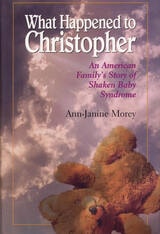
What Happened to Christopher
An American Family's Story of Shaken Baby SyndromeAnn-Janine Morey. Foreword by M. Joan McDermott
Southern Illinois University Press, 1998
A tragedy and a trial placed Ann-Janine Morey in an ideal position to write this wrenching exploration of the havoc wreaked on a family by Shaken Baby Syndrome. As an alternate juror in a 1995 murder trial in Murphysboro, Illinois, she observed a case that has become too common: that of an adult caregiver shaking to death a baby. A seasoned researcher and published scholar, in this book Morey witnesses the court proceedings firsthand, comes to know the families of the toddler intimately, and augments her observations and interviews through research into Shaken Baby Syndrome. The result is an agonizingly human tale supported by the evidence of science, sociology, and criminology.
Morey's What Happened to Christopher memorializes the short life of nineteen-month-old Christopher Attig (1992–1994). To reveal what Christopher meant to those closest to him, Morey conducts extensive interviews with the child's parents and grand-parents. She also interviews the officials involved in the case to set the scene from a legal and police angle. Gary Lynn Gould, who was convicted of and imprisoned for killing Christopher, did not answer Morey's requests for interviews.
Morey characterizes her investigation as a "story of quiet horror because it takes place in a way and a setting that could be any town and many families." Nonetheless, Morey's narrative skill transforms Christopher into much more than an ordinary child, senselessly slain. He is Christopher, irreplaceable and unique. And by the time she reconstructs Christopher's final days and the aftermath of his murder, Morey has depicted the principals in the case so deftly and imbued them with such humanity that we experience their torment and their hope.
Morey also provides a juror's insight into the trial. By showing what happened to Christopher Attig and by presenting the accumulated findings relative to Shaken Baby Syndrome, she seeks through education to help prevent future deaths like Christopher's.

What Happened to Notre Dame?
Charles E. Rice
St. Augustine's Press, 2009
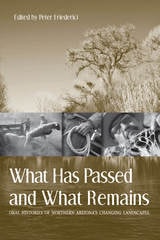
What Has Passed and What Remains
Oral Histories of Northern Arizona's Changing LandscapesEdited by Peter Friederici
University of Arizona Press, 2010
Thirteen narratives—from ranchers, foresters, scientists, Native American farmers, and others—tell how northern Arizona landscapes and livelihoods reflect rapid social and environmental change. The twentieth century saw huge changes as Arizona’s human population swelled and vacation-home developments arose in the backcountry. Riparian areas dried up, cattle ranching declined, and some wildlife species vanished while others thrived. The people whose words are preserved here have watched it all happen.
The book is a product of Northern Arizona University’s Ecological Oral Histories project, which has been collecting remembrances of long-time area residents who have observed changes to the land from the 1930s to the present day. It carves a wide swath, from the Arizona Strip to the Mogollon Rim, from valleys near Prescott to the New Mexico line. It takes readers to the Bar Heart Ranch north of Williams and to the Doy Reidhead Ranch southeast of Holbrook, to the forests of Flagstaff and the mesas of Indian country.
Enhanced with more than fifty illustrations, this book brings environmental change down to earth by allowing us to see it through the eyes of those whose lives it has directly touched. What Has Passed and What Remains is a window on the past that carries important lessons for the future.
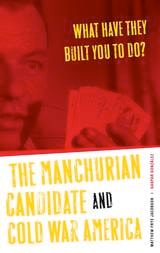
What Have They Built You to Do?
The Manchurian Candidate and Cold War AmericaMatthew Frye Jacobson
University of Minnesota Press, 2006