Results by title
22279 books match the query 'Social Science' and 963 start with w

When We Imagine Grace
Black Men and Subject MakingSimone C. Drake
University of Chicago Press, 2016
In When We Imagine Grace, Drake borrows from Toni Morrison’s Beloved to bring imagination to the center of black masculinity studies—allowing individual black men to exempt themselves and their fates from a hateful, ignorant society and open themselves up as active agents at the center of their own stories. Against a backdrop of crisis, Drake brings forth the narratives of black men who have imagined grace for themselves. We meet African American cowboy, Nat Love, and Drake’s own grandfather, who served in the first black military unit to fight in World War II. Synthesizing black feminist and black masculinity studies, Drake analyzes black fathers and daughters, the valorization of black criminals, the black entrepreneurial pursuits of Marcus Garvey, Berry Gordy, and Jay-Z, and the denigration and celebration of gay black men: Cornelius Eady, Antoine Dodson, and Kehinde Wiley. With a powerful command of its subjects and a passionate dedication to hope, When We Imagine Grace gives us a new way of seeing and knowing black masculinity—sophisticated in concept and bracingly vivid in telling.

When We Say “Hiroshima”
Selected PoemsKurihara Sadako; Translated with an Introduction by Richard H. Minear
University of Michigan Press, 1999

When Whites Riot
Writing Race and Violence in American and South African CulturesSheila Smith McKoy
University of Wisconsin Press, 2001
In a bold work that cuts across racial, ethnic, cultural, and national boundaries, Sheila Smith McKoy reveals how race colors the idea of violence in the United States and in South Africa—two countries inevitably and inextricably linked by the central role of skin color in personal and national identity.
Although race riots are usually seen as black events in both the United States and South Africa, they have played a significant role in shaping the concept of whiteness and white power in both nations. This emerges clearly from Smith McKoy's examination of four riots that demonstrate the relationship between the two nations and the apartheid practices that have historically defined them: North Carolina's Wilmington Race Riot of 1898; the Soweto Uprising of 1976; the Los Angeles Rebellion in 1992; and the pre-election riot in Mmabatho, Bhoputhatswana in 1994. Pursuing these events through narratives, media reports, and film, Smith McKoy shows how white racial violence has been disguised by race riots in the political and power structures of both the United States and South Africa.
The first transnational study to probe the abiding inclination to "blacken" riots, When Whites Riot unravels the connection between racial violence—both the white and the "raced"—in the United States and South Africa, as well as the social dynamics that this connection sustains.
When Women Have Wings
Feminism and Development in Medellin, ColombiaDonna F. Murdock
University of Michigan Press, 2008

When Women Rule the Court
Gender, Race, and Japanese American BasketballWillms, Nicole
Rutgers University Press, 2017
For nearly one hundred years, basketball has been an important part of Japanese American life. Women’s basketball holds a special place in the contemporary scene of highly organized and expansive Japanese American leagues in California, in part because these leagues have produced numerous talented female players. Using data from interviews and observations, Nicole Willms explores the interplay of social forces and community dynamics that have shaped this unique context of female athletic empowerment. As Japanese American women have excelled in mainstream basketball, they have emerged as local stars who have passed on the torch by becoming role models and building networks for others.
When Worlds Collide
Hunter-Gatherer World-System Change in the 19th Century Canadian ArcticT. Max Friesen
University of Arizona Press, 2013
Max Friesen has adapted and expanded world-system theory in order to develop a model that explains how hunter-gatherer interaction networks, or world-systems, are structured—and why they change. He has utilized this model to better understand the development of Inuvialuit society in the western Canadian Arctic over a 500-year span, from the pre-contact period to the early twentieth century.
As Friesen combines local archaeological data with more extensive ethnographic and archaeological evidence from the surrounding region, a picture emerges of a dynamic Inuvialuit world-system characterized by bounded territories, trade, warfare, and other forms of interaction. This world-system gradually intensified as the impacts of Euroamerican colonial activities increased. This intensification, Friesen suggests, was based on pre-existing Inuvialuit social and economic structures rather than on patterns imposed from outside. Ultimately, this intense interacting network collapsed near the end of the nineteenth century. When Worlds Collide offers a new way to comprehend small-scale world-systems from the point of view of indigenous people. Its approach will prove valuable for understanding hunter-gatherer societies around the globe.
When Writing Met Art
From Symbol to StoryBy Denise Schmandt-Besserat
University of Texas Press, 2007
Denise Schmandt-Besserat opened a major new chapter in the history of literacy when she demonstrated that the cuneiform script invented in the ancient Near East in the late fourth millennium BC—the world's oldest known system of writing—derived from an archaic counting device. Her discovery, which she published in Before Writing: From Counting to Cuneiform and How Writing Came About, was widely reported in professional journals and the popular press. In 1999, American Scientist chose How Writing Came About as one of the "100 or so Books that shaped a Century of Science."
In When Writing Met Art, Schmandt-Besserat expands her history of writing into the visual realm of communication. Using examples of ancient Near Eastern writing and masterpieces of art, she shows that between 3500 and 3000 BC the conventions of writing—everything from its linear organization to its semantic use of the form, size, order, and placement of signs—spread to the making of art, resulting in artworks that presented complex visual narratives in place of the repetitive motifs found on preliterate art objects. Schmandt-Besserat then demonstrates art's reciprocal impact on the development of writing. She shows how, beginning in 2700-2600 BC, the inclusion of inscriptions on funerary and votive art objects emancipated writing from its original accounting function. To fulfill its new role, writing evolved to replicate speech; this in turn made it possible to compile, organize, and synthesize unlimited amounts of information; and to preserve and disseminate information across time and space.
Schmandt-Besserat's pioneering investigation of the interface between writing and art documents a key turning point in human history, when two of our most fundamental information media reciprocally multiplied their capacities to communicate. When writing met art, literate civilization was born.
When You Learn the Alphabet
Kendra Allen
University of Iowa Press, 2019
These dynamics strive for some semblance of accountability, and the essays within this collection are used as displays of deep unlearning and restoring—balancing trauma and humor, poetics and reality, forgiveness and resentment.
When You Learn the Alphabet allots space for large moments of tenderness and empathy for all black bodies—but especially all black woman bodies—space for the underrepresented humanity and uncared for pain of black girls, and space to have the opportunity to be listened to in order to evolve past it.

When and Where They Enter
Black Women's Candidate Emergence at the State LevelJamil S. Scott-Cummings
University of Michigan Press, 2027
While Black women are often called the backbone of American democracy, their journeys to political office remain understudied. When and Where They Enter offers a way to develop our understanding of the women transforming American politics. By focusing on state-level elections, it explores what motivates Black women to run for public office, the biases they navigate in the public eye, and the structural factors that help or hinder their path to victory.
By deliberately departing from traditional, single-axis models of political ambition, Jamil Scott-Cummings frames candidate emergence through an explicit intersectional lens, treating Black women’s political agency as a dynamic interplay between psychological motivations, institutional factors, personal characteristics, and race-gender bias. She introduces a new conceptual model that challenges standard strategic entry theories: the intentional candidacy framework. Incorporating experiments, observational data, and elite interviews, When and Where They Enter offers robust empirical evidence of how race-gender identity shapes modern electoral supply. An essential read for voters, changemakers, and future leaders, the book offers a roadmap for understanding identity, power, and the future of political representation in America.
When the Air Became Important
A Social History of the New England and Lancashire Textile IndustriesJanet Greenlees
Rutgers University Press, 2019
When the Bones Speak
The Living, the Dead, and the Sacrifice of Contemporary OkinawaChristopher T. Nelson
Duke University Press, 2025
When the Center Is on Fire
Passionate Social Theory for Our TimesBy Diane Harriford and Becky Thompson
University of Texas Press, 2008
In this lively and provocative book, two feminist public sociologists turn to classical social thinkers—W. E. B. Du Bois, Max Weber, Karl Marx, and Émile Durkheim—to understand a series of twenty-first century social traumas, including the massacre at Columbine High School, the 9/11 attacks, the torture at Abu Ghraib prison, and Hurricane Katrina. Each event was overwhelming in its own right, while the relentless pace at which they occurred made it nearly impossible to absorb and interpret them in any but the most superficial ways. Yet, each uncovered social problems that cry out for our understanding and remediation.
In When the Center Is on Fire, Becky Thompson and Diane Harriford assert that classical social theorists grappled with the human condition in ways that remain profoundly relevant. They show, for example, that the loss of "double consciousness" that Du Bois identified in African Americans enabled political elites to turn a blind eye to the poverty and vulnerability of many of New Orleans's citizens. The authors' compelling, sometimes irreverent, often searing interpretations make this book essential reading for students, activists, generations X, Y, and Z, and everybody bored by the 6 o'clock news.
When the Earth Was New
Memory, Materiality, and Numic RitualAlex K. Ruuska
University of Utah Press, 2025
In When the Earth Was New, Alex K. Ruuska explores riveting multigenerational memories of Numic-speaking communities that extend back, potentially, to the late Pleistocene. These diverse oral traditions describe geological, climatic, and ecological events that occurred over thousands of years and were passed down across many generations. Through the examination of place-based memories and the architecture of Numic knowledge, Ruuska demonstrates convergences of oral traditions, ethnography, ethnohistory, archaeology, and geology.
When the Earth Was New critically compares and considers multiple forms of knowledge that contribute to overlapping as well as disparate understandings of both recent and distant pasts in the regions of California, the Great Basin, and the Colorado Plateau. It works at balancing key themes in these regions’ histories within a more holistic framework, exploring ancient and modern strands of knowledge with the assistance of twenty-four Tribes and Consolidated Organizations.

When the Girls Came Out to Play
The Birth Of American SportswearPatricia C. Warner
University of Massachusetts Press, 2006
A study of the evolution of American women's clothing, When the Girls Came Out to Play traces the history of modern sportswear as a universal style that broke down traditional gender roles. Patricia Warner shows how this profound cultural shift, which did not reach fruition until World War II, originated during the previous century with the gradual expansion of socially acceptable physical activity for women. Behind this development was a growing interest in sports and exercise that was further nurtured by the establishment of schools of higher education for women. The participation of women in athletic pursuits previously reserved for men began with the relatively genteel sports of croquet and tennis. With the founding of women's colleges, these “ladylike” games were supplemented by more vigorous activities and competitive team sports, from gymnastics to swimming to basketball. At first, Warner points out, women literally had nothing to wear for these activities. Whereas such fashionable attire as corsets, petticoats, hats, and gloves could be worn while playing outdoor lawn games, more strenuous athletic endeavors required less physically restrictive clothing. Even so, change came only gradually, as women's colleges, shielded from public scrutiny and prying male eyes, permitted the adoption of looser, more comfortable apparel for physical education. Many of these new outfits featured trousers, garments considered taboo for women, though they often remained hidden beneath voluminous skirts.
Over time, however, the practicality and versatility of such clothing led to social acceptance, laying the foundation for the emergence of the now ubiquitous yet distinctly American style known as sportswear. Although we take it for granted, Warner observes, this is the first time in the history of the world that such universality has existed in clothing, and it has lasted now for well over half a century—in itself a marvel, considering the speed of fashion change in an era of instant messages and images.

When the Good Life Goes Bad
The US and Its Seven Deadly SinsStacey M. Floyd-Thomas Foreword by Michael Eric Dyson
University of Illinois Press, 2026
Stacey M. Floyd-Thomas examines how the Seven Deadly Sins have shaped the moral strivings and sociopolitical condition of American society and culture in the twenty-first century. Drawing on a multidimensional approach, Floyd-Thomas uses race, gender, class, and other lenses to break down the moral crises that define the American Dream. Her critique exposes the harm done by individual and collective practices of sexual objectification, capitalist materialism, wealth inequality, and technological hubris before pivoting to the rise of right-wing populism, white Christian nationalism, and the politics of cruelty. But Floyd-Thomas also proposes an ethic that emphasizes truth-telling, community engagement, and values rooted in humility, justice, and mercy—a new path for the US to overcome systemic oppression and create a more just society.
Evocative and ambitious, When the Good Life Goes Bad takes readers on a wide-ranging journey through US life and culture to explain what corrupted the American dream.
When the Hills Are Gone
Frac Sand Mining and the Struggle for CommunityThomas W. Pearson
University of Minnesota Press, 2017
Fracking is one of the most controversial methods of fossil fuel extraction in the United States, but a great deal about it remains out of the public eye. In Wisconsin it has ignited an unprecedented explosion in the state’s sand mining operations, an essential ingredient in hydraulic fracturing that has shaken local communities to the core.
In When the Hills Are Gone, Thomas W. Pearson reveals the jolting impact of sand mining on Wisconsin’s environment and politics. A source of extraordinary wealth for a lucky few, and the cause of despoiled land for many others, sand mining has raised alarm over air quality, water purity, noise, blasting, depressed tourism, and damage to the local way of life. It has also spurred a backlash in a grassroots effort that has grown into a mature political movement battling a powerful mining industry.
When the Hills Are Gone tells the story of Wisconsin’s sand mining wars. Providing on-the-ground accounts from both the mining industry and the concerned citizens who fought back, Pearson blends social theory, ethnography, stirring journalism, and his own passionate point of view to offer an essential chapter of Wisconsin’s history and an important episode in the national environmental movement. Digging deep into the struggles over place, community, and local democracy that are occurring across the United States, When the Hills Are Gone gives vital insight into America’s environmental battles along the unexpected frontlines of energy development.
When the Light Is Fire
Maasai Schoolgirls in Contemporary KenyaHeather D. Switzer
University of Illinois Press, 2018
Heather D. Switzer's interviews with over one hundred Kenyan Maasai schoolgirls challenge the widespread view of education as a silver bullet solution to global poverty. In their own voices, the girls offer incisive insights into their commitments, aspirations, and desires. Switzer weaves this ethnographic material into an astute analysis of historical literature, education and development documents, and theoretical literature. Maasai schoolgirls express a particular knowledge about themselves and provocative hopes for their futures. Yet, as Switzer shows, new opportunities force them to face, and navigate, new vulnerabilities and insecurities within a society that is itself in flux.

When the Press Fails
Political Power and the News Media from Iraq to KatrinaW. Lance Bennett, Regina G. Lawrence, and Steven Livingston
University of Chicago Press, 2007
“The hand-in-glove relationship of the U.S. media with the White House is mercilessly exposed in this determined and disheartening study that repeatedly reveals how the press has toed the official line at those moments when its independence was most needed.”—George Pendle, Financial Times
“Bennett, Lawrence, and Livingston are indisputably right about the news media’s dereliction in covering the administration’s campaign to take the nation to war against Iraq.”—Don Wycliff, Chicago Tribune
When the Rainbow Goddess Wept
Cecilia Manguerra Brainard
University of Michigan Press, 1999

When the River Burned
The Untold Story of the Jupiter ExplosionJoey Oliver
Michigan State University Press, 2026
On September 16, 1990, the tanker ship Jupiter exploded while unloading gasoline at a Bay City pier on the Saginaw River. The blast killed one worker, injured eleven others, and triggered what the U.S. Coast Guard later described as an unprecedented crisis on the Great Lakes. For weeks, the disaster commanded national attention as officials worked to contain the damage and investigate the cause. Then, like so many industrial accidents, the story faded from public memory.
When the River Burned tells the story of this overlooked chapter in Great Lakes maritime history. Drawing on newspaper archives, Coast Guard investigations, and eyewitness accounts, Joey Oliver reconstructs how a series of small oversights—in equipment, procedure, and human judgment—aligned to produce catastrophe.
The book places the Jupiter explosion within a broader history of the Saginaw River, tracing its evolution into a vital artery of Michigan industry. Oliver examines the fragile interdependence of ships, piers, and river traffic, revealing how disasters emerge not from single causes but from the breakdown of complex systems. When the River Burned is not only the account of a deadly tanker explosion; it is a reflection on what caused it, on the safety changes that followed, and on changes that never came.
When the Smoke Cleared
Attica Prison Poems and JournalCeles Tisdale, editor
Duke University Press, 2022
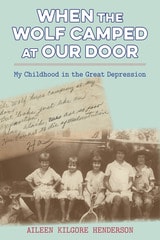
When the Wolf Camped at Our Door
My Childhood in the Great DepressionAileen Kilgore Henderson
University of Alabama Press, 2022
Recounts the hardships and joys the Kilgore family and their neighbors experienced in a close-knit southern rural community during the Great Depression
As the Great Depression tightened its grip on the world, six members of the Kilgore family were living in a cramped farmhouse in Brookwood, Alabama. Crops didn’t grow well, food was scarce, shoes were in short supply, and the few clothes they had were all hand-me-downs. The Kilgores struggled to make ends meet, cobbling together odd jobs and working the land by hand.
Despite all of this, young Aileen thought life was full of hope. She longed to hold on to it and scribbled down daily events on whatever odds and ends of paper she could find. In her new memoir, When the Wolf Camped at Our Door, Aileen Kilgore Henderson creates a vivid portrait of what life was like for so many living in the rural South during the Depression. The book begins when Aileen is ten years old and follows her into her teenage years over the course of twenty-seven episodic chapters. Drawing on her girlhood diaries and told through the charismatic voice of her younger self, Henderson’s nuanced storytelling sheds light on the common struggle for survival during a time when people were at their most vulnerable.
Against the backdrop of a world where hard work and harsh conditions like hunger, privation, sickness, and early death were everyday realities, Henderson’s stories are nevertheless tinged with young Aileen’s lively sense of humor and optimistic faith in people and in the promise of life despite trying circumstances. We follow her rambles in the woods, her visits with friends, a trip to a fortune teller, and a search for the Howton Horror, a mysterious monster rumored to live deep in the Alabama backwoods.
Where Are All the Good Jobs Going?
What National and Local Job Quality and Dynamics Mean for U.S. WorkersHarry J. Holzer
Russell Sage Foundation, 2011
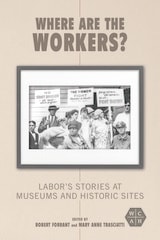
Where Are the Workers?
Labor's Stories at Museums and Historic SitesEdited by Robert Forrant and Mary Anne Trasciatti
University of Illinois Press, 2022
A wide-ranging blueprint for change, Where Are the Workers? shows how working-class perspectives can expand our historical memory and inform and inspire contemporary activism.
Contributors: Jim Beauchesne, Rebekah Bryer, Rebecca Bush, Conor Casey, Rachel Donaldson, Kathleen Flynn, Elijah Gaddis, Susan Grabski, Amanda Kay Gustin, Karen Lane, Rob Linné, Erik Loomis, Tom MacMillan, Lou Martin, Scott McLaughlin, Kristin O’Brassill-Kulfan, Karen Sieber, and Katrina Windon

Where Bad Jobs Are Better
Retail Jobs Across Countries and CompaniesFrancoise Carre
Russell Sage Foundation, 2017
In surveying retail work across the United States, Carré and Tilly find that the majority of retail workers receive low pay and nearly half work part-time, which contributes to high turnover and low productivity. Jobs staffed predominantly by women, such as grocery store cashiers, pay even less than retail jobs in male-dominated fields, such as consumer electronics. Yet, when comparing these jobs to similar positions in Western Europe, Carré and Tilly find surprising differences. In France, though supermarket cashiers perform essentially the same work as cashiers in the United States, they receive higher pay, are mostly full-time, and experience lower turnover and higher productivity. And unlike the United States, where many retail employees are subject to unpredictable schedules, in Germany, retailers are required by law to provide their employees notice of work schedules six months in advance.
The authors show that disparities in job quality are largely the result of differing social norms and national institutions. For instance, weak labor regulations and the decline of unions in the United States have enabled retailers to cut labor costs aggressively in ways that depress wages and discourage full-time work. On the other hand, higher minimum wages, greater government regulation of work schedules, and stronger collective bargaining through unions and works councils have improved the quality of retail jobs in Europe.
As retail and service work continue to expand, American employers and policymakers will have to decide the extent to which these jobs will be good or bad. Where Bad Jobs Are Better shows how stronger rules and regulations can improve the lives of retail workers and boost the quality of low-wage jobs across the board.
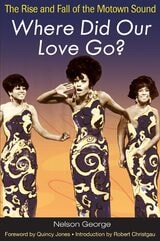
Where Did Our Love Go?
The Rise and Fall of the Motown SoundNelson George. Foreword by Quincy Jones, Introduction by Robert Christgau.
University of Illinois Press, 2007
Gordy's uncanny instinct for finding extraordinary talent--from performers and musicians to songwriters and producers—packed the label's roster with a who's who of historic artists and hitmakers. Here is the story of the Supremes and superstar Diana Ross, of the towering solo acts Marvin Gaye and Stevie Wonder, of vocal groups led by the Temptations and Four Tops, of the phenomenal Jackson Five and Michael Jackson, and of singer/songwriter and Motown executive Smokey Robinson. Up front about Gordy's manipulative and complex relationships with his artists, George reveals the inner workings of how Motown conducted its business. He also offers portraits of the Funk Brothers and other musicians who played the unforgettable songs.
George's preface shows how Motown influenced a later generation of young artists and music moguls, including R. Kelly, D'Angelo, Sean Combs, and Russell Simmons.
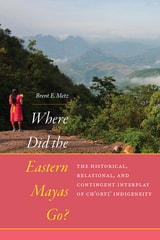
Where Did the Eastern Mayas Go?
The Historical, Relational, and Contingent Interplay of Ch’orti’ Indigeneityby Brent E. Metz
University Press of Colorado, 2022
Copublished with the Institute for Mesoamerican Studies, University of Albany
In Where Did the Eastern Mayas Go? Brent E. Metz explores the complicated issue of who is Indigenous by focusing on the sociohistorical transformations over the past two millennia of the population currently known as the Ch’orti’ Maya. Epigraphers agree that the language of elite writers in Classic Maya civilization was Proto-Ch’olan, the precursor of the Maya languages Ch’orti’, Ch’olti’, Ch’ol, and Chontal. When the Spanish invaded in the early 1500s, the eastern half of this area was dominated by people speaking various dialects of Ch’olti’ and closely related Apay (Ch’orti’), but by the end of the colonial period (1524–1821) only a few pockets of Ch’orti’ speakers remained.
From 2003 to 2018 Metz partnered with Indigenous leaders to conduct a historical and ethnographic survey of Ch’orti’ Maya identity in what was once the eastern side of the Classic period lowland Maya region and colonial period Ch’orti’-speaking region of eastern Guatemala, western Honduras, and northwestern El Salvador. Today only 15,000 Ch’orti’ speakers remain, concentrated in two municipalities in eastern Guatemala, but since the 1990s nearly 100,000 impoverished farmers have identified as Ch’orti’ in thirteen Guatemalan and Honduran municipalities, with signs of Indigenous revitalization in several Salvadoran municipalities as well. Indigenous movements have raised the ethnic consciousness of many non-Ch’orti’-speaking semi-subsistence farmers, or campesinos. The region’s inhabitants employ diverse measures to assess identity, referencing language, history, traditions, rurality, “blood,” lineage, discrimination, and more.
Where Did the Eastern Mayas Go? approaches Indigenous identity as being grounded in historical processes, contemporary politics, and distinctive senses of place. The book is an engaged, activist ethnography not on but, rather, in collaboration with a marginalized population that will be of interest to scholars of the eastern lowland Maya region, indigeneity generally, and ethnographic experimentation.

Where Human Rights Begin
Edited by Wendy Chavkin and Ellen Chesler
Rutgers University Press, 2005
More than a decade ago, three landmark world conferences placed the human rights of women on the international agenda. The first, in Vienna, officially extended the definition of human rights to include a woman’s right to self-determination and equality. A year later, in Cairo, this concept was elaborated to deal explicitly with issues of sexuality and procreation. Subsequently, at a conference in Beijing, the international community committed to a wide range of practical interventions to advance women’s sexual, social, political, and economic rights.
Despite these accomplishments, we find ourselves at an ever more difficult juncture in the struggle to fully realize women’s rights as human rights. Complications, such as terrorism and the “war” against it, the HIV/AIDS pandemic, the incursion of religious fundamentalism into governments, and the U.S. government’s retreat from the international agenda on sexual and reproductive rights have raised questions about the direction of policy implementations and have prevented straightforward progress.
This timely collection brings together eight wide-reaching and provocative essays that examine the practical and theoretical issues of sexual and reproductive health policy and implementation.

Where I Have Never Been
Migration, Melancholia, and Memory in Asian American Narratives of ReturnPatricia P. Chu
Temple University Press, 2019
In researching accounts of diasporic Chinese offspring who returned to their parents’ ancestral country, author Patricia Chu learned that she was not alone in the experience of growing up in America with an abstract affinity to an ancestral homeland and community. The bittersweet emotions she had are shared in Asian American literature that depicts migration-related melancholia, contests official histories, and portrays Asian American families as flexible and transpacific.
Where I Have Never Been explores the tropes of return, tracing both literal return visits by Asian emigrants and symbolic “returns”: first visits by diasporic offspring. Chu argues that these Asian American narratives seek to remedy widely held anxieties about cultural loss and the erasure of personal and family histories from public memory. In fiction, memoirs, and personal essays, the writers of return narratives—including novelists Lisa See, May-lee Chai, Lydia Minatoya, and Ruth Ozeki, and best-selling author Denise Chong, diplomat Yung Wing, scholar Winberg Chai, essayist Josephine Khu, and many others—register and respond to personal and family losses through acts of remembrance and countermemory.
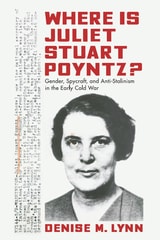
Where Is Juliet Stuart Poyntz?
Gender, Spycraft, and Anti-Stalinism in the Early Cold WarDenise Lynn
University of Massachusetts Press, 2021
In Where Is Juliet Stuart Poyntz?, Denise M. Lynn argues that Poyntz's sudden disappearance was the final straw for many on the American political left, who then abandoned Marxism and began to embrace anti-communism. In the years to follow, the left crafted narratives of her disappearance that became central to the Cold War. While scholars have thoroughly analyzed the influence of the political right in the anti-communism of this era, this captivating and compelling study is unique in exploring the influence of the political left.

Where Is the Light Coming From
Essays on Art and Regular PeopleDan Kois
Duke University Press, 2027

Where No Black Woman Has Gone Before
Subversive Portrayals in Speculative Film and TVBy Diana Adesola Mafe
University of Texas Press, 2018
When Lieutenant Uhura took her place on the bridge of the Starship Enterprise on Star Trek, the actress Nichelle Nichols went where no African American woman had ever gone before. Yet several decades passed before many other black women began playing significant roles in speculative (i.e., science fiction, fantasy, and horror) film and television—a troubling omission, given that these genres offer significant opportunities for reinventing social constructs such as race, gender, and class. Challenging cinema’s history of stereotyping or erasing black women on-screen, Where No Black Woman Has Gone Before showcases twenty-first-century examples that portray them as central figures of action and agency.
Writing for fans as well as scholars, Diana Adesola Mafe looks at representations of black womanhood and girlhood in American and British speculative film and television, including 28 Days Later, AVP: Alien vs. Predator, Children of Men, Beasts of the Southern Wild, Firefly, and Doctor Who: Series 3. Each of these has a subversive black female character in its main cast, and Mafe draws on critical race, postcolonial, and gender theories to explore each film and show, placing the black female characters at the center of the analysis and demonstrating their agency. The first full study of black female characters in speculative film and television, Where No Black Woman Has Gone Before shows why heroines such as Lex in AVP and Zoë in Firefly are inspiring a generation of fans, just as Uhura did.

Where Rivers Meet the Sea
The Political Ecology of WaterStephanie Kane
Temple University Press, 2012
Where fresh water appears to be abundant and generally accessible, chronic pollution may be relatively ignored as a public issue. Yet there are those whose lives, livelihoods, and traditions are touched directly by the destructive albeit essential relationship between humans and water.
In her passionate and persuasively argued Where Rivers Meet the Sea, Stephanie Kane compares two cities and nations—Salvador, Brazil and Buenos Aires, Argentina—as she tells the stories of those who organize in the streets, petition the courts, and challenge their governments to implement and enforce existing laws designed to protect springs, lakes, harbors, and rivers.
Illuminating the complex and distinctive cultural forces in the South Atlantic that shape conflicts and collaborations pertaining to particular waterfront settings, Kane shows the dilemmas, inventiveness, and persistence that provide the foundation for environmental and social justice movements writ large.
Where Social Identities Converge
Latin American and Latinx Youth on ScreenTraci Roberts-Camps
Vanderbilt University Press, 2024

Where Valor Proudly Sleeps
A History of Fredericksburg National Cemetery, 1866–1933Donald C. Pfanz
Southern Illinois University Press, 2018

Where Was the Working Class?
REVOLUTION IN EASTERN GERMANYLinda Fuller
University of Illinois Press, 1999
In this unprecedented study, Linda Fuller sets out to explain why the working class was largely missing from the 1989-90 revolution. Drawing on pre- and post-revolutionary visits to East German work sites and dozens of interviews, Fuller documents workers' day-to-day experience of the labor process, workplace union politics, and class. She shows how all three factors led most workers to withdraw from politics, even while prompting a handful to become actively involved in the struggle.
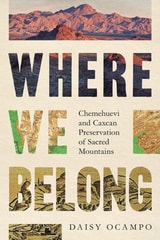
Where We Belong
Chemehuevi and Caxcan Preservation of Sacred MountainsDaisy Ocampo
University of Arizona Press, 2023
The author brings together the history and experiences of the Chemehuevi people and their ties with Mamapukaib, or the Old Woman Mountains in the East Mojave Desert, and the Caxcan people and their relationship with Tlachialoyantepec, or Cerro de las Ventanas, in Zacatecas, Mexico. Through a trans-Indigenous approach, Daisy Ocampo weaves historical methodologies (oral histories, archival research, ethnography) with Native studies and historic preservation to reveal why Native communities are the most knowledgeable and transformational caretakers of their sacred places.
This work transcends national borders to reveal how settler structures are sustained through time and space in the Americas. Challenging these structures, traditions such as the Chemehuevi Salt Songs and Caxcan Xuchitl Dance provide both an old and a fresh look at how Indigenous people are reimagining worlds that promote Indigenous-to-Indigenous futures through preservation.
Ultimately, the stories of these two peoples and places in North America illuminate Indigenous sovereignty within the field of public history, which is closely tied to governmental policies, museums, archives, and agencies involved in historic preservation.

Where Women Run
Gender and Party in the American StatesKira Sanbonmatsu
University of Michigan Press, 2010
“Kira Sanbonmatsu has done a masterful job of linking the representation of women in elective office to the activities of party organizations in the states. She combines qualitative and quantitative data to show how women are navigating the campaign process to become elected leaders and the changing role of party organizations in their recruitment and election. It is a significant contribution to the study of representative democracy.”
--Barbara Burrell, Northern Illinois University
“Sanbonmatsu has produced an excellent study that will invigorate research on the role of political parties and the recruitment of women candidates. Using a variety of methods and data sources, she has crafted a tightly constructed, clearly argued, and exceedingly well-written study. A commendable and convincing job.”
--Gary Moncrief, Boise State University
“Sanbonmatsu offers important insights in two neglected areas of American politics: the role of political parties in recruiting candidates and the continued under-representation of women in elected office. Connecting the two subjects through careful qualitative and statistical methods, insightful interpretation of the literature and interesting findings, the book is a significant new addition to scholarship on parties, gender, and political recruitment.”
--Linda Fowler, Dartmouth College
Kira Sanbonmatsu is Associate Professor of Political Science at Rutgers University and Senior Scholar at the Eagleton Institute of Politics’ Center for American Women and Politics (CAWP). She was previously associate professor at Ohio State University. She is the author of Democrats, Republicans, and the Politics of Women’s Place.

Where Women Work
A Study of Yoruba Women in the Marketplace and in the HomeNiara Sudarkasa
University of Michigan Press, 1973

Where the Hood At?
Fifty Years of Change in Black NeighborhoodsMichael C. Lens
Russell Sage Foundation, 2024
Hip hop music was born out of Black neighborhoods in the 1970s and has evolved alongside them. In Where the Hood At? Lens uses rap’s growth and influence across the country to frame discussions about the development and conditions of Black neighborhoods. Lens finds that social and economic improvement in Black neighborhoods since the 1970s has been slow. However, how well Black neighborhoods are doing varies substantially by region. Overall, Black neighborhoods in the South are doing well and growing quickly. Washington D.C. and Atlanta, in particular, stand out as centers of Black affluence. Black neighborhoods in the Midwest and the Rust Belt, on the other hand, are particularly disadvantaged. The welfare of Black neighborhoods is related not only to factors within neighborhoods, such as the unemployment rate, but also to characteristics of the larger metropolitan area, such as overall income inequality. Lens finds that while gentrification is increasingly prevalent, it is growing slowly, and is not as pressing an issue as public discourse would make it seem. Instead, concentrated disadvantage is by far the most common and pressing problem in Black neighborhoods.
Lens argues that Black neighborhoods represent urban America’s greatest policy failures, and that recent housing policies have only had mild success. He provides several suggestions for policies with the goal of uplifting Black neighborhoods. One radical proposal is enacting policies and programs, such as tax breaks for entrepreneurs or other small business owners, that would encourage Black Americans to move back to the South. Black Americans migrating South would have a better chance at moving to an advantaged Black neighborhood as improving neighborhood location is higher when moving across regions. It would also help Black Americans expand their political and economic power. He also suggests a regional focus for economic development policies, particularly in the Midwest where Black neighborhoods are struggling the most. One way to boost economic development would be to move federal agencies to the area. He also calls for building more affordable housing in Black suburbs. Black poverty is lower in suburbs than in central cities, so increasing housing in Black suburbs would allow Black households to relocate to more advantaged neighborhoods, which research has shown leads to improved life outcomes.
Where the Hood At? is a remarkable and comprehensive account of Black neighborhoods that helps us to better understand the places and conditions that allow them flourish or impedes their advancement.
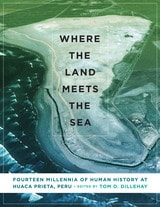
Where the Land Meets the Sea
Fourteen Millennia of Human History at Huaca Prieta, PeruEdited by Tom D. Dillehay
University of Texas Press, 2017
Huaca Prieta—one the world’s best-known, yet least understood, early maritime mound sites—and other Preceramic sites on the north coast of Peru bear witness to the beginnings of civilization in the Americas. Across more than fourteen millennia of human occupation, the coalescence of maritime, agricultural, and pastoral economies in the north coast settlements set in motion long-term biological and cultural transformations that led to increased social complexity and food production, and later the emergence of preindustrial states and urbanism. These developments make Huaca Prieta a site of global importance in world archaeology.
This landmark volume presents the findings of a major archaeological investigation carried out at Huaca Prieta, the nearby mound Paredones, and several Preceramic domestic sites in the lower Chicama Valley between 2006 and 2013 by an interdisciplinary team of more than fifty international specialists. The book’s contributors report on and analyze the extensive material records from the sites, including data on the architecture and spatial patterns; floral, faunal, and lithic remains; textiles; basketry; and more. Using this rich data, they build new models of the social, economic, and ontological practices of these early peoples, who appear to have favored cooperation and living in harmony with the environment over the accumulation of power and the development of ruling elites. This discovery adds a crucial new dimension to our understanding of emergent social complexity, cosmology, and religion in the Neolithic period.
Where the North Sea Touches Alabama
Allen C. Shelton
University of Chicago Press, 2013
A few years later, 180 miles away from Keim’s grave, a bulldozer operator uncovered a pine coffin in an old beaver swamp down the road from Allen C. Shelton’s farm. He quickly reburied it, but Shelton, a friend of Keim’s who had a suitcase of his unfinished projects, became convinced that his friend wasn’t dead and fixed in the ground, but moving between this world and the next in a traveling coffin in search of his incomplete work.
In Where the North Sea Touches Alabama, Shelton ushers us into realms of fantasy, revelation, and reflection, paced with a slow unfurling of magical correspondences. Though he is trained as a sociologist, this is a genre-crossing work of literature, a two-sided ethnography: one from the world of the living and the other from the world of the dead.
What follows isn’t a ghost story but an exciting and extraordinary kind of narrative. The psycho-sociological landscape that Shelton constructs for his reader is as evocative of Kafka, Bataille, and Benjamin as it is of Weber, Foucault, and Marx. Where the North Sea Touches Alabama is a work of sociological fictocriticism that explores not only the author’s relationship to the artist but his physical, historical, and social relationship to northeastern Alabama, in rare style.
Where the River Ends
Contested Indigeneity in the Mexican Colorado DeltaShaylih Muehlmann
Duke University Press, 2013
Where the Wind Blows Us
Practicing Critical Community Archaeology in the Canadian NorthNatasha Lyons
University of Arizona Press, 2013
Lyons offers an extended case study of her work with the Inuvialuit community of the Canadian Western Arctic. She documents the development of this longstanding research relationship and presents both the theoretical and practical products of the work to date. Integrating knowledge drawn from archaeology, ethnography, oral history, and community interviews, Lyons utilizes a multivocal approach that actively listens to Inuvialuit speak about their rich and textured history.
The overall significance of this volume lies in outlining a method of practicing archaeology that embraces local ways of knowing with a critically constructed and evolving methodology that is responsive to community needs. It will serve as a handbook to mine for elements of critical practice, a model of community-based archaeology, and a useful set of concepts and examples for classroom study.

Where the Wires End
Stories from the Digital DivideChristopher Ali
University of Chicago Press, 0
The stories of those without access to broadband services—and an urgent call for their connection.
The average American will spend years of their lives online. For many, the Internet is life, facilitating employment, education, commerce, and connection. But imagine students who only have online access in the early hours of the morning, when the sun is down, and the Internet traffic is low. Imagine living through a pandemic without Internet access because you can’t afford the monthly subscription. Imagine a first responder unable to find a strong enough signal to seek life-saving services. In this eye-opening book, communications scholar Christopher Ali shares such stories—and calls for policymakers, broadband companies, and governments to connect these communities with meaningful, affordable broadband.
It may seem unthinkable that tens of millions of people across the country are unable to access the Internet because of a lack of infrastructure; a computer; affordable broadband subscription options; or training, support, and skills. These people, some who are still using dial-up connections, are part of what is often called “the digital divide.” Where the Wires End brings them into the broadband policy conversation, incorporating interviews, surveys, focus groups, and field visits with individuals, communities, and organizations across the country, from inner-city Pittsburgh to the Hoopa Valley Indian Reservation in California. Ali focuses on the stories of those without access to broadband and those who work to get them attention and connection. He then links these stories to ongoing policy issues, demonstrating how we all benefit from a more empathetic approach to broadband policy that is digitally equitable, inclusive, and ultimately, more successful.
Where's the Rhetoric?
Imagining a Unified FieldS. Scott Graham
The Ohio State University Press, 2020
Building on this foundation, Graham then argues for a more unified approach to contemporary rhetorical inquiry—one that eschews disciplinary demarcations between rhetoric’s various subareas. Specifically, Graham uses his unified field theory to explore 1) the rise of the “tweetorial” as a parascientific genre, 2) inventional practices in new media design, 3) statistical approaches to understanding biomedical discourse, and 4) American electioneering rhetorics. The book overall demonstrates how seemingly disparate intellectual approaches within rhetoric can be made to speak productively to one another in the pursuit of shared scholarly goals around questions of genre, media, and political discourse—thereby providing a foundation for imagining a more unified field.
Whether a Christian Woman Should Be Educated and Other Writings from Her Intellectual Circle
Anna Maria van Schurman
University of Chicago Press, 1998
Gathered here in meticulous translation are Anna Maria van Schurman's defense of women's education, her letters to other learned women, and her own account of her early life, as well as responses to her work from male contemporaries, and rare writings by Schurman's mentor, Voetius. This volume will interest the general reader as well as students of women's, religious, and social history.

Which Team Are You On?
Visibility and Gender Dissidence in Brazilian SoccerC. K. Snyder
University of Texas Press, 0
Examines how Brazilian soccer’s trailblazers—women, gay men, and trans players—leverage their visibility to fight marginalization and advance gender justice.
In Brazil, national identity is tightly bound up with soccer. In turn, soccer leaves a masculinist and heteronormative mark on what it means to be Brazilian. After all, for much of the twentieth century, the law deemed futbol “incompatible with female nature,” and women were banned from participating. Though the prohibition was lifted in 1979, the national soccer culture continued to serve the reproduction of a gendered society.
Which Team Are You On? develops theoretical and ethnographic insights into the struggle of dissident athletes for recognition and redistribution. By tracing three groundbreaking "firsts"—pioneer women Olympians, the national LGBTQ+ league (LiGay), and Brazil’s first trans team, the Meninos Bons de Bola—C. K. Snyder examines the athletes’ “visibility dilemma,” in which being seen is essential for legitimacy as futebolistas yet dangerously exposes players to violence and backlash. Snyder argues that, today, soccer is a key battleground for gender justice in Brazil, as a surging reactionary movement lays claim to the nation’s proud sporting heritage, placing women, gay, and trans athletes at even greater risk. To fight back, they take to the pitch, continuing to demand not only respect but also a place in the life of their country.

Whispered Consolations
Law and Narrative in African American LifeJon-Christian Suggs
University of Michigan Press, 2000
Whispering Truth to Power
Everyday Resistance to Reconciliation in Postgenocide RwandaSusan Thomson
University of Wisconsin Press, 2013
“Reveals the lengths [to which] the current government has gone to restructure all spaces of Rwandan society, and how Rwandans continue to resist this state interference in their everyday lives.”—Ethnic and Racial Studies
“Thomson’s elegant research is praiseworthy and her arguments are forthright. . . . This important publication will be of great value to scholars of Rwanda and genocide as well as students of reconciliation politics and transitional justice.”—Human Rights Quarterly
“Sobering and disturbing. . . . The peasant peoples’ resistance to official policies of national unity and reconciliation emerged because these national schemes do not reflect the peasants’ own lived realities and experiences of state power, genocide, and day-to-day living within their communities. Instead, these official policies disrupt everyday life and endanger existing networks of mutual support and dependence.”—Canadian Journal of Development Studies
Outstanding Academic Title, Choice Magazine