Results by title
496 books match the query 'Jewish' and 3 start with y

Year Zero of the Arab-Israeli Conflict 1929
Hillel Cohen
Brandeis University Press, 2015
In late summer 1929, a countrywide outbreak of Arab-Jewish-British violence transformed the political landscape of Palestine forever. In contrast with those who point to the wars of 1948 and 1967, historian Hillel Cohen marks these bloody events as year zero of the Arab-Israeli conflict that persists today. The murderous violence inflicted on Jews caused a fractious—and now traumatized—community of Zionists, non-Zionists, Ashkenazim, and Mizrachim to coalesce around a unified national consciousness arrayed against an implacable Arab enemy. While the Jews unified, Arabs came to grasp the national essence of the conflict, realizing that Jews of all stripes viewed the land as belonging to the Jewish people. Through memory and historiography, in a manner both associative and highly calculated, Cohen traces the horrific events of August 23 to September 1 in painstaking detail. He extends his geographic and chronological reach and uses a non-linear reconstruction of events to call for a thorough reconsideration of cause and effect. Sifting through Arab and Hebrew sources—many rarely, if ever, examined before—Cohen reflects on the attitudes and perceptions of Jews and Arabs who experienced the events and, most significantly, on the memories they bequeathed to later generations. The result is a multifaceted and revealing examination of a formative series of episodes that will intrigue historians, political scientists, and others interested in understanding the essence—and the very beginning—of what has been an intractable conflict.
[more]
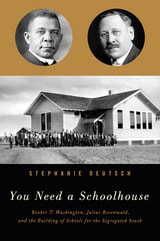
You Need a Schoolhouse
Booker T. Washington, Julius Rosenwald, and the Building of Schools for the Segregated SouthStephanie Deutsch
Northwestern University Press, 2011
Booker T. Washington, the founder of Tuskegee Institute, and Julius Rosenwald, the president of Sears, Roebuck, and Company, first met in 1911 at a Chicago luncheon. By charting the lives of these two men both before and after the meeting, Stephanie Deutsch offers a fascinating glimpse into the partnership that would bring thousands of modern schoolhouses to African American communities in the rural South in the era leading up to the civil rights movement. Trim and vital at just shy of fifty, Rosenwald was the extraordinarily rich chairman of one of the nation’s largest businesses, interested in using his fortune to do good not just in his own Jewish community but also to promote the well-being of African Americans.
Washington, though widely admired, had weathered severe crises both public and private in his fifty-six years. He had dined with President Theodore Roosevelt and drunk tea with Queen Victoria, but he had also been assaulted on a street in New York City. He had suffered personal heartbreak, years of overwork, and the discouraging knowledge that, despite his optimism and considerable success, conditions for African Americans were not improving as he had assumed they would. From within his own community, Washington faced the bitter charge of accommodationism that haunts his legacy to this day. Despite their differences, the two men would work together well and their collaboration would lead to the building of five thousand schoolhouses. By the time segregation ended, the “Rosenwald Schools” that sprang from this unlikely partnership were educating one third of the South’s African American children. These schoolhouses represent a significant step in the ongoing endeavor to bring high quality education to every child in the United States—an ideal that remains to be realized even today.
Washington, though widely admired, had weathered severe crises both public and private in his fifty-six years. He had dined with President Theodore Roosevelt and drunk tea with Queen Victoria, but he had also been assaulted on a street in New York City. He had suffered personal heartbreak, years of overwork, and the discouraging knowledge that, despite his optimism and considerable success, conditions for African Americans were not improving as he had assumed they would. From within his own community, Washington faced the bitter charge of accommodationism that haunts his legacy to this day. Despite their differences, the two men would work together well and their collaboration would lead to the building of five thousand schoolhouses. By the time segregation ended, the “Rosenwald Schools” that sprang from this unlikely partnership were educating one third of the South’s African American children. These schoolhouses represent a significant step in the ongoing endeavor to bring high quality education to every child in the United States—an ideal that remains to be realized even today.
[more]
You've Told Me Before
Jennifer Anne Moses
University of Wisconsin Press, 2025
Sometimes hilarious, sometimes sad, always compelling, the stories in this collection explore the many manifestations of being Jewish in a modern and largely secular world. Jennifer Anne Moses creates characters, mostly American, who are struggling with love, relationships, faith, tradition, family, and the ties that bind.
A professor of Jewish literature buys a lake house in the countryside with the aim of enjoying it with her husband, dogs, and grown sons, only to discover that her new neighbor is a sexist, dog-hating, and deeply antisemitic bully. The editor of a magazine devoted to lost languages resents the popularity of a younger, less sophisticated novelist, who happens to have been her student. A young woman tries to find her way after her fiancé calls off their wedding. With the contradictions, yearnings, imperfections, and longing for grace that beset all of us, these characters reach their own epiphanies—with results that are by turns breathtaking and heartbreaking.
A professor of Jewish literature buys a lake house in the countryside with the aim of enjoying it with her husband, dogs, and grown sons, only to discover that her new neighbor is a sexist, dog-hating, and deeply antisemitic bully. The editor of a magazine devoted to lost languages resents the popularity of a younger, less sophisticated novelist, who happens to have been her student. A young woman tries to find her way after her fiancé calls off their wedding. With the contradictions, yearnings, imperfections, and longing for grace that beset all of us, these characters reach their own epiphanies—with results that are by turns breathtaking and heartbreaking.
[more]