Results by title
28164 books match the query 'History' and 31 start with z

Zanzibar under Colonial Rule
Abdul Sheriff
Ohio University Press, 1991
Zanzibar stands at the center of the Indian Ocean system’s involvement in the history of Eastern Africa. This book follows on from the period covered in Abdul Sheriff’s acclaimed Slaves, Spices and Ivory in Zanzibar.
The first part of the book shows the transition of Zanzibar from the commercial economy of the nineteenth century to the colonial economy of the twentieth century.
The authors begin with the abolition of the slave trade in 1873 that started the process of transformation. They show the transition from slavery to colonial “free” labor, the creation of the capitalist economy, and the resulting social contradictions. They take the history up to formal independence in 1963 with a postscript on the 1964 insurrection.
In the second part the authors analyze social classes. The landlords and the merchants were dominant in the commercial empire of the nineteenth century and had difficulties in adjusting to the colonial condition. At the same time the development of capitalist farmers and a fully proletarianized working class was hindered.
The conservative administration could not resolve the contradictions of colonial capitalism, and the formation of a united nationalist movement was hampered. This period culminated in the insurrection of 1964, but the revolution could not be consummated without mature revolutionary classes.

Zapatista!
Reinventing Revolution in MexicoEdited by John Holloway and Eloina Pelaez
Pluto Press, 1998
Zapatistas
The Chiapas Revolt and What It Means For Radical PoliticsMihalis Mentinis
Pluto Press, 2006
The Zapatista Army for National Liberation burst onto the world stage on 1 January 1994. Zapatista commander Subcomandante Marcos announced a revolution, and declared war on the Mexican government and global capitalism. Since then, the Zapatistas have inspired thousands of activists across the world. They have attracted much attention from political theorists and analysts. Despite this, there is little consensus about the real nature and efficacy of the movement.
Zapatistas provides a bold new approach to understanding the insurrection. Mentinis spent nine months visiting the Zapatista autonomous zone, and the result is this unique exploration of the indigenous political theory emerging within the movement. Combining this with an analysis of the integrity of the Zaptista project, Mentinis draws on the concept of the 'event' from Badiou, ideas from Situationism, the 'project of autonomy' of Cornelius Castoriadis and the 'constituent power' of Antonio Negri, to present a rigourous account of the movement and the impact it has had on radical political theory.
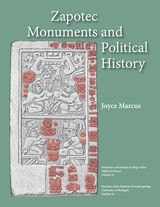
Zapotec Monuments and Political History
Joyce Marcus
University of Michigan Press, 2020
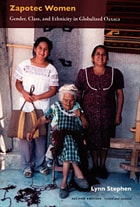
Zapotec Women
Gender, Class, and Ethnicity in Globalized OaxacaLynn Stephen
Duke University Press, 2005
Stephen presents new information about the weaving cooperatives women have formed over the last two decades in an attempt to gain political and cultural rights within their community and standing as independent artisans within the global market. She also addresses the place of Zapotec weaving within Mexican folk art and the significance of increased migration out of Teotitlán. The women weavers and merchants collaborated with Stephen on the research for this book, and their perspectives are key to her analysis of how gender relations have changed within rituals, weaving production and marketing, local politics, and family life. Drawing on the experiences of women in Teotitlán, Stephen considers the prospects for the political, economic, and cultural participation of other indigenous women in Mexico under the policies of economic neoliberalism which have prevailed since the 1990s.
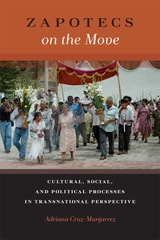
Zapotecs on the Move
Cultural, Social, and Political Processes in Transnational PerspectiveCruz-Manjarrez, Adriana
Rutgers University Press, 2013
Based on multi-site fieldwork conducted over a five-year period, Adriana Cruz-Manjarrez analyzes how and why Yalálag Zapotec identity and culture have been reconfigured in the United States, using such cultural practices as music, dance, and religious rituals as a lens to bring this dynamic process into focus. By illustrating the sociocultural, economic, and political practices that link immigrants in Los Angeles to those left behind, the book documents how transnational migration has reflected, shaped, and transformed these practices in both their place of origin and immigration.

Zaprudered
The Kennedy Assassination Film in Visual CultureBy Øyvind Vågnes
University of Texas Press, 2011
Winner, Peter C. Rollins Book Award, 2012
As the fiftieth anniversary of the Kennedy assassination approaches, the traumatic aspects of the tragedy continue to haunt our perceptions of the 1960s. One reason for this lies in the home movie of the incident filmed by Abraham Zapruder, a bystander who became one of the twentieth century's most important accidental documentarians.
The first book devoted exclusively to the topic, Zaprudered traces the journey of the film and its effect on the world's collective imagination. Providing insightful perspective as an observer of American culture, Norwegian media studies scholar Øyvind Vågnes begins by analyzing three narratives that are projections of Zapruder's images: performance group Ant Farm's video The Eternal Frame, Don DeLillo's novel Underworld, and an episode from Seinfeld. Subsequent topics he investigates include Dealey Plaza's Sixth Floor Museum, Zoran Naskovski's installation Death in Dallas, assassin video games, and other artifacts of the ways in which the footage has made a lasting impact on popular culture and the historical imagination. Vågnes also explores the role of other accidental documentarians, such as those who captured scenes of 9/11.
Zapruder's footage has never yielded a conclusive account of what happened in Dealey Plaza. Zaprudered thoroughly examines both this historical enigma and its indelible afterimages in our collective imagination.

Zealots for Zion
Inside Israel's West Bank Settlement MovementRobert I Friedman
Rutgers University Press, 1994
"With his sensitive reporter's eyes, Mr. Friedman takes us inside the settlement movement, to the synagogies, kitchen tables and television rooms where ordinary people talk of extraordinary things . . . . This is a chilling book. The contrast drawn between charming suburban lawns of settlement communities and the political threat they represent is sobering. The current Labor government in Israel, and American diplomats pursing the peace process, minimize the movement as an irritant that can be managed when the time comes. Anyone who knows about the tenacity of the settlers, as described by Mr. Friedman, dares not be so confident."--Peter Grose, The New York Times Book Review
"[Zealots for Zion] is among a new genre of works on Israel that . . . appears to be setting a higher standard of objectivity for studies of the Palestinian-Israeli conflict. . . . It is not only a penetrating look at the violence-prone Israeli zealots who are behind the aggressive establishment of Jewish settlements on Palestinian land in the occupied territories, but also at the Jewish Americans who encourage, justify and help fund them."--Donald Neff, The Washington Post Book World
"Above all else, Friedman documents the extent to which Israeli political figures have used the settler movement for their own purposes. He also argues convincingly that the general unwillingness of many Israelis to thwart the zealots poses a grave threat to the future of Palestinian-Israel relations and the tenuous chance of negotiating a peace between Israel and its Arab neighbors."--Rita E. Hauser, Tikkun
"The mystical mythology, yuppie yearnings, willful naivete and raw prejudices of those staking a claim to what they consider to be 'Greater Israel' have rarely been this revealingly and comprehensively documented."--Nisid Hajari, Newsday
The peace agreement between Israel and the Palestine Liberation Organization gives us hope for the future of the West Bank, but no one expects the transition to be easy. Who are the zealots who care so deeply about retaining that land for their own? Robert Friedman, a prize-winning writer, takes a hard, close look at the legacy of the controversial policy of building settlements in the Occupied Territories. Zealots for Zion is a shocking investigation of the movement by militant right-wing Zionists to reinstitute the ancient civilization of Eretz Yisrael (Greater Israel) on lands seized in the 1967 Six-Day War.
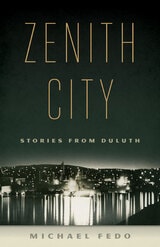
Zenith City
Stories from DuluthMichael Fedo
University of Minnesota Press, 2014
Duluth may be the city of “untold delights” as lampooned in a Kentucky congressman’s speech in 1871. Or it may be portrayed by a joke in Woody Allen’s film Manhattan. Or then again, it may be the “Zenith City of the unsalted seas” celebrated by Dr. Thomas Preston Foster, founder of the city’s first newspaper. But whatever else it may be, this city of granite hills, foghorns, and gritty history, the last stop on the shipping lanes of the Great Lakes, is undeniably a city with character—and characters. Duluth native Michael Fedo captures these characters through the happy-go-melancholy lens nurtured by the people and landscape of his youth. In Zenith City Fedo brings it back home. Framed by his reflections on Duluth’s colorful—and occasionally very dark—history and its famous visitors, such as Sinclair Lewis, Joe DiMaggio, and Bob Dylan, his memories make the city as real as the boy next door but with a better story.
Here, among the graceful, poignant, and often hilarious remembered moments—pranks played on a severe teacher, the family’s unlikely mob connections, a rare childhood affliction—are the coordinates of Duluth’s larger landscape: the diners and supper clubs, the baseball teams, radio days, and the smelt-fishing rites of spring. Woven through these tales of Duluth are Fedo’s curious, instructive, and ultimately deeply moving stories about becoming a writer, from the guidance of an English teacher to the fourteen-year-old reporter’s interview with Louis Armstrong to his absorption in the events that would culminate in his provocative and influential book The Lynchings in Duluth. These are the sorts of essays—personal, cultural, and historical, at once regional and far-reaching—that together create a picture of people in a place as rich in history and anecdote as Duluth and of the forces that forever bind them together.

Zhang Hongtu
Expanding Visions of a Shrinking WorldLuchia Meihua Lee and Jerome Silbergeld, editors
Duke University Press, 2015
From his early work in China during the Cultural Revolution to his decades as an artist in New York, Zhang reflects the complex attitudes of a scholar-artist toward modernity, as well as toward Asian and Western societies and himself. Placing Zhang in the context of his cultural milieu both in China and in the Chinese immigrant artist community in America, this volume's contributors examine his adaptations of classic art to reflect a contemporary sensibility, his relation to Cubism and Social Realism, his collaboration with the celebrated fashion designer Vivienne Tam, and his visual critique of China's current environmental crisis. Zhang's work will be on display at the Queens Museum in New York City from October 17, 2015 to March 6, 2016.
Contributors: Julia F. Andrews, Alexandra Chang, Tom Finkelpearl, Michael Fitzgerald, Wu Hung, Luchia Meihua Lee, Morgan Perkins, Kui Yi Shen, Jerome Silbergeld, Eugenie Tsai, Thuy Linh Nguyen Tu, Lilly Wei
Co-published by the Queens Museum and Duke University Press.
Zig-Zag-and-Swirl
Alfred W. Lawson's Quest for GreatnessLyell D. Henry
University of Iowa Press, 1991
Zion Canyon
A Storied LandText by Greer K. Chesher; Photographs by Michael Plyler
University of Arizona Press, 2007
Greer K. Chesher brings us the first personal and in-depth look at Zion. In striking and elegant prose, she vividly recounts experiences that only a park ranger and resident of the region for more than two decades could have. She also lucidly explains the area’s natural and geological wonders, including the dynamics of Zion’s ecology, changes to plant and animal species wrought through human technology, and what these changes mean for the future.
Beyond the region’s amazing array of flora and fauna, she describes the landscape’s lasting imprint on settlers and current residents, and explains the politics that have long surrounded its protection. Award-winning photographer Michael Plyler, also a resident of the region, captures the allure of the park in spectacular images that illustrate the intimate details and geological wonder of the place. These exquisite photographs make this book a stunning pictorial as well as literary tribute to a place that is known to so many but about which so little is truly understood.
Zion in the Courts
A Legal History of the Church of Jesus Christ of Latter-day Saints, 1830-1900Edwin Brown Firmage and Richard Collin Mangrum
University of Illinois Press, 1988
This first paperback edition includes two new introductory pieces in which the authors discuss the Mormon emphasis on settling disputes outside the court, a practice that foreshadows current trends toward arbitration and mediation.
Zion in the Valley, Volume I
The Jewish Community of St. Louis, Volume I, 1807-1907Walter Ehrlich
University of Missouri Press, 1997
St. Louis contains one of the largest Jewish communities in the interior of the United States. Yet, despite the important contributions of St. Louis Jews to the city's cultural and economic growth and to national and international Jewry, no history of their accomplishments has heretofore been written.
In this masterful book, Walter Ehrlich shows how the St. Louis Jewish community grew in two separate yet intricately related milieux. One was the internal socioreligious community, which centered on relations of Jews with fellow Jews. The other was the broader secular environment, in which Jews individually and collectively interacted with the non-Jewish population, assuming significant roles in the political, economic, social, and religious developments of one of the country's most important urban centers.
Employing many previously unused primary materials--especially congregational archives, organizational and business records, contemporary newspapers, and vivid personal memoirs--Ehrlich presents a fascinating description of how individuals and groups contributed to the growth and development of a major American urban area. He clarifies significant aspects of social and economic structure, mobility, and philanthropy within the Jewish community and integrates them within the broader framework of American society. In the process, Ehrlich provides a unique perspective on St. Louis history, as well as on American urban, ethnic, and immigration history.
Zion in the Valley is an invaluable contribution to the field of Jewish studies. It will appeal to scholars and students of Jewish, urban, and ethnic history, as well as to members of the broader St. Louis community.
Zion in the Valley, Volume II
The Jewish Community of St. Louis, Volume II, The Twentieth CenturyWalter Ehrlich
University of Missouri Press, 2002
Zion on the Hudson
Dutch New York and New Jersey in the Age of RevivalsFabend, Firth Haring
Rutgers University Press, 2000
Winner of the 2001 New Jersey Author's Award by the New Jersey Academic Alliance
The Dutch came to the New World in the seventeenth century as explorers and traders, but religion soon followed, for it was accepted in the Netherlands that state and church were mutually benefited by advancing the “true Christian religion.” The influence of “Dutchness”—defined here as loyalty to what are presumed to be the distinctive qualities of Dutch national character and culture—persisted in New York and New Jersey for more than 200 years after Dutch emigration ended. Why?
Firth Haring Fabend finds the explanation in the devotion of the Reformed Dutch Church membership to the doctrines and traditions of their church. She looks at the individual and personal beliefs and behaviors of this often-neglected ethnic group. Thus, Zion on the Hudson presents both a broad and an intimate look at the way one mainstream Protestant denomination dealt with the transformative events of the evangelical era.
As Fabend describes the efforts of the Dutch to preserve the European standards and traditions of their church, while developing a taste for a new kind of theology and a preference for an American identity, she documents how Dutchness finally became a historical memory. The Americanization of the Reformed Dutch Church, Fabend writes, is a microcosm of the story of the Americanization of the United States itself.
Zionism and the Melting Pot
Preachers, Pioneers, and Modern Jewish PoliticsM. M. Silver
University of Alabama Press, 2020
Zionism and the Melting Pot pivots away from commonplace accounts of the origins of Jewish politics and focuses on the ongoing activities of actors instrumental in the theological, political, diplomatic, and philanthropic networks that enabled the establishment of new Jewish communities in Palestine and the United States. M. M. Silver’s innovative new study highlights the grassroots nature of these actors and their efforts—preaching, fundraising, emigration campaigns, and mutual aid organizations—and argues that these activities were not fundamentally ideological in nature but instead grew organically from traditional Judaic customs, values, and community mores.
Silver examines events in three key locales—Ottoman Palestine, czarist Russia and the United States—during a period from the early 1870s to a few years before World War I. This era which was defined by the rise of new forms of anti-Semitism and by mass Jewish migration, ended with institutional and artistic expressions of new perspectives on Zionism and American Jewish communal life. Within this timeframe, Silver demonstrates, Jewish ideologies arose somewhat amorphously, without clear agendas; they then evolved as attempts to influence the character, pace, and geographical coordinates of the modernization of East European Jews, particularly in, or from, Russia’s czarist empire.
Unique in his multidisciplinary approach, Silver combines political and diplomatic history, literary analysis, biography, and organizational history. Chapters switch successively from the Zionist context, both in the czarist and Ottoman empires, to the United States’ melting-pot milieu. More than half of the figures discussed are sermonizers, emissaries, pioneers, or writers unknown to most readers. And for well-known figures like Theodor Herzl or Emma Lazarus, Silver’s analysis typically relates to texts and episodes that are not covered in extant scholarship. By uncovering the foundations of Zionism—the Jewish nationalist ideology that became organized formally as a political movement—and of melting-pot theories of Jewish integration in the United States, Zionism and the Melting Pot breaks ample new ground.
Zionism in Translation
Encounters in the German-Hebrew ArchiveNa'ama Rokem
University of Chicago Press, 2026
Examining a network of correspondences and encounters that cross between German and Hebrew, Zionism in Translation argues that the space between the languages enabled ambivalent conversations about the foundation of the State of Israel.
Zionism in Translation concerns exchanges—primarily of letters but also drafts, reviews, and other ephemera—sent to or from Jerusalem in the decades after 1948. All were written in German and Hebrew by a fascinating range of literary figures, including Hannah Arendt, Gershom Scholem, Yehuda Amichai, Ludwig Strauss, Erich Auerbach, Walter Benjamin, Leah Goldberg, Peter Szondi, Paul Celan, and Tuvia Ruebner. Na’ama Rokem illuminates the complexities that emerge as the two languages mix in this extraordinary epistolary network.
The writers that Rokem studies here contend with the genocidal violence that brought the rich historical relation between German and Hebrew to a seeming end. They also grapple, in different ways, with the new reality in Israel/Palestine in the wake of the founding of the State of Israel and the Palestinian Nakba. The bilingual conversation that crosses over between German and Hebrew in these letters thus centers around the question of Jewish fate in the twentieth century and is immersed in negotiations about Jewish nationalism, the Zionist movement, and the possibilities of Jewish poetry. In the space between German and Hebrew, Rokem argues, the protagonists of her story voice ambivalences and hesitancies not found elsewhere.
Zionism in Translation joins a growing body of scholarship that uncovers the complex modes of belonging and resistance that unfold around the Zionist movement in the twentieth century. It will interest all readers concerned with modern Jewish intellectual, cultural, and literary history, the history of Zionism, and writers such as Arendt or Celan.
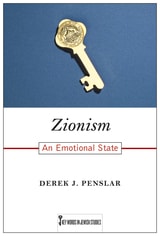
Zionism
An Emotional StateDerek J. Penslar
Rutgers University Press, 2023
Finalist for the National Jewish Book Award for Modern Jewish Thought and Experience.
Emotion lies at the heart of all national movements, and Zionism is no exception. For those who identify as Zionist, the word connotes liberation and redemption, uniqueness and vulnerability. Yet for many, Zionism is a source of distaste if not disgust, and those who reject it are no less passionate than those who embrace it. The power of such emotions helps explain why a word originally associated with territorial aspiration has survived so many years after the establishment of the Israeli state.
Zionism: An Emotional State expertly demonstrates how the energy propelling the Zionist project originates from bundles of feeling whose elements have varied in volume, intensity, and durability across space and time. Beginning with an original typology of Zionism and a new take on its relationship to colonialism, Penslar then examines the emotions that have shaped Zionist sensibilities and practices over the course of the movement’s history. The resulting portrait of Zionism reconfigures how we understand Jewish identity amidst continuing debates on the role of nationalism in the modern world.

Zion’s Last Frontier
LDS Ranchers, Federal Regulators, and the Clash of the New West in Capitol Reef Country, UtahThomas E. Sheridan
University of Arizona Press, 2026
Zion’s Last Frontier is a historical ethnography that documents the uniquely Latter-Day Saints (Mormon) ranching community around Capitol Reef National Park in south-central Utah over the last 150 years.
From the arrival of the first LDS pioneers in the 1870s to fifth- and sixth-generation descendants of those pioneers today, anthropologist Thomas E. Sheridan documents their ongoing struggles with the federal and state agencies that control 96 percent of the land they ranch. Changing policies and management philosophies profoundly impact the ranchers’ livelihoods and ways of life. Sheridan argues that the ranchers should qualify as Traditionally Associated People. Only one allotment on the Park remains, but the Park still allows ranchers to drive their cattle on horseback along the few canyons that cut through the Waterpocket Fold as they move their herds from their traditional summer grazing lands to their winter grazing lands.
Pushing beyond binary arguments, Sheridan offers an empathetic look at the lived experiences of rural communities often mischaracterized in debates over public lands and environmentalism. Tensions have been aggravated by a massive increase in the number of tourists that swarm the area in the warmer months and a steady increase in the number of seasonal residents who build second homes there.
Zion’s Last Frontier provides an in-depth look at the clash of cultures between the agrarian Old West and the New West of tourism and second-homers that is playing itself out across so many parts of the rural West today.
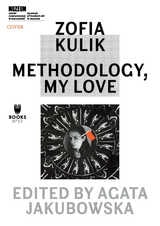
Zofia Kulik
Methodology, My LoveEdited by Agata Jakubowska
Museum of Modern Art in Warsaw, 2019
Zombie History
Lies About Our Past that Refuse to DiePeter Charles Hoffer
University of Michigan Press, 2020
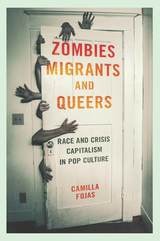
Zombies, Migrants, and Queers
Race and Crisis Capitalism in Pop CultureCamilla Fojas
University of Illinois Press, 2017
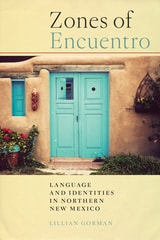
Zones of Encuentro
Language and Identities in Northern New MexicoLillian Gorman
The Ohio State University Press, 2024
Winner, 2025 New Mexico Book Awards, Multicultural Category
Finalist, New Mexico Book Awards, BIPOC Author or Subject Category and First Book Category
Working at the intersection of Latina/o/x cultural studies, sociocultural linguistics, and Chicana feminist studies, Lillian Gorman’s Zones of Encuentro takes an in-depth look at the cultural and linguistic interactions between two distinct Latina/o/x communities in the region: Nuevomexicanos (Hispanic people who trace their presence in the region to colonial times and whose families have historically spoken Traditional New Mexican Spanish, or TNMS) and first-generation Mexicano immigrants (who tend to speak Mexican Spanish). Gorman examines the everyday lived language experiences and ethnolinguistic identities of Mexicanos and Nuevomexicanos together, specifically through the case of mixed Mexicano-Nuevomexicano families. Through an interdisciplinary critical reading of ethnographic data, pláticas (informal conversations that gather family and community knowledge), interviews, articles, and historical memoirs, Gorman analyzes language ideologies, identity formations, and language practices by exploring complex spaces of encounter within Mexicano-Nuevomexicano families. Zones of Encuentro complicates homogeneous notions of language and identity and contemplates what a shared cultural and linguistic homeplace looks like for Mexicanos and Nuevomexicanos in northern New Mexico.
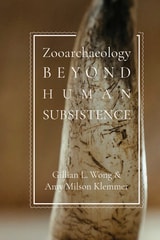
Zooarchaeology beyond Human Subsistence
Gillian L. Wong and Amy Milson Klemmer, eds.
University of Utah Press, 2025
In this dynamic volume, Gillian L. Wong and Amy Milson Klemmer present seven groundbreaking chapters that delve into the diverse ways humans have interacted with animals in the past, as revealed through archaeological research into animal remains. Zooarchaeology beyond Human Subsistence explores a wide range of topics, from the role of animals in trade and prestige to their influence on cultural development and the shared spaces humans and animals occupied. The studies also highlight the importance of community engagement, showcasing collaborations between archaeologists and heritage communities.
Ideal for professionals and enthusiasts in archaeology, anthropology, zoology, biology, ecology, history, and beyond, this book offers a fresh perspective on zooarchaeology, emphasizing human-animal bonds, trade, ritual, and environmental impacts. With Spanish translations for chapters on South America, this volume invites a broader audience to explore the intricate web of human-animal interactions throughout history, offering insights far beyond mere subsistence.
Zooarchaeology of Six Prehistoric Sites in the Sierra Blanca Region, New Mexico
Jonathan C. Driver
University of Michigan Press, 1985

Zoom-In to Madisonville
Penelope Ballard Drooker
University of Michigan Press, 0
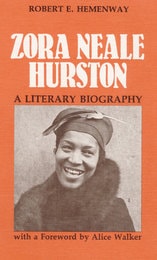
Zora Neale Hurston
A Literary BiographyRobert E. Hemenway. Foreword by Alice Walker
University of Illinois Press, 1977
The life and work of the iconic author and intellectual
Zora Neale Hurston transformed each hour of her life into something bubbling, exuberant, and brimming with joy. Robert Hemenway’s biography is a towering portrait of the novelist, folklorist, and anthropologist. Drawing on archival documents and interviews with people who knew her, Hemenway explores Hurston’s art and work, from her extraordinary novels and autobiography to a popular treatment of black folkways that revealed her deep commitment to the black folk tradition. He also provides a sensitive look at her two marriages; her relationships with Mrs. R. Osgood Mason, Franz Boas, and Langston Hughes; her time as a member of the black literati of the 1920s and 1930s; and the penniless final years leading to her death.
Sophisticated and original, Zora Neale Hurston tells the compelling story of a woman who reveled in a fully lived life dedicated to a lasting art and the preservation of a vital cultural heritage.
Zora Neale Hurston
And A History Of Southern LifeTiffany Ruby Patterson
Temple University Press, 2005
Zuñi Coyote Tales
Frank Hamilton Cushing
University of Arizona Press, 1998
These tales pit the wily Coyote against various demons and other creatures in order to convey simple lessons or explain animal characteristics or behavior. They tell how the tip of the coyote's tail became black after dancing with blackbirds and how coyotes learned never to insult horned-toads—and to keep clear of burrowing-owls. Through these tales, we learn why Coyote meddles with everything that does not concern him, makes a universal nuisance of himself, and is ready to jump into any trap laid for him.
Zworykin, Pioneer of Television
Albert Abramson. Foreword by Erik Barnouw
University of Illinois Press, 1995
"His achievements rank him with Thomas Edison and Alexander Graham Bell," states Albert Abramson in this discerning, often dramatic biography of Vladimir Kosma Zworykin, the Russian-born scientist who "did more to create our present system of cathode-ray television than any other person."