Results by title
645 books match the query 'Judaism' and 4 start with z
Zer Rimonim
Studies in Biblical Literature and Jewish Exegesis Presented to Professor Rimon KasherMichael Avioz
SBL Press, 2013
An engaging collection of essays in honor of Professor Rimon Kasher
Zer Rimonim includes papers of interest to Professor Kasher in the areas of the Hebrew Bible and the ancient Near East and Jewish interpretations of the Hebrew Bible. Contributors from a variety of Israeli universities include Yairah Amit, Elie Assis, Jonathan Ben-Dov, Joshua Berman, Gershon Brin, Hezi Cohen, Tmima Davidovitz, David Elgavish, Brachi Elitzur, Yitzhaq Feder, Joseph Fleishman, Gershon Galil, Tova Ganzel, Isaac Gottlieb, Edward L. Greenstein, Jonathan Grossman, Mayer Gruber, Jair Haas, Jonathan Jacobs, Bustenay Oded, Yosef Ofer, Jordan S. Penkower, Yosi Peretz, Frank Polak, Meira Poliak, Moshe Rachimi, Ayelet Seidler, Yael Shemesh, Shimon Shtober, Nili Shupak, Uriel Simon, Miriam Sklarz, Yechiel Tzeitkin, Shmuel Vargon, Eran Viezel, and Yair Zakovitch.
Features:
- Essays in modern Hebrew
- Coverage of topics related to the Hebrew Bible, key rabbinic interpreters, and Karaitic and Byzantine interpretations
- English table of contents, front matter, and abstracts
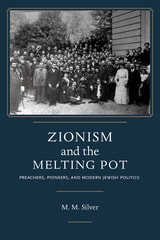
Zionism and the Melting Pot
Preachers, Pioneers, and Modern Jewish PoliticsM. M. Silver
University of Alabama Press, 2020
Zionism and the Melting Pot pivots away from commonplace accounts of the origins of Jewish politics and focuses on the ongoing activities of actors instrumental in the theological, political, diplomatic, and philanthropic networks that enabled the establishment of new Jewish communities in Palestine and the United States. M. M. Silver’s innovative new study highlights the grassroots nature of these actors and their efforts—preaching, fundraising, emigration campaigns, and mutual aid organizations—and argues that these activities were not fundamentally ideological in nature but instead grew organically from traditional Judaic customs, values, and community mores.
Silver examines events in three key locales—Ottoman Palestine, czarist Russia and the United States—during a period from the early 1870s to a few years before World War I. This era which was defined by the rise of new forms of anti-Semitism and by mass Jewish migration, ended with institutional and artistic expressions of new perspectives on Zionism and American Jewish communal life. Within this timeframe, Silver demonstrates, Jewish ideologies arose somewhat amorphously, without clear agendas; they then evolved as attempts to influence the character, pace, and geographical coordinates of the modernization of East European Jews, particularly in, or from, Russia’s czarist empire.
Unique in his multidisciplinary approach, Silver combines political and diplomatic history, literary analysis, biography, and organizational history. Chapters switch successively from the Zionist context, both in the czarist and Ottoman empires, to the United States’ melting-pot milieu. More than half of the figures discussed are sermonizers, emissaries, pioneers, or writers unknown to most readers. And for well-known figures like Theodor Herzl or Emma Lazarus, Silver’s analysis typically relates to texts and episodes that are not covered in extant scholarship. By uncovering the foundations of Zionism—the Jewish nationalist ideology that became organized formally as a political movement—and of melting-pot theories of Jewish integration in the United States, Zionism and the Melting Pot breaks ample new ground.
Zionism in Translation
Encounters in the German-Hebrew ArchiveNa'ama Rokem
University of Chicago Press, 2026
Examining a network of correspondences and encounters that cross between German and Hebrew, Zionism in Translation argues that the space between the languages enabled ambivalent conversations about the foundation of the State of Israel.
Zionism in Translation concerns exchanges—primarily of letters but also drafts, reviews, and other ephemera—sent to or from Jerusalem in the decades after 1948. All were written in German and Hebrew by a fascinating range of literary figures, including Hannah Arendt, Gershom Scholem, Yehuda Amichai, Ludwig Strauss, Erich Auerbach, Walter Benjamin, Leah Goldberg, Peter Szondi, Paul Celan, and Tuvia Ruebner. Na’ama Rokem illuminates the complexities that emerge as the two languages mix in this extraordinary epistolary network.
The writers that Rokem studies here contend with the genocidal violence that brought the rich historical relation between German and Hebrew to a seeming end. They also grapple, in different ways, with the new reality in Israel/Palestine in the wake of the founding of the State of Israel and the Palestinian Nakba. The bilingual conversation that crosses over between German and Hebrew in these letters thus centers around the question of Jewish fate in the twentieth century and is immersed in negotiations about Jewish nationalism, the Zionist movement, and the possibilities of Jewish poetry. In the space between German and Hebrew, Rokem argues, the protagonists of her story voice ambivalences and hesitancies not found elsewhere.
Zionism in Translation joins a growing body of scholarship that uncovers the complex modes of belonging and resistance that unfold around the Zionist movement in the twentieth century. It will interest all readers concerned with modern Jewish intellectual, cultural, and literary history, the history of Zionism, and writers such as Arendt or Celan.
Zionism
An Emotional StateDerek J. Penslar
Rutgers University Press, 2023
Finalist for the National Jewish Book Award for Modern Jewish Thought and Experience.
Emotion lies at the heart of all national movements, and Zionism is no exception. For those who identify as Zionist, the word connotes liberation and redemption, uniqueness and vulnerability. Yet for many, Zionism is a source of distaste if not disgust, and those who reject it are no less passionate than those who embrace it. The power of such emotions helps explain why a word originally associated with territorial aspiration has survived so many years after the establishment of the Israeli state.
Zionism: An Emotional State expertly demonstrates how the energy propelling the Zionist project originates from bundles of feeling whose elements have varied in volume, intensity, and durability across space and time. Beginning with an original typology of Zionism and a new take on its relationship to colonialism, Penslar then examines the emotions that have shaped Zionist sensibilities and practices over the course of the movement’s history. The resulting portrait of Zionism reconfigures how we understand Jewish identity amidst continuing debates on the role of nationalism in the modern world.