Results by title
17 books match the query 'Abyss'

At the Edge of the Abyss
A Concentration Camp Diary, 1943-1944David Koker; Edited by Robert Jan van Pelt; Translated from the Dutch by Michiel Horn and John Irons
Northwestern University Press, 2012
Finalist for 2012 National Jewish Book Award in the Holocaust category
David Koker's diary is one of the most notable accounts of life in a German concentration camp written by a Jew during the years of the Holocaust. First brought to attention when the Dutch historian Jacob Presser-Koker's history teacher in high school-quoted from Koker's diary in his monumental history, published in English as The Destruction of the Dutch Jews (1968), the diary itself became a part of the Dutch literary canon when it was published in 1977 as Dagboek geschreven in Vught (Diary Written in Vught). It has remained in print ever since, and is notable for its literary qualities, weaving poetry and powerful observations of the emotional life of a camp prisoner, including reflections after an in-person visit by Heinrich Himmler. Surprisingly, the book has never before been translated into English.
During his time in the Vught concentration camp, the 21-year-old David recorded on an almost daily basis his observations, thoughts, and feelings. He mercilessly probed the abyss that opened around him and, at times, within himself. David's diary covers almost a year, both charting his daily life in Vught as it developed over time and tracing his spiritual evolution as a writer. Until early February 1944, David was able to smuggle some 73,000 words from the camp to his best friend Karel van het Reve, a non-Jew.
With an informative introduction, annotation, and list of dramatis personae by Robert Jan van Pelt, At the Edge of the Abyss offers an immediate and wholly original look into the life of a concentration camp prisoner.
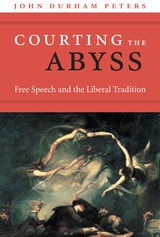
Courting the Abyss
Free Speech and the Liberal TraditionJohn Durham Peters
University of Chicago Press, 2005
A mesmerizing account of the role of public communication in the Anglo-American world, Courting the Abyss shows that liberty's earliest advocates recognized its fraternal relationship with wickedness and evil. While we understand freedom of expression to mean "anything goes," John Durham Peters asks why its advocates so often celebrate a sojourn in hell and the overcoming of suffering. He directs us to such well-known sources as the prose and poetry of John Milton and the political and philosophical theory of John Locke, Adam Smith, John Stuart Mill, and Oliver Wendell Holmes Jr., as well as lesser-known sources such as the theology of Paul of Tarsus. In various ways they all, he shows, envisioned an attitude of self-mastery or self-transcendence as a response to the inevitable dangers of free speech, a troubled legacy that continues to inform ruling norms about knowledge, ethical responsibility, and democracy today.
A world of gigabytes, undiminished religious passion, and relentless scientific discovery calls for a fresh account of liberty that recognizes its risk and its splendor. Instead of celebrating noxious doctrine as proof of society's robustness, Courting the Abyss invites us to rethink public communication today by looking more deeply into the unfathomable mystery of liberty and evil.

Ernst Jünger and Germany
Into the Abyss, 1914-1945Thomas R. Nevin
Duke University Press, 1996
Ernst Jünger is in many ways Germany’s conscience, and much of the controversy surrounding him is at its source measured by his relation to the Nazis and Nazi culture. But as Nevin suggests, Jünger can more specifically and properly be regarded as the still living conscience of a Germany that existed before Hitler. Although his memoir of service as a highly decorated lieutenant in World War I made him a hero to the Nazis, he refused to join the party. A severe critic of the Weimar Republic, he has often been denounced as a fascist who prepared the way for the Reich, but in 1939 he published a parable attacking despotism. Close to the men who plotted Hitler’s assassination in 1944, he narrowly escaped prosecution and death. Drawing largely on Jünger’s untranslated work, much of which has never been reprinted in Germany, Nevin reveals Jünger’s profound ambiguities and examines both his participation in and resistance to authoritarianism and the cult of technology in the contexts of his Wilhelmine upbringing, the chaos of Weimar, and the sinister culture of Nazism.
Winner of Germany’s highest literary awards, Ernst Jünger is regularly disparaged in the German press. His writings, as this book indicates, put him at an unimpeachable remove from the Nazis, but neo-Nazi rightists in Germany have rushed to embrace him. Neither apology, whitewash, nor vilification, Ernst Jünger and Germany is an assessment of the complex evolution of a man whose work and nature has been viewed as both inspiration and threat.
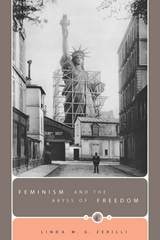
Feminism and the Abyss of Freedom
Linda M. G. Zerilli
University of Chicago Press, 2005
Offering both a discussion of feminism in its postmodern context and a critique of contemporary theory, Zerilli here challenges feminists to move away from a theory-based approach, which focuses on securing or contesting "women" as an analytic category of feminism, to one rooted in political action and judgment. She revisits the democratic problem of exclusion from participation in common affairs and elaborates a freedom-centered feminism as the political practice of beginning anew, world-building, and judging.
In a series of case studies, Zerilli draws on the political thought of Hannah Arendt to articulate a nonsovereign conception of political freedom and to explore a variety of feminist understandings of freedom in the twentieth century, including ones proposed by Judith Butler, Monique Wittig, and the Milan Women's Bookstore Collective. In so doing, Zerilli hopes to retrieve what Arendt called feminism's lost treasure: the original and radical claim to political freedom.
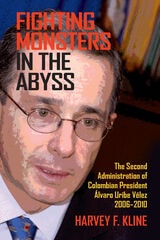
Fighting Monsters in the Abyss
The Second Administration of Colombian President Álvaro Uribe Vélez, 2006–2010Harvey F. Kline
University of Alabama Press, 2015
Studies the complex constraints and trade-offs the second administration of Colombian President Uribe (2006–2010) encountered as it attempted to resolve that nation’s violent Marxist insurrection and to have a more efficient judicial system
Fighting Monsters in the Abyss offers a deeply insightful analysis of the efforts by the second administration of Colombian President Álvaro Uribe Vélez (2006–2010) to resolve a decades-long Marxist insurgency in one of Latin America’s most important nations. Continuing work from his prior books about earlier Colombian presidents and yet written as a stand-alone study, Colombia expert Harvey F. Kline illuminates the surprising successes and setbacks in Uribe’s response to this existential threat.
In State Building and Conflict Resolution in Colombia, 1986–1994, Kline documented and explained the limited successes of Presidents Virgilio Barco and César Gaviria in putting down the revolutionaries while also confronting challenges from drug dealers and paramilitary groups. The following president Andrés Pastrana then boldly changed course and attempted resolution through negotiations, an effort whose failure Kline examines in Chronicle of a Failure Foretold. In his third book, Showing Teeth to the Dragons, Kline shows how in his first term President Álvaro Uribe Vélez more successfully quelled the insurrection through a combination of negotiated demobilization of paramilitary groups and using US backing to mount more effective military campaigns.
Kline opens Fighting Monsters in the Abyss with a recap of Colombia’s complex political history, the development of Marxist rebels and paramilitary groups and their respective relationships to the narcotics trade, and the attempts of successive Colombian presidents to resolve the crisis. Kline next examines the ability of the Colombian government to reimpose rule in rebel-controlled territories as well as the challenges of administering justice. He recounts the difficulties in the enforcement of the landmark Law of Justice and Peace as well as two significant government scandals, that of the “false positives” (“falsos positivos”) in which innocent civilians were killed by the military to inflate the body counts of dead insurgents and a second scandal related to illegal wiretapping.
In tracing Uribe’s choices, strategies, successes, and failures, Kline also uses the example of Colombia to explore a dimension quite unique in the literature about state building: what happens when some members of a government resort to breaking rules or betraying their societies’ values in well-intentioned efforts to build a stronger state?

Fire on Water
Porgess and The AbyssArnost Lustig
Northwestern University Press, 2005
It occurred to me why I was able to forgive the Italians, but never the Germans. Was it because the Italians never slept on mattresses stuffed with the hair of Luster Leibling or Weltfeind Flusser?
In this pair of short novels, Arnošt Lustig continues his lifelong project of creating a universe-at once concrete and dreamlike-to examine the horrors of the Holocaust and the impossible burden of living as a survivor.
The Abyss is the fragmented memories of David Wiesenthal, aged twenty, tortured by what he has witnessed and by the knowledge that luck-not skill, not courage, certainly not goodness-separated the survivors from the doomed. He seeks solace remembering the women he's loved or desired, even the one who represents his death.
In Porgess, the narrator recounts the life of the title character, "the most handsome boy in Jewish Prague" who was paralyzed on the last day of World War II. The two discuss their mutual fascinations-women, jazz, the significance of numbers-in sometimes bitter, sometimes sardonic voices, but always with the specters of the dead and the guilt of survival close at hand.
Forms in the Abyss
A Philosophical Bridge Between Sartre and DerridaSteve Martinot
Temple University Press, 2007
Martinot argues that a bridge between these two thinkers can be constructed. He demonstrates that one can use the critical tools provided by Derrida, and the forms of discourse and reasoning developed by Sartre, to set the two in dialogue with each other. In the process, Martinot develops a theory of dialogue that incorporates both ethics and form and contributes a new way of thinking about critical and social theory. More importantly, he adds a new ethical and political imperative to postmodern thought that many dritics have often found missing in the works of thinkers like Derrida.
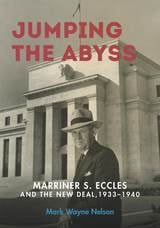
Jumping the Abyss
Marriner S. Eccles and the New Deal, 1933–1940Mark Wayne Nelson
University of Utah Press, 2017
Mark Wayne Nelson details the efforts of one of America’s most underappreciated public servants. In 1934, Franklin D. Roosevelt invited Marriner S. Eccles, a Mormon from Utah, to join his administration. As a Republican businessman, Eccles seemed an unlikely candidate for the role of leading crusader for a fairer and more economically sound distribution of the nation’s wealth. From his first position in the Treasury Department, though, he emerged as the central mover in revolutionizing the mortgage structure of the private home market in the United States.
After FDR appointed him to head the Federal Reserve, Eccles drafted legislation that restructured that institution as well. Throughout the remainder of the New Deal, he was the most powerful advocate of what came to be called “Keynesian Policy,” which involved direct federal stimulus of the economy. Presenting the first comprehensive and independent analysis of Eccles’s influential career, Jumping the Abyss wrestles with economic issues that remain relevant today.
Finalist for the Utah State Historical Society Best Book Award.
Looking Into the Abyss
Essays on ScenographyArnold Aronson
University of Michigan Press, 2005
Theater is, first and foremost, a visual art; Looking Into the Abyss examines the ways in which the visual theater affects our understanding of the dramatic event. Arnold Aronson, an internationally prominent historian and theorist of theater set design, opens with an overview of scenographic concepts, including postmodern design and the use of new media in the theater, and continues with analyses of the work of specific designers (including Richard Foreman and David Rockwell) and scenographic responses to playwrights like Chekhov and Tony Kushner. These essays serve to open a dialogue that will bring the physical aspect of theater back into its proper place: an element as integral to the performance as the spoken word, and they will inspire theater-goers to become more aware of their role as seers of the theater.
Arnold Aronson is Professor of Theater, Columbia University. He is author of American Avant-Garde Theatre: A History; Architect of Dreams: The Theatrical Vision of Joseph Urban; American Set Design; and The History and Theory of Environmental Scenography.
On the Edge of the Abyss
The Jewish Unconscious before FreudClémence Boulouque
University of Chicago Press, 2025
When Sigmund Freud published his theory of the unconscious, in 1899, he popularized an idea that had fascinated generations of Jewish philosophers before him. In this book, Clémence Boulouque charts the development of the pre-Freudian unconscious from subcultural inquiry to dominant discourse during the long nineteenth century. Although Freud’s scientific notion differed from Schelling’s mythical description of the abyss from which creation springs, its resonance with older ideas was celebrated as an opportunity to express specifically Jewish contributions to modernity. Indeed, Boulouque shows that the pre-Freudian unconscious emerged from conversations in Jewish mysticism about otherness and coexistence. In the hopeful years before World War I, Boulouque argues, such reflections offered the possibility of emancipation not only to Jews but to all.

The Abyss of Freedom/Ages of the World
Slavoj Zizek and F.W.J. von Schelling
University of Michigan Press, 1997
Zizek argues that Schelling's most profound thoughts are found in the series of three consecutive attempts he made to formulate the "ages of the world/Weltalter," the stages of the self-development of the Absolute. Of the three versions, claims Zizek, it is the second that is the most eloquent and definitive encompassing of Schelling's lyrical thought. It centers on the problem of how the Absolute (God) himself, in order to become actual, to exist effectively, has to accomplish a radically contingent move of acquiring material, bodily existence. Never before available in English, this version finally renders accessible one of the key texts of modern philosophy, a text that is widely debated in philosophical circles today.
The Abyss of Freedom is Zizek's own reading of Schelling based upon Lacanian psychoanalytic theory. It focuses on the notion that Lacan's theory--which claims that the symbolic universe emerged from presymbolic drives--is prefigured in Schelling's idea of logos as given birth to from the vortex of primordial drives, or from what "in God is not yet God." For Zizek, this connection is monumental, showing that Schelling's ideas forcefully presage the post-modern "deconstruction" of logocentrism.
Slavoj Zizek is not a philosopher who stoops to conquer objects but a radical voice who believes that philosophy is nothing if it is not embodied, nothing if it is only abstract. For him, true philosophy always speaks of something rather than nothing. Those interested in the genesis of contemporary thought and the fate of reason in our "age of anxiety" will find this coupling of texts not only philosophically relevant, but vitally important.
Slavoj Zizek is the author of The Sublime Object of Ideology, Tarrying with the Negative: Kant, Hegel and the Critique of Ideology, and most recently, The Indivisible Remainder: An Essay on Schelling and Related Matters. Currently he is a Senior Researcher at the Institute for Social Sciences, University of Ljubljana. Judith Norman is Assistant Professor of Philosophy at Trinity University in San Antonio, Texas.
The Abyss of Representation
Marxism and the Postmodern SublimeGeorge Hartley
Duke University Press, 2003
Hartley describes how modern theory from Kant through Lacan attempts to come to terms with the sublime limits of representation and how ideas developed with the Marxist tradition—such as Marx’s theory of value, Althusser’s theory of structural causality, or Zizek’s theory of ideological enjoyment—can be seen as variants of the sublime object. Representation, he argues, is ultimately a political problem. Whether that problem be a Marxist representation of global capitalism, a deconstructive representation of subaltern women, or a Chicano self-representation opposing Anglo-American images of Mexican Americans, it is only through this grappling with the negative, Hartley explains, that a Marxist theory of postmodernism can begin to address the challenges of global capitalism and resurgent imperialism.
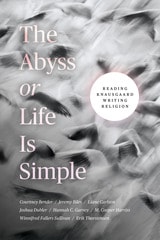
The Abyss or Life Is Simple
Reading Knausgaard Writing ReligionCourtney Bender, Jeremy Biles, Liane Carlson, Joshua Dubler, Hannah C. Garvey, M. Cooper Harriss, Winnifred Fallers Sullivan, and Erik Thorstensen
University of Chicago Press, 2022
Min kamp, or My Struggle, is a six-volume novel by Karl Ove Knausgaard and one of the most significant literary works of the young twenty-first century. Published in Norwegian between 2009 and 2011, the novel presents an absorbing first-person narrative of the life of a writer with the same name as the author, in a world at once fully disillusioned and thoroughly enchanted.
In 2015, a group of scholars began meeting to discuss the peculiarly religious qualities of My Struggle. Some were interested in Knausgaard’s attention to explicitly religious subjects and artworks, others to what they saw as more diffuse attention to the religiousness of contemporary life. The group wondered what reading these textures of religion in these volumes might say about our times, about writing, and about themselves. The Abyss or Life Is Simple is the culmination of this collective endeavor—a collection of interlocking essays on ritual, beauty, and the end of the world.
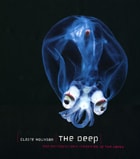
The Deep
The Extraordinary Creatures of the AbyssClaire Nouvian
University of Chicago Press, 2007
On dry land, most organisms are confined to the surface, or at most to altitudes of a hundred meters—the height of the tallest trees. In the oceans, though, living space has both vertical and horizontal dimensions: with an average depth of 3800 meters, the oceans offer 99% of the space on Earth where life can develop. And the deep sea, which has been immersed in total darkness since the dawn of time, occupies 85% of ocean space, forming the planet’s largest habitat. Yet these depths abound with mystery. The deep sea is mostly uncharted—only about 5 percent of the seafloor has been mapped with any reasonable degree of detail—and we know very little about the creatures that call it home. Current estimates about the number of species yet to be found vary between ten and thirty million. The deep sea no longer has anything to prove; it is without doubt Earth’s largest reservoir of life.
Combining the latest scientific discoveries with astonishing color imagery, The Deep takes readers on a voyage into the darkest realms of the ocean. Revealing nature’s oddest and most mesmerizing creatures in crystalline detail, The Deep features more than two hundred color photographs of terrifying sea monsters, living fossils, and ethereal bioluminescent creatures, some photographed here for the very first time. Accompanying these breathtaking photographs are contributions from some of the world’s most respected researchers that examine the biology of deep-sea organisms, the ecology of deep-sea habitats, and the history of deep-sea exploration.
An unforgettable visual and scientific tour of the teeming abyss, The Deep celebrates the incredible diversity of life on Earth and will captivate anyone intrigued by the unseen—and unimaginable—creatures of the deep sea.

The People of the Abyss
Jack London
Pluto Press, 2001
As well as being a literary masterpiece, The People of the Abyss stands as a major sociological study. While other American writers were blindly celebrating the glories of the British Empire at its peak, Jack London was asking why such misery was to be found in the heart of a capital city of immense wealth.
This is a work of reportage - London lets his observations speak for themselves. A precursor to the writings of George Orwell, this book remains a standard-bearer critique of capitalism, as powerful today as it was then.
The World as Abyss
The Caribbean and Critical Thought in the AnthropoceneJonathan Pugh and David Chandler
University of Westminster Press, 2023
This book is about a distinctive ‘abyssal’ approach to the crisis of modernity. In this framing, influenced by contemporary critical Black studies, another understanding of the world of modernity is foregrounded – a world violently forged through the projects of Indigenous dispossession, chattel slavery and colonial world-making. Modern and colonial world-making violently forged the ‘human’ by dividing those with ontological security from those without, and by carving out the ‘world’ in a fixed grid of space and time, delineating a linear temporality of ‘progress’ and ‘development’. The distinctiveness of abyssal thought is that it inverts the stakes of critique and brings indeterminacy into the heart of ontological assumptions of a world of entities, essences, and universal determination. This is an approach that does not focus upon tropes of rescue and salvation but upon the generative power of negation. In doing so, it highlights how Caribbean experiences and writings have been drawn upon to provide an important and distinct perspective for critical thought.
"How is it that ontology has come to be seen as the antidote for modernity? While Foucault denigrated ontology as a mistaken and parochial exercise, contemporary social theory holds out the promise that new modes of planetary knowledge will save us from our own excesses. Drawing together long traditions in Caribbean scholarship with Afro-pessimist thought, Pugh and Chandler illustrate how the search for more emancipatory ontologies - relational ontologies, indigenous ontologies, non-human ontologies, etc. – not only misunderstands the problem of modernity but (more importantly) works to veil the negative force that marks both the limit and cause of all such knowledge practices: what they term the abyss. To engage in abyssal thought – as they lay out – is to inhabit a site of refusal: a determination not to be drawn into the lure of ontological ‘correction’ and to recognise that the practice of world making cannot not bear the imprint of colonial violence. Articulated in passionate declarative prose, these authors powerfully illuminate the trap of the emancipatory instinct and the promise of a deconstructive ethic." — Mitch Rose, Senior Lecturer in Human Geography, Aberystwyth University, UK
“A much-needed intellectual effort in the non-reductionist and non-essentialising style of Pugh and Chandler's previous book. The World as Abyss gives Caribbean thought and culture the place they deserve within critical theory and materialist studies.” — Mónica Fernández Jiménez, Valladolid University, Spain
“For some time now scholars have questioned the overly general assumptions about the ‘anthropos’ of the Anthropocene, but much work needs to be done to flesh out what a decolonized Anthropocene might be. Pugh and Chandler’s The World as Abyss provides an original, intriguing and compelling counterpoint to bland Anthropocene humanism (and posthumanism). This timely work explores the poetics of the Caribbean and provides a way to think about the Anthropocene and the future beyond the managerialism of the present. This book is essential reading for those working in the environmental humanities or Anthropocene studies.” — Claire Colebrook, Professor, Penn State University, USA
“This book names an apocalypse that began long ago. Pugh and Chandler patiently follow the journey of thought as it travels from the Middle Passage to the Caribbean. This brings them face-to-face with the horror of anti-Black violence, not as just another resource to strip-mine, but as an unavoidable abyss that confines all thought. Its reminder: that we have still not yet begun to think a truly Black world.” — Andrew Culp, Professor, California Institute of the Arts, USA
"With the force of a manifesto, the intensity of a polemic, and the nuance of a treatise, thisbook sets out to disavow the disavowal of Colonial violence in the making of thecontemporary world and thought. Learning from Caribbean thinkers, writers, and poets, itsets to work unworking, desedimenting and deconstructing, the violent ontologicalfoundations by which anti-Black worlds maintain and reproduce their innocence andignorance. Replaying and reiterating, extending and multiplying, gestures of refusal –refusals of subjection, of History, of Geography, of meaning, of Being – there is the refusalof the World as it is and of the World as it could be. The World as Abyss artfully combines acritique of the historical forces which make and unmake the contemporary moment withthe suspension of horizons, of ends, of grounds. What emerges in the wake is anintensification of the generative capacity of this refusal; voids, arrhythmia, counter-times,displacements, dislocations, the abyssal. First as threat and then as promise" — PaulHarrison, Associate Professor of Human Geography, Durham University, UK
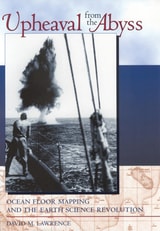
Upheaval from the Abyss
Ocean Floor Mapping and the Earth Science RevolutionLawrence, David M.
Rutgers University Press, 2002
The deep oceans are the last great frontier remaining on Earth. Humans have conquered the vast wilderness of the terrestrial surface, from the searing deserts and dark forests of the tropics to the icy polar regions. Today, anyone with enough ambition and money can travel upriver into the heart of the Borneo jungle, climb Mount Everest, or spend the night at the South Pole. But the oceans beyond the continental shelves remain forbidding, beyond the reach of science, adventurism, and commerce.
Not long ago, scientists viewed the ocean floor as a vast, featureless plain, an ancient repository of detritus eroded from the surface of an unchanging Earth. Light never reached the seemingly lifeless depths. The ocean basins were only of marginal scholarly interest. This all changed with the Herculean quest to discover what lay on the world's ocean floor—a quest that inspired the continental drift-plate tectonics revolution and overturned prevailing scientific notions of how the Earth’s surface was created, rearranged, and destroyed.
Upheaval from the Abyss spans a 130-year period, beginning with the early, backbreaking efforts to map the depths during the age of sail; continuing with improvements in research methods spurred by maritime disaster and war; and culminating in the publication of the first map of the world’s ocean floor in 1977. The author brings this tale to life by weaving through it the personalities of the scientists-explorers who struggled to see the face of the deep, and reveals not only the facts of how the ocean floor was mapped, but also the human dimensions of what the scientists experienced and felt while in the process.