Results by title
15 books match the query 'Act (Philosophy)'
Aquinas on Imitation of Nature
Source of Principles of Moral ActionWojciech Golubiewski
Catholic University of America Press, 2022
Automatic Religion
Nearhuman Agents of Brazil and FrancePaul Christopher Johnson
University of Chicago Press, 2021
Automatic Religion explores an unlikely series of episodes from the end of the nineteenth century, when crucial ideas related to automatism and, in a different realm, the study of religion were both being born. Paul Christopher Johnson draws on years of archival and ethnographic research in Brazil and France to explore the crucial boundaries being drawn at the time between humans, “nearhumans,” and automata. As agency came to take on a more central place in the philosophical, moral, and legal traditions of the West, certain classes of people were excluded as less-than-human. Tracking the circulation of ideas across the Atlantic, Johnson tests those boundaries, revealing how they were constructed on largely gendered and racial foundations. In the process, he reanimates one of the most mysterious and yet foundational questions in trans-Atlantic thought: what is agency?
Doing
Jean-Luc Nancy
Seagull Books, 2020
Hamletics
Shakespeare, Kafka, BeckettMassimo Cacciari
Seagull Books, 2023
During the dramatic course of the twentieth century, amid the clash of the titans which marked that era, humanity could still think in terms of partisan struggles in which large masses took sides against one another. The new millennium, by contrast, appears to have opened under the guise of generalized insecurity, which pertains not only to the historical and social situation, or to one’s personal psychological predicament, but to our very being. The Earth’s current faltering and the twilight of every convention that might govern it—where roles, images, and languages become confused by a lack of direction and distance—were already powerfully prophesied in Shakespeare’s Hamlet, and later in the works of Kafka and Beckett. In Hamletics, Massimo Cacciari, one of Italy’s foremost philosophers and leftist political figures, establishes a dialogue between these fateful authors, exploring the relationship between European nihilism and the aporias of action in the present.
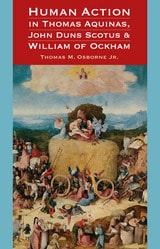
Human Action in Thomas Aquinas, John Duns Scotus, and William of Ockham
Thomas M. Osborne Jr.
Catholic University of America Press, 2014
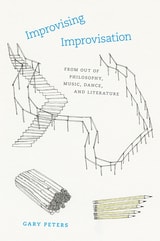
Improvising Improvisation
From Out of Philosophy, Music, Dance, and LiteratureGary Peters
University of Chicago Press, 2017
Guided by Kant, Hegel, Heidegger, and especially Deleuze—and exploring a range of artists from Hendrix to Borges—Peters illuminates new fundamentals about what, as an experience, improvisation truly is. As he shows, improvisation isn’t so much a genre, idiom, style, or technique—it’s a predicament we are thrown into, one we find ourselves in. The predicament, he shows, is a complex entwinement of choice and decision. The performativity of choice during improvisation may happen “in the moment,” but it is already determined by an a priori mode of decision. In this way, improvisation happens both within and around the actual moment, negotiating a simultaneous past, present, and future. Examining these and other often ignored dimensions of spontaneous creativity, Peters proposes a consistently challenging and rigorously argued new perspective on improvisation across an extraordinary range of disciplines.
Judgment and Action
Fragments toward a HistoryEdited by Vivasvan Soni and Thomas Pfau
Northwestern University Press, 2018
Interpretation is essential to every humanistic discipline, and every interpretation is an act of judgment. Yet the work of interpretation and judgment has been called into question by contemporary methods in the humanities, which incline either toward contextual determination of meaning or toward the suspension of judgment altogether. Action is closely related to judgment and interpretation and like them, it has been rendered questionable. An action is not simply the performance of a deed but requires the deed’s intelligibility, which can be secured only through interpretation and judgment.
Organized into four broad themes—interiority/contemplation, ethics, politics/community, and aesthetics/image—the aim of this broad-ranging and insightful collection is to illuminate the histories of judgment and action, identify critical sites from which rethinking them may begin, clarify how they came to be challenged, and relocate them within a broader intellectual-historical trajectory that renders them intelligible.
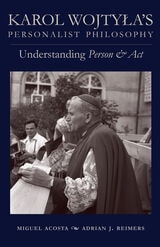
Karol Wojtyla's Personalist Philosophy
Miguel Acosta
Catholic University of America Press, 2016
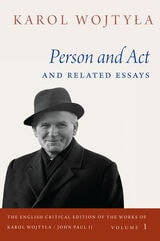
Person and Act and Related Essays
Karol Wojtyla
Catholic University of America Press, 2021
Practical Reflection
J. David Velleman
CSLI, 2013
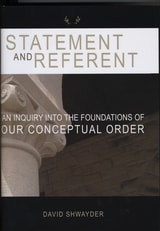
Statement and Referent
An Inquiry into the Foundations of our Conceptual OrderDavid Shwayder
CSLI, 2008
Plato’s Parmenides and Aristotle’s Metaphysics initiated the discussion of the “First Philosophy” in the Western canon. Here, David Shwayder continues this debate by considering statements as the fundamental bearers of truth-values. Systematically moving from action to utterance, Shwayder argues that the category of “bodies” is fundamental to the human scheme of conceptualization and that if we had no capacity to refer to bodies then we would be unable to address referents from other categories.
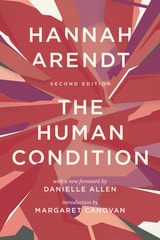
The Human Condition
Second EditionHannah Arendt
University of Chicago Press, 2018
The twenty-first century has seen a resurgence of interest in the political thinker Hannah Arendt, “the theorist of beginnings,” whose work probes the logics underlying unexpected transformations—from totalitarianism to revolution.
A work of striking originality, The Human Condition is in many respects more relevant now than when it first appeared in 1958. In her study of the state of modern humanity, Hannah Arendt considers humankind from the perspective of the actions of which it is capable. The problems Arendt identified then—diminishing human agency and political freedom, the paradox that as human powers increase through technological and humanistic inquiry, we are less equipped to control the consequences of our actions—continue to confront us today. This new edition, published to coincide with the sixtieth anniversary of its original publication, contains Margaret Canovan’s 1998 introduction and a new foreword by Danielle Allen.
A classic in political and social theory, The Human Condition is a work that has proved both timeless and perpetually timely.
The Possibility of Practical Reason
J. David Velleman
Michigan Publishing Services, 2015
Toward a Philosophy of the Act
By M. M. Bakhtin
University of Texas Press, 1993
Rescued in 1972 from a storeroom in which rats and seeping water had severely damaged the fifty-year-old manuscript, this text is the earliest major work (1919-1921) of the great Russian philosopher M. M. Bakhtin. Toward a Philosophy of the Act contains the first occurrences of themes that occupied Bakhtin throughout his long career. The topics of authoring, responsibility, self and other, the moral significance of "outsideness," participatory thinking, the implications for the individual subject of having "no-alibi in existence," the difference between the world as experienced in actions and the world as represented in discourse—all are broached here in the heat of discovery. This is the "heart of the heart" of Bakhtin, the center of the dialogue between being and language, the world and mind, "the given" and "the created" that forms the core of Bakhtin's distinctive dialogism.
A special feature of this work is Bakhtin's struggle with the philosophy of Immanuel Kant. Put very simply, this text is an attempt to go beyond Kant's formulation of the ethical imperative. mci will be important for scholars across the humanities as they grapple with the increasingly vexed relationship between aesthetics and ethics.
When Spinoza Met Marx
Experiments in Nonhumanist ActivityTracie Matysik
University of Chicago Press, 2022
Karl Marx was a fiery revolutionary theorist who heralded the imminent demise of capitalism, while Spinoza was a contemplative philosopher who preached rational understanding and voiced skepticism about open rebellion. Spinoza criticized all teleological ideas as anthropomorphic fantasies, while Marxism came to be associated expressly with teleological historical development. Why, then, were socialists of the German nineteenth century consistently drawn to Spinoza as their philosophical guide? Tracie Matysik shows how the metaphorical meeting of Spinoza and Marx arose out of an intellectual conundrum around the meaning of activity. How is it, exactly, that humans can be fully determined creatures but also able to change their world? To address this paradox, many revolutionary theorists came to think of activity in the sense of Spinoza—as relating. Matysik follows these Spinozist-socialist intellectual experiments as they unfolded across the nineteenth century, drawing lessons from them that will be meaningful for the contemporary world.