Results by title
8 books match the query 'Afghan War (2001-2021)'
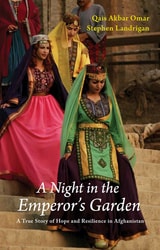
A Night in the Emperor's Garden
A True Story of Hope and Resilience in AfghanistanQais Akbar Omar and Stephen Landrigan
Haus Publishing, 2015
An actress visiting from Paris casually proposed to some Afghan actors in Kabul: Why not put on a play? The challenges were huge. It had been thirty years since men and women had appeared on stage together in Afghanistan. Was the country ready for it? Few Afghan actors had ever done theater. Did they even know how? They had performed only in films and television dramas.
Still, a company of actors gathered—among them a housewife, a policewoman, and a street kid turned film star. With no certainty of its outcome, they set out on a journey that would have life-changing consequences for all of them, and along the way lead to A Night in the Emperor’s Garden.
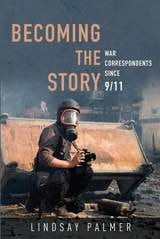
Becoming the Story
War Correspondents since 9/11Lindsay Palmer
University of Illinois Press, 2018
Becoming the Story examines the transformation of war reporting in the decade after 9/11. Lindsay Palmer delves into times when print or television correspondents themselves received intense public scrutiny because of an incident associated with the work of war reporting. Such instances include Daniel Pearl’s kidnapping and murder; Bob Woodruff’s near-fatal injury in Iraq; the expulsions of Maziar Bahari and Nazila Fathi from Iran in 2009; the sexual assault of Lara Logan; and Marie Colvin’s 2012 death in Syria. Merging analysis with in-depth interviews of Woodruff and others, Palmer shows what these events say about how post-9/11 conflicts transformed the day-to-day labor of reporting. But they also illuminate how journalists’ work became entangled with issues ranging from digitization processes to unprecedented hostility from all sides to the political logic of the War on Terror.
Bedrooms of the Fallen
Ashley Gilbertson
University of Chicago Press, 2014
The book’s wide-format black-and-white images depict the bedrooms of forty fallen soldiers—the equivalent of a single platoon—from the United States, Canada, and several European nations. Left intact by families of the deceased, the bedrooms are a heartbreaking reminder of lives cut short: we see high school diplomas and pictures from prom, sports medals and souvenirs, and markers of the idealism that carried them to war, like images of the Twin Towers and Osama Bin Laden. A moving essay by Gilbertson describes his encounters with the families who preserve these private memorials to their loved ones, and shares what he has learned from them about war and loss.
Bedrooms of the Fallen is a masterpiece of documentary photography, and an unforgettable reckoning with the human cost of war.
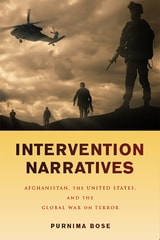
Intervention Narratives
Afghanistan, the United States, and the Global War on TerrorPurnima Bose
Rutgers University Press, 2020
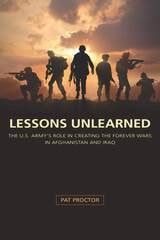
Lessons Unlearned
The U.S. Army's Role in Creating the Forever Wars in Afghanistan and IraqPat Proctor
University of Missouri Press, 2020
In this blunt critique of the senior leadership of the U.S. Army, Proctor contends that after the fall of the Soviet Union, the U.S. Army stubbornly refused to reshape itself in response to the new strategic reality, a decision that saw it struggle through one low-intensity conflict after another—some inconclusive, some tragic—in the 1980s and 1990s, and leaving it largely unprepared when it found itself engaged—seemingly forever—in wars in Afghanistan and Iraq. The first book-length study to connect the failures of these wars to America’s disastrous performance in the war on terror, Proctor’s work serves as an attempt to convince Army leaders to avoid repeating the same mistakes.

Looking for Marshall McLuhan in Afghanistan
iProbes and iPhone PhotographsRita Leistner
Intellect Books, 2013
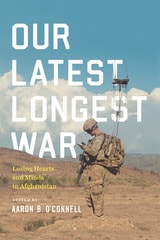
Our Latest Longest War
Losing Hearts and Minds in AfghanistanEdited by Aaron B. O'Connell
University of Chicago Press, 2017
America’s goals in Afghanistan were lofty to begin with: dismantle al Qaeda, remove the Taliban from power, remake the country into a democracy. But not only did the mission come completely unmoored from reality, the United States wasted billions of dollars, and thousands of lives were lost. Our Latest Longest War is a chronicle of how, why, and in what ways the war in Afghanistan failed. Edited by historian and Marine lieutenant colonel Aaron B. O’Connell, the essays collected here represent nine different perspectives on the war—all from veterans of the conflict, both American and Afghan. Together, they paint a picture of a war in which problems of culture and an unbridgeable rural-urban divide derailed nearly every field of endeavor. The authors also draw troubling parallels to the Vietnam War, arguing that deep-running ideological currents in American life explain why the US government has repeatedly used armed nation-building to try to transform failing states into modern, liberal democracies. In Afghanistan, as in Vietnam, this created a dramatic mismatch of means and ends that neither money, technology, nor the force of arms could overcome.
The war in Afghanistan has been the longest in US history, and in many ways, the most confounding. Few who fought in it think it has been worthwhile. These are difficult topics for any American or Afghan to consider, especially those who lost friends or family in it. This sobering history—written by the very people who have been fighting the war—is impossible to ignore.
The Other Air Force
U.S. Efforts to Reshape Middle Eastern Media Since 9/11Sienkiewicz, Matt
Rutgers University Press, 2016
As it seeks to win the hearts and minds of citizens in the Muslim world, the United States has poured millions of dollars into local television and radio programming, hoping to generate pro-American currents on Middle Eastern airwaves. However, as this fascinating new book shows, the Middle Eastern media producers who rely on these funds are hardly puppets on an American string, but instead contribute their own political and creative agendas while working within U.S. restrictions.