Results by title

9 books match the query 'African American labor union members'
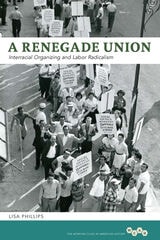
cover of A Renegade Union: Interracial Organizing and Labor Radicalism

A Renegade Union

Interracial Organizing and Labor Radicalism

Lisa Phillips

University of Illinois Press, 2013
Dedicated to organizing workers from diverse racial, ethnic, and religious backgrounds, many of whom were considered "unorganizable" by other unions, the progressive New York City-based labor union District 65 counted among its 30,000 members retail clerks, office workers, warehouse workers, and wholesale workers. In this book, Lisa Phillips presents a distinctive study of District 65 and its efforts to secure economic equality for minority workers in sales and processing jobs in small, low-end shops and warehouses throughout the city. Phillips shows how organizers fought tirelessly to achieve better hours and higher wages for "unskilled," unrepresented workers and to destigmatize the kind of work they performed.
 
Closely examining the strategies employed by District 65 from the 1930s through the early Cold War years, Phillips assesses the impact of the McCarthy era on the union's quest for economic equality across divisions of race, ethnicity, and skill. Though their stories have been overshadowed by those of auto, steel, and electrical workers who forced American manufacturing giants to unionize, the District 65 workers believed their union provided them with an opportunity to re-value their work, the result of an economy inclining toward fewer manufacturing jobs and more low-wage service and processing jobs.
 
Phillips recounts how District 65 first broke with the CIO over the latter's hostility to left-oriented politics and organizing agendas, then rejoined to facilitate alliances with the NAACP. In telling the story of District 65 and detailing community organizing efforts during the first part of the Cold War and under the AFL-CIO umbrella, A Renegade Union continues to revise the history of the left-led unions of the Congress of Industrial Organizations. 

[more]
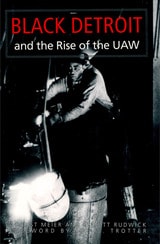
cover of Black Detroit and the Rise of the UAW

Black Detroit and the Rise of the UAW

August Meier and Elliott Rudwick

University of Michigan Press, 2007
For almost two decades, August Meier and Elliott Rudwick have roamed the frontier of Afro-American history, blazing trails that others have followed. This book forges a solid link between race and class conflict in the twentieth century.---Ira Berlin, The Nation"This fact-filled study is essential to students of the labor and civil rights movements."---David Kusnet, The New Republic"A fascinating slice of history illustrating important race and class issues that are still with us."---Library Journal"By ignoring the conventional lines between labor and black history, Meier and Rudwick have found an unexplored middle ground---the net of relations between the black community and white economic institutions---that shaped the working life of blacks in Detroit's auto plants. This is a major achievement."---David Brody, Professor Emeritus of History, University of California, Davis". . . an important work . . . one of the first to apply the nitty-gritty of social and institutional history to 20th century African American and labor history." ---Eric Arnesen, University of Illinois at ChicagoBlack Detroit and the Rise of the UAW is essential reading for historians of labor and race in America, as well those interested in Detroit's importance as a crucible for American urban history.
[more]
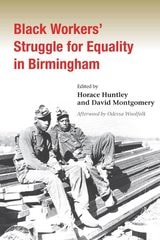
cover of Black Workers' Struggle for Equality in Birmingham

Black Workers' Struggle for Equality in Birmingham

Edited by Horace Huntley and David Montgomery

University of Illinois Press, 2004

Horace Huntley and David Montgomery curate a collection of annotated oral interviews of black workers who served on the front lines of the Civil Rights Movement in Birmingham, Alabama. As the interviewees recount their struggles against discrimination, they show how collective action--whether through unions, the Movement, or networks of workplace activists--sought to gain access to better jobs, municipal services, housing, and less restrictive voter registration. 

Powerful and honest, Black Workers' Struggle for Equality in Birmingham draws on work by the Birmingham Civil Rights Institute to offer readers vivid eyewitness accounts of American history in the making.
[more]
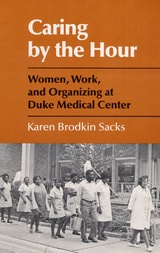
cover of Caring by the Hour: Women, Work, and Organizing at Duke Medical Center

Caring by the Hour

Women, Work, and Organizing at Duke Medical Center

Karen Brodkin Sacks

University of Illinois Press, 1988

Karen Sacks offers the first detailed account of the hospital industry's nonprofessional support staff---their roles in day-to-day health care delivery, and why they fought so tenaciously throughout the 1970s to unionize. This case study of the relationships between work life and unionization in Duke medical Center highlights women's activism in general and black women's leadership in particular.
 
In addition to an analysis of the dynamics of women's activism, Caring by the Hour provides a comparative study of Duke Medical Center's treatment of both black and white female workers. Sacks links patterns of racial segregation in clerical jobs to the relationship between race, working conditions, and unequal opportunities for black and white women, and to their differing work cultures and patterns of public militance. She also discusses recent changes in service, clerical, and professional work and their effects on white and black women, placing them in the context of national changes in health funding and policies.
[more]
cover of Marching Together: Women of the Brotherhood of Sleeping Car Porters

Marching Together

Women of the Brotherhood of Sleeping Car Porters

Melinda Chateauvert

University of Illinois Press, 1998

The Brotherhood of Sleeping Car Porters (BSCP) was the first national trade union for African Americans. Standard BSCP histories focus on the men who built the union. Yet the union's Ladies' Auxiliary played an essential role in shaping public debates over black manhood and unionization, setting political agendas for the black community, and crafting effective strategies to win racial and economic justice. 

Melinda Chateauvert explores the history of the Ladies' Auxiliary and the wives, daughters, and sisters of Pullman porters who made up its membership and used the union to claim respectability and citizenship. As she shows, the Auxiliary actively educated other women and children about the labor movement, staged consumer protests, and organized local and national civil rights campaigns ranging from the 1941 March on Washington to school integration to the Montgomery Bus Boycott. Chateauvert also sheds light on the plight of Pullman maids, who—relegated to the Auxiliary—found their problems as working women neglected in favor of the rhetoric of racial solidarity.

[more]
cover of Miles of Smiles, Years of Struggle: STORIES OF BLACK PULLMAN PORTERS

Miles of Smiles, Years of Struggle

STORIES OF BLACK PULLMAN PORTERS

Jack Santino

University of Illinois Press, 1989

As service workers in a luxurious sleeping-car train system, Pullman porters had both the highest status in the black community and the lowest rank on the train. They were trapped in the dual roles of charming host and obedient servant, and their constant smiles--even in the face of unreasonable demands by white passengers--were part of the job requirement.
 
Jack Santino's interviews with retired porters provide extensive firsthand accounts of their work, the job inequities they faced, the formation of the Brotherhood of Sleeping Car Porters, and the aborted Pullman porter strike of 1928. Through the testimony of ran-and-file workers as well as key figures such as E. D. Nixon, the porter who initiated the Montgomery bus boycott and helped launch the career of Martin Luther King, Jr. and C.L. Dellums, the only surviving founding member of the BSCP, Miles of Smiles, Years of Struggle illuminates the Pullman porters' struggle for dignity.
 
 
[more]
cover of Race against Liberalism: Black Workers and the UAW in Detroit

Race against Liberalism

Black Workers and the UAW in Detroit

David M. Lewis-Colman

University of Illinois Press, 2007

Race against Liberalism examines how black worker activism in Detroit shaped the racial politics of the labor movement and the white working class. David M. Lewis-Colman traces the substantive, long-standing disagreements between liberals and the black workers who embraced autonomous race-based action. As he shows, black autoworkers placed themselves at the center of Detroit's working-class politics and sought to forge a kind of working class unity that accommodated their interests as African Americans. The book covers the independent caucuses in the 1940s and the Trade Union Leadership Council in the 1950s; the black power movement and Revolutionary Union Movements of the mid-1960s; and the independent race-based activism of the 1970s that resulted in Coleman Young's 1973 election as the city's first black mayor.

[more]
cover of Race, Class, and Power in the Alabama Coalfields, 1908-21

Race, Class, and Power in the Alabama Coalfields, 1908-21

Brian Kelly

University of Illinois Press, 2001
Brian Kelly's acclaimed look at the fault lines in the society of an Alabama city challenges the notion that white workers led the resistance to racial equality in the Jim Crow South. Kelly focuses on the forces that brought the black and white miners of Birmingham, Alabama, together during the hard-fought strikes of 1908 and 1920. He examines the systematic efforts by the region's powerful industrialists to create racial divisions as a means of splitting the workforce, preventing unionization, and keeping wages the lowest in the United States. He also details the role played by Birmingham's small but influential black middle class, whose espousal of industrial accommodation outraged black miners and revealed significant tensions within the African American community.
[more]
cover of Southern Labor and Black Civil Rights: Organizing Memphis Workers

Southern Labor and Black Civil Rights

Organizing Memphis Workers

Michael K. Honey

University of Illinois Press, 1993

Widely praised upon publication and now considered a classic study, Southern Labor and Black Civil Rights chronicles the southern industrial union movement from the Great Depression to the Cold War, a history that created the context for the sanitation workers' strike that brought Dr. Martin Luther King, Jr. to Memphis in April 1968. Michael K. Honey documents the dramatic labor battles and sometimes heroic activities of workers and organizers that helped to set the stage for segregation's demise.

Winner of the Charles S. Sydnor Award, given by the Southern Historical Association, 1994.  Winner of the James A. Rawley Prize given by the Organization of American Historians, 1994.  Winner of the Herbert G. Gutman Award for an outstanding book in American social history.
[more]