Results by title
31 books match the query 'African Americans in motion pictures'
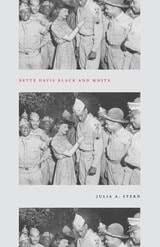
Bette Davis Black and White
Julia A. Stern
University of Chicago Press, 2021
Bette Davis was not only one of Hollywood’s brightest stars, but also one of its most outspoken advocates on matters of race. In Bette Davis Black and White, Julia A. Stern explores this largely untold facet of Davis’s brilliant career.
Bette Davis Black and White analyzes four of Davis’s best-known pictures—Jezebel (1938), The Little Foxes (1941), In This Our Life (1942), and What Ever Happened to Baby Jane? (1962)—against the history of American race relations. Stern also weaves in memories of her own experiences as a young viewer, coming into racial consciousness watching Davis’s films on television in an all-white suburb of Chicago.
Davis’s egalitarian politics and unique collaborations with her Black costars offer Stern a window into midcentury American racial fantasy and the efforts of Black performers to disrupt it. This book incorporates testimony from Davis’s Black contemporaries, including James Baldwin and C. L. R. James, as well as the African American fans who penned letters to Warner Brothers praising Davis’s work. A unique combination of history, star study, and memoir, Bette Davis Black and White allows us to contemplate cross-racial spectatorship in new ways.
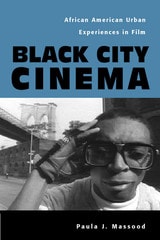
Black City Cinema
African American Urban Experiences In FilmPaula J. Massood
Temple University Press, 2003
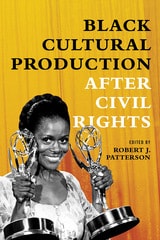
Black Cultural Production after Civil Rights
Edited by Robert J. Patterson
University of Illinois Press, 2019
This collection's fascinating spectrum of topics begins with the literary and cinematic representations of slavery from the 1970s to the present. Other authors delve into visual culture from Blaxploitation to the art of Betye Saar to stage works like A Movie Star Has to Star in Black and White as well as groundbreaking literary works like Corregidora and Captain Blackman. A pair of concluding essays concentrate on institutional change by looking at the Seventies surge of black publishing and by analyzing Ntozake Shange's for colored girls. . . in the context of current controversies surrounding sexual violence. Throughout, the writers reveal how Seventies black cultural production anchors important contemporary debates in black feminism and other issues while spurring the black imagination to thrive amidst abject social and political conditions.
Contributors: Courtney R. Baker, Soyica Diggs Colbert, Madhu Dubey, Nadine Knight, Monica White Ndounou, Kinohi Nishikawa, Samantha Pinto, Jermaine Singleton, Terrion L. Williamson, and Lisa Woolfork
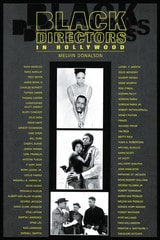
Black Directors in Hollywood
By Melvin Donalson
University of Texas Press, 2003
Hollywood film directors are some of the world's most powerful storytellers, shaping the fantasies and aspirations of people around the globe. Since the 1960s, African Americans have increasingly joined their ranks, bringing fresh insights to movie characterizations, plots, and themes and depicting areas of African American culture that were previously absent from mainstream films. Today, black directors are making films in all popular genres, while inventing new ones to speak directly from and to the black experience.
This book offers a first comprehensive look at the work of black directors in Hollywood, from pioneers such as Gordon Parks, Melvin Van Peebles, and Ossie Davis to current talents including Spike Lee, John Singleton, Kasi Lemmons, and Carl Franklin. Discussing 67 individuals and over 135 films, Melvin Donalson thoroughly explores how black directors' storytelling skills and film techniques have widened both the thematic focus and visual style of American cinema. Assessing the meanings and messages in their films, he convincingly demonstrates that black directors are balancing Hollywood's demand for box office success with artistic achievement and responsibility to ethnic, cultural, and gender issues.
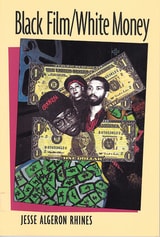
Black Film/White Money
Jesse Algeron Rhines
Rutgers University Press, 1996
In this vivid portrait of their historic and present-day contributions, Jesse Rhines explores the roles African American men and women have played in the motion picture business from 1915 to the present. He illuminates his discussion by carefully linking the history of early Black filmmaking to the current success of African American filmmakers and examines how African Americans have been affected by changes that have taken place in the industry as a whole. He focuses on the crucial role of distribution companies, the difficulty of raising money for production, the compromises that directors and writers must make to get funding, and the effect of negative, sensationalistic images on the Black community. Many well-known directors, including Spike Lee, Reginald Hudlin, and Grace Blake are interviewed in the book, allowing Rhines to give readers an inside look at how deal making does--or does not--work.
Rhines surveys significant eras in film history and their impact on African Americans, from the silent era and the impact of The Birth of a Nation , through the emergence of the Black-owned Lincoln Motion Picture Company, and the later introduction of sound, to the postwar era, the antitrust suit against Paramount Pictures, the introduction of television, and Blaxploitation movies that won audiences back. He brings the story up to date with present-day blockbusters and the success of Spike Lee, who began as an independent and became a force in the industry, and others who hope to follow in Lee's footsteps. Rhines, who has worked behind the camera himself, reflects on independent filmmaking, the risks of both failure and success, and his hope for positive change in the African African community if more African American filmmakers can come to the forefront in the business.
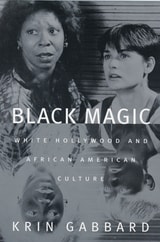
Black Magic
White Hollywood and African American CultureKrin Gabbard
Rutgers University Press, 2004
As Krin Gabbard brilliantly reveals in Black Magic, we duly recognize the cultural heritage of African Americans in literature, music, and art, but there is a disturbing pattern in the roles that blacks are asked to play-particularly in the movies. Many recent films, including The Matrix, Fargo, The Green Mile, Ghost, The Talented Mr. Ripley, Pleasantville, The Bridges of Madison County, and Crumb, reveal a fascination with black music and sexuality even as they preserve the old racial hierarchies. Quite often the dependence on African American culture remains hidden-although it is almost perversely pervasive. In the final chapters of Black Magic, Gabbard looks at films by Robert Altman and Spike Lee that attempt to reverse many of these widespread trends.
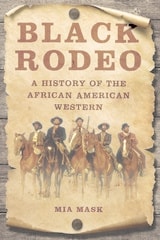
Black Rodeo
A History of the African American WesternMia Mask
University of Illinois Press, 2023
A first-of-its kind survey, Black Rodeo illuminates the figure of the Black cowboy while examining the intersection of African American film history and the western.

Black Space
Imagining Race in Science Fiction FilmBy Adilifu Nama
University of Texas Press, 2008
Winner, Rollins Book Award, Southwest Texas Popular Culture Association/American Culture Association, 2008
Science fiction film offers its viewers many pleasures, not least of which is the possibility of imagining other worlds in which very different forms of society exist. Not surprisingly, however, these alternative worlds often become spaces in which filmmakers and film audiences can explore issues of concern in our own society. Through an analysis of over thirty canonic science fiction (SF) films, including Logan's Run, Star Wars, Blade Runner, Back to the Future, Gattaca, and Minority Report, Black Space offers a thorough-going investigation of how SF film since the 1950s has dealt with the issue of race and specifically with the representation of blackness.
Setting his study against the backdrop of America's ongoing racial struggles and complex socioeconomic histories, Adilifu Nama pursues a number of themes in Black Space. They include the structured absence/token presence of blacks in SF film; racial contamination and racial paranoia; the traumatized black body as the ultimate signifier of difference, alienness, and "otherness"; the use of class and economic issues to subsume race as an issue; the racially subversive pleasures and allegories encoded in some mainstream SF films; and the ways in which independent and extra-filmic productions are subverting the SF genre of Hollywood filmmaking.
The first book-length study of African American representation in science fiction film, Black Space demonstrates that SF cinema has become an important field of racial analysis, a site where definitions of race can be contested and post-civil rights race relations (re)imagined.
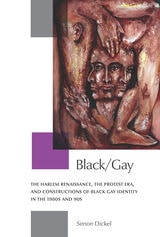
Black/Gay
The Harlem Renaissance, the Protest Era, and the Constructions of Black Gay Identity in the 1980s and 90sSimon Dickel
Michigan State University Press, 2011
This book explores key texts of the black gay culture of the 1980s and ’90s. Starting with an analysis of the political discourse in anthologies such as In the Life and Brother to Brother, it identifies the references to the Harlem Renaissance and the Protest Era as common elements of black gay discourse. This connection to African American cultural and political traditions legitimizes black gay identity and criticizes the construction of gay identity as white. Readings of Isaac Julien’s Looking for Langston, Samuel R. Delany’s “Atlantis: Model 1924” and The Motion of Light in Water, Melvin Dixon’s Vanishing Rooms, Randall Kenan’s A Visitation of Spirits, and Steven Corbin’s No Easy Place to Be demonstrate how these strategies of signifying are used in affirmative, humorous, and ironic ways.
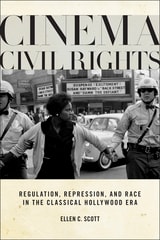
Cinema Civil Rights
Regulation, Repression, and Race in the Classical Hollywood EraScott, Ellen C
Rutgers University Press, 2015
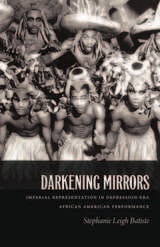
Darkening Mirrors
Imperial Representation in Depression-Era African American PerformanceStephanie Leigh Batiste
Duke University Press, 2012
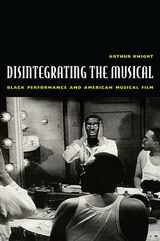
Disintegrating the Musical
Black Performance and American Musical FilmArthur Knight
Duke University Press, 2002
Arthur Knight focuses on American film’s classic sound era, when Hollywood studios made eight all-black-cast musicals—a focus on Afro-America unparalleled in any other genre. It was during this same period that the first black film stars—Paul Robeson, Louis Armstrong, Lena Horne, Harry Belafonte, Dorothy Dandridge—emerged, not coincidentally, from the ranks of musical performers. That these films made so much of the connection between African Americans and musicality was somewhat ironic, Knight points out, because they did so in a form (song) and a genre (the musical) celebrating American social integration, community, and the marriage of opposites—even as the films themselves were segregated and played before even more strictly segregated audiences.
Disintegrating the Musical covers territory both familiar—Show Boat, Stormy Weather, Porgy and Bess—and obscure—musical films by pioneer black director Oscar Micheaux, Lena Horne’s first film The Duke Is Tops, specialty numbers tucked into better-known features, and lost classics like the short Jammin’ the Blues. It considers the social and cultural contexts from which these films arose and how African American critics and audiences responded to them. Finally, Disintegrating the Musical shows how this history connects with the present practices of contemporary musical films like O Brother, Where Art Thou? and Bamboozled.
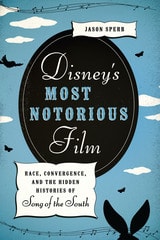
Disney's Most Notorious Film
Race, Convergence, and the Hidden Histories of Song of the SouthBy Jason Sperb
University of Texas Press, 2012
The Walt Disney Company offers a vast universe of movies, television shows, theme parks, and merchandise, all carefully crafted to present an image of wholesome family entertainment. Yet Disney also produced one of the most infamous Hollywood films, Song of the South. Using cartoon characters and live actors to retell the stories of Joel Chandler Harris, SotS portrays a kindly black Uncle Remus who tells tales of Brer Rabbit, Brer Fox, and the “Tar Baby” to adoring white children. Audiences and critics alike found its depiction of African Americans condescending and outdated when the film opened in 1946, but it grew in popularity—and controversy—with subsequent releases. Although Disney has withheld the film from American audiences since the late 1980s, SotS has an enthusiastic fan following, and pieces of the film—such as the Oscar-winning “Zip-a-Dee-Doo-Dah”—remain throughout Disney’s media universe.
Disney’s Most Notorious Film examines the racial and convergence histories of Song of the South to offer new insights into how audiences and Disney have negotiated the film’s controversies over the last seven decades. Jason Sperb skillfully traces the film’s reception history, showing how audience perceptions of SotS have reflected debates over race in the larger society. He also explores why and how Disney, while embargoing the film as a whole, has repurposed and repackaged elements of SotS so extensively that they linger throughout American culture, serving as everything from cultural metaphors to consumer products.
Film Blackness
American Cinema and the Idea of Black FilmMichael Boyce Gillespie
Duke University Press, 2016
Fire and Desire
Mixed-Race Movies in the Silent EraJane M. Gaines
University of Chicago Press, 2001
Fire and Desire offers a penetrating look at the black independent film movement during the silent period. Gaines traces the profound influence that D. W. Griffith's racist epic The Birth of a Nation exerted on black filmmakers such as Oscar Micheaux, the director of the newly recovered Within Our Gates. Beginning with What Happened in the Tunnel, a movie that played with race and sex taboos by featuring the first interracial kiss in film, Gaines also explores the cinematic constitution of self and other through surprise encounters: James Baldwin sees himself in the face of Bette Davis, family resemblance is read in Richard S. Robert's portrait of an interracial family, and black film pioneer George P. Johnson looks back on Micheaux.
Given the impossibility of purity and the co-implication of white and black, Fire and Desire ultimately questions the category of "race movies" itself.
Framing Blackness
The African American Image in FilmEd Guerrero
Temple University Press, 1993
From D.W. Griffith's The Birth of a Nation to Spike Lee's Malcolm X, Ed Guerrero argues, the commercial film industry reflects white domination of American society. Written with the energy and conviction generated by the new black film wave, Framing Blackness traces an ongoing epic—African Americans protesting screen images of blacks as criminals, servants, comics, athletes, and sidekicks.
These images persist despite blacks' irrepressible demands for emancipated images and a role in the industry. Although starkly racist portrayals of blacks in early films have gradually been replaced by more appealing characterizations, the legacy of the plantation genre lives on in Blaxpoitation films, the fantastic racialized imagery in science fiction and horror films, and the resubordination of blacks in Reagan-era films. Probing the contradictions of such images, Guerrero recalls the controversies surrounding role choices by stars like Sidney Poitier, Eddie Murphy, Whoopie Goldberg, and Richard Pryor.
Throughout his study, Guerrero is attentive to the ways African Americans resist Hollywood's one-dimensional images and superficial selling of black culture as the latest fad. Organizing political demonstrations and boycotts, writing, and creating their own film images are among the forms of active resistance documented.
The final chapter awakens readers to the artistic and commercial breakthrough of black independent filmmakers who are using movies to channel their rage at social injustice. Guerrero points out their diverse approaches to depicting African American life and hails innovative tactics for financing their work. Framing Blackness is the most up-to-date critical study of how African Americans are acquiring power once the province of Hollywood alone: the power of framing blackness.
In the series Culture and the Moving Image, edited by Robert Sklar.
From SWEETBACK to SUPER FLY
Race and Film Audiences in Chicago's LoopGerald R. Butters, Jr.
University of Missouri Press, 2014
High Contrast
Race and Gender in Contemporary Hollywood FilmsSharon Willis
Duke University Press, 1997
Capturing the political complexity of these films, Willis argues that race, gender, and sexuality, as they are figured in the fantasy of popular film, do not function separately, but rather inform and determine each other’s meaning. She demonstrates how collective anxieties regarding social difference are mapped onto big budget movies like the Die Hard and Lethal Weapon series, Basic Instinct, Fatal Attraction, Thelma and Louise, Terminator 2, and others. Analyzing the artistic styles of directors Lynch, Tarantino, and Lee, in such films as Wild at Heart, Pulp Fiction, and Do the Right Thing, she investigates how these interactions of difference are linked to the production of specific authorial styles, and how race functions for each of these directors, particularly in relation to gender identity, erotics, and fantasy.
Hollywood's African American Films
The Transition to SoundRyan Friedman
Rutgers University Press, 2011
Josephine Baker and Katherine Dunham
Dances in Literature and CinemaHannah Durkin
University of Illinois Press, 2019

Our Gang
A Racial History of The Little RascalsJulia Lee
University of Minnesota Press, 2015
It was the age of Jim Crow, riddled with racial violence and unrest. But in the world of Our Gang, black and white children happily played and made mischief together. They even had their own black and white version of the KKK, the Cluck Cluck Klams—and the public loved it.
The story of race and Our Gang, or The Little Rascals, is rife with the contradictions and aspirations of the sharply conflicted, changing American society that was its theater. Exposing these connections for the first time, Julia Lee shows us how much this series, from the first silent shorts in 1922 to its television revival in the 1950s, reveals about black and white American culture—on either side of the silver screen. Behind the scenes, we find unconventional men like Hal Roach and his gag writers, whose Rascals tapped into powerful American myths about race and childhood. We meet the four black stars of the series—Ernie “Sunshine Sammy” Morrison, Allen “Farina” Hoskins, Matthew “Stymie” Beard, and Billie “Buckwheat” Thomas—the gang within the Gang, whose personal histories Lee pursues through the passing years and shifting political landscape.
In their checkered lives, and in the tumultuous life of the series, we discover an unexplored story of America, the messy, multiracial nation that found in Our Gang a comic avatar, a slapstick version of democracy itself.
Red, White & Black
Cinema and the Structure of U.S. AntagonismsFrank B. Wilderson III
Duke University Press, 2010
Wilderson provides detailed readings of two films by Black directors, Antwone Fisher (Denzel Washington) and Bush Mama (Haile Gerima); one by an Indian director, Skins (Chris Eyre); and one by a White director, Monster’s Ball (Marc Foster). These films present Red and Black people beleaguered by problems such as homelessness and the repercussions of incarceration. They portray social turmoil in terms of conflict, as problems that can be solved (at least theoretically, if not in the given narratives). Wilderson maintains that at the narrative level, they fail to recognize that the turmoil is based not in conflict, but in fundamentally irreconcilable racial antagonisms. Yet, as he explains, those antagonisms are unintentionally disclosed in the films’ non-narrative strategies, in decisions regarding matters such as lighting, camera angles, and sound.
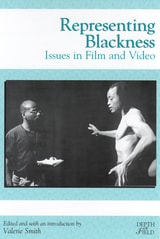
Representing Blackness
Issues in Film and VideoSmith, Valerie
Rutgers University Press, 1997
The essays in this collection provide a variety of perspectives on black representation and questions of racial authenticity in mainstream as well as African American independent cinema. This volume includes seminal essays on racial stereotypes, trenchant critiques of that discourse, original essays on important directors such as Haile Gerima and Charles Burnett, and an insightful discussion of black gay and lesbian film and video.
The contributors include Donald Bogle, Thomas Cripps, Jane Gaines, Nathan Grant, Stuart Hall, Tommy L. Lott, Wahneema Lubiano, Mike Murashige, Valerie Smith, James Snead, and David Van Leer. This volume is an important contribution to the Depth of Field series and should be indispensible for courses and individual scholars in film and multicultural studies. The book contains a mix of original and previously published pieces.
Representing
Hip Hop Culture and the Production of Black CinemaS. Craig Watkins
University of Chicago Press, 1998
"Watkins is at his most sophisticated and persuasive when he explains the surprising success of hyper-talented, entrepreneurial, and energetic black artists."—Archon Fung, Boston Book Review
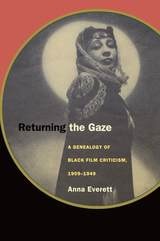
Returning the Gaze
A Genealogy of Black Film Criticism, 1909–1949Anna Everett
Duke University Press, 2001
Culling black newspapers, magazines, scholarly and political journals, and monographs, Everett has produced an unparalleled investigation of black critical writing on the early cinema during the era of racial segregation in America. Correcting the notion that black critical interest in the cinema began and ended with the well-documented press campaign against D. W. Griffith’s Birth of a Nation, she discovers that as early as 1909 black newspapers produced celebratory discourses about the cinema as a much-needed corrective to the predominance of theatrical blackface minstrelsy. She shows how, even before the Birth of a Nation controversy, the black press succeeded in drawing attention to both the callous commercial exploitation of lynching footage and the varied work of black film entrepreneurs. The book also reveals a feast of film commentaries that were produced during the “roaring twenties” and the jazz age by such writers as W.E.B. DuBois, Langston Hughes, and Zora Neale Hurston, as well as additional pieces that were written throughout the Depression and the pre– and post–war periods. Situating this wide-ranging and ideologically complex material in its myriad social, political, economic, and cultural contexts, Everett aims to resuscitate a historical tradition for contemporary black film literature and criticism.
Returning the Gaze will appeal to scholars and students of film, black and ethnic studies, American studies, cultural studies, literature, and journalism.
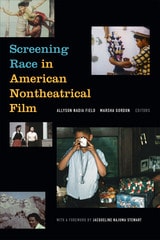
Screening Race in American Nontheatrical Film
Nadia Allyson Field and Marsha Gordon, editors
Duke University Press, 2019
Contributors. Crystal Mun-hye Baik, Jasmyn R. Castro, Nadine Chan, Mark Garrett Cooper, Dino Everett, Allyson Nadia Field, Walter Forsberg, Joshua Glick, Tanya Goldman, Marsha Gordon, Noelle Griffis, Colin Gunckel, Michelle Kelley, Todd Kushigemachi, Martin L. Johnson, Caitlin McGrath, Elena Rossi-Snook, Laura Isabel Serna, Jacqueline Najuma Stewart, Dan Streible, Lauren Tilton, Noah Tsika, Travis L. Wagner, Colin Williamson
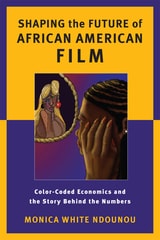
Shaping the Future of African American Film
Color-Coded Economics and the Story Behind the NumbersMonica White Ndounou
Rutgers University Press, 2014
In Hollywood, we hear, it’s all about the money. It’s a ready explanation for why so few black films get made—no crossover appeal, no promise of a big payoff. But what if the money itself is color-coded? What if the economics that governs film production is so skewed that no film by, about, or for people of color will ever look like a worthy investment unless it follows specific racial or gender patterns? This, Monica Ndounou shows us, is precisely the case. In a work as revealing about the culture of filmmaking as it is about the distorted economics of African American film, Ndounou clearly traces the insidious connections between history, content, and cash in black films.
How does history come into it? Hollywood’s reliance on past performance as a measure of potential success virtually guarantees that historically underrepresented, underfunded, and undersold African American films devalue the future prospects of black films. So the cycle continues as it has for nearly a century. Behind the scenes, the numbers are far from neutral. Analyzing the onscreen narratives and off-screen circumstances behind nearly two thousand films featuring African Americans in leading and supporting roles, including such recent productions as Bamboozled, Beloved, and Tyler Perry’s Diary of a Mad Black Woman, Ndounou exposes the cultural and racial constraints that limit not just the production but also the expression and creative freedom of black films. Her wide-ranging analysis reaches into questions of literature, language, speech and dialect, film images and narrative, acting, theater and film business practices, production history and financing, and organizational history.
By uncovering the ideology behind profit-driven industry practices that reshape narratives by, about, and for people of color, this provocative work brings to light existing limitations—and possibilities for reworking stories and business practices in theater, literature, and film.
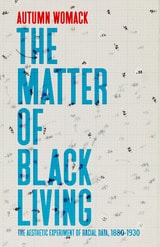
The Matter of Black Living
The Aesthetic Experiment of Racial Data, 1880–1930Autumn Womack
University of Chicago Press, 2022
As the nineteenth century came to a close and questions concerning the future of African American life reached a fever pitch, many social scientists and reformers approached post-emancipation Black life as an empirical problem that could be systematically solved with the help of new technologies like the social survey, photography, and film. What ensued was nothing other than a “racial data revolution,” one which rendered African American life an inanimate object of inquiry in the name of social order and racial regulation. At the very same time, African American cultural producers and intellectuals such as W. E. B. Du Bois, Kelly Miller, Sutton Griggs, and Zora Neale Hurston staged their own kind of revolution, un-disciplining racial data in ways that captured the dynamism of Black social life.
The Matter of Black Living excavates the dynamic interplay between racial data and Black aesthetic production that shaped late nineteenth-century social, cultural, and literary atmosphere. Through assembling previously overlooked archives and seemingly familiar texts, Womack shows how these artists and writers recalibrated the relationship between data and Black life. The result is a fresh and nuanced take on the history of documenting Blackness. The Matter of Black Living charts a new genealogy from which we can rethink the political and aesthetic work of racial data, a task that has never been more urgent.
The Problem of the Color[blind]
Racial Transgression and the Politics of Black PerformanceBrandi Wilkins Catanese
University of Michigan Press, 2011

Trying to Get Over
African American Directors after Blaxploitation, 1977-1986By Keith Corson
University of Texas Press, 2016
From 1972 to 1976, Hollywood made an unprecedented number of films targeted at black audiences. But following this era known as “blaxploitation,” the momentum suddenly reversed for black filmmakers, and a large void separates the end of blaxploitation from the black film explosion that followed the arrival of Spike Lee’s She's Gotta Have It in 1986. Illuminating an overlooked era in African American film history, Trying to Get Over is the first in-depth study of black directors working during the decade between 1977 and 1986.
Keith Corson provides a fresh definition of blaxploitation, lays out a concrete reason for its end, and explains the major gap in African American representation during the years that followed. He focuses primarily on the work of eight directors—Michael Schultz, Sidney Poitier, Jamaa Fanaka, Fred Williamson, Gilbert Moses, Stan Lathan, Richard Pryor, and Prince—who were the only black directors making commercially distributed films in the decade following the blaxploitation cycle. Using the careers of each director and the twenty-four films they produced during this time to tell a larger story about Hollywood and the shifting dialogue about race, power, and access, Corson shows how these directors are a key part of the continuum of African American cinema and how they have shaped popular culture over the past quarter century.
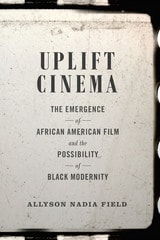
Uplift Cinema
The Emergence of African American Film and the Possibility of Black ModernityAllyson Nadia Field
Duke University Press, 2015